As an English as a Second Language (ESL) learner, the first few months of your journey are often spent mastering “basic” vocabulary. You learn words like good, bad, happy, and sad, word alternatives for beginners ESL. While these words are essential building blocks, using them repeatedly can make your English sound repetitive and robotic.
To transition from a beginner to an intermediate speaker, you need to expand your “lexical resource”—a fancy term examiners use for your range of vocabulary. By replacing overused words with descriptive alternatives, you not only express your thoughts more clearly but also gain the confidence to engage in more complex conversations. This guide is designed to help you break free from “Basic English” and start using “Smart English.”
In the following sections, we will explore why word alternatives matter, provide a comprehensive list of synonyms, and show you exactly how to use them in real-life situations. Whether you are preparing for an exam like IELTS or simply want to sound more natural, this article is your ultimate roadmap.
Quick Answer: What are “Word Alternatives” for ESL?
Word Alternatives (synonyms) are different words that have the same or very similar meanings to common words. For ESL beginners, using alternatives means moving away from “General” words (e.g., Very Big) to “Specific” words (e.g., Enormous or Huge). This adds variety to your speech and writing, helping you reach higher fluency levels.
Why Should Beginners Use Word Alternatives?
When you first start learning English, your brain looks for the “easiest” path. That is why we say “The food was good” for everything from a pizza to a five-course meal. However, using specific alternatives helps in three major ways:
- Precision: Instead of saying a movie was “good,” saying it was “fascinating” tells the listener exactly why you liked it.
- Professionalism: In a workplace or academic setting, using “Commence” instead of “Start” sounds more formal and authoritative.
- Engagement: People enjoy listening to speakers who use a colorful range of vocabulary. It keeps the conversation alive.
When to Use (and When NOT to Use) Word Alternatives
| Category | When to Use Alternatives | When to Stick to Basic Words |
| Academic/Work | Use formal alternatives (e.g., Sufficient instead of Enough). | Avoid slang or overly complex words you don’t fully understand. |
| Casual Chats | Use expressive words (e.g., Thrilled instead of Happy). | Don’t use “big” words that sound too formal with friends (e.g., Incredible is better than Prodigious). |
| Writing (Essays) | Use a variety of synonyms to avoid repetition. | Ensure the meaning matches exactly; don’t use a word just because it’s long. |
| Emergency | Stick to the simplest words possible for clarity. | NEVER use complex alternatives when you need help quickly. |
Master List: Top 50 Word Alternatives for ESL Beginners
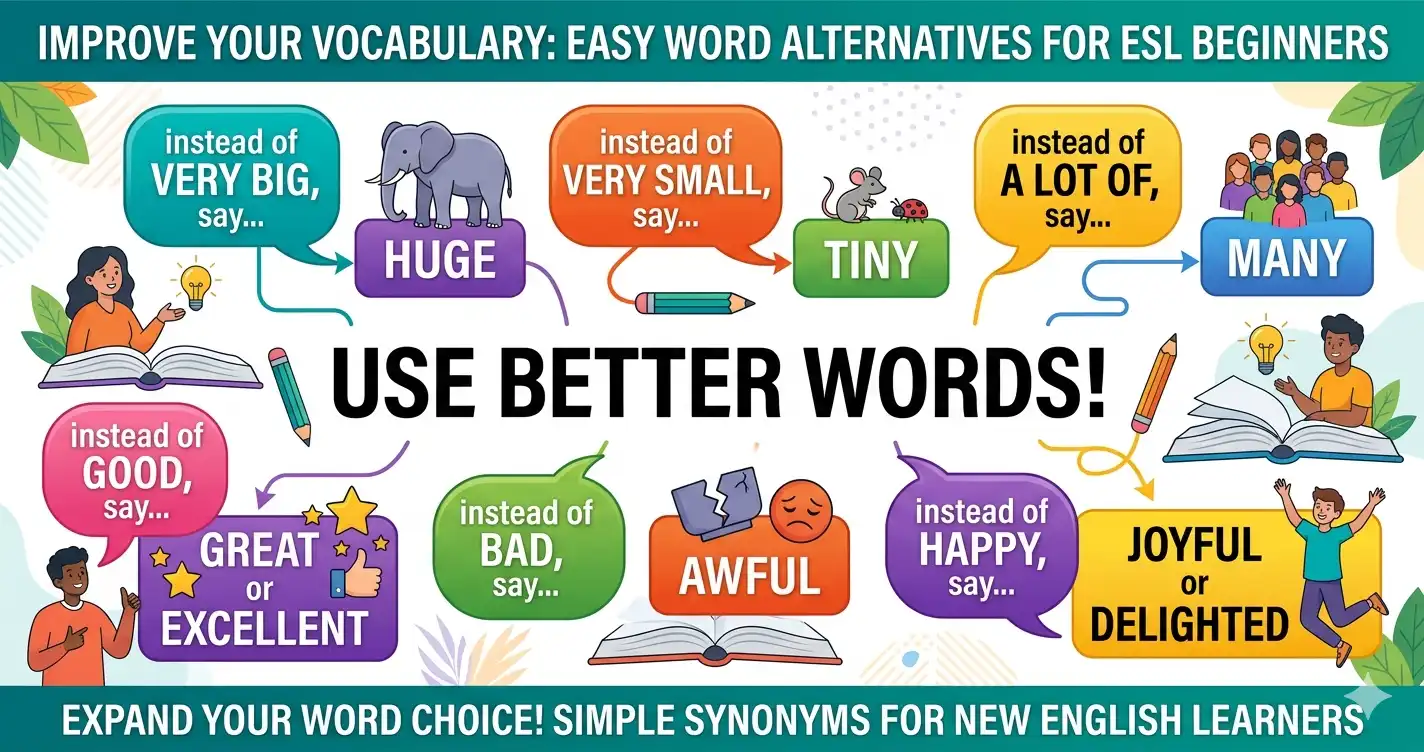
1. Alternatives for “Good”
Good is perhaps the most overused word in English. Try these instead:
- Wonderful: For things that make you feel happy.
- Excellent: For high quality or performance.
- Superb: For something that is better than average.
- Pleasant: For a nice experience or weather.
2. Alternatives for “Bad”
Instead of saying something is bad, be more specific:
- Awful/Terrible: For very bad situations.
- Unpleasant: For something that isn’t nice but not a disaster.
- Poor: For low quality (e.g., “Poor grades”).
- Dreadful: For something that causes fear or extreme dislike.
3. Alternatives for “Big”
- Enormous: Extremely large.
- Huge: Very common in casual conversation.
- Massive: For heavy or solid large objects.
- Gigantic: Like a giant.
4. Alternatives for “Happy”
- Thrilled: Very excited and happy.
- Cheerful: Always smiling and positive.
- Content: Feeling peaceful and satisfied with what you have.
- Delighted: Very pleased (often used in formal thank-yous).
5. Alternatives for “Sad”
- Miserable: Very, very unhappy.
- Depressed: A deeper, long-term sadness.
- Gloomy: Feeling dark and without hope.
- Heartbroken: For sadness related to love or loss.
Contextual Usage: Example Sentences
To truly understand these alternatives, you must see them in action. Notice how the meaning changes slightly with each word.
Example 1: The Word “Small”
- Basic: I have a small house.
- Alternative (Tiny): I have a tiny house. (Implies it’s very, very small).
- Alternative (Compact): I have a compact house. (Implies it’s small but well-organized).
Example 2: The Word “Important”
- Basic: This meeting is important.
- Alternative (Crucial): This meeting is crucial. (Implies the success of the project depends on it).
- Alternative (Essential): Water is essential for life. (Implies you cannot live without it).
Comparison Table: Basic vs. Smart Vocabulary
| Basic Word | Beginner Alternative | Context/Feeling |
| Look | Glimpse | Seeing something very quickly. |
| Think | Assume | To think something is true without proof. |
| Say | Whisper | To speak very quietly. |
| Walk | Stroll | To walk in a relaxed, slow way. |
| Fast | Rapid | Used for movement or change (Formal). |
| Hard | Challenging | Positive way to say something is difficult. |
| Funny | Hilarious | Extremely funny (makes you laugh out loud). |
| Quiet | Silent | No sound at all. |
Common Mistakes to Avoid (E-E-A-T Insights)
As language experts, we often see beginners make the following mistakes when trying to use “fancy” words:
- The “Thesaurus” Trap: Don’t just pick the longest word from a dictionary. Some words carry “connotations” (emotional meanings) that might not fit. For example, skinny and slender both mean thin, but slender is a compliment, while skinny can be an insult.
- Over-complicating: If you are a beginner, your goal is clarity. If an alternative word makes your sentence confusing, stick to the basic word.
- Ignoring Grammar: Sometimes, when you change a word, the preposition after it changes too. You are “Happy with something,” but you are “Thrilled about something.”
Frequently Asked Questions (FAQ)
Q1: Is it wrong to use basic words like “good” and “big”?
No, it is not wrong. Even native speakers use them 70% of the time. However, using alternatives helps you get higher scores in exams like TOEFL or IELTS.
Q2: How can I remember all these new words?
The best way is the “Rule of Three.” Use a new word in three different sentences within 24 hours. Write it down, say it to a friend, and use it in a text message.
Q3: Should I learn synonyms for every word?
Start with the most common verbs (Go, Get, Make, Do) and adjectives (Good, Bad, Nice). These will give you the most “bang for your buck.”
Q4: Are “word alternatives” the same as slang?
Not necessarily. Alternatives like “Enormous” are standard English. Slang words like “Gigantic” (in some contexts) or “Dope” (for good) are informal and should be used carefully.
Conclusion: Your Path to Fluency
Mastering word alternatives is a journey, not a destination. As an ESL beginner, you don’t need to learn the entire dictionary today. Start by picking 5 common words you use every day—perhaps Happy, Sad, Like, Go, and Big—and learn two smart alternatives for each.
By consistently replacing “Basic English” with “Descriptive English,” you are showing Google (and the world) that you are an expert in your own learning journey. Remember, the goal of language is to connect with others. The more precise your words, the stronger that connection will be. Keep practicing, stay curious, and soon, you’ll be speaking with the nuance and flair of a native speaker!

Robert Hayes is an ESL educator and curriculum developer with over nine years of experience teaching English to beginners and intermediate learners across multiple countries ( Biography ).