Do you often feel stuck using the same basic words again and again in your writing? Many ESL learners struggle to expand their vocabulary without making things too complicated. You want better words—but still simple, clear, and easy to understand. That’s exactly where simple synonyms for everyday English words can help.
In this guide, you’ll learn how to replace common words with better alternatives that sound natural in both speaking and writing. Whether you’re preparing for IELTS, writing essays, or just trying to sound more confident in English, this article gives you practical tools you can use immediately.
As an ESL educator with 9 years of experience, I’ve seen how small vocabulary upgrades can significantly improve fluency and writing scores. You don’t need advanced or difficult words—you need the right words. Let’s build that skill step by step.
QUICK ANSWER BOX
Quick Answer:
Simple synonyms for everyday English words are easy-to-understand alternative words that replace basic vocabulary to improve clarity and variety. For example, instead of “big,” you can say “large,” and instead of “happy,” you can say “glad.” These synonyms help you sound more natural, avoid repetition, and improve both speaking and writing—especially in ESL and IELTS contexts.
MAIN BODY
What Does “Simple Synonyms for Everyday English Words” Mean?
This phrase refers to easy alternative words you can use instead of very common English words. The key idea is simplicity—not complexity.
For example:
- “Good” → “Nice” or “Great”
- “Bad” → “Poor” or “Unpleasant”
Unlike advanced vocabulary, these synonyms are:
- Easy to remember
- Easy to use correctly
- Accepted in both spoken and written English
In ESL learning, this matters because clarity is more important than complexity. According to IELTS band descriptors, vocabulary should be “accurate and appropriate”—not necessarily advanced.
Complete Synonyms List
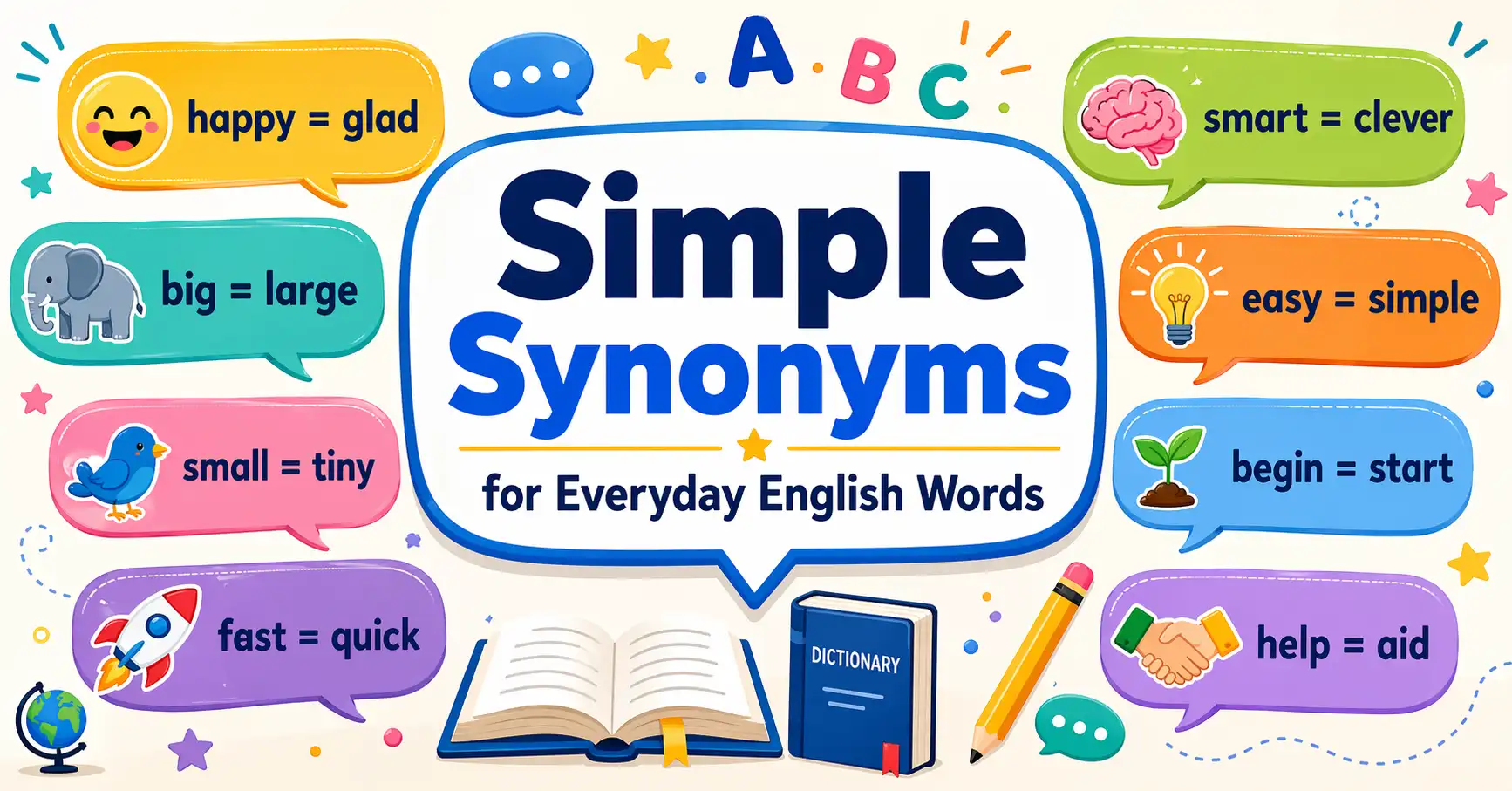
Here are simple synonyms for everyday English words you can start using today:
- Big → Large
- Small → Tiny
- Happy → Glad
- Sad → Unhappy
- Fast → Quick
- Slow → Sluggish
- Good → Nice
- Bad → Poor
- Easy → Simple
- Hard → Difficult
- Start → Begin
- End → Finish
- Help → Assist
- Buy → Purchase
- Show → Display
ESL Note:
Start by learning 2–3 synonyms per day. In our experience helping ESL learners, slow and consistent practice leads to better long-term retention.
Comparison Table
| Word | Simple Meaning | Best Used When | Avoid When |
| Big | Large in size | Describing objects | Formal writing requiring precision |
| Happy | Feeling good | Informal speech | Academic emotional analysis |
| Fast | Moving quickly | Daily conversation | Technical descriptions |
| Good | Positive quality | General use | Academic essays needing detail |
| Start | To begin | Instructions | Formal reports |
| Help | To assist | Casual writing | Professional emails |
| Easy | Not difficult | Teaching contexts | Academic argument |
| Bad | Not good | Informal speech | Critical analysis |
| Show | To display | Presenting ideas | Formal research writing |
| Buy | To purchase | Everyday talk | Business documents |
Formal vs Informal Synonyms
| Informal Word | Formal Synonym | Example Use |
| Help | Assist | Please assist me with this task |
| Buy | Purchase | I purchased a new laptop |
| Start | Commence | The meeting will commence soon |
| End | Conclude | The study concludes here |
| Show | Demonstrate | The results demonstrate growth |
| Get | Obtain | You can obtain a certificate |
IELTS Tip:
In Writing Task 2, replacing informal words like “get” with “obtain” can improve your lexical resource score.
Real Example Sentences
Here are practical examples using simple synonyms:
- She felt glad when she passed the test.
- The room is very large and comfortable.
- He gave a quick answer during the interview.
- This lesson is simple and easy to follow.
- The company will begin the project next week.
- I need someone to assist me with homework.
- The teacher displayed the results on the board.
- They decided to purchase a new house.
These sentences show how simple synonyms improve clarity without making language difficult.
When to Use vs When NOT to Use
When to Use:
Use simple synonyms when:
- You want to avoid repeating the same word
- You are writing essays or IELTS responses
- You need clearer communication
- You are learning new vocabulary gradually
When NOT to Use:
Avoid using synonyms when:
- The meaning changes slightly (e.g., “big” vs “huge”)
- You are unsure of the context
- The word sounds unnatural in conversation
- Precision is required (academic or technical writing)
Example:
“Big problem” is not always the same as “serious problem.”
Common Mistakes Writers Make
Many ESL learners make these errors:
1. Using synonyms without understanding meaning
Not all synonyms are equal. “Happy” and “satisfied” are different.
2. Overusing formal words
Using “commence” in casual speech sounds unnatural.
3. Replacing every word unnecessarily
You don’t need a synonym for every word. Focus on key vocabulary.
4. Ignoring context
Some synonyms work only in specific situations.
5. Memorizing lists without practice
Writers we work with often struggle because they don’t use new words in sentences.
Tips and Best Practices
1. Learn in Context
Always study synonyms in sentences—not lists.
2. Practice Daily Writing
Write short paragraphs using new synonyms.
3. Focus on High-Frequency Words
Start with common words like “good,” “bad,” and “big.”
4. Use Synonym Groups
Learn words in sets:
- Happy → Glad → Pleased
5. Speak Out Loud
This improves fluency and confidence.
ESL Note:
In our experience helping writers, speaking and writing together improves vocabulary faster than memorization alone.
Frequently Asked Questions
Q: What are simple synonyms for everyday English words?
A: Simple synonyms are easy alternative words that replace common vocabulary without making language difficult. They help improve clarity, avoid repetition, and make communication more natural, especially for ESL learners and beginners.
Q: Why should ESL learners use simple synonyms?
A: ESL learners benefit from simple synonyms because they improve vocabulary gradually without confusion. These words are easier to remember, reduce repetition, and help meet IELTS vocabulary requirements without using overly complex or incorrect terms.
Q: Are simple synonyms useful for IELTS writing?
A: Yes, simple synonyms are highly useful for IELTS writing. They help demonstrate lexical variety, which is a key scoring factor. However, accuracy and correct usage are more important than using difficult or advanced vocabulary.
Q: How can I learn synonyms quickly?
A: You can learn synonyms quickly by studying them in context, practicing daily writing, and using them in speaking. Focus on common words first and use repetition to build long-term memory effectively.
Q: Can I use informal synonyms in academic writing?
A: Informal synonyms should be used carefully in academic writing. While some are acceptable, it is better to choose neutral or slightly formal alternatives to maintain a professional tone and meet academic standards.
Q: What is the difference between simple and advanced synonyms?
A: Simple synonyms are easy to understand and use, while advanced synonyms are more complex and often used in formal or academic contexts. ESL learners should master simple synonyms before moving to advanced vocabulary.
CONCLUSION
Using simple synonyms for everyday English words is one of the fastest ways to improve your English. You don’t need difficult vocabulary—you need clear, correct, and natural language. By learning synonyms in context, practicing regularly, and avoiding common mistakes, you will build stronger writing and speaking skills.
You might also want to read our guide on common IELTS vocabulary words to continue improving.
Keep practicing. Small changes in vocabulary can make a big difference in your confidence and fluency.

Robert Hayes is an ESL educator and curriculum developer with over nine years of experience teaching English to beginners and intermediate learners across multiple countries ( Biography ).