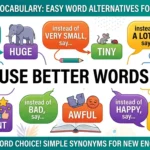

Most writing Simple Vocabulary Upgrade for Writing advice tells you to “read more books” or “use a thesaurus.” That is fine advice — but it does not help you right now, in the middle of editing an article, email, or essay.
What you actually need is a practical, ready-to-use list of simple vocabulary upgrades. Words you can swap out immediately, without spending weeks building your vocabulary from scratch.
That is exactly what this guide delivers. You will find categorized word swap tables, before-and-after sentence examples, and clear rules for knowing when to upgrade a word and when to leave it alone.
No theory. No fluff. Just upgrades you can copy and use today.
Why Simple Vocabulary Upgrades Matter More Than Fancy Words
The goal of a vocabulary upgrade is not to sound smarter. It is to communicate more precisely and hold your reader’s attention longer.
Research in cognitive psychology shows that readers respond more strongly to specific, sensory words than to vague, generic ones. When you write “she sprinted down the hallway” instead of “she ran quickly,” the reader sees the image. That is the power of word choice.
Here is the problem: most writers use the same 200 words repeatedly — words like good, nice, things, very, got, said, and big. These are not wrong words. They are just weak. They drain energy from your sentences without the writer even noticing.
A simple vocabulary upgrade does not mean replacing every word with a thesaurus find. It means replacing specific types of weak words with more precise, energetic alternatives.
The Three Types of Words That Weaken Your Writing
Before you start swapping words, understand which categories cause the most damage:
1. Vague adjectives — Words like good, bad, nice, big, small tell readers almost nothing. They describe without describing.
2. Filler adverbs — Words like very, really, quite, basically, totally make you sound uncertain and take up space without adding meaning.
3. Weak verbs — Words like is, was, got, went, said, do lack movement and energy. They make sentences feel flat and passive.
Once you can spot these three categories in your own writing, you will be able to upgrade your vocabulary quickly and confidently.
Simple Vocabulary Upgrade — Vague Adjectives to Replace
These are the adjectives that appear in almost every piece of weak writing. The fix is to replace them with words that show why something is good, bad, big, or small.
Replace “Good” With Something That Actually Means Something
| Instead of “Good” | Use This Instead |
| A good book | An absorbing / gripping / thought-provoking book |
| Good advice | Sound / valuable / practical advice |
| Good writing | Polished / compelling / precise writing |
| A good teacher | An inspiring / effective / patient teacher |
| Good results | Impressive / measurable / significant results |
Before: She gave good advice about the situation. After: She gave sound, practical advice that changed how I approached the situation.
Replace “Nice” With a Word That Carries Weight
| Instead of “Nice” | Use This Instead |
| A nice smile | A warm / radiant / genuine smile |
| A nice day | A crisp / peaceful / sunlit day |
| She was nice | She was gracious / thoughtful / considerate |
| A nice place | A charming / welcoming / picturesque place |
Before: It was a nice evening with family. After: It was a warm, unhurried evening — the kind that stays with you.
Replace “Bad” With Something Precise
| Instead of “Bad” | Use This Instead |
| A bad decision | A reckless / shortsighted / costly decision |
| Bad weather | Harsh / brutal / relentless weather |
| Bad writing | Confusing / sloppy / disjointed writing |
| A bad experience | A disheartening / frustrating / unpleasant experience |
Replace “Big” and “Small” With Specific Scale
| Instead of “Big” | Use This Instead |
| A big problem | A significant / pressing / critical problem |
| A big change | A dramatic / sweeping / transformative change |
| Big success | Remarkable / outstanding / hard-won success |
| Instead of “Small” | Use This Instead |
| A small improvement | A modest / incremental / subtle improvement |
| A small mistake | A minor / negligible / barely noticeable mistake |
Simple Vocabulary Upgrade — Filler Adverbs to Cut or Replace
Filler adverbs are the vocabulary equivalent of throat-clearing. They feel like emphasis but actually weaken the sentence they appear in.
H3: Cut These Words Almost Every Time You See Them
| Filler Word | What to Do Instead |
| Very | Replace with a stronger adjective (see table below) |
| Really | Delete it or rephrase the sentence |
| Quite | Delete it — it hedges where you should commit |
| Basically | Delete it — it sounds apologetic |
| Totally | Delete it — it adds nothing |
| Literally | Delete it unless you mean it literally |
| Actually | Delete it — it usually just stalls the sentence |
| Just | Delete it — it shrinks your confidence |
“Very + Weak Adjective” Upgrades
This is one of the most powerful quick fixes in writing. Instead of adding “very” to a weak adjective, replace both words with a single strong adjective.
| Weak Combination | Strong Single Word |
| Very tired | Exhausted |
| Very happy | Elated / thrilled |
| Very angry | Furious / livid |
| Very cold | Freezing / bitter |
| Very hot | Sweltering / scorching |
| Very surprised | Astonished / stunned |
| Very important | Critical / essential |
| Very difficult | Grueling / challenging |
| Very hungry | Famished / ravenous |
| Very scared | Terrified / petrified |
| Very funny | Hilarious |
| Very sad | Heartbroken / devastated |
Before: She was very tired after the very long and very difficult meeting. After: She was exhausted after the grueling meeting.
Notice: the upgraded version is shorter AND more powerful.
Simple Vocabulary Upgrade — Weak Verbs to Replace
Verbs carry more weight in a sentence than any other word. A strong verb can eliminate the need for adverbs and adjectives entirely.
Replace “Said” in Dialogue and Reporting
| Instead of “Said” | Use This When… |
| Whispered | The speaker was quiet or secretive |
| Insisted | The speaker was emphatic |
| Admitted | The speaker was confessing something |
| Announced | The speaker was making a formal statement |
| Argued | The speaker was defending a position |
| Conceded | The speaker was giving ground |
| Muttered | The speaker was displeased |
| Declared | The speaker was making a strong claim |
H3: Replace “Got” — One of the Most Overused Verbs in English
| Instead of “Got” | Use This Instead |
| He got the message | He received the message |
| She got angry | She grew angry / erupted |
| They got to the city | They arrived in the city |
| He got better | He recovered |
| She got the job | She secured / landed the job |
Replace “Went” With Movement Verbs
| Instead of “Went” | Use This Instead |
| He went quickly | He rushed / sprinted / darted |
| She went slowly | She trudged / crept / wandered |
| They went inside | They slipped / stepped / filed inside |
Replace “Is / Was” (Passive & Weak Be-Verbs)
| Weak Version | Stronger Version |
| The report was written by her | She wrote the report |
| The meeting was held by the manager | The manager led the meeting |
| He was running | He ran |
| The decision was made | They decided |
| The project is being reviewed | Reviewers are examining the project |
Simple Vocabulary Upgrade — Common Words That Sound Too Casual
These words are fine in conversation but weaken professional, academic, or blog writing.
| Casual Word | Professional Upgrade |
| Things | Details / elements / factors / aspects |
| Stuff | Material / content / information |
| A lot | Many / numerous / a significant number |
| Kind of | Somewhat / slightly / rather |
| Pretty (as in “pretty good”) | Fairly / reasonably / notably |
| Show | Demonstrate / reveal / illustrate |
| Use | Employ / utilize (when formal) / apply |
| Help | Assist / support / facilitate |
| Start | Initiate / begin / launch |
| End | Conclude / finalize / wrap up |
How to Apply These Vocabulary Upgrades Without Overdoing It
Here is what separates good writers from writers who just picked up a thesaurus and started swapping every word they could find: restraint and context.
Rule 1 — Match the Upgrade to Your Audience
A blog post for casual readers should not read like an academic paper. If you are writing for general audiences, upgrade selectively — focus on replacing the most obviously weak words and leave conversational phrasing intact.
For professional writing, emails, or formal articles, apply upgrades more aggressively — especially cutting filler adverbs and passive constructions.
Rule 2 — Never Sacrifice Clarity for Sophistication
The purpose of a vocabulary upgrade is clarity, not complexity. If a reader needs to look up your replacement word, you have not upgraded your writing — you have made it harder to read.
A strong word is a precise word, not necessarily a rare one. “Exhausted” is better than “very tired” because it is precise, not because it is rare.
Rule 3 — Edit, Don’t Write With Upgrades in Mind
Write your first draft freely, using whatever words come naturally. Then, during editing, scan specifically for the categories listed in this guide: vague adjectives, filler adverbs, and weak verbs. Replace them one pass at a time.
This method is far more effective than trying to choose the “perfect word” while drafting, which slows you down and disrupts creative flow.
Rule 4 — Read the Sentence Aloud After Upgrading
After swapping a word, read the sentence aloud. If it sounds natural, keep the upgrade. If it sounds stiff, formal, or out of place, revert to the original or try a different replacement.
Your ear is one of the best editing tools you have.
Frequently Asked Questions
How do I upgrade my vocabulary for writing without sounding fake?
Focus on replacing weak words — not adding fancy ones. Swap “very tired” for “exhausted,” not “fatigued to the point of prostration.” Upgrades should feel natural, not performed.
What is the fastest way to improve word choice in writing?
The fastest method is the “very + adjective” fix. Every time you see “very” followed by an adjective, replace both with a single stronger adjective. It takes seconds and immediately makes your writing feel more confident and precise.
Should I use a thesaurus for vocabulary upgrades?
Yes — but carefully. A thesaurus shows you options; you still need to verify that your chosen word carries the right meaning, tone, and connotation for your context. Never pick a thesaurus word you have never seen used in a real sentence before.
H3: Is upgrading vocabulary important for SEO writing?
Yes. Strong, specific vocabulary reduces bounce rate because readers stay engaged longer. Google’s EEAT guidelines reward content that demonstrates genuine expertise — and precise word choice signals expertise far more convincingly than generic language does.
How often should I use upgraded vocabulary in one piece of writing?
There is no fixed rule, but a practical guideline is this: if you read a sentence and the first word that comes to mind is “nice,” “good,” “things,” or “very” — upgrade it. For every other word, use your judgment. Over-upgraded writing feels artificial. The goal is natural precision.
Final Thoughts
A simple vocabulary upgrade for writing is not about impressing anyone. It is about respecting your reader’s time by choosing words that do their job precisely, efficiently, and memorably.
Start with the tables in this guide. Print the checklist. Run it over your next piece of writing before you publish. The difference in quality will be immediate and visible — no months of study required.
Good writing is not written. It is edited. And the easiest place to start editing is the words you already know you are overusing.

Robert Hayes is an ESL educator and curriculum developer with over nine years of experience teaching English to beginners and intermediate learners across multiple countries ( Biography ).