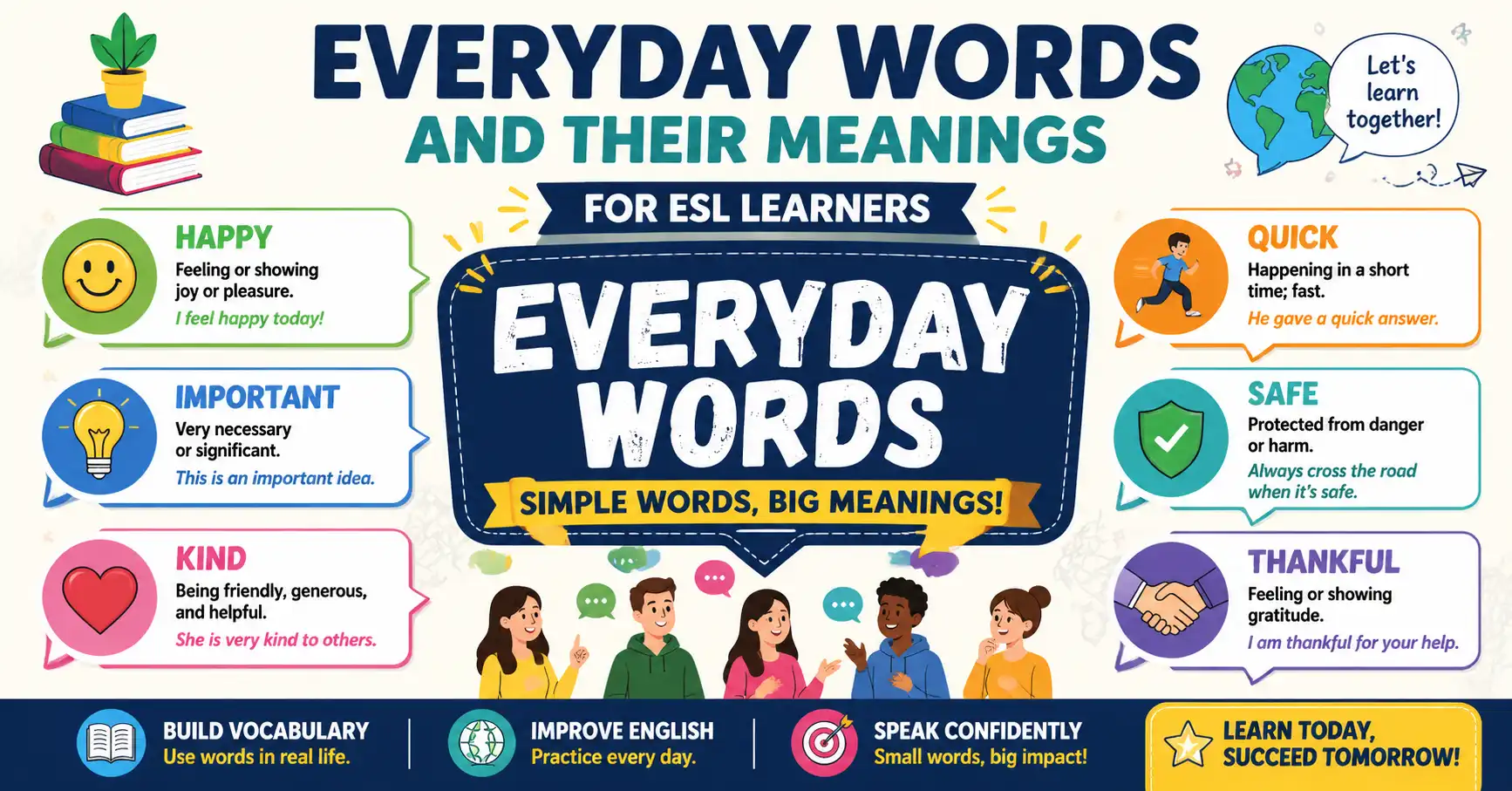
Do you often feel confused when native speakers use simple English words in daily conversations? Many ESL learners understand grammar but struggle with basic vocabulary used every day. That’s where mastering everyday words and their meanings for ESL becomes essential.
In your daily life—whether you are speaking, writing emails, or preparing for exams like IELTS—you need clear and practical vocabulary. Without it, even simple communication becomes difficult. The good news? You don’t need thousands of words to start improving. You just need the right everyday words and to understand how to use them correctly.
In this guide, you’ll learn common everyday English words, their meanings, synonyms, and real-life examples. You’ll also discover when to use them, when to avoid them, and how they can improve your academic and conversational English. If you want to sound more natural and confident in English, you’re in the right place.
Quick Answer:
Everyday words and their meanings for ESL are simple, commonly used English words that help learners communicate clearly in daily situations. These include basic verbs, nouns, and adjectives like get, make, happy, important, and use, along with their meanings, synonyms, and correct usage in context.
MAIN BODY
H2: What does “Everyday Words” mean?
H3: Simple Definition
Everyday words are the common English words you use regularly in daily communication. These words are not complex or technical. Instead, they help you express ideas clearly in both spoken and written English.
Examples include:
- Go
- Make
- Help
- Good
- Big
H3: Why They Matter for ESL Learners
In our experience helping writers, students often focus too much on advanced vocabulary and ignore basic words. However, according to IELTS band descriptors, clarity and correct usage matter more than complexity.
You need everyday vocabulary to:
- Speak fluently in conversations
- Write simple and clear sentences
- Understand native speakers
- Build confidence in English
H2: Complete Synonyms List
Below is a list of common everyday words and their useful synonyms:
| Everyday Word | Synonyms |
| Big | Large, Huge, Enormous |
| Small | Tiny, Little, Mini |
| Good | Great, Excellent, Fine |
| Bad | Poor, Terrible, Awful |
| Make | Create, Build, Produce |
| Get | Receive, Obtain, Gain |
| Help | Assist, Support, Aid |
| Use | Utilize, Apply, Employ |
| Happy | Glad, Joyful, Cheerful |
| Important | Essential, Significant, Crucial |
👉 IELTS Tip: Use synonyms carefully. Repeating the same word lowers your lexical score.
H2: Comparison Table
| Word | Simple Meaning | Best Used When | Avoid When |
| Get | Receive or obtain something | Informal speaking | Formal essays |
| Obtain | To get something formally | Academic writing | Casual conversation |
| Big | Large in size | Daily speech | Formal reports |
| Large | More formal than “big” | Academic writing | Casual talk |
| Help | Assist someone | Everyday use | — |
| Assist | Formal version of help | Academic writing | Informal speech |
H2: Formal vs Informal Synonyms
| Informal Word | Formal Equivalent |
| Get | Obtain |
| Buy | Purchase |
| Help | Assist |
| Start | Commence |
| End | Conclude |
| Ask | Inquire |
👉 Writers we work with often confuse these levels. Using informal words in essays can reduce your IELTS Writing score.
H2: Real Example Sentences
Here are practical examples using everyday words:
- I got a new phone yesterday.
- She made a delicious cake.
- This book is very important for your exam.
- He is a good student.
- They helped me finish the project.
- I feel happy when I learn new words.
- Please use simple English in your essay.
- This is a big opportunity for you.
👉 Notice how these words are simple but powerful in communication.
H2: When to Use vs When NOT to Use
When to Use Everyday Words:
- In conversations
- In emails or casual writing
- When explaining simple ideas
- When speaking with beginners
When NOT to Use:
- In formal academic essays (replace with formal synonyms)
- In professional reports
- When you need precise meaning
Example:
❌ “I got good results” (too simple for IELTS Writing Task 2)
✅ “I obtained excellent results” (better for academic context)
H2: Common Mistakes Writers Make
Many ESL learners make these mistakes:
1. Overusing Simple Words
Using “good” in every sentence reduces quality.
2. Using Informal Words in Essays
Words like “get” and “stuff” are not suitable for academic writing.
3. Ignoring Context
Not all synonyms fit every sentence.
4. Mixing Formal and Informal Tone
Example:
❌ “The study was good and obtained great results.”
(Tone inconsistency)
5. Memorizing Without Practice
You must use words, not just learn them.
H2: Tips and Best Practices
1. Learn Words in Context
Don’t memorize lists. Learn through sentences.
2. Practice Daily Speaking
Use everyday words in real conversations.
3. Replace Gradually
Start with simple words, then upgrade:
- good → excellent
- big → significant
4. Keep a Vocabulary Notebook
Write:
- Word
- Meaning
- Example sentence
5. Read Simple English Content
This improves natural understanding of everyday vocabulary.
👉 ESL Note: Focus on clarity first. Accuracy is more important than complexity.
H2: Frequently Asked Questions
Q1: What are everyday words in English?
A: Everyday words are simple and commonly used English words that help in daily communication. They include basic verbs, nouns, and adjectives such as go, make, good, and help, which are essential for ESL learners to speak and write clearly.
Q2: Why are everyday words important for ESL learners?
A: Everyday words form the foundation of communication. Without them, learners struggle to express ideas. These words help build confidence, improve fluency, and support better understanding in conversations, exams, and real-life situations.
Q3: Can I use everyday words in IELTS writing?
A: Yes, but with caution. Everyday words are acceptable for simple explanations, but higher IELTS scores require more formal vocabulary. Replacing basic words with precise synonyms improves lexical resource and overall writing quality.
Q4: How can I learn everyday English vocabulary fast?
A: Practice daily speaking, read simple texts, and use new words in sentences. Learning vocabulary in context is more effective than memorizing lists. Consistent practice leads to faster improvement and better retention.
Q5: What is the difference between formal and informal words?
A: Informal words are used in daily conversation, while formal words are used in academic or professional writing. For example, “get” is informal, while “obtain” is formal. Choosing the right tone is important for clarity and correctness.
Q6: How many everyday words should ESL learners know?
A: ESL learners should aim to master at least 1,000–2,000 everyday words. Research shows this range covers most daily communication needs, helping learners understand conversations and express ideas effectively.
CONCLUSION
Mastering everyday words and their meanings for ESL is the first step toward confident English communication. These simple words form the base of speaking, writing, and understanding English in real life. By learning their meanings, synonyms, and proper usage, you improve both fluency and accuracy.
Keep practicing, use words in context, and gradually expand your vocabulary. You might also want to read our guide on basic English synonyms for beginners to continue improving.
Stay consistent—you’re closer to fluency than you think.

Robert Hayes is an ESL educator and curriculum developer with over nine years of experience teaching English to beginners and intermediate learners across multiple countries ( Biography ).