Do you struggle to describe people clearly in English? Many ESL learners find it difficult to choose the right words when talking about personality. You may know a few basic adjectives like “kind” or “mean,” but that’s not enough for strong speaking or writing. This is where a personality words positive and negative list becomes useful.
In this guide, you will learn a wide range of personality words with simple meanings, examples, and usage tips. Whether you are preparing for IELTS, writing essays, or improving everyday English, this article will help you expand your vocabulary in a practical way. You will also learn when to use certain words and when to avoid them—an important skill for academic writing.
By the end, you will feel more confident describing people accurately and naturally in English.
Quick Answer:
A personality words positive and negative list includes adjectives used to describe a person’s character, such as “kind, honest, and friendly” (positive) and “rude, selfish, and lazy” (negative). These words help you express opinions clearly in speaking and writing, especially in essays, IELTS tasks, and daily communication.
What Does “Personality Words Positive and Negative List” Mean?
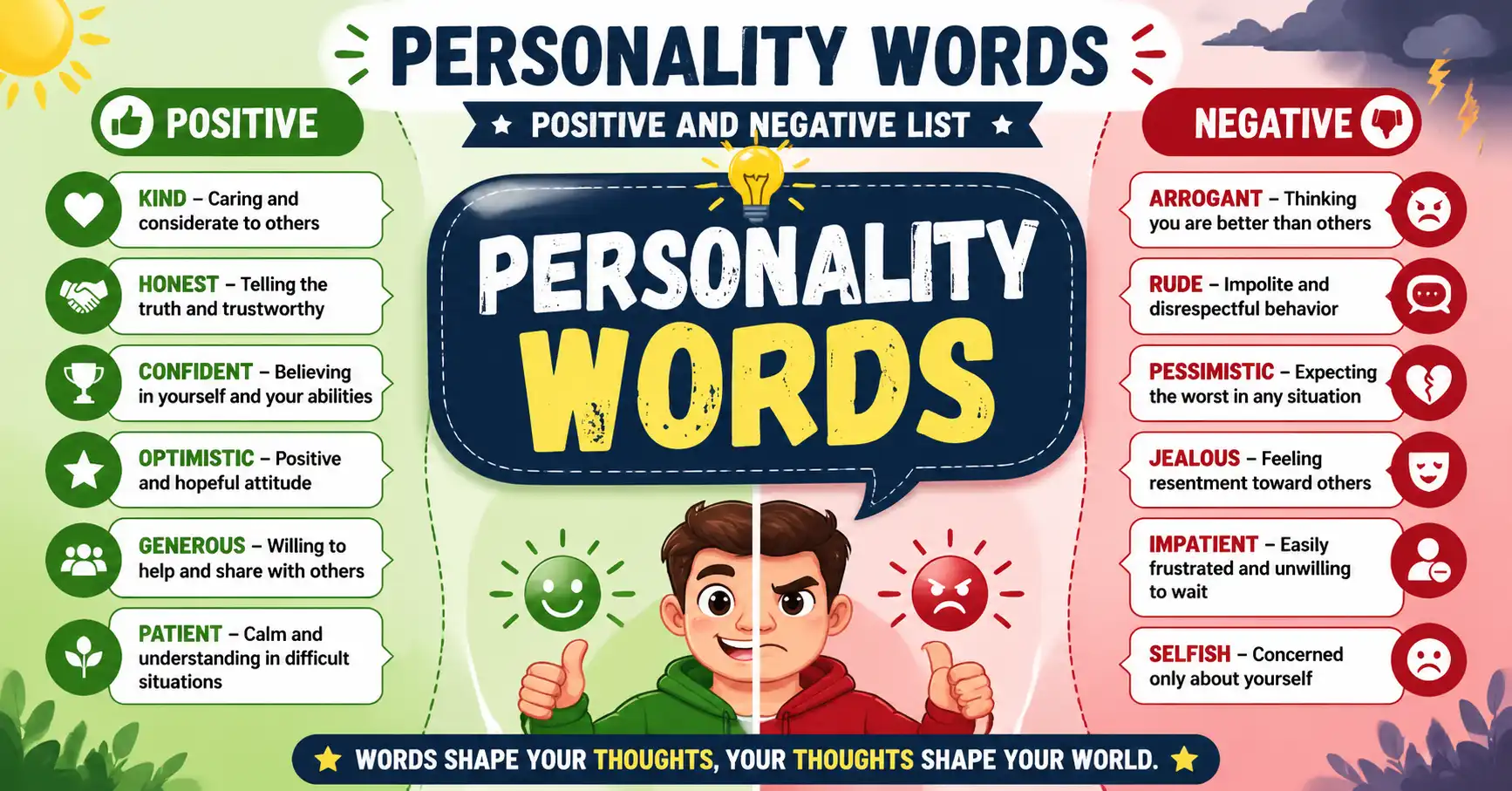
A personality words positive and negative list is a collection of adjectives used to describe human behavior and character traits.
- Positive personality words describe good qualities
→ Example: helpful, honest, cheerful - Negative personality words describe bad qualities
→ Example: arrogant, rude, careless
In ESL learning, these words are essential because they help you:
- Describe people clearly
- Improve essay quality
- Achieve higher IELTS band scores
According to academic writing conventions, precise vocabulary improves clarity and coherence—key factors in IELTS scoring.
Complete Synonyms List
Here is a useful list of personality words you should know:
Positive Personality Words
- Kind
- Honest
- Friendly
- Generous
- Responsible
- Confident
- Patient
- Creative
- Hardworking
- Polite
Negative Personality Words
- Rude
- Lazy
- Selfish
- Arrogant
- Impatient
- Dishonest
- Careless
- Aggressive
- Moody
- Jealous
ESL Note: Start by learning 5–7 words from each group and practice using them in sentences daily.
Comparison Table
| Word | Simple Meaning | Best Used When | Avoid When |
| Kind | Nice to others | Describing helpful people | Formal academic essays (too basic) |
| Generous | Gives freely | Talking about actions | When no clear example is given |
| Honest | Tells the truth | Academic writing | When unsure of behavior |
| Arrogant | Thinks too highly | Negative personality critique | Formal tone without evidence |
| Lazy | Does not work hard | Casual speech | Formal essays |
| Responsible | Can be trusted | Professional writing | When unclear context |
Formal vs Informal Synonyms
| Formal Word | Informal Word | Usage Context |
| Generous | Giving | Essays, reports |
| Arrogant | Big-headed | Informal conversation |
| Responsible | Reliable | Both formal & informal |
| Impolite | Rude | Formal writing |
| Industrious | Hardworking | Academic writing |
ESL Note: In IELTS writing, always prefer formal words like “industrious” instead of “hardworking” when possible.
Real Example Sentences
Here are practical examples to help you understand usage:
- She is a kind teacher who helps every student.
- He is very responsible at work and always finishes tasks on time.
- My friend is generous and often shares her food.
- The manager is arrogant, which makes employees uncomfortable.
- He is too lazy to complete his homework.
- She is honest, so people trust her.
- His aggressive behavior caused problems in the team.
- The child is creative and enjoys drawing.
In our experience helping ESL learners, practicing sentences daily improves retention faster than memorizing lists alone.
When to Use vs When NOT to Use
When to Use:
Use personality words when you:
- Describe people in essays
- Answer IELTS speaking questions
- Write stories or emails
- Express opinions about behavior
When NOT to Use:
Avoid using personality words when:
- You have no clear example (weak argument)
- Writing very formal reports without evidence
- Overusing basic words like “nice” or “bad”
- Using emotional words in academic analysis
ESL Tip: Replace simple words like “good” with specific adjectives like “reliable” or “helpful” to improve clarity.
Common Mistakes Writers Make
Many learners make these errors:
- Using very basic words repeatedly
→ “He is nice” (too simple) - Confusing similar meanings
→ “Arrogant” vs “Confident” - Using informal words in essays
→ “Big-headed” instead of “arrogant” - No supporting examples
→ Weakens writing quality - Wrong tone
→ Mixing formal and informal styles
Writers we work with often improve quickly by replacing simple adjectives with precise vocabulary.
Tips and Best Practices
Follow these strategies to improve your vocabulary:
- Learn words in pairs (positive vs negative)
- Practice writing daily sentences
- Use new words in speaking practice
- Read essays to see real usage
- Keep a vocabulary notebook
Simple Practice Method:
- Choose 5 words
- Write 5 sentences
- Speak them aloud
- Review the next day
This method is proven effective for ESL beginners.
Frequently Asked Questions
Q: What are personality words in English?
A: Personality words are adjectives used to describe a person’s character or behavior. They help you explain how someone acts, feels, or interacts with others in both speaking and writing contexts, especially in ESL learning and IELTS preparation.
Q: What are examples of positive personality words?
A: Positive personality words include kind, honest, friendly, generous, and hardworking. These words describe good qualities and are commonly used in essays, interviews, and daily conversations to express positive opinions about people.
Q: What are examples of negative personality words?
A: Negative personality words include rude, lazy, selfish, arrogant, and dishonest. These describe bad traits and are useful when explaining problems or criticizing behavior in discussions, essays, or real-life situations.
Q: How can I improve my personality vocabulary?
A: You can improve by learning small groups of words, practicing sentences daily, and using them in conversation. Reading essays and listening to English speakers also helps you understand how these words are used naturally.
Q: Are personality words important for IELTS?
A: Yes, personality words are important for IELTS speaking and writing tasks. Using varied and accurate vocabulary can increase your lexical resource score, which is one of the key grading criteria in the IELTS exam.
Q: What is the difference between confident and arrogant?
A: Confident means having belief in your abilities in a positive way, while arrogant means having too much pride and looking down on others. The difference is important in academic writing because it changes the tone completely.
CONCLUSION
A strong understanding of a personality words positive and negative list helps you describe people clearly and effectively in English. You now know how to use these words, avoid common mistakes, and choose the right tone for different contexts. This skill is especially important for ESL learners aiming to improve writing and IELTS performance.
You might also want to read our guide on descriptive adjectives list for beginners to continue building your vocabulary.
Keep practicing daily—small steps lead to big progress.

Robert Hayes is an ESL educator and curriculum developer with over nine years of experience teaching English to beginners and intermediate learners across multiple countries ( Biography ).