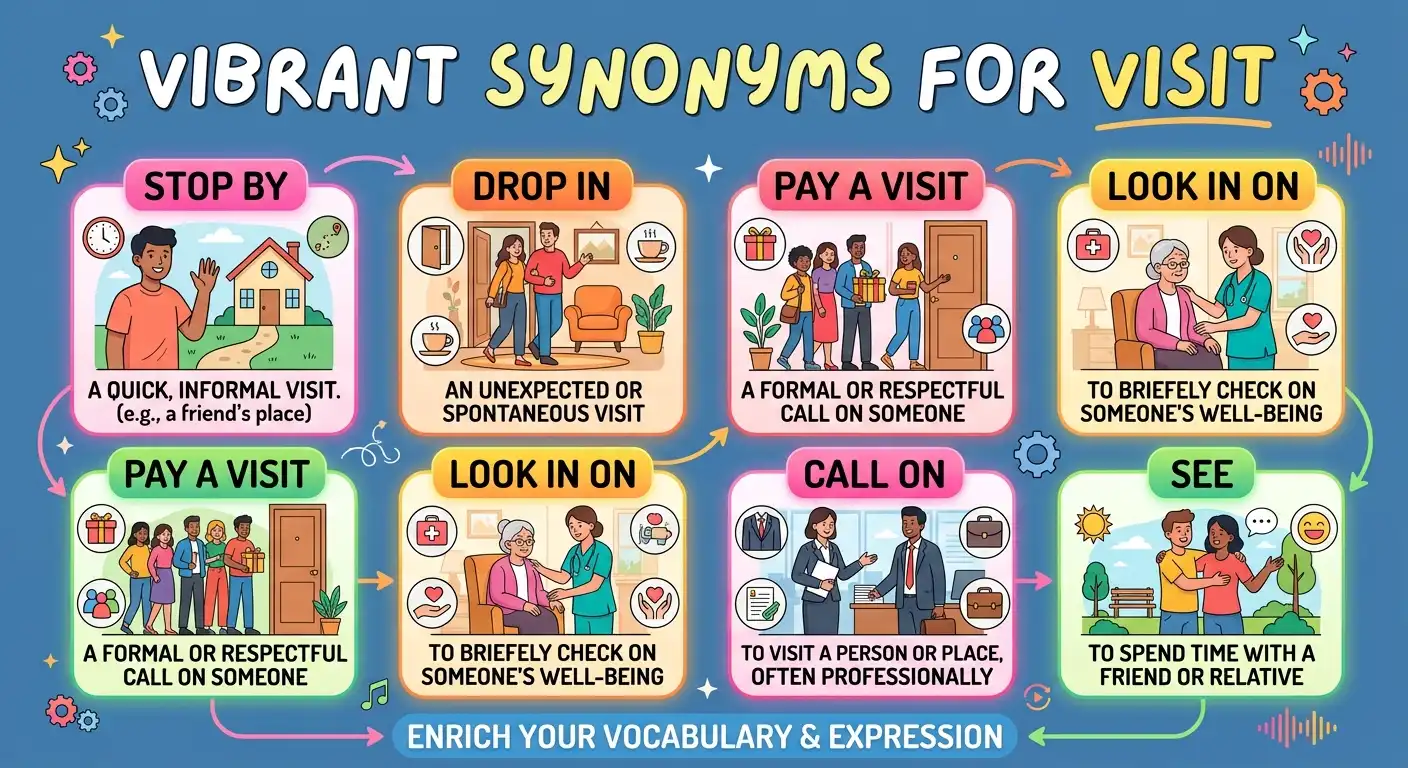
Finding exact synonyms for visit helps you share travel stories, personal plans, and daily meetings with ease. When you learn diverse synonyms for visit, you can easily explain trip details, describe friendly social calls, and write engaging stories. Using precise synonyms for visit keeps your writing fresh, dynamic, and clear.
Imagine a travel writer telling readers about a weekend trip to a mountain town. If they use the word “visit” in every sentence, the article feels dull and repetitive. Switching to lively choices like “explore,” “stop by,” or “tour” makes the story exciting and fun to read.
For instance, when you go to see a friend at their home for a quick chat, you can say you dropped by. Using clear options like “call on” or “check in” helps listeners understand your exact plan right away.
The word visit means going to see a person or place for social, professional, or recreational reasons. Expanding your knowledge of synonyms for visit helps many groups of readers:
- Students write descriptive travel essays and school projects.
- Bloggers craft vibrant travel guides that hold reader attention.
- Content writers improve search rankings with natural keyword phrasing.
- Daily English users speak smoothly and naturally in everyday chats.
“Choosing the right word turns a basic journey into a memorable story.”
“A rich vocabulary brings warmth, clarity, and life to every conversation.”
Linguistic Breakdown of “Visit”
Connotative Meaning
The word visit carries warm, friendly, and practical connotations. It implies connection, curiosity, movement, and spending intentional time with people or at places.
Etymology
- Origin: From Old French visiter (to go to see, inspect, or call upon).
- Latin Root: From Latin visitare (to go to see frequently), frequentative of visere (to examine or view), from videre (to see).
- Historical Shift: Entered Middle English to describe both formal calls on people and travel to holy or special places.
Pronunciation
- US (IPA): /ˈvɪz.ɪt/
- UK (IPA): /ˈvɪz.ɪt/
Syllables & Affixation Pattern
- Syllables: 2 syllables (vis-it)
- Base Structure: Root verb/noun visit
- Grammatical Patterns:
- Active Verb: Is visiting / Visited
- Noun Form: A quick visit / A long visit
- Agent Noun: Visitor
Comparison Table: Common Synonyms for Visit
| Keyword | Meaning | Usage Type | Context |
| Drop by | Making a brief, informal stop to see someone | Casual / Conversational | Friends, Neighbors, & Quick Chats |
| Call on | Paying a formal or polite call to a person | Formal / Professional | Business Clients, Elders, & Social Calls |
| Tour | Travelling through a place to explore it fully | Recreational / Informational | Sightseeing, Museums, & New Cities |
| Inspect | Visiting a site to examine conditions closely | Professional / Analytical | Workplaces, Property, & Safety Checks |
| Check in | Stopping by briefly to see how someone is doing | Caring / Friendly | Family, Co-workers, & Sick Friends |
| Pop in | Dropping into a place for a very short time | Casual / Upbeat | Local Shops, Office Desks, & Neighbors |
| Explore | Visiting a place to discover new sights and facts | Adventurous / Descriptive | Travel, Parks, Cities, & Nature |
21 Best Synonyms for Visit
1. Call on
- Pronunciation: US /kɑːl ɑːn/ | UK /kɔːl ɒn/
- Meaning: Call on means to make a short, polite call to see a person.
- Examples:
- We decided to call on our new neighbors yesterday afternoon.
- The doctor will call on his patients at home today.
2. Drop by
- Pronunciation: US /drɑːp baɪ/ | UK /drɒp baɪ/
- Meaning: Drop by means to pay a quick, informal visit to someone.
- Examples:
- Feel free to drop by my office after lunch.
- She dropped by her sister’s house to bring flowers.
3. Pop in
- Pronunciation: US /pɑːp ɪn/ | UK /pɒp ɪn/
- Meaning: Pop in means to enter a place briefly for a quick chat or task.
- Examples:
- I will pop in to the bakery before going home.
- He popped in for five minutes to say hello.
4. Stop by
- Pronunciation: US /stɑːp baɪ/ | UK /stɒp baɪ/
- Meaning: Stop by means to halt your trip briefly to go see someone or somewhere.
- Examples:
- Please stop by the store and grab some milk.
- They stopped by our table to say congratulations.
5. Tour
- Pronunciation: US /tʊr/ | UK /tʊə/
- Meaning: Tour means to travel around a place to see its main sights.
- Examples:
- The family planned to tour the famous castle downtown.
- We spent three days touring the historic coastal towns.
6. Inspect
- Pronunciation: US /ɪnˈspekt/ | UK /ɪnˈspekt/
- Meaning: Inspect means to go to a place to check its condition carefully.
- Examples:
- The safety officer came to inspect the factory floor.
- A buyer went to inspect the house before making an offer.
7. Check in
- Pronunciation: US /tʃek ɪn/ | UK /tʃek ɪn/
- Meaning: Check in means to visit someone briefly to see if they need help.
- Examples:
- I stopped by to check in on my grandmother today.
- Her friend called to check in after her long flight.
8. Attend
- Pronunciation: US /əˈtend/ | UK /əˈtend/
- Meaning: Attend means to be present at an event, gathering, or place.
- Examples:
- Many guests will attend the weekend wedding party.
- He plans to attend the morning meeting tomorrow.
9. Stay with
- Pronunciation: US /steɪ wɪð/ | UK /steɪ wɪð/
- Meaning: Stay with means to live as a guest at someone’s home for a time.
- Examples:
- We like to stay with our cousins during summer break.
- She stayed with her aunt while looking for a job.
10. Explore
- Pronunciation: US /ɪkˈsplɔːr/ | UK /ɪkˈsplɔː/
- Meaning: Explore means to walk around a new area to learn about it.
- Examples:
- Children love to explore the woods behind the park.
- We set out early to explore the old city streets.
“Exploring new places with exact words fills every story with vivid color.”
11. Frequent
- Pronunciation: US /frɪˈkwent/ | UK /frɪˈkwent/
- Meaning: Frequent means to visit a place very often or regularly.
- Examples:
- Writers often frequent that quiet coffee shop downtown.
- They frequent the local beach during hot summer months.
12. Drop in
- Pronunciation: US /drɑːp ɪn/ | UK /drɒp ɪn/
- Meaning: Drop in means to stop by without making a formal plan first.
- Examples:
- My brother dropped in for dinner without calling first.
- Neighbors love to drop in on weekends to chat.
13. Travel to
- Pronunciation: US /ˈtræv.əl tuː/ | UK /ˈtræv.əl tuː/
- Meaning: Travel to means making a trip to reach a distant location.
- Examples:
- Thousands of tourists travel to the island each year.
- Our family will travel to the mountains this winter.
14. Pay a visit
- Pronunciation: US /peɪ ə ˈvɪz.ɪt/ | UK /peɪ ə ˈvɪz.ɪt/
- Meaning: Pay a visit means to go see a person or place intentionally.
- Examples:
- We should pay a visit to the new art museum.
- He paid a visit to his old teacher at school.
15. Guest
- Pronunciation: US /ɡest/ | UK /ɡest/
- Meaning: Guest means to stay at a place as a welcomed visitor.
- Examples:
- The famous singer will guest at the city concert.
- She stayed as a guest at her friend’s beach house.
16. See
- Pronunciation: US /siː/ | UK /siː/
- Meaning: See means to go meet or spend time with a person.
- Examples:
- I am going to see my doctor for a checkup.
- They went to see their grandparents over the weekend.
17. Look in on
- Pronunciation: US /lʊk ɪn ɑːn/ | UK /lʊk ɪn ɒn/
- Meaning: Look in on means to make a short call to check someone’s welfare.
- Examples:
- Could you look in on the dog while I am out?
- The nurse came by to look in on the patient.
18. Sojourn
- Pronunciation: US /ˈsoʊ.dʒɝːn/ | UK /ˈsɒdʒ.ən/
- Meaning: Sojourn means to stay at a place for a short temporary period.
- Examples:
- The artist enjoyed a peaceful sojourn in the countryside.
- Their sojourn in the capital city lasted two weeks.
19. Hang out at
- Pronunciation: US /hæŋ aʊt æt/ | UK /hæŋ aʊt æt/
- Meaning: Hang out at means to spend leisure time at a place casually.
- Examples:
- Teens like to hang out at the park after school.
- We hung out at the local diner until dark.
20. Revisit
- Pronunciation: US /ˌriːˈvɪz.ɪt/ | UK /ˌriːˈvɪz.ɪt/
- Meaning: Revisit means to go back to see a place or person again.
- Examples:
- She wanted to revisit her childhood home town.
- The tourist decided to revisit the historic castle site.
21. Vacation at
- Pronunciation: US /veɪˈkeɪ.ʃən æt/ | UK /vəˈkeɪ.ʃən æt/
- Meaning: Vacation at means to spend a holiday period visiting a resort or destination.
- Examples:
- Many families vacation at the sunny lake every July.
- They plan to vacation at a mountain cabin this year.
Antonyms of “Visit”
Knowing opposite terms helps you express staying away, leaving, or avoiding places clearly.
- Avoid: Staying completely away from a person or place.
- Depart: Leaving a location to go somewhere else.
- Ignore: Choosing not to see, greeting, or calling on someone.
- Neglect: Failing to pay attention or visit someone in need.
- Shun: Keeping away from a person or place on purpose.
- Vacate: Leaving a space or building empty.
Prototype Meaning & Categorization of “Visit”
The core concept of visit centers on presence, social connection, travel, and site inspection. Depending on your intent, these 21 synonyms divide into four operational groups:
- Casual & Friendly Social Calls: Drop by, pop in, stop by, check in, drop in, look in on, hang out at.
- Formal & Professional Visits: Call on, inspect, attend, pay a visit, sojourn.
- Travel & Exploration: Tour, explore, travel to, revisit, vacation at, stay with.
- Direct Interaction & Presence: See, frequent, guest.
Frequently Asked Questions (FAQs)
1. What is the most common formal synonym for “visit”?
In formal and professional writing, “call on,” “pay a visit,” or “attend” work best. They show clear purpose and polite respect.
2. What is the difference between “drop by” and “tour”?
“Drop by” means a short, informal social stop to see a person. “Tour” means travelling around an entire place or venue to explore its sights.
3. Which synonym for “visit” works best in travel blogs?
For travel content, terms like “explore,” “tour,” “revisit,” and “travel to” add action and excitement for readers.
4. Is “pop in” appropriate for academic essays?
No, “pop in” is a casual idiom best for blog posts and daily conversations. Use “pay a visit” or “call on” in formal essays.
5. Can “check in” be used for both business and personal contexts?
Yes, “check in” works well when checking on a friend’s well-being or giving a quick work update to a manager.
6. How does learning synonyms for “visit” boost SEO performance?
Using varied terms prevents keyword repetition, targets different user search intents, and builds stronger semantic links across your content.
Conclusion
Expanding your collection of synonyms for visit brings clarity, energy, and style to your everyday language. Replacing repetitive words with exact choices like explore, drop by, call on, or tour ensures your message connects clearly with readers every time.
Whether you are writing travel blogs, drafting academic essays, sending work emails, or catching up in daily chats, exact vocabulary builds instant confidence. Strong word choices remove fluff and turn plain statements into vivid descriptions. Practice these 21 synonyms today to share your travel and social plans with lasting impact.
“Mastering simple word choices turns everyday news into engaging updates.”
“Clear and varied vocabulary gives every writer a warm and authentic voice.”

Robert Hayes is an ESL educator and curriculum developer with over nine years of experience teaching English to beginners and intermediate learners across multiple countries ( Biography ).