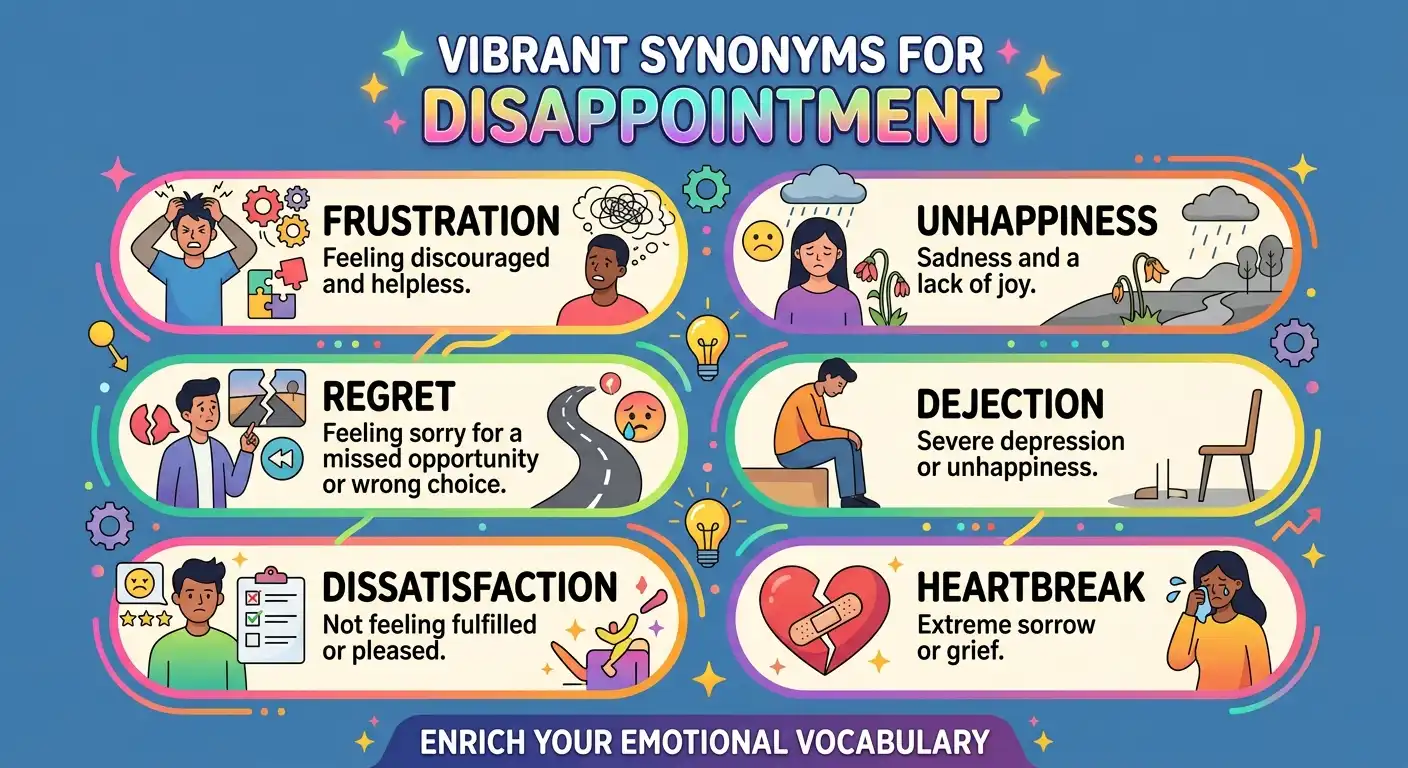
Finding exact synonyms for disappointment helps you describe sad feelings and failed hopes with true precision. When you learn diverse synonyms for disappointment, you can easily explain upset feelings, discuss canceled plans, and share personal setbacks. Using clear synonyms for disappointment strengthens your daily vocabulary and makes your writing sound natural.
Imagine a student who studies hard for two weeks for a final math exam. When the results come out, they receive a much lower grade than they expected. Simply calling this feeling “sadness” does not tell the full story. Calling it a deep letdown or a sharp setback paints a much clearer picture of what they feel.
For example, when a long-awaited rainy day cancels an outdoor family picnic, you feel a sudden letdown. Using accurate words like “frustration” or “dismay” helps your friends understand your mood right away.
The word disappointment means the sad or unhappy feeling you get when your hopes or expectations do not come true. Expanding your list of synonyms for disappointment helps many groups of readers:
- Students write better essays and express character feelings in literature assignments.
- Bloggers write relatable personal stories that keep readers interested.
- Content writers create emotional, clear content that ranks high in search results.
- Daily English users share feelings smoothly in daily conversations with friends and family.
“Choosing the right word turns a quiet feeling into a powerful story.”
“A rich vocabulary helps us share our true feelings with clarity and grace.”
Linguistic Breakdown of “Disappointment”
Connotative Meaning
The word disappointment carries negative, sorrowful, and discouraging connotations. It shows a painful gap between what a person hoped would happen and what actually occurred.
Etymology
- Dis-: Latin prefix meaning “away,” “opposite,” or “not.”
- Appoint: From Old French apointier (to prepare, arrange, or settle).
- Historical Shift: Originally meant to undo an agreement or appointment, then evolved in the 17th century to mean the emotional sadness caused by failed expectations.
Pronunciation
- US (IPA): /ˌdɪs.əˈpɔɪnt.mənt/
- UK (IPA): /ˌdɪs.əˈpɔɪnt.mənt/
Syllables & Affixation Pattern
- Syllables: 4 syllables (dis-ap-point-ment)
- Base Structure: Prefix dis- + Verb root appoint + Noun suffix -ment
- Grammatical Patterns:
- Noun Form: Disappointment / Disappointments
- Adjective Form: Disappointed / Disappointing
- Verb Form: Disappoint / Disappoints / Disappointed
Comparison Table: Common Synonyms for Disappointment
| Keyword | Meaning | Usage Type | Context |
| Letdown | A feeling of sadness when something is not as good as expected | Casual / Conversational | Everyday life, canceled plans, & movies |
| Frustration | Anger or sadness caused by being unable to achieve something | Emotional / Personal | Work tasks, daily challenges, & goals |
| Setback | A unexpected problem that slows down progress | Professional / Formal | Business, sports, career, & projects |
| Heartbreak | Deep sorrow or distress caused by severe loss or failure | Deep Emotional | Relationships, family loss, & dreams |
| Dismay | Sudden sadness and loss of courage caused by bad news | Formal / Expressive | News events, sudden bad news, & surprises |
| Chagrin | Distress or embarrassment caused by failure or humiliation | Formal / Academic | Public mistakes, social blunders, & work |
| Despair | The complete loss of hope or belief in success | Extreme Emotional | Hard life struggles & deep sadness |
24 Best Synonyms for Disappointment
1. Letdown
- Pronunciation: US /ˈlet.daʊn/ | UK /ˈlet.daʊn/
- Meaning: Letdown means a feeling of sadness when an event is less good than you hoped.
- Examples:
- The new movie was a total letdown after all the big news.
- Rain on our beach trip day was a big letdown for the kids.
2. Frustration
- Pronunciation: US /frʌsˈtreɪ.ʃən/ | UK /frʌsˈtreɪ.ʃən/
- Meaning: Frustration means the upset feeling you get when you cannot reach a goal.
- Examples:
- She felt deep frustration when the slow computer kept crashing.
- Traffic jams bring constant frustration to morning drivers.
3. Disillusionment
- Pronunciation: US /ˌdɪs.ɪˈluː.ʒən.mənt/ | UK /ˌdɪs.ɪˈluː.ʒən.mənt/
- Meaning: Disillusionment means sadness when you learn something is not as good as you believed.
- Examples:
- The honest book created disillusionment about famous heroes.
- He felt disillusionment when his favorite job turned out boring.
4. Dissatisfaction
- Pronunciation: US /ˌdɪs.sæt̬.ɪsˈfæk.ʃən/ | UK /ˌdɪs.sæt.ɪsˈfæk.ʃən/
- Meaning: Dissatisfaction means a unhappy feeling because a result did not meet your standard.
- Examples:
- The customer voiced dissatisfaction with the cold restaurant meal.
- Poor service led to growing dissatisfaction among hotel guests.
5. Setback
- Pronunciation: US /ˈset.bæk/ | UK /ˈset.bæk/
- Meaning: Setback means an unexpected problem that delays your progress.
- Examples:
- Losing the key file was a minor setback for the team.
- The runner faced a heavy setback after hurting his leg.
6. Heartbreak
- Pronunciation: US /ˈhɑːrt.breɪk/ | UK /ˈhɑːt.breɪk/
- Meaning: Heartbreak means great sorrow or deep emotional pain.
- Examples:
- Losing the final championship match caused deep heartbreak.
- Moving away from best friends brings true heartbreak to kids.
7. Dismay
- Pronunciation: US /dɪsˈmeɪ/ | UK /dɪsˈmeɪ/
- Meaning: Dismay means sudden sadness and worry caused by bad news.
- Examples:
- To our dismay, the morning train left five minutes early.
- She looked at the messy broken vase with complete dismay.
8. Discontent
- Pronunciation: US /ˌdɪs.kənˈtent/ | UK /ˌdɪs.kənˈtent/
- Meaning: Discontent means a general lack of happiness with your current situation.
- Examples:
- Low wages caused wide discontent among office workers.
- The long cold winter created general discontent in town.
9. Despair
- Pronunciation: US /dɪˈsper/ | UK /dɪˈspeər/
- Meaning: Despair means the complete feeling that all hope is lost.
- Examples:
- He gave up his search for the lost ring in deep despair.
- Do not fall into despair when a small project fails.
“Every setback holds a quiet lesson that helps you grow stronger tomorrow.”
10. Regret
- Pronunciation: US /rɪˈɡret/ | UK /rɪˈɡret/
- Meaning: Regret means sadness about a past choice you wish you could change.
- Examples:
- She felt deep regret for missing her sister’s party.
- Buying the expensive old car brought him instant regret.
11. Chagrin
- Pronunciation: US /ʃəˈɡrɪn/ | UK /ˈʃæɡ.rɪn/
- Meaning: Chagrin means annoyance or sadness caused by failure or embarrassment.
- Examples:
- To his chagrin, he forgot the speech lines on stage.
- She noted her rival’s victory with quiet chagrin.
12. Failure
- Pronunciation: US /ˈfeɪ.ljɚ/ | UK /ˈfeɪ.ljər/
- Meaning: Failure means an event where a goal was not reached.
- Examples:
- The primary test was a failure due to bad planning.
- He learned useful lessons from every small career failure.
13. Unfulfillment
- Pronunciation: US /ˌʌn.fʊlˈfɪl.mənt/ | UK /ˌʌn.fʊlˈfɪl.mənt/
- Meaning: Unfulfillment means a empty feeling caused by unreached goals.
- Examples:
- Working at a dull desk brought her continuous unfulfillment.
- Unfulfillment often happens when you ignore your true dreams.
14. Disapproval
- Pronunciation: US /ˌdɪs.əˈpruː.vəl/ | UK /ˌdɪs.əˈpruː.vəl/
- Meaning: Disapproval means a clear feeling that something is wrong or unsatisfactory.
- Examples:
- The team leader expressed disapproval of the late report.
- Her quiet frown showed clear disapproval of the plan.
15. Blow
- Pronunciation: US /bloʊ/ | UK /bləʊ/
- Meaning: Blow means a sudden shock or disappointing hard hit to your plans.
- Examples:
- Losing the main store contract was a hard blow to the business.
- The sudden news came as a heavy blow to the family.
16. Defeat
- Pronunciation: US /dɪˈfiːt/ | UK /dɪˈfiːt/
- Meaning: Defeat means the sad outcome of losing a game, fight, or goal.
- Examples:
- The team accepted their game defeat with quiet dignity.
- Admitting defeat early allowed them to rest and try again.
17. Sadness
- Pronunciation: US /ˈsæd.nəs/ | UK /ˈsæd.nəs/
- Meaning: Sadness means a normal unhappy emotional state caused by bad events.
- Examples:
- The sad ending of the story brought tears and sadness.
- She felt a soft touch of sadness when summer ended.
18. Displeasure
- Pronunciation: US /dɪsˈpleʒ.ɚ/ | UK /dɪsˈpleʒ.ər/
- Meaning: Displeasure means a feeling of annoyance or mild unhappiness.
- Examples:
- The boss showed displeasure when the meeting started late.
- Bad weather caused great displeasure among beach tourists.
19. Misfortune
- Pronunciation: US /ˌmɪsˈfɔːr.tʃuːn/ | UK /ˌmɪsˈfɔː.tʃuːn/
- Meaning: Misfortune means an unlucky event that causes hardship or sorrow.
- Examples:
- He faced his recent financial misfortune with great courage.
- Misfortune hit when their car engine broke down on vacation.
20. Bummer
- Pronunciation: US /ˈbʌm.ɚ/ | UK /ˈbʌm.ər/
- Meaning: Bummer means an informal term for a disappointing situation.
- Examples:
- Missing the morning bus was a real bummer today.
- It is a total bummer that the local concert got canceled.
21. Downer
- Pronunciation: US /ˈdaʊ.nɚ/ | UK /ˈdaʊ.nər/
- Meaning: Downer means something that makes people feel sad or disappointed.
- Examples:
- The rainy news forecast was a downer for our party plans.
- Ending the fun night on a bad note was a downer.
22. Disenchantment
- Pronunciation: US /ˌdɪs.ɪnˈtʃænt.mənt/ | UK /ˌdɪs.ɪnˈtʃɑːnt.mənt/
- Meaning: Disenchantment means losing fondness or positive belief in something.
- Examples:
- Years of false promises led to wide disenchantment.
- She felt growing disenchantment with her current city life.
23. Mortification
- Pronunciation: US /ˌmɔːr.t̬ə.fəˈkeɪ.ʃən/ | UK /ˌmɔː.tɪ.fɪˈkeɪ.ʃən/
- Meaning: Mortification means intense disappointment combined with deep shame.
- Examples:
- Imagine her mortification when she spilled juice on her dress.
- He hid his face in mortification after dropping the cake.
24. Disillusion
- Pronunciation: US /ˌdɪs.ɪˈluː.ʒən/ | UK /ˌdɪs.ɪˈluː.ʒən/
- Meaning: Disillusion means the loss of a pleasant belief or false hope.
- Examples:
- The sudden failure brought quick disillusion to the young investors.
- She experienced disillusion when her dream home had leaking pipes.
Antonyms of “Disappointment”
Knowing opposite words helps you describe joy, success, and fulfilled expectations accurately.
- Satisfaction: The happy feeling you get when your hopes or needs are met.
- Delight: High pleasure and joy caused by something wonderful.
- Triumph: A great victory or success following hard effort.
- Fulfillment: The peaceful feeling of reaching your goals and dreams.
- Joy: Deep happiness and pleasure in a good situation.
- Success: Achieving the exact outcome you worked hard for.
Prototype Meaning & Categorization of “Disappointment”
The main idea of disappointment centers on unmet expectations, sad feelings, and unexpected setbacks. Depending on your intent, these 24 synonyms divide into four operational groups:
- Mild & Everyday Disappointment: Letdown, bummer, downer, dissatisfaction, displeasure, discontent.
- Unexpected Problems & Delays: Setback, blow, failure, misfortune, defeat.
- Loss of Hope & Belief: Disillusionment, disenchantment, disillusion, unfulfillment, despair.
- Deep Emotional Sorrow & Shame: Heartbreak, dismay, regret, chagrin, sadness, mortification, disapproval.
Frequently Asked Questions (FAQs)
1. What is the most common formal synonym for “disappointment”?
In formal writing or business settings, “setback,” “dissatisfaction,” or “unfulfillment” work best. They explain problems clearly without sounding overly casual.
2. What is the difference between “letdown” and “heartbreak”?
A letdown describes mild to moderate sadness when an event fails to meet expectations. A heartbreak describes deep, severe emotional pain caused by major loss or broken relationships.
3. Can I use “bummer” in an academic essay?
No, “bummer” is a casual slang word best reserved for daily chat or informal blogging. Use “setback” or “misfortune” in formal essays.
4. Which synonym for “disappointment” fits business emails best?
In professional workplace emails, words like “setback,” “dissatisfaction,” or “unfortunate outcome” keep your tone calm, respectful, and objective.
5. Why is “chagrin” different from normal sadness?
“Chagrin” combines disappointed feelings with embarrassment or hurt pride, usually after a public mistake or personal failure.
6. How does using diverse synonyms for “disappointment” improve SEO?
Using varied words prevents keyword repetition, satisfies different user searches, strengthens semantic connections, and keeps readers on your page longer.
Conclusion
Expanding your collection of synonyms for disappointment brings depth, clarity, and emotion to your language. Replacing repetitive words with exact options like letdown, setback, frustration, or dismay ensures your message connects with your reader every single time.
Whether you write business emails, post personal blog entries, draft school essays, or talk in daily conversations, exact words build confidence. Diverse vocabulary turns basic statements into touching, meaningful stories. Practice using these 24 synonyms today to express your true feelings with comfort and ease.
“Clear words help us turn life’s hardest moments into quiet strength.”
“Mastering gentle, exact vocabulary makes every conversation warmer and clearer.”

Robert Hayes is an ESL educator and curriculum developer with over nine years of experience teaching English to beginners and intermediate learners across multiple countries ( Biography ).