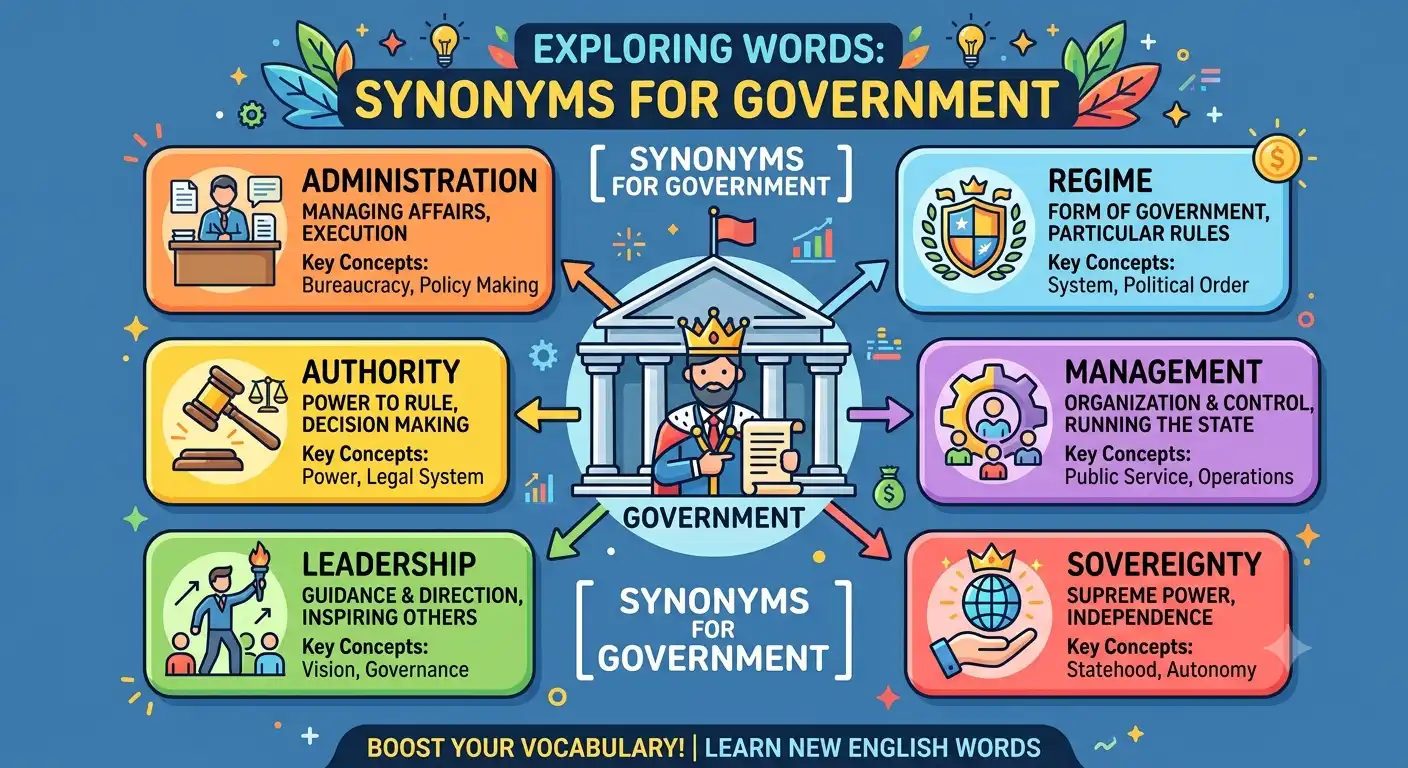
Finding clear synonyms for government helps you express ideas about leadership and public systems with great accuracy. When you study synonyms for government, you learn how to talk about political leaders, state agencies, and ruling bodies using simple words. Using different synonyms for government makes your everyday writing, academic essays, and news summaries much more precise and interesting.
Imagine waking up to read the daily news on your phone. You see stories about new law updates, tax rules, and community road repairs. These official public choices come from the leaders who guide your city or nation. Knowing the right words helps you explain these actions clearly to your friends, teachers, or coworkers.
Learning these vocabulary options is helpful for many reasons:
- Students: Improve your essay scores by replacing repeated words with rich vocabulary.
- Bloggers: Keep your readers engaged with fresh, dynamic language on every page.
- Content Writers: Craft punchy headlines and distinct personality tones for brand stories.
- Daily English Users: Choose the exact right word for casual chats, family talks, or office meetings.
“A wise state cares for the rights and peace of every single citizen.” – Unknown
“Good leadership guides a nation toward progress and justice for all.” – Unknown
Technical & Linguistic Breakdown of “Government”
Connotative Meaning
The word government usually carries a neutral or formal connotation. As a noun, it refers to the system, group of people, or official body that controls and makes decisions for a country, state, or city. Depending on the context, it can express positive feelings like safety and order, or negative feelings like strict rules and bureaucracy.
Etymology of “Government”
- Greek Root: Derived from Ancient Greek kybernān (meaning “to steer, guide, or govern a ship”).
- Latin Entry: Adopted into Latin as gubernare (meaning “to steer or rule”).
- Old French Entry: Passed into Old French as governement (meaning “control or administration”).
- English Entry: Entered the English language in the late 1300s to describe the system of ruling a state.
Pronunciation (IPA)
- US IPA: /ˈɡʌv.ɚn.mənt/ or /ˈɡʌv.ɚ.mənt/
- UK IPA: /ˈɡʌv.ən.mənt/
Syllables & Structure
- Syllables: 3 Syllables (gov – ern – ment)
- Stress Pattern: Primary stress on the first syllable (GOV-ern-ment).
Affixation Pattern
- Base Verb: Govern
- Suffix: -ment (noun suffix meaning “the action, result, or state of”)
- Plural Form: Governments
Quick Comparison Table of Key Synonyms
| Keyword | Meaning | Usage Type | Context |
| Administration | The team of leaders running a country or city | Formal / Professional | Politics, public news, presidency |
| Regime | A specific leadership system or ruling group | Formal / Critical | History, politics, strict rule |
| State | The whole organized political community | Formal / Legal | Laws, international relations |
| Authority | The power or official group in control | Formal / Casual | Rules, police, public safety |
| Executive | The branch that carries out laws | Professional / Formal | Politics, government branches |
| Ministry | A major government department | Formal / Official | Healthcare, education, defense |
| Council | A local group elected to make decisions | Casual / Formal | Local towns, city planning |
| Bureaucracy | The official system of office workers | Formal / Critical | Papers, permits, office rules |
50 Best Synonyms for Government
1. Administration
- Pronunciation: US: /ədˌmɪn.əˈstreɪ.ʃən/ | UK: /ədˌmɪn.ɪˈstreɪ.ʃən/
- Meaning: This is the team of leaders currently in charge of a nation.
- Examples:
- The new administration plans to build more public schools.
- Our town Mayor leads the local administration.
2. Regime
- Pronunciation: US: /reɪˈʒiːm/ | UK: /reɪˈʒiːm/
- Meaning: This is a strong or strict system of political leadership.
- Examples:
- The old regime ended after the peaceful election.
- People hoped the new regime would lower market prices.
3. State
- Pronunciation: US: /steɪt/ | UK: /steɪt/
- Meaning: This is an organized political area under one ruling power.
- Examples:
- The state provides clean water and safe roads.
- She works for a local state office in her city.
4. Authority
- Pronunciation: US: /əˈθɔːr.ə.t̬i/ | UK: /ɔːˈθɒr.ə.ti/
- Meaning: This is the official power or group in control of rules.
- Examples:
- The transit authority fixed the subway lines today.
- Always respect the lawful authority in your community.
5. Leadership
- Pronunciation: US: /ˈliː.dɚ.ʃɪp/ | UK: /ˈliː.də.ʃɪp/
- Meaning: These are the people who guide and direct a large group.
- Examples:
- Strong national leadership brings peace during hard times.
- The city leadership met to talk about park safety.
6. Ministry
- Pronunciation: US: /ˈmɪn.ə.stri/ | UK: /ˈmɪn.ɪ.stri/
- Meaning: This is an official government department led by a minister.
- Examples:
- The ministry of health opened new medical centers.
- He works as a clerk for the sports ministry.
7. Cabinet
- Pronunciation: US: /ˈkæb.ən.ət/ | UK: /ˈkæb.ɪ.nət/
- Meaning: This is a special group of top advisers to a leader.
- Examples:
- The President called a morning cabinet meeting today.
- Each member of the cabinet manages a big department.
8. Executive
- Pronunciation: US: /ɪɡˈzek.jə.t̬ɪv/ | UK: /ɪɡˈzek.jə.tɪv/
- Meaning: This is the branch that carries out laws and manages public affairs.
- Examples:
- The executive branch signed the new trade deal.
- Her uncle works in the executive office of the state.
9. Parliament
- Pronunciation: US: /ˈpɑːr.lə.mənt/ | UK: /ˈpɑː.lə.mənt/
- Meaning: This is an elected group of lawmakers who create national rules.
- Examples:
- Members of parliament voted on the new tax bill.
- The crowd gathered outside parliament to watch the speech.
10. Council
- Pronunciation: US: /ˈkaʊn.səl/ | UK: /ˈkaʊn.səl/
- Meaning: This is an elected local group that manages town affairs.
- Examples:
- The city council approved the plans for a new park.
- You can write a letter to your local council.
11. Bureaucracy
- Pronunciation: US: /bjʊˈrɑː.krə.si/ | UK: /bjʊəˈrɒk.rə.si/
- Meaning: This is the broad system of official workers and paperwork.
- Examples:
- Fixing the bridge took time due to local bureaucracy.
- She navigated the bureaucracy to get her driver’s license.
12. Directorate
- Pronunciation: US: /dɪˈrek.tɚ.ət/ | UK: /dɪˈrek.tər.ət/
- Meaning: This is a specific board or department that directs public services.
- Examples:
- The health directorate issued new rules for clean food.
- He leads the public safety directorate in his town.
13. Legislature
- Pronunciation: US: /ˈledʒ.ə.slə.tʃɚ/ | UK: /ˈledʒ.ɪ.slə.tʃər/
- Meaning: This is the official group of people elected to write laws.
- Examples:
- The state legislature passed a law to protect wild trees.
- Voters send representatives to the national legislature.
14. Rule
- Pronunciation: US: /ruːl/ | UK: /ruːl/
- Meaning: This is the continuous exercise of control or authority over a place.
- Examples:
- The nation grew prosperous under peaceful rule.
- History records many changes during their long rule.
15. Command
- Pronunciation: US: /kəˈmænd/ | UK: /kəˈmɑːnd/
- Meaning: This is the highest level of official order and control.
- Examples:
- The central command gave orders to clear the roads.
- She took command of the emergency response team.
16. Control
- Pronunciation: US: /kənˈtroʊl/ | UK: /kənˈtrəʊl/
- Meaning: This is the power to direct and manage public actions.
- Examples:
- The official body holds control over regional water supplies.
- Good leadership keeps clear control during natural storms.
17. Management
- Pronunciation: US: /ˈmæn.ədʒ.mənt/ | UK: /ˈmæn.ɪdʒ.mənt/
- Meaning: This is the act of organizing and directing public resources.
- Examples:
- Smart financial management helps towns save public money.
- The park management keeps the play areas safe and clean.
18. Jurisdiction
- Pronunciation: US: /ˌdʒʊr.ɪsˈdɪk.ʃən/ | UK: /ˌdʒʊə.rɪsˈdɪk.ʃən/
- Meaning: This is the legal power or area where a ruling body makes rules.
- Examples:
- The local police operating area is under city jurisdiction.
- This public lake falls under national jurisdiction.
19. Power
- Pronunciation: US: /paʊ.ɚ/ | UK: /paʊ.ər/
- Meaning: This is the political ability to govern and enforce choices.
- Examples:
- The peaceful transition of power happened after the vote.
- Public officials use their power to protect citizens.
20. Governance
- Pronunciation: US: /ˈɡʌv.ɚ.nəns/ | UK: /ˈɡʌv.ə.nəns/
- Meaning: This is the way a nation or group is steered and managed.
- Examples:
- Honest governance builds strong trust among all neighbors.
- Good governance ensures every child receives free education.
21. Establishment
- Pronunciation: US: /ɪˈstæb.lɪʃ.mənt/ | UK: /ɪˈstæb.lɪʃ.mənt/
- Meaning: This is the traditional group of leaders that holds social power.
- Examples:
- The political establishment favored new trade ideas.
- Young voters asked the establishment for fresh solutions.
22. Hierarchy
- Pronunciation: US: /ˈhaɪ.rɑːr.ki/ | UK: /ˈhaɪə.rɑː.ki/
- Meaning: This is a system where leaders are ranked one above another.
- Examples:
- Information moves up the department hierarchy quickly.
- She holds a high rank in the civic hierarchy.
23. Commonwealth
- Pronunciation: US: /ˈkɑː.mən.welθ/ | UK: /ˈkɒm.ən.welθ/
- Meaning: This is an independent state or political union governed for the common good.
- Examples:
- Citizens worked hard to build a safe commonwealth.
- Representatives met to discuss shared commonwealth trade.
24. Federation
- Pronunciation: US: /ˌfed.əˈreɪ.ʃən/ | UK: /ˌfed.ərˈeɪ.ʃən/
- Meaning: This is a group of states joined together under one central ruling body.
- Examples:
- The federation made national rules for highway safety.
- States work together inside a strong federation.
25. Republic
- Pronunciation: US: /rɪˈpʌb.lɪk/ | UK: /rɪˈpʌb.lɪk/
- Meaning: This is a nation ruled by elected leaders without a king.
- Examples:
- The citizens voted for a president in the new republic.
- Our republic guarantees equal rights under the law.
“True political power belongs to the citizens who participate in public choices.” – Unknown
26. Monarchy
- Pronunciation: US: /ˈmɑː.nɚ.ki/ | UK: /ˈmɒn.ə.ki/
- Meaning: This is a ruling system led by a king, queen, or royal family.
- Examples:
- Tourists visited the historic palace of the ancient monarchy.
- The nation changed from a monarchy to a democracy long ago.
27. Empire
- Pronunciation: US: /ˈem.paɪ.ɚ/ | UK: /ˈem.paɪ.ər/
- Meaning: This is a large group of countries ruled by a single power.
- Examples:
- History books describe the trade routes of the Roman empire.
- The ancient empire covered vast lands across the sea.
28. Agency
- Pronunciation: US: /ˈeɪ.dʒən.si/ | UK: /ˈeɪ.dʒən.si/
- Meaning: This is an official organization that handles specific state duties.
- Examples:
- The environmental agency tests local river water every week.
- Call the safety agency if you notice damaged power lines.
29. Board
- Pronunciation: US: /bɔːrd/ | UK: /bɔːd/
- Meaning: This is an official group of elected people who manage public tasks.
- Examples:
- The school board voted to buy new science textbooks.
- Our town planning board met to review building permits.
30. Commission
- Pronunciation: US: /kəˈmɪʃ.ən/ | UK: /kəˈmɪʃ.ən/
- Meaning: This is a formal group chosen to research or manage public issues.
- Examples:
- The election commission counted the votes carefully.
- A special commission studied ways to reduce street traffic.
31. Officialdom
- Pronunciation: US: /əˈfɪʃ.əl.dəm/ | UK: /əˈfɪʃ.əl.dəm/
- Meaning: This is the collective group of officers and public workers in charge.
- Examples:
- Local officialdom approved the community garden project.
- Papers must be signed by state officialdom before construction.
32. Assembly
- Pronunciation: US: /əˈsem.bli/ | UK: /əˈsem.bli/
- Meaning: This is a gathering of elected leaders who meet to vote on laws.
- Examples:
- The regional assembly passed a new rule for solar energy.
- Community members watched the legislative assembly debate.
33. Congress
- Pronunciation: US: /ˈkɑːŋ.ɡrəs/ | UK: /ˈkɒŋ.ɡres/
- Meaning: This is a national lawmaking assembly of elected representatives.
- Examples:
- Members of congress met to write the annual budget bill.
- The speech was broadcast live from the central congress.
34. Senate
- Pronunciation: US: /ˈsen.ət/ | UK: /ˈsen.ət/
- Meaning: This is the upper lawmaking house of a national assembly.
- Examples:
- The senate confirmed the appointment of the new judge.
- Representatives sent the healthcare bill to the senate.
35. Chamber
- Pronunciation: US: /ˈtʃeɪm.bɚ/ | UK: /ˈtʃeɪm.bər/
- Meaning: This is an official hall where a lawmaking body meets to decide rules.
- Examples:
- Leaders debated the farm bill inside the main council chamber.
- Visitors observed public debates from the upper chamber.
36. Ruling body
- Pronunciation: US: /ˈruː.lɪŋ ˌbɑː.di/ | UK: /ˈruː.lɪŋ ˌbɒd.i/
- Meaning: This is the central group of people holding official power in a region.
- Examples:
- The ruling body announced new rules for sea shipping.
- Representatives serve on the regional ruling body.
37. Civil service
- Pronunciation: US: /ˌsɪv.əl ˈsɝː.vɪs/ | UK: /ˌsɪv.əl ˈsɜː.vɪs/
- Meaning: These are non-military government workers who perform state duties.
- Examples:
- She chose a career in the civil service after college.
- The civil service keeps public offices running smoothly.
38. High command
- Pronunciation: US: /ˌhaɪ kəˈmænd/ | UK: /ˌhaɪ kəˈmɑːnd/
- Meaning: This is the top decision-making authority in state defense or safety.
- Examples:
- The high command coordinated relief supplies after the flood.
- Orders came directly from defense high command.
39. Department
- Pronunciation: US: /dɪˈpɑːrt.mənt/ | UK: /dɪˈpɑːt.mənt/
- Meaning: This is a specialized division of a public administration.
- Examples:
- The fire department responded quickly to the alarm call.
- She works at the state tax department near main street.
40. Office
- Pronunciation: US: /ˈɑː.fɪs/ | UK: /ˈɒf.ɪs/
- Meaning: This is a position or bureau of official authority in state work.
- Examples:
- The Mayor holds public office for four full years.
- Visit the registration office to collect your official papers.
41. Judiciary
- Pronunciation: US: /dʒuːˈdɪʃ.i.er.i/ | UK: /dʒuːˈdɪʃ.ər.i/
- Meaning: This is the system of courts and judges that interprets public laws.
- Examples:
- An independent judiciary protects law and civil fairness.
- The judiciary reviewed the local housing laws carefully.
42. Crown
- Pronunciation: US: /kraʊn/ | UK: /kraʊn/
- Meaning: This represents royal government authority in a monarchical system.
- Examples:
- Land owned by the state is managed by the crown.
- The prosecutor represented the crown during the trial.
43. Sovereignty
- Pronunciation: US: /ˈsɑːv.rən.ti/ | UK: /ˈsɒv.rɪn.ti/
- Meaning: This is the supreme political authority and independence of a state.
- Examples:
- The nation values its national sovereignty and free laws.
- Border rules help maintain peaceful state sovereignty.
44. Union
- Pronunciation: US: /ˈjuː.njən/ | UK: /ˈjuː.njən/
- Meaning: This is an alliance of independent states joined under one leadership.
- Examples:
- Member nations met to discuss trade inside the union.
- The union shared common laws regarding international travel.
45. System
- Pronunciation: US: /ˈsɪs.təm/ | UK: /ˈsɪs.təm/
- Meaning: This is the structured set of rules and offices that organize rule.
- Examples:
- Voters work to improve the democratic system every year.
- Our legal system protects equal rights for every family.
46. House
- Pronunciation: US: /haʊs/ | UK: /haʊs/
- Meaning: This is a single official lawmaking body inside a government.
- Examples:
- The house debated new tax credits for clean energy.
- Members entered the legislative house to vote on the budget.
47. Principality
- Pronunciation: US: /ˌprɪn.səˈpæl.ə.t̬i/ | UK: /ˌprɪn.sɪˈpæl.ə.ti/
- Meaning: This is a small state or territory ruled directly by a prince.
- Examples:
- The coastal principality welcomed thousands of summer tourists.
- Laws inside the principality protect local historic castles.
48. Directorate
- Pronunciation: US: /dɪˈrek.tɚ.ət/ | UK: /dɪˈrek.tər.ət/
- Meaning: This is an administrative department managed by public directors.
- Examples:
- The transit directorate added twenty new electric buses.
- Reports were sent to the national housing directorate.
49. Presidium
- Pronunciation: US: /prɪˈsɪd.i.əm/ | UK: /prɪˈsɪd.i.əm/
- Meaning: This is a permanent executive committee in a legislative body.
- Examples:
- The presidium set the agenda for the upcoming national assembly.
- Leaders met at the presidium table to review state reports.
50. Junta
- Pronunciation: US: /ˈhʊn.tə/ or /ˈdʒʌn.tə/ | UK: /ˈhʊn.tə/
- Meaning: This is a group of military officers holding political power after taking control.
- Examples:
- Neighboring states urged the military junta to hold free elections.
- Peace talks began between citizen groups and the junta.
Antonyms of “Government”
Understanding direct opposites helps you contrast organized leadership with states of lawlessness or non-regulation:
- Anarchy: A complete lack of government, political authority, or social order.
- Lawlessness: A state where established laws and public rules are ignored completely.
- Disorder: A chaotic condition with no ruling authority or public organization.
- Chaos: Extreme confusion and lack of structure in public affairs.
- Deregulation: The complete removal of state rules, controls, and administrative laws.
- Individualism: A principle where personal independence exists without state oversight.
Prototype Meaning and Categorization of Government
To master these synonyms for government, it helps to organize the terms into written written categories based on political structure, administration level, lawmaking bodies, and specific ruling systems:
Core Prototype Definition
At its core, “government” represents the central political or administrative authority that establishes rules, maintains public order, manages resources, and leads a group of citizens within a defined territory.
1. Central Executive and State Authority
This category includes general terms for top leadership, national power, and overall political control.
- Primary Focus: Supreme state power, national leadership, and central ruling groups.
- Key Synonyms: Administration, regime, state, authority, leadership, governance, power, ruling body, sovereignty, establishment.
- Common Contexts: National news reports, international affairs essays, presidential politics, and history textbooks.
2. Lawmaking and Legislative Assemblies
This category focuses on elected or appointed bodies responsible for writing, debating, and passing laws.
- Primary Focus: Assemblies, elected chambers, lawmaking bodies, and parliaments.
- Key Synonyms: Parliament, legislature, council, assembly, congress, senate, chamber, house, presidium.
- Common Contexts: Civic studies, legal reporting, election updates, and town hall news.
3. Administrative Bureaus and Civil Services
These terms describe specific state departments, offices, and official worker systems that run daily services.
- Primary Focus: Public offices, service agencies, official departments, and administrative workers.
- Key Synonyms: Ministry, cabinet, executive, bureaucracy, directorate, agency, board, commission, officialdom, civil service, department, office.
- Common Contexts: Permits, public safety news, health updates, municipal forms, and corporate applications.
4. Specific Ruling Systems and Territorial Unions
This category includes terms defining the legal structure, territorial makeup, or political form of a government.
- Primary Focus: Forms of government, territorial unions, legal structures, and military regimes.
- Key Synonyms: Hierarchy, commonwealth, federation, republic, monarchy, empire, crown, union, system, principality, junta.
- Common Contexts: World history, geography papers, political philosophy, and global trade agreements.
Frequently Asked Questions (FAQs)
1. What is the most common synonym for government?
The most common everyday synonyms for government are administration (for current elected leaders), state (for political systems), and authority (for official bodies).
2. What is the difference between “government” and “administration”?
Government refers to the entire ongoing political system and legal institutions. Administration refers specifically to the specific group of leaders currently managing the government.
3. Is “regime” a positive or negative synonym for government?
Regime often carries a slightly negative or formal tone, usually describing an authoritarian, strict, or distinct historical leadership system.
4. What does “bureaucracy” mean compared to government?
While government refers to the political leaders and laws, bureaucracy refers specifically to the administrative workers, offices, and paper processes that carry out those laws.
5. Which synonym for government should I use in business and resumes?
In professional and business contexts, use clean formal terms like administration, directorate, governance, agency, or executive branch.
6. Can “state” always replace “government”?
In formal writing, yes. However, “state” emphasizes the whole organized territory and continuous nation under law, whereas “government” focuses on the active ruling body.
Conclusion
Learning dynamic synonyms for government will greatly enhance your daily English writing and speaking skills. Expanding your vocabulary allows you to choose precise words that match your exact context and audience. Whether you are writing an essay for school, drafting a news summary, sending an email, or discussing world events, using varied vocabulary makes your communication clear and professional.
When you replace repetitive words with precise terms like administration, legislature, ministry, or governance, your sentences sound polished and informative. Practice adding two or three new terms each week to your emails, essays, and daily discussions. Regular vocabulary practice will help you express complex ideas with confidence and ease.
“Clear expression in public speech forms the foundation of good citizen understanding.” – Unknown
“Words carry the strength of ideas, and exact words build lasting truth.” – Unknown

Robert Hayes is an ESL educator and curriculum developer with over nine years of experience teaching English to beginners and intermediate learners across multiple countries ( Biography ).