Finding clear synonyms for apply helps you write better job emails, school forms, and daily guides. When you learn useful synonyms for apply, you can easily describe putting on lotion, requesting a position, or using a new rule. Learning exact synonyms for apply keeps your writing fresh and makes your everyday speech easy to understand.
Imagine a candidate filling out ten job forms in one sitting. Writing “I want to apply” in every single message makes the email feel dull and repetitive. Choosing precise options like “submit,” “register,” or “seek” gives your request more energy and purpose.
For instance, when you spread sunscreen before going outside, you can say you put on lotion. Using exact choices like “smooth on” or “cover” helps listeners picture what you mean right away.
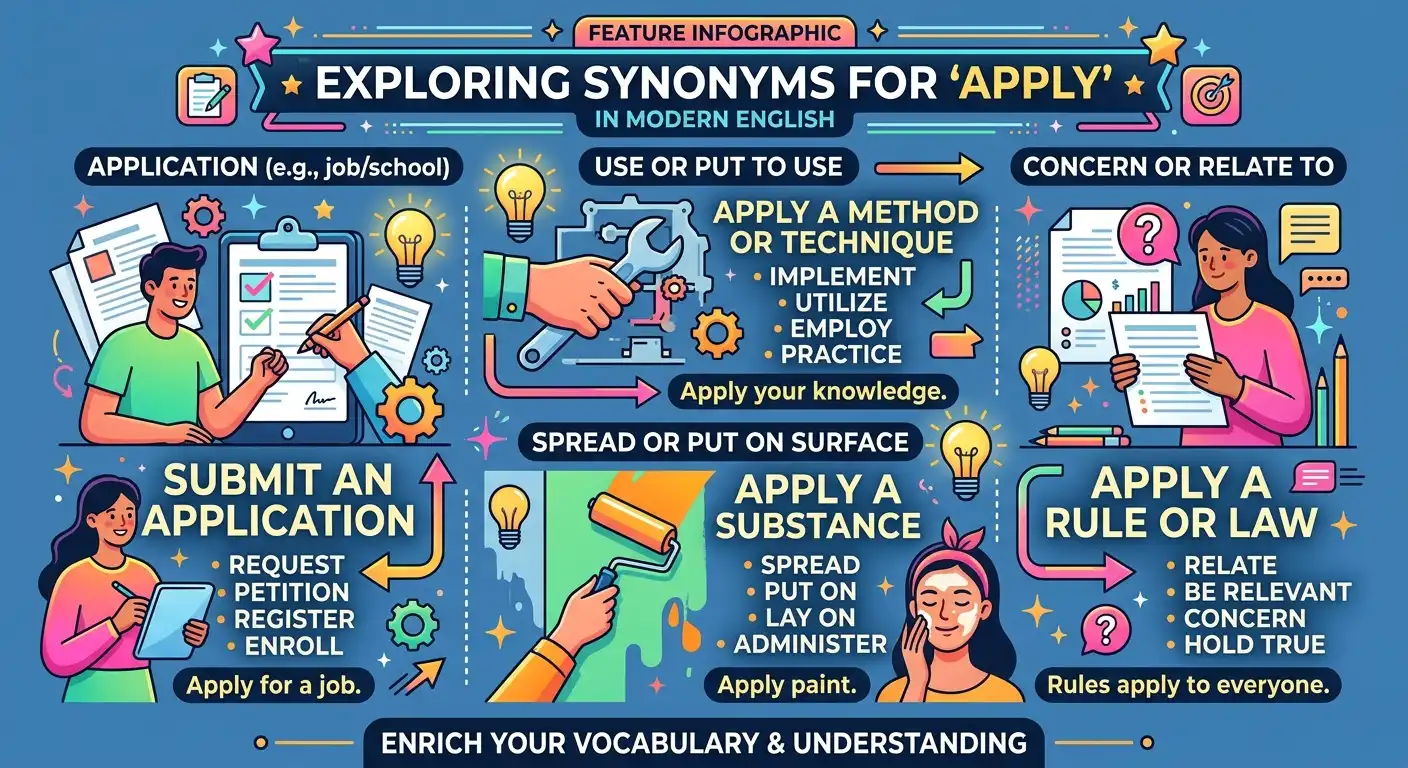
The word apply means to put something onto a surface, make a formal request for a job, or use a rule in real life. Expanding your knowledge of synonyms for apply helps many groups of readers:
- Students write clear college applications and essay responses.
- Bloggers write helpful tutorials that keep readers focused.
- Content writers boost search traffic with simple, natural language.
- Daily English users speak with confidence in daily situations.
“The right word turns a basic request into a clear statement.”
“A strong vocabulary helps you share your thoughts with ease.”
Linguistic Breakdown of “Apply”
Connotative Meaning
The word apply carries active, organized, and practical connotations. It shows purposeful action, whether you submit a form, put on a cream, or follow a rule.
Etymology
- Origin: From Anglo-French applier and Old French aplier.
- Root Word: From Latin applicare (to attach, join, or fold onto).
- Historical Shift: First used to mean attaching something physically, then expanded to mean putting effort toward a job or goal.
Pronunciation
- US (IPA): /əˈplaɪ/
- UK (IPA): /əˈplaɪ/
Syllables & Affixation Pattern
- Syllables: 2 syllables (ap-ply)
- Base Structure: Prefix ad- (to/toward) + Root plicare (to fold/bend)
- Grammatical Patterns:
- Active Form: Applies / Applied / Applying
- Noun Form: Application / Applicant
- Adjective Form: Applicable
Comparison Table: Common Synonyms for Apply
| Keyword | Meaning | Usage Type | Context |
| Submit | To hand in a form or document | Formal / Professional | Job Applications, Homework, & Legal Forms |
| Put on | To place a substance onto skin or a surface | Casual / Conversational | Skincare, Painting, & Daily Routine |
| Implement | To put a plan or rule into action | Formal / Business | Workplace Rules, Projects, & Policy |
| Request | To ask for something formally | Polite / Formal | Asking for Help, Grants, & Formal Approval |
| Spread | To layer a substance over an area | Casual / Descriptive | Cooking, Crafts, & Surface Prep |
| Enforce | To make people follow a rule | Official / Legal | Law, School Rules, & Management |
| Register | To sign up official names on a list | Official / Administrative | School Enrolment, Voting, & Events |
33 Best Synonyms for Apply
1. Submit
- Pronunciation: US /səbˈmɪt/ | UK /səbˈmɪt/
- Meaning: Submit means to hand in a document or form for review.
- Examples:
- Please submit your job form before Friday.
- She will submit her essay to the teacher today.
2. Put on
- Pronunciation: US /pʊt ɑːn/ | UK /pʊt ɒn/
- Meaning: Put on means to place a cream or clothing on your body.
- Examples:
- Put on warm lotion after your shower.
- He will put on his coat before going outside.
3. Implement
- Pronunciation: US /ˈɪm.plə.ment/ | UK /ˈɪm.plɪ.ment/
- Meaning: Implement means to start using a plan or new rule.
- Examples:
- The office will implement a new safety policy.
- Teachers implement simple rules to keep order.
4. Request
- Pronunciation: US /rɪˈkwest/ | UK /rɪˈkwest/
- Meaning: Request means to ask for something in a polite way.
- Examples:
- You can request a free copy of the book.
- She called the office to request more time.
5. Spread
- Pronunciation: US /spred/ | UK /spred/
- Meaning: Spread means to cover a surface with a thin layer.
- Examples:
- Spread butter evenly over the warm toast.
- He used a brush to spread paint on the wall.
6. Enforce
- Pronunciation: US /ɪnˈfɔːrs/ | UK /ɪnˈfɔːs/
- Meaning: Enforce means to make sure people obey a rule or law.
- Examples:
- Guards enforce the safety rules at the park.
- The city will enforce low speed limits near schools.
7. Register
- Pronunciation: US /ˈredʒ.ə.stɚ/ | UK /ˈredʒ.ɪ.stər/
- Meaning: Register means to sign your name on an official list.
- Examples:
- Remember to register for the summer swimming class.
- New voters must register before election day.
8. Administer
- Pronunciation: US /ədˈmɪn.ə.stɚ/ | UK /ədˈmɪn.ɪ.stər/
- Meaning: Administer means to give out medicine, help, or a test.
- Examples:
- The nurse will administer the daily medicine.
- Teachers administer the test at nine in the morning.
9. Execute
- Pronunciation: US /ˈek.sə.kjuːt/ | UK /ˈek.sɪ.kjuːt/
- Meaning: Execute means to carry out a planned task or order.
- Examples:
- The team worked hard to execute the plan well.
- She can execute fast decisions under pressure.
10. Smear
- Pronunciation: US /smɪr/ | UK /smɪər/
- Meaning: Smear means to rub a thick cream messily on a surface.
- Examples:
- Do not smear mud across the clean floor.
- The baby tried to smear food on the high table.
“Choosing exact words turns basic choices into clear statements of value.”
11. Practice
- Pronunciation: US /ˈpræk.tɪs/ | UK /ˈpræk.tɪs/
- Meaning: Practice means to use an idea or rule in real life.
- Examples:
- We should practice kindness every single day.
- Good drivers practice safe habits on busy roads.
12. Enroll
- Pronunciation: US /ɪnˈroʊl/ | UK /ɪnˈrəʊl/
- Meaning: Enroll means to join a school course or group activity.
- Examples:
- Parents can enroll kids in art class today.
- I want to enroll in an online computer course.
13. Lay on
- Pronunciation: US /leɪ ɑːn/ | UK /leɪ ɒn/
- Meaning: Lay on means to put a layer of paint or material down.
- Examples:
- Lay on a thick coat of paint to cover dark spots.
- Workers lay on new cement to fix the garden path.
14. Utilize
- Pronunciation: US /ˈjuː.t̬əl.aɪz/ | UK /ˈjuː.tɪ.laɪz/
- Meaning: Utilize means to make good practical use of a tool or idea.
- Examples:
- Students utilize public books to write school reports.
- We utilize solar power to heat our home water.
15. Petition
- Pronunciation: US /pəˈtɪʃ.ən/ | UK /pəˈtɪʃ.ən/
- Meaning: Petition means to ask a court or leader for official help.
- Examples:
- Neighbors petition the town for a safer street sign.
- The group will petition the court for fair treatment.
16. Cover
- Pronunciation: US /ˈkʌv.ɚ/ | UK /ˈkʌv.ər/
- Meaning: Cover means to place a layer over something completely.
- Examples:
- Cover the cut with a clean bandage right away.
- Snow began to cover the green grass outside.
17. Exercise
- Pronunciation: US /ˈek.sɚ.saɪz/ | UK /ˈek.sə.saɪz/
- Meaning: Exercise means to use your rights, authority, or options.
- Examples:
- Citizens exercise their right to vote in local elections.
- Leaders must exercise wise care when making laws.
18. File
- Pronunciation: US /faɪl/ | UK /faɪl/
- Meaning: File means to record an official paper or complaint.
- Examples:
- You must file your tax forms on time every year.
- He went to file a report at the local police desk.
19. Rub in
- Pronunciation: US /rʌb ɪn/ | UK /rʌb ɪn/
- Meaning: Rub in means to press a cream into skin until absorbed.
- Examples:
- Rub in the hand cream until your skin feels soft.
- Gently rub in the oil to soothe sore muscles.
20. Employ
- Pronunciation: US /ɪmˈplɔɪ/ | UK /ɪmˈplɔɪ/
- Meaning: Employ means to make use of a method, skill, or tool.
- Examples:
- Writers employ simple words to explain big thoughts.
- The builder will employ new tools to speed up work.
21. Solicit
- Pronunciation: US /səˈlɪs.ɪt/ | UK /səˈlɪs.ɪt/
- Meaning: Solicit means to ask people for advice, help, or funds.
- Examples:
- The shelter will solicit funds for homeless pets.
- Teachers solicit feedback from students after class.
22. Coat
- Pronunciation: US /koʊt/ | UK /kəʊt/
- Meaning: Coat means to cover an object with a thin outer layer.
- Examples:
- Coat the baking pan with fresh oil before cooking.
- Ice began to coat the tree branches overnight.
23. Bring to bear
- Pronunciation: US /brɪŋ tuː ber/ | UK /brɪŋ tuː beər/
- Meaning: Bring to bear means to use strength or effort on a problem.
- Examples:
- They bring to bear all resources to fix the water leak.
- The team will bring to bear its full power today.
24. Lodge
- Pronunciation: US /lɑːdʒ/ | UK /lɒdʒ/
- Meaning: Lodge means to place a formal complaint with an authority.
- Examples:
- Shoppers can lodge a complaint about broken goods.
- He decided to lodge an appeal with the main office.
25. Dab
- Pronunciation: US /dæb/ | UK /dæb/
- Meaning: Dab means to touch a surface lightly with a small amount.
- Examples:
- Dab a little water on the paper stain to clean it.
- She likes to dab perfume behind her ears.
26. Operate
- Pronunciation: US /ˈɑː.pə.reɪt/ | UK /ˈɒp.ər.eɪt/
- Meaning: Operate means to run or manage a machine or system.
- Examples:
- Drivers learn how to operate heavy cars safely.
- Small shop owners operate daily on tight budgets.
27. Sign up
- Pronunciation: US /saɪn ʌp/ | UK /saɪn ʌp/
- Meaning: Sign up means to join an activity by adding your name.
- Examples:
- You can sign up for the free newsletter online.
- Many kids sign up for soccer during early spring.
28. Smooth on
- Pronunciation: US /smuːð ɑːn/ | UK /smuːð ɒn/
- Meaning: Smooth on means to put cream gently over skin.
- Examples:
- Smooth on face lotion every morning after washing.
- She helped smooth on sun block on her child’s back.
29. Engage
- Pronunciation: US /ɪnˈɡeɪdʒ/ | UK /ɪnˈɡeɪdʒ/
- Meaning: Engage means to start using a feature, rule, or system.
- Examples:
- Driver safety features engage when speed drops fast.
- Workers engage best habits when handling machinery.
30. Seek
- Pronunciation: US /siːk/ | UK /siːk/
- Meaning: Seek means to search for or try to gain something.
- Examples:
- Many young people seek new job openings in cities.
- You should seek help if you feel sick today.
31. Slap on
- Pronunciation: US /slæp ɑːn/ | UK /slæp ɒn/
- Meaning: Slap on means to put something on quickly without care.
- Examples:
- Slap on a patch to cover the bike tire hole.
- He tried to slap on paint to finish work fast.
32. Pertain
- Pronunciation: US /pɚˈteɪn/ | UK /pəˈteɪn/
- Meaning: Pertain means to relate or be appropriate to a subject.
- Examples:
- These safety rules pertain to all factory workers.
- Questions that pertain to sales go to the front desk.
33. Relate
- Pronunciation: US /rɪˈleɪt/ | UK /rɪˈleɪt/
- Meaning: Relate means to have a direct connection to something.
- Examples:
- The new facts relate closely to our main topic.
- Good habits relate directly to personal health.
Antonyms of “Apply”
Knowing opposite terms helps you describe removal, ignoring rules, or withdrawing forms.
- Remove: To take off a layer or substance from a surface.
- Withdraw: To take back a job form or formal request.
- Ignore: To pay no attention to a rule or instruction.
- Detach: To unfasten or take away something that was attached.
- Neglect: To fail to use or care for a rule or duty.
- Cancel: To stop a request, signup, or registration.
Prototype Meaning & Categorization of “Apply”
The primary concept of apply rests on attaching, requesting, and executing rules. Depending on your intent, these 33 synonyms divide into three operational categories:
- Formal Requests & Admissions: Submit, request, register, enroll, petition, file, solicit, lodge, sign up, seek.
- Physical Surface Action: Put on, spread, smear, lay on, cover, rub in, coat, dab, smooth on, slap on.
- Practical Execution & Relevance: Implement, enforce, administer, execute, practice, utilize, exercise, employ, bring to bear, operate, engage, pertain, relate.
Frequently Asked Questions (FAQs)
1. What is the best formal synonym for “apply” on a resume?
In formal resumes or cover letters, “submit,” “seek,” or “file” work best. They show professional intent clearly.
2. Which synonym for “apply” should I use for skincare or cosmetics?
For creams and skin products, terms like “put on,” “smooth on,” “rub in,” or “dab” sound natural and clear.
3. What is the difference between “apply” and “implement”?
“Apply” can mean putting on lotion, requesting a job, or using a rule. “Implement” strictly means putting a policy, rule, or plan into real action.
4. Can I use “slap on” in academic writing?
No, “slap on” is a casual phrase best suited for daily chats or informal blogs. Use “apply” or “cover” in essays.
5. How does using diverse synonyms for “apply” improve writing?
Using varied synonyms avoids word repetition, makes instructions clear, keeps readers engaged, and helps search engines understand your topic.
6. What synonym works best for official rules and laws?
When talking about rules or laws, terms like “enforce,” “implement,” or “exercise” fit best.
Conclusion
Expanding your collection of synonyms for apply brings clarity, precision, and authority to your language. Replacing repetitive phrases with exact terms like submit, implement, smooth on, or enroll ensures your message lands with maximum impact every time.
Whether you are writing professional job emails, drafting academic essays, publishing blog posts, or speaking in daily conversations, using exact vocabulary builds instant confidence. Varied language removes fluff and transforms basic statements into persuasive arguments. Practice using these 33 synonyms today to share your ideas with lasting clarity.
“Clear words make every message easy to read and understand.”
“Mastering simple vocabulary builds confidence in everyday writing.”

Robert Hayes is an ESL educator and curriculum developer with over nine years of experience teaching English to beginners and intermediate learners across multiple countries ( Biography ).