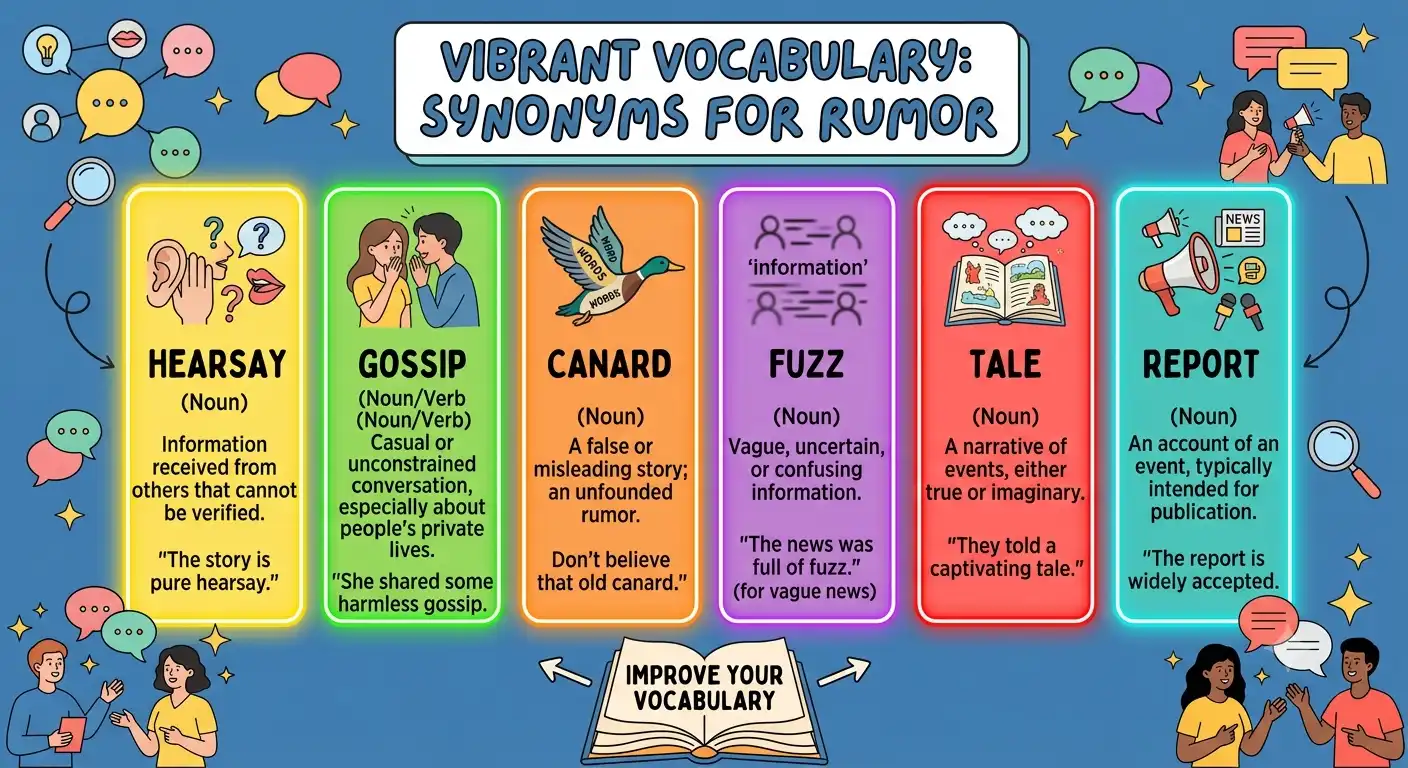
Searching for the right synonyms for rumor helps you talk about unverified news, office gossip, and unconfirmed stories with clarity. Knowing good synonyms for rumor gives you precise words for academic papers, creative stories, and everyday chat. When you use diverse synonyms for rumor, your content becomes much more engaging for your audience.
Imagine reading a news story where the writer uses the word “rumor” five times in one paragraph. The text feels repetitive and flat. By swapping in words like “hearsay,” “gossip,” or “speculation,” the writing instantly becomes sharp and interesting.
For example, when coworkers talk about a possible office change before any official announcement, they are spreading a rumor. Calling it a “whisper” or “scuttlebutt” makes your description far more colorful.
A rumor is a story or statement that people pass around when nobody has proven it true yet. Learning different words for this concept helps many people:
- Students write stronger essays and avoid repeating basic words.
- Bloggers keep their posts fresh and full of variety.
- Content writers improve readability and capture diverse search traffic.
- Daily English users speak clearly and express subtle differences in tone.
“Words shape how we share stories and understand the truth.”
“A precise vocabulary turns everyday chatter into powerful communication.”
Linguistic Breakdown of “Rumor”
Connotative Meaning
The word rumor usually carries a neutral to slightly negative connotation. It suggests uncertainty, unverified information, potential misinformation, or secret social chatter.
Etymology
- Origin: Middle English rumour, from Old French ramour.
- Root: Latin rumorem (nominative rumor), meaning “noise,” “clamor,” “common talk,” or “report.”
- Historical Shift: Entered English in the late 14th century to describe unverified talk or public noise circulating among people.
Pronunciation
- US (IPA): /ˈruː.mɚ/
- UK (IPA): /ˈruː.mə(r)/
Syllables & Affixation
- Syllables: 2 syllables (ru-mor)
- Base Word: Rumor
- Affixation Patterns:
- Prefix: None
- Suffixes: -monger (rumormonger), -ed (rumored)
Comparison Table: Common Synonyms for Rumor
| Keyword | Meaning | Usage Type | Context |
| Gossip | Talk about the private lives of others | Casual / Informal | Social circles & Workplace |
| Hearsay | Information heard from another person | Legal / Formal | Law, News & Official Talk |
| Speculation | Forming opinions without firm evidence | Professional / Academic | Finance, Politics & Research |
| Whisper | Secret or quietly shared rumor | Emotional / Literary | Stories, Drama & Politics |
| Scuttlebutt | Informal news, gossip, or rumor | Casual / Workplace | Office & Military |
| Canard | An unfounded or false rumor | Formal | Journalism & History |
| Fabrication | An invented or made-up story | Neutral / Formal | Crime, News & Debates |
50 Best Synonyms for Rumor
1. Gossip
- Pronunciation: US /ˈɡɑː.sɪp/ | UK /ˈɡɒs.ɪp/
- Meaning: Gossip is talk about the private lives of other people.
- Examples:
- The office gossip spread quickly before lunch.
- She does not like to share bad gossip about her friends.
2. Hearsay
- Pronunciation: US /ˈhɪr.seɪ/ | UK /ˈhɪə.seɪ/
- Meaning: Hearsay is information you hear from someone else without proof.
- Examples:
- The judge said the report was only hearsay.
- Do not trust that news because it is pure hearsay.
3. Whisper
- Pronunciation: US /ˈwɪs.pɚ/ | UK /ˈwɪs.pə(r)/
- Meaning: A whisper is a quiet piece of news passed secretly between people.
- Examples:
- We heard a quiet whisper about the new boss.
- The strange whisper made everyone in the room curious.
4. Report
- Pronunciation: US /rɪˈpɔːrt/ | UK /rɪˈpɔːt/
- Meaning: A report is an unconfirmed account or story about an event.
- Examples:
- Early reports say the main street is closed.
- We received an unverified report about the weather change.
5. Tale
- Pronunciation: US /teɪl/ | UK /teɪl/
- Meaning: A tale is a story that may not be completely true.
- Examples:
- He told a wild tale about his missing dog.
- Do not believe every tall tale you hear.
6. Story
- Pronunciation: US /ˈstɔːr.i/ | UK /ˈstɔː.ri/
- Meaning: A story is a statement about events that people share socially.
- Examples:
- Her strange story moved from person to person.
- The newspaper checked the story before printing it.
7. Canard
- Pronunciation: US /kəˈnɑːrd/ | UK /kæˈnɑːd/
- Meaning: A canard is an intentionally false or silly rumor.
- Examples:
- The story about the closing factory was a total canard.
- Readers quickly exposed the online canard.
8. Buzz
- Pronunciation: US /bʌz/ | UK /bʌz/
- Meaning: Buzz is excited talk or news moving through a crowd.
- Examples:
- The new phone created a lot of online buzz.
- There is a happy buzz about the upcoming holiday.
9. Speculation
- Pronunciation: US /ˌspek.jəˈleɪ.ʃən/ | UK /ˌspek.jəˈleɪ.ʃən/
- Meaning: Speculation is guessing about something without full evidence.
- Examples:
- Market speculation caused the price of gold to rise.
- Her sudden retirement raised endless speculation.
10. Talk
- Pronunciation: US /tɑːk/ | UK /tɔːk/
- Meaning: Talk refers to general conversation or informal news among people.
- Examples:
- There is much talk about the new city park.
- Ignore the idle talk in the hallway.
“Truth travels slowly, but gossip flies on swift wings.”
11. Tattle
- Pronunciation: US /ˈtæt̬.əl/ | UK /ˈtæt.əl/
- Meaning: Tattle is petty gossip or reporting on someone else’s secrets.
- Examples:
- The teacher asked the kids to stop their tattle.
- She ignored the childish tattle at the playground.
12. Libel
- Pronunciation: US /ˈlaɪ.bəl/ | UK /ˈlaɪ.bəl/
- Meaning: Libel is a published false statement that harms a person’s reputation.
- Examples:
- The actor sued the magazine for libel.
- Printing that false story was a clear case of libel.
13. Slander
- Pronunciation: US /ˈslæn.dɚ/ | UK /ˈslɑːn.də(r)/
- Meaning: Slander is a spoken false statement meant to damage someone.
- Examples:
- He defended his name against vicious slander.
- Spreading false slander can get you into trouble.
14. Falsehood
- Pronunciation: US /ˈfɑːls.hʊd/ | UK /ˈfɒls.hʊd/
- Meaning: A falsehood is a statement that is not true.
- Examples:
- The article was filled with more than one falsehood.
- She corrected the falsehood before the meeting ended.
15. Myth
- Pronunciation: US /mɪθ/ | UK /mɪθ/
- Meaning: A myth is a widely held but untrue belief or idea.
- Examples:
- The idea that sugar causes hyperactivity is a common myth.
- Our teacher busted a popular science myth today.
16. Fabrication
- Pronunciation: US /ˌfæb.rɪˈkeɪ.ʃən/ | UK /ˌfæb.rɪˈkeɪ.ʃən/
- Meaning: A fabrication is an invented story made to deceive people.
- Examples:
- His excuse for missing work was a complete fabrication.
- The detective proved the story was a pure fabrication.
17. Lie
- Pronunciation: US /laɪ/ | UK /laɪ/
- Meaning: A lie is a statement that the speaker knows is false.
- Examples:
- Telling a lie breaks trust between friends.
- She realized the claim was a bold lie.
18. Fib
- Pronunciation: US /fɪb/ | UK /fɪb/
- Meaning: A fib is a small, harmless, or minor lie.
- Examples:
- The young boy told a small fib about eating cookie dough.
- It is better to tell the truth than a fib.
19. Innuendo
- Pronunciation: US /ˌɪn.juˈen.doʊ/ | UK /ˌɪn.juˈen.dəʊ/
- Meaning: An innuendo is an indirect hint or suggestion, often negative.
- Examples:
- The politician used sharp innuendo against his opponent.
- Her speech was full of subtle innuendo.
20. Scandal
- Pronunciation: US /ˈskæn.dəl/ | UK /ˈskæn.dəl/
- Meaning: A scandal is talk about shocking or immoral actions.
- Examples:
- The big financial scandal shocked the town.
- News of the scandal spread on social media.
21. Chatter
- Pronunciation: US /ˈtʃæt̬.ɚ/ | UK /ˈtʃæt.ə(r)/
- Meaning: Chatter is rapid, continuous, and casual conversation.
- Examples:
- Constant chatter filled the school lunchroom.
- Online chatter suggests a new game release soon.
22. Prattle
- Pronunciation: US /ˈpræt̬.əl/ | UK /ˈpræt.əl/
- Meaning: Prattle is simple, foolish, or meaningless talk.
- Examples:
- We listened to his endless prattle during the long trip.
- Her cheerful prattle brightened up the morning.
23. Yarn
- Pronunciation: US /jɑːrn/ | UK /jɑːn/
- Meaning: A yarn is a long and elaborate story that is hard to believe.
- Examples:
- The old sailor spun an exciting yarn about the sea.
- Grandpa loves to tell a good yarn around the campfire.
24. Allegation
- Pronunciation: US /ˌæl.əˈɡeɪ.ʃən/ | UK /ˌæl.ɪˈɡeɪ.ʃən/
- Meaning: An allegation is a claim that someone did something wrong without proof yet.
- Examples:
- The company denied the serious allegation.
- Police investigated every allegation carefully.
25. Grapevine
- Pronunciation: US /ˈɡreɪp.vaɪn/ | UK /ˈɡreɪp.vaɪn/
- Meaning: The grapevine is an informal system for spreading news and rumors.
- Examples:
- I heard through the grapevine that we get a bonus.
- The news moved fast across the office grapevine.
26. Word
- Pronunciation: US /wɝːd/ | UK /wɜːd/
- Meaning: Word means news, information, or a rumor circulating around.
- Examples:
- Word on the street is that the team won.
- Send word as soon as you land at the airport.
27. News
- Pronunciation: US /nuːz/ | UK /njuːz/
- Meaning: News is newly received information or updates about events.
- Examples:
- We received great news about our project score.
- Breaking news spread across the city quickly.
28. Tidings
- Pronunciation: US /ˈtaɪ.dɪŋz/ | UK /ˈtaɪ.dɪŋz/
- Meaning: Tidings is an old term for news or information brought to someone.
- Examples:
- The messenger brought good tidings to the king.
- We await tidings from our friends overseas.
29. Rumblings
- Pronunciation: US /ˈrʌm.blɪŋz/ | UK /ˈrʌm.blɪŋz/
- Meaning: Rumblings are early signs or quiet talk about future trouble or changes.
- Examples:
- We heard early rumblings about a change in management.
- Policy rumblings started months before the vote.
30. Murmur
- Pronunciation: US /ˈmɝː.mɚ/ | UK /ˈmɜː.mə(r)/
- Meaning: A murmur is a quiet expression of discontent or a secret report.
- Examples:
- A gentle murmur went through the crowd.
- There was a low murmur of complaint in the hall.
31. Intimation
- Pronunciation: US /ˌɪn.təˈmeɪ.ʃən/ | UK /ˌɪn.tɪˈmeɪ.ʃən/
- Meaning: An intimation is an indirect hint or subtle signal.
- Examples:
- She gave no intimation of her plan to leave.
- The letter provided a small intimation of the truth.
32. Leak
- Pronunciation: US /liːk/ | UK /liːk/
- Meaning: A leak is secret information revealed to the public before time.
- Examples:
- The government investigated the document leak.
- An unexpected leak ruined the product surprise.
33. Dirt
- Pronunciation: US /dɝːt/ | UK /dɜːt/
- Meaning: Dirt is informal slang for harmful or shocking gossip.
- Examples:
- She wanted to find some dirt on the main rival.
- Nobody wanted to spill the dirt during the dinner.
34. Dish
- Pronunciation: US /dɪʃ/ | UK /dɪʃ/
- Meaning: Dish is casual slang for interesting gossip or insider talk.
- Examples:
- She gave us all the dish on the party.
- Let us sit down and spill the dish together.
35. Scuttlebutt
- Pronunciation: US /ˈskʌt̬.əl.bʌt/ | UK /ˈskʌt.əl.bʌt/
- Meaning: Scuttlebutt is informal news or office gossip.
- Examples:
- What is the latest scuttlebutt near the water cooler?
- Workplace scuttlebutt said a new office was opening.
36. Buzzword
- Pronunciation: US /ˈbʌz.wɝːd/ | UK /ˈbʌz.wɜːd/
- Meaning: A buzzword is a fashionable word or phrase popular in current talk.
- Examples:
- Innovation is a popular buzzword in business today.
- Try not to use too many buzzwords in your essay.
37. Supposition
- Pronunciation: US /ˌsʌp.əˈzɪʃ.ən/ | UK /ˌsʌp.əˈzɪʃ.ən/
- Meaning: A supposition is an idea assumed to be true without proof.
- Examples:
- The entire claim rests on a wrong supposition.
- Science needs evidence instead of simple supposition.
38. Conjecture
- Pronunciation: US /kənˈdʒek.tʃɚ/ | UK /kənˈdʒek.tʃə(r)/
- Meaning: Conjecture is an opinion formed on incomplete information.
- Examples:
- His explanation was based on mere conjecture.
- We need factual proof, not unverified conjecture.
39. Implication
- Pronunciation: US /ˌɪm.pləˈkeɪ.ʃən/ | UK /ˌɪm.plɪˈkeɪ.ʃən/
- Meaning: An implication is a suggestion that something is true without stating it directly.
- Examples:
- The heavy implication was that he knew the secret.
- She disliked the negative implication of his statement.
40. Fiction
- Pronunciation: US /ˈfɪk.ʃən/ | UK /ˈfɪk.ʃən/
- Meaning: Fiction is a statement or story that is made up and not factual.
- Examples:
- The rumor about the bank closing was pure fiction.
- Separating truth from fiction takes careful checking.
41. Half-truth
- Pronunciation: US /ˈhæf.truːθ/ | UK /ˈhɑːf.truːθ/
- Meaning: A half-truth is a statement that mixes a little truth with falsehood.
- Examples:
- The article presented a misleading half-truth.
- Do not mislead people with a clever half-truth.
42. Hoax
- Pronunciation: US /hoʊks/ | UK /həʊks/
- Meaning: A hoax is a humorous or malicious deception meant to trick people.
- Examples:
- The viral alien story turned out to be a hoax.
- Police warned citizens about the online phone hoax.
43. Disinformation
- Pronunciation: US /ˌdɪs.ɪn.fɚˈmeɪ.ʃən/ | UK /ˌdɪs.ɪn.fəˈmeɪ.ʃən/
- Meaning: Disinformation is false information spread on purpose to deceive.
- Examples:
- The nation fought against foreign disinformation online.
- Check your facts to avoid sharing dangerous disinformation.
44. Misinformation
- Pronunciation: US /ˌmɪs.ɪn.fɚˈmeɪ.ʃən/ | UK /ˌmɪs.ɪn.fəˈmeɪ.ʃən/
- Meaning: Misinformation is wrong information spread without harmful intent.
- Examples:
- Social platforms work hard to reduce misinformation.
- Simple typos can cause widespread misinformation.
45. Invention
- Pronunciation: US /ɪnˈven.ʃən/ | UK /ɪnˈven.ʃən/
- Meaning: An invention is a created story or claim that has no reality.
- Examples:
- That strange excuse was a total invention of his.
- Her heroic story was proven to be an invention.
46. Exaggeration
- Pronunciation: US /ɪɡˌzædʒ.əˈreɪ.ʃən/ | UK /ɪɡˌzædʒ.əˈreɪ.ʃən/
- Meaning: An exaggeration makes something sound much bigger or worse than it is.
- Examples:
- Saying he caught a giant fish was an exaggeration.
- The news headline was a big exaggeration.
47. Distortion
- Pronunciation: US /dɪˈstɔːr.ʃən/ | UK /dɪˈstɔː.ʃən/
- Meaning: A distortion is a change in facts that gives a false impression.
- Examples:
- His story was a complete distortion of the facts.
- Correct the distortion before publishing the report.
48. Chatterbox
- Pronunciation: US /ˈtʃæt̬.ɚ.bɑːks/ | UK /ˈtʃæt.ə.bɒks/
- Meaning: A chatterbox refers to a person who talks constantly, often spreading rumors.
- Examples:
- The young girl was a cheerful little chatterbox.
- Our chatterbox neighbor told us all the local news.
49. On-dit
- Pronunciation: US /ˌɑːnˈdiː/ | UK /ˌɒnˈdiː/
- Meaning: An on-dit is a French-derived term for a piece of casual rumor or gossip.
- Examples:
- She shared the latest on-dit from the fashion show.
- High society loved to talk about the latest on-dit.
50. Slur
- Pronunciation: US /slɝː/ | UK /slɜː(r)/
- Meaning: A slur is an insulting remark or rumor intended to damage someone’s honor.
- Examples:
- He faced an unfair slur on his professional character.
- The report cleared her name from the malicious slur.
Antonyms of “Rumor”
Knowing opposites helps you show clear contrast between unverified talk and solid facts.
- Fact: A piece of information that is known or proven to be true.
- Truth: The actual state of things verified by real evidence.
- Reality: What actually exists rather than what is imagined or rumored.
- Certainty: A state of being completely confident and sure about something.
- Evidence: Facts or information indicating whether a belief is valid.
- Confirmation: Official proof that validates a report or statement.
Prototype Meaning & Categorization of “Rumor”
The prototype of rumor revolves around unverified communication passed socially. Depending on tone and situation, rumors fall into four main categories:
- Workplace & Official Rumors: Hearsay, speculation, scuttlebutt, report, leak, rumblings.
- Social & Casual Gossip: Gossip, chatter, grapevine, dish, dirt, tattle.
- Deceptive & False Claims: Canard, lie, hoax, fabrication, disinformation, falsehood.
- Literary & Subtle Hints: Whisper, murmur, innuendo, yarn, intimation.
Frequently Asked Questions (FAQs)
1. What is the most common synonym for rumor in daily use?
The most common casual synonym for rumor is gossip. In workplace environments, people also frequently use hearsay or scuttlebutt.
2. Is “hearsay” the exact same thing as a rumor?
Not always. Hearsay specifically refers to information heard from others without direct proof. It is often used in legal contexts, while rumor is broader and social.
3. What is the difference between rumor and speculation?
A rumor is an unverified story circulating among people. Speculation is educated guessing about future or unknown facts based on partial information.
4. Can a rumor turn out to be true?
Yes. A rumor is simply information that has not been verified yet. Once proven with real evidence, a rumor becomes an established fact.
5. What does “grapevine” mean when discussing rumors?
The term grapevine describes the informal network people use to pass along unofficial news, rumors, and office chatter.
6. What is the opposite of a rumor?
Common antonyms for rumor include fact, truth, reality, and confirmation.
Conclusion
Mastering synonyms for rumor improves your ability to express ideas clearly and colorfully across every medium. Replacing repeated instances of “rumor” with rich terms like hearsay, speculation, scuttlebutt, or canard gives your writing precision and authority.
Whether you write professional emails, school essays, or creative stories, picking the right word shows deep command of language. It sharpens your tone, keeps readers interested, and elevates your professional voice. Try incorporating these 50 synonyms into your daily chats and writing tasks to build a versatile vocabulary naturally.
“Choosing the right word at the right moment unlocks true clarity.”
“A versatile vocabulary allows your ideas to shine with confidence.”

Robert Hayes is an ESL educator and curriculum developer with over nine years of experience teaching English to beginners and intermediate learners across multiple countries ( Biography ).