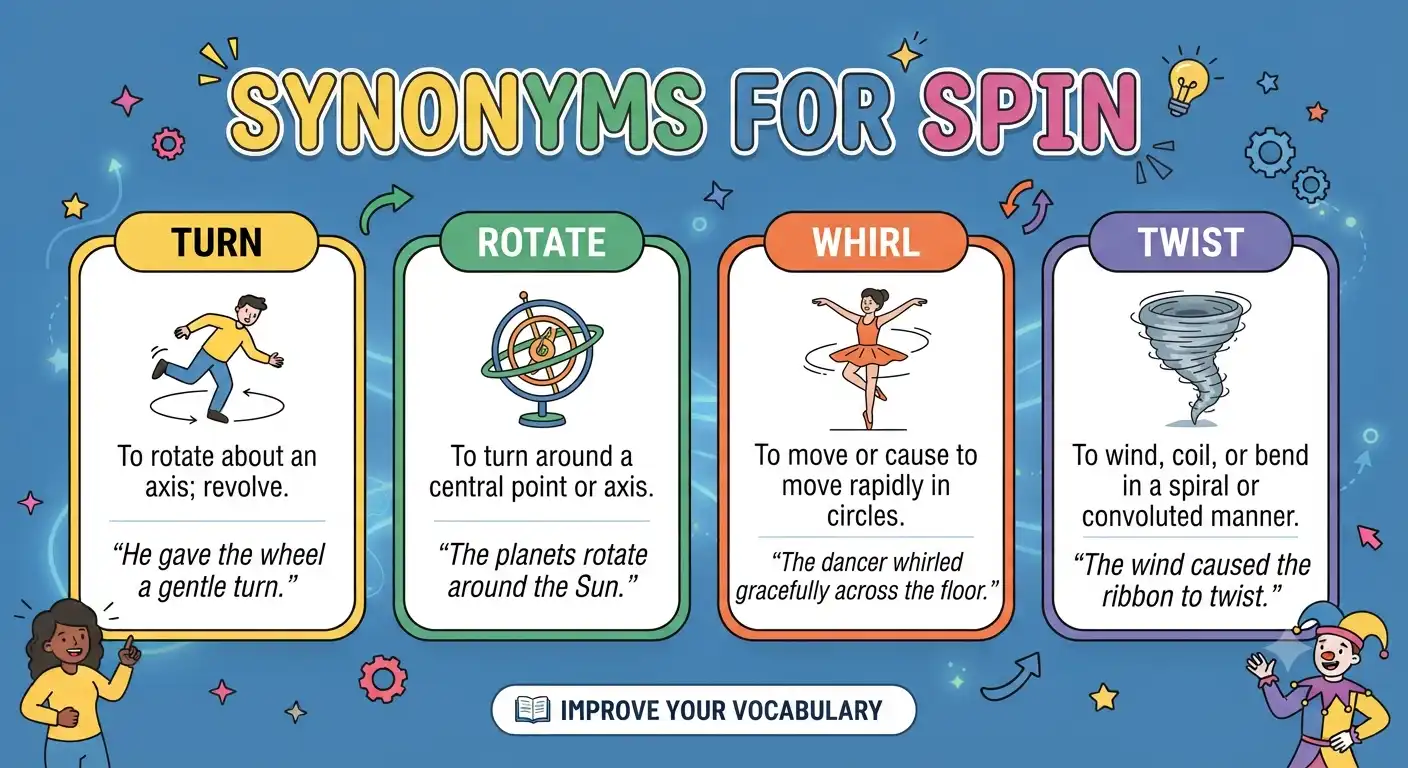
Learning accurate synonyms for spin helps you describe physical circular motion and clever media statements with high accuracy. When you search for synonyms for spin, you discover clear words to describe rotating objects or presenting news in a specific way. Using diverse synonyms for spin makes your daily writing and speaking far more precise and expressive.
Imagine watching a child play with a colorful toy top on a wooden floor. The child gives the toy a fast push, and it begins to turn around very quickly in one spot. This quick circular motion is a classic real-life example of a spin. In simple terms, to spin means to turn around a central point fast, or to tell a story with a special point of view.
Understanding these vocabulary options is helpful for many reasons:
- Students: Improve your essay scores by choosing precise movement and narrative words.
- Bloggers: Keep your readers engaged with fresh, energetic phrasing across every article.
- Content Writers: Craft powerful headlines that describe physical action or marketing angles clearly.
- Daily English Users: Pick the exact right word for casual talks, work reports, or story sharing.
“The world spins on the axis of clear communication.” – Unknown
“Change the way you look at things and the things you look at change.” – Wayne Dyer
Technical & Linguistic Breakdown of “Spin”
Connotative Meaning
The word spin carries multiple connotations depending on context. In physical movement, it has a neutral or playful connotation describing circular motion. In media, journalism, and politics, it carries a slightly negative or manipulative connotation, implying that someone is shaping facts to favor a specific opinion.
Etymology of “Spin”
- Old English Origin: Derived from Old English spinnan (meaning “to draw out and twist fibers into thread”).
- Proto-Germanic Root: Traced back to spinnana (meaning “to stretch or weave”).
- Evolution of Usage: Expanded in the 20th century from textile weaving and circular motion to describe public relations shaping (“media spin”).
Pronunciation (IPA)
- US IPA: /spɪn/
- UK IPA: /spɪn/
Syllables & Structure
- Syllables: 1 Syllable (spin)
- Stress Pattern: Single stressed syllable.
Affixation Pattern
- Base Verb/Noun: Spin
- Present Participle: Spinning (/ˈspɪn.ɪŋ/)
- Past Tense: Spun (/spʌn/)
- Noun Derivative: Spinner (/ˈspɪn.ər/)
Quick Comparison Table of Key Synonyms
| Keyword | Meaning | Usage Type | Context |
| Rotate | Turn around a central point or axis | Formal / Technical | Science, wheels, machinery |
| Twirl | Turn around quickly in a light way | Casual / Playful | Dancing, baton, ribbons |
| Whirl | Move around very fast in circles | Casual / Energetic | Wind, water, rapid movement |
| Revolve | Move in a circle around an object | Formal / Educational | Planets, orbits, engines |
| Twist | Turn or bend out of normal shape | Casual / General | Ropes, stories, ankles |
| Slant | Present information with a personal bias | Professional / Media | News reports, articles, debates |
| Frame | Express an idea from a specific angle | Professional / Formal | Politics, business, marketing |
| Distort | Change facts so they are no longer true | Formal / Critical | Arguments, news, legal cases |
50 Best Synonyms for Spin
1. Rotate
- Pronunciation: US: /ˈroʊ.teɪt/ | UK: /rəʊˈteɪt/
- Meaning: It means to turn around a central point in a circle.
- Examples:
- The big wheel began to rotate slowly.
- Earth takes one day to rotate on its axis.
2. Twirl
- Pronunciation: US: /twɜːrl/ | UK: /twɜːl/
- Meaning: It means to turn around quickly in a light or playful way.
- Examples:
- The dancer started to twirl across the floor.
- She likes to twirl her hair when she thinks.
3. Whirl
- Pronunciation: US: /wɜːrl/ | UK: /wɜːl/
- Meaning: It means to move around very fast in rapid circles.
- Examples:
- Dry leaves began to whirl in the autumn wind.
- The dancer made a sudden whirl toward the crowd.
4. Revolve
- Pronunciation: US: /rɪˈvɑːlv/ | UK: /rɪˈvɒlv/
- Meaning: It means to move in a full circle around a central object.
- Examples:
- Planets revolve around the sun in steady paths.
- The dark ring began to revolve near the wheel.
5. Swirl
- Pronunciation: US: /swɜːrl/ | UK: /swɜːl/
- Meaning: It means to move around smoothly in twisting circular paths.
- Examples:
- Cream began to swirl inside the hot cup of coffee.
- Snow began to swirl outside the bedroom window.
6. Gyrate
- Pronunciation: US: /ˈdʒaɪ.reɪt/ | UK: /ˌdʒaɪˈreɪt/
- Meaning: It means to move or dance in rapid circular patterns.
- Examples:
- The toy top began to gyrate on the table.
- Music played while dancers started to gyrate.
7. Turn
- Pronunciation: US: /tɜːrn/ | UK: /tɜːn/
- Meaning: It means to move around a fixed point or change direction.
- Examples:
- Please turn the key to unlock the front door.
- The bicycle wheel began to turn fast.
8. Pivot
- Pronunciation: US: /ˈpɪv.ət/ | UK: /ˈpɪv.ət/
- Meaning: It means to turn on a central point without leaving the spot.
- Examples:
- The basketball player decided to pivot on his left foot.
- The robot arm can pivot in every direction.
9. Reel
- Pronunciation: US: /riːl/ | UK: /riːl/
- Meaning: It means to turn round and round or feel dizzy.
- Examples:
- The fisherman began to reel in the big fish.
- His head started to reel after the fast ride.
10. Swivel
- Pronunciation: US: /ˈswɪv.əl/ | UK: /ˈswɪv.əl/
- Meaning: It means to turn around freely on a fixed joint.
- Examples:
- You can swivel your office chair toward the desk.
- The camera can swivel to capture the whole room.
11. Wheel
- Pronunciation: US: /wiːl/ | UK: /wiːl/
- Meaning: It means to turn or move in a large circular path.
- Examples:
- Birds began to wheel high above the open beach.
- He chose to wheel his bicycle down the path.
12. Circle
- Pronunciation: US: /ˈsɜːr.kəl/ | UK: /ˈsɜː.kəl/
- Meaning: It means to move completely around something in a ring shape.
- Examples:
- Planes circle over the airport while waiting to land.
- The kids love to circle around the tall tree.
13. Purl
- Pronunciation: US: /pɜːrl/ | UK: /pɜːl/
- Meaning: It means to swirl with a gentle curling motion.
- Examples:
- Water began to purl smoothly over the river rocks.
- Soft streams purl through the green valley.
14. Roll
- Pronunciation: US: /roʊl/ | UK: /rəʊl/
- Meaning: It means to turn over and over while moving along a surface.
- Examples:
- The red ball began to roll down the wooden hill.
- Children love to roll on the soft grass.
15. Spiral
- Pronunciation: US: /ˈspaɪ.rəl/ | UK: /ˈspaɪ.rəl/
- Meaning: It means to wind around a continuous point while rising or falling.
- Examples:
- Smoke began to spiral up into the morning sky.
- Leaves spiral down to the ground during autumn.
16. Orbit
- Pronunciation: US: /ˈɔːr.bɪt/ | UK: /ˈɔː.bɪt/
- Meaning: It means to travel around a central planet or star in space.
- Examples:
- Moons orbit their planets in regular paths.
- Satellites orbit Earth to send weather signals.
17. Twist
- Pronunciation: US: /twɪst/ | UK: /twɪst/
- Meaning: It means to turn something or change a story in a new way.
- Examples:
- Be careful not to twist the wire too hard.
- Writers often twist facts to make a plot fun.
18. Slant
- Pronunciation: US: /slænt/ | UK: /slɑːnt/
- Meaning: It means to present news or ideas with a strong personal bias.
- Examples:
- Do not slant the news report to favor one team.
- The article shows a clear political slant.
19. Frame
- Pronunciation: US: /freɪm/ | UK: /freɪm/
- Meaning: It means to present a story from a specific point of view.
- Examples:
- Leaders try to frame their choices as positive steps.
- They frame the issue around family values.
20. Angle
- Pronunciation: US: /ˈæŋ.ɡəl/ | UK: /ˈæŋ.ɡəl/
- Meaning: It means to direct a story or camera toward one viewpoint.
- Examples:
- The reporter found a new angle for the story.
- Try to angle your essay to highlight hard work.
21. Distort
- Pronunciation: US: /dɪˈstɔːrt/ | UK: /dɪˈstɔːt/
- Meaning: It means to change true facts so they lose original meaning.
- Examples:
- Loud noise can distort the radio music.
- Do not distort the truth during your talk.
22. Reframe
- Pronunciation: US: /ˌriːˈfreɪm/ | UK: /ˌriːˈfreɪm/
- Meaning: It means to present a hard situation in a new better light.
- Examples:
- Try to reframe your mistakes as helpful lessons.
- She learned to reframe challenges into chances.
23. Bias
- Pronunciation: US: /ˈbaɪ.əs/ | UK: /ˈbaɪ.əs/
- Meaning: It means to influence opinion unfairly toward one side.
- Examples:
- Personal feelings should not bias your judgment.
- Judges work hard not to show any bias.
24. Skew
- Pronunciation: US: /skjuː/ | UK: /skjuː/
- Meaning: It means to change data or results so they are unfair.
- Examples:
- Bad survey questions can skew the final answers.
- Do not let anger skew your fair decisions.
25. Color
- Pronunciation: US: /ˈkʌl.ɚ/ | UK: /ˈkʌl.ər/
- Meaning: It means to influence someone’s opinion or alter a fact.
- Examples:
- Past failures should not color your current hope.
- Fear can color how you see friendly advice.
“Words can turn a quiet thought into a powerful motion.” – Anonymous
26. Misrepresent
- Pronunciation: US: /ˌmɪs.rep.rɪˈzent/ | UK: /ˌmɪs.rep.rɪˈzent/
- Meaning: It means to give a false or misleading account of facts.
- Examples:
- It is wrong to misrepresent your work experience.
- Advertisements must not misrepresent product safety.
27. Warp
- Pronunciation: US: /wɔːrp/ | UK: /wɔːp/
- Meaning: It means to bend or distort facts out of true shape.
- Examples:
- Heat can warp wooden boards over time.
- Lies can warp how people view the truth.
28. Stretch
- Pronunciation: US: /stretʃ/ | UK: /stretʃ/
- Meaning: It means to exaggerate facts beyond their true limits.
- Examples:
- Saying you ran fifty miles is a big stretch.
- Do not stretch the truth to impress friends.
29. Package
- Pronunciation: US: /ˈpæk.ɪdʒ/ | UK: /ˈpæk.ɪdʒ/
- Meaning: It means to present information in an attractive arrangement.
- Examples:
- Marketers package ideas to make them sell fast.
- She knows how to package her career achievements.
30. Cook
- Pronunciation: US: /kʊk/ | UK: /kʊk/
- Meaning: It means to alter or alter facts dishonest to trick people.
- Examples:
- Dishonest managers try to cook the company books.
- Never try to cook test results in science class.
31. Doctor
- Pronunciation: US: /ˈdɑːk.tɚ/ | UK: /ˈdɒk.tər/
- Meaning: It means to change or tamper with a document dishonestly.
- Examples:
- Someone tried to doctor the official photos online.
- It is illegal to doctor official legal papers.
32. Embellish
- Pronunciation: US: /ɪmˈbel.ɪʃ/ | UK: /ɪmˈbel.ɪʃ/
- Meaning: It means to add extra fake details to make stories exciting.
- Examples:
- He likes to embellish his fishing stories with tall tales.
- Speakers often embellish stories to keep crowds happy.
33. Exaggerate
- Pronunciation: US: /ɪɡˈzædʒ.ə.reɪt/ | UK: /ɪɡˈzædʒ.ə.reɪt/
- Meaning: It means to describe something as much larger than it is.
- Examples:
- Do not exaggerate how hard the test was today.
- Stories grow when people exaggerate tiny facts.
34. Fudge
- Pronunciation: US: /fʌdʒ/ | UK: /fʌdʒ/
- Meaning: It means to adjust numbers or details in a dishonest way.
- Examples:
- Do not try to fudge your total study hours.
- Accountants must never fudge company expense reports.
35. Garble
- Pronunciation: US: /ˈɡɑːr.bəl/ | UK: /ˈɡɑː.bəl/
- Meaning: It means to mix up words so a message becomes unclear.
- Examples:
- Poor phone signals can garble your voice call.
- Fear caused him to garble his speech words.
36. Bend
- Pronunciation: US: /bend/ | UK: /bend/
- Meaning: It means to stretch rules or facts slightly without breaking them.
- Examples:
- Managers sometimes bend rules for good customers.
- Do not bend facts to win a simple argument.
37. Slur
- Pronunciation: US: /slɜːr/ | UK: /slɜː/
- Meaning: It means to speak unclearly or run words together smoothly.
- Examples:
- Tired speakers may slur their words late at night.
- Cold weather made him slur his spoken answers.
38. Pitch
- Pronunciation: US: /pɪtʃ/ | UK: /pɪtʃ/
- Meaning: It means to present a product or idea in a persuasive way.
- Examples:
- Salespeople pitch products to new store clients.
- She gave a quick pitch for her project idea.
39. Weave
- Pronunciation: US: /wiːv/ | UK: /wiːv/
- Meaning: It means to combine different threads or story points together.
- Examples:
- Authors weave exciting plots into novel books.
- Spiders weave fine webs on tree branches.
40. Whir
- Pronunciation: US: /wɜːr/ | UK: /wɜː/
- Meaning: It means to spin quickly while making a low continuous sound.
- Examples:
- Computer fans whir when processing big files.
- Small engine blades whir inside the machine.
41. Eddy
- Pronunciation: US: /ˈed.i/ | UK: /ˈed.i/
- Meaning: It means to move in small circular currents of air or water.
- Examples:
- Leaves eddy in corners during windy days.
- River currents eddy near the big bridge posts.
42. Pirouette
- Pronunciation: US: /ˌpɪr.uˈet/ | UK: /ˌpɪr.uˈet/
- Meaning: It means to spin round smoothly on one foot in ballet.
- Examples:
- The dancer made a clean pirouette on stage.
- Practice helps you spin a sharp pirouette.
43. Trundle
- Pronunciation: US: /ˈtrʌn.dəl/ | UK: /ˈtrʌn.dəl/
- Meaning: It means to roll heavy wheels along a path slowly.
- Examples:
- Heavy carts trundle across the stone street.
- Trains trundle down old mountain tracks.
44. Pinwheel
- Pronunciation: US: /ˈpɪn.wiːl/ | UK: /ˈpɪn.wiːl/
- Meaning: It means to turn around rapidly like a paper toy in wind.
- Examples:
- Sparks pinwheel into the dark night air.
- Windmills pinwheel across open field plains.
45. Gyre
- Pronunciation: US: /dʒaɪər/ | UK: /dʒaɪə/
- Meaning: It means to turn in a massive circular or spiral motion.
- Examples:
- Ocean currents gyre across big water basins.
- Storm winds gyre around the quiet center.
46. Swig
- Pronunciation: US: /swɪɡ/ | UK: /swɪɡ/
- Meaning: It means to tilt and turn a bottle to drink quickly.
- Examples:
- He took a quick swig from his water flask.
- Runners swig cold juice after long races.
47. Wind
- Pronunciation: US: /waɪnd/ | UK: /waɪnd/
- Meaning: It means to turn a handle or wrap something in coils.
- Examples:
- Remember to wind the old clock every morning.
- Rivers wind through quiet green mountain valleys.
48. Coil
- Pronunciation: US: /kɔɪl/ | UK: /kɔɪl/
- Meaning: It means to twist into smooth concentric rings or loops.
- Examples:
- Garden hoses coil neatly on the grass storage rack.
- Snakes coil tightly before resting in shade.
49. Loop
- Pronunciation: US: /luːp/ | UK: /luːp/
- Meaning: It means to move in a complete curve that double backs.
- Examples:
- Coasters loop through high metal tracks fast.
- Planes loop high in the clear blue sky.
50. Turn around
- Pronunciation: US: /tɜːrn əˈraʊnd/ | UK: /tɜːn əˈraʊnd/
- Meaning: It means to change orientation or spin face to the opposite side.
- Examples:
- Please turn around so I can see your jacket.
- Good plans can turn around bad team results.
Antonyms of “Spin”
Learning direct opposites of “spin” helps you contrast straight facts and still objects with circular motion or slanted stories:
- Stagnate: To stay completely still without any circular motion or movement.
- Clarify: To state plain facts clearly without adding bias or slanted views.
- Stabilize: To hold an object firm so it does not rotate or swing around.
- Unvarnish: To present facts exactly as they happened without extra decorations.
- Straighten: To move in a direct line without twisting or curving.
- Expose: To reveal raw truth without framing or public relations cover.
Prototype Meaning and Categorization
To master these synonyms for spin, it helps to organize the terms into four distinct categories based on mechanical action, media slant, artistic movement, and narrative shaping:
Core Prototype Definition
At its core, spinning refers to any action where something rotates around an axis, or where a narrative is manipulated to guide audience perception.
1. Mechanical and Physical Rotation (Circular Motion)
This category includes terms used when physical objects turn or revolve around a fixed point or axis.
- Primary Focus: Physical movement, science, machinery, and geometry.
- Key Synonyms: Rotate, revolve, turn, pivot, swivel, wheel, roll, wind, coil.
- Common Contexts: Engineering, astronomy, sports, daily machine operation, and physical tasks.
2. Rapid and Fluid Swirling (Energetic Motion)
This category covers terms describing fast, continuous, or fluid movement in circular or spiral shapes.
- Primary Focus: Fast motion, liquids, weather, dancing, and playfulness.
- Key Synonyms: Twirl, whirl, swirl, gyrate, reel, purl, spiral, eddy, pirouette, pinwheel.
- Common Contexts: Dance routines, weather reports, water currents, child games, and gymnastics.
3. Media Slant and Perspective (Public Relations)
These terms apply when reporters, politicians, or marketers present facts from a calculated viewpoint.
- Primary Focus: Public relations, marketing angles, framing, and strategic storytelling.
- Key Synonyms: Slant, frame, angle, reframe, package, pitch, weave, color.
- Common Contexts: Journalism, business pitches, marketing strategy, essays, and political speeches.
4. Exaggeration and Misrepresentation (Distorted Truth)
This category involves terms used when facts are intentionally altered, stretched, or manipulated.
- Primary Focus: False claims, altered numbers, exaggerated stories, and deception.
- Key Synonyms: Distort, bias, skew, misrepresent, warp, stretch, cook, doctor, embellish, fudge.
- Common Contexts: Legal cases, debates, financial audits, and contentious discussions.
Frequently Asked Questions (FAQs)
1. What is the most common physical synonym for spin?
The most common physical synonyms for spin are rotate (for turning on an axis) and twirl (for light, fast motion).
2. What does “spin” mean in news and media writing?
In news media, “spin” means framing a story or presenting facts with a specific bias to make a person or event look good or bad.
3. What is the difference between “rotate” and “revolve”?
You rotate when you turn around your own internal axis (like Earth spinning once a day). You revolve when you move in a circle around another object (like Earth traveling around the sun).
4. Can “spin” be used as both a noun and a verb?
Yes. As a verb, it describes action (“The wheel begins to spin”). As a noun, it describes the motion or perspective (“Put a positive spin on the news”).
5. Which synonym for spin works best in formal academic essays?
In formal academic writing, use words like rotate, revolve, slant, distort, or frame instead of informal words like cook or fudge.
6. Is “embellish” the same as “spin”?
While related, embellish specifically means adding extra decorative or fake details to a story, whereas spin focuses on changing the perspective or interpretation of true facts.
Conclusion
Learning dynamic synonyms for spin will greatly enhance your English vocabulary and communication skills. Expanding your vocabulary allows you to select precise terms for physical movement, storytelling, and media analysis. Whether you are drafting an academic essay, writing a blog post, preparing a work presentation, or chatting with friends, choosing exact words makes your writing clear and impactful.
When you replace repetitive words with options like rotate, twirl, slant, or frame, your sentences become far more vivid for readers. Make it a habit to practice 2 to 3 new words every week in your daily writing and spoken conversations. With regular practice, selecting the perfect vocabulary word for any situation will become second nature.
“Language is the dress of thought.” – Samuel Johnson
“To speak well and to write well is to think clearly.” – John Ruskin

Robert Hayes is an ESL educator and curriculum developer with over nine years of experience teaching English to beginners and intermediate learners across multiple countries ( Biography ).