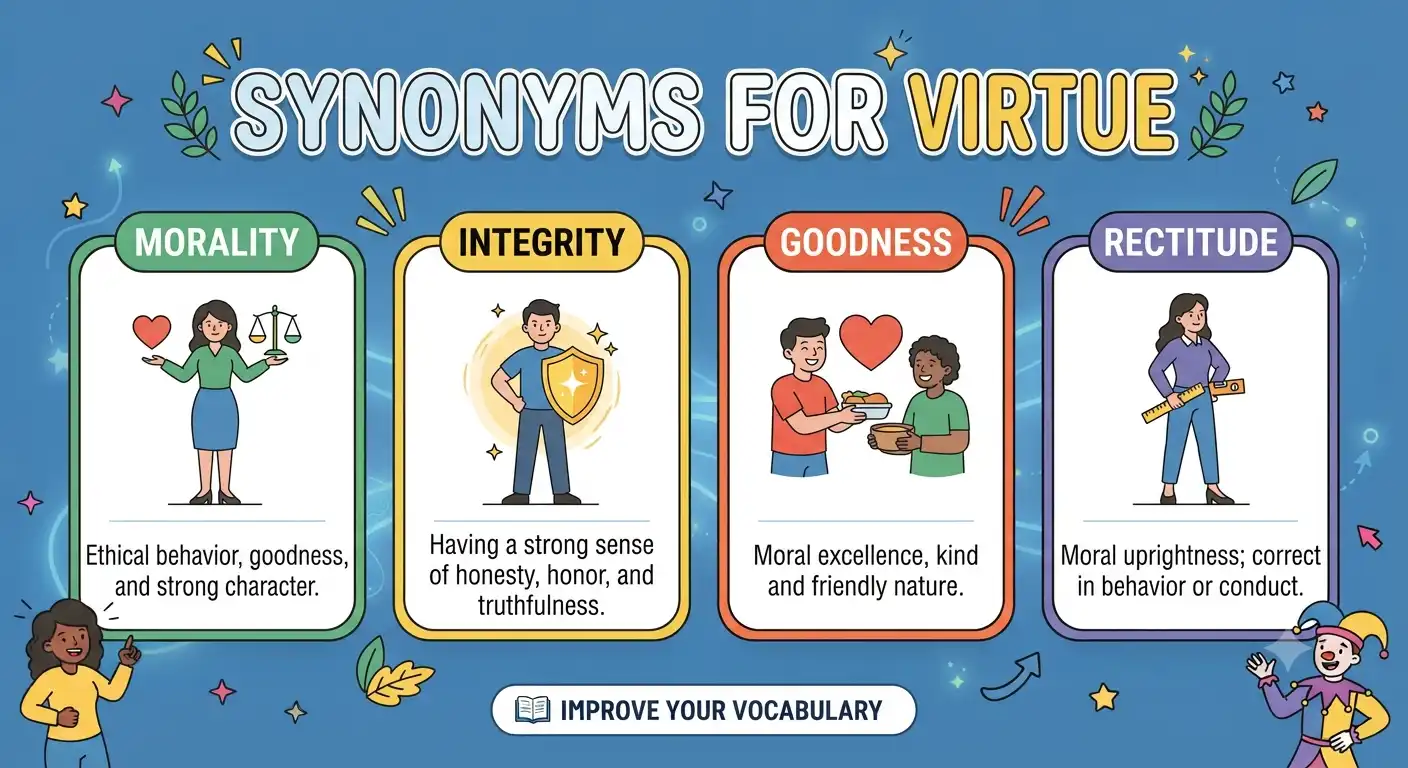
Learning standard synonyms for virtue helps you describe good behavior, strong morals, and positive traits with clarity. When you search for synonyms for virtue, you discover better ways to express honesty, kindness, and personal integrity. Using diverse synonyms for virtue makes your daily writing and speaking far more precise and engaging.
Imagine a student who finds a lost wallet full of cash on a park bench and immediately turns it in to the local police station. This honest decision shows high moral character in action. In simple terms, a virtue is a good moral habit or positive personal quality.
Understanding these vocabulary options is helpful for many reasons:
- Students: Improve your essay grades by replacing repeated words with precise academic terms.
- Bloggers: Keep your readers interested with fresh, natural wording across every article.
- Content Writers: Craft powerful stories that clearly describe character traits and corporate values.
- Daily English Users: Choose the exact right word for work chats, family conversations, or casual emails.
“Virtue is its own reward.” – Cicero
“The ultimate value of life depends upon awareness and the power of contemplation rather than upon mere survival.” – Aristotle
Technical & Linguistic Breakdown of “Virtue”
Connotative Meaning
The word virtue carries a strongly positive connotation. It implies high moral excellence, righteousness, purity, or a useful benefit. Depending on the context, it can describe a personal moral trait, an advantageous quality of an object, or a high standard of personal conduct.
Etymology of “Virtue”
- Latin Origin: Derived from Latin virtus (meaning “manliness, worth, courage, or moral excellence”).
- Old French Transition: Evolved into Old French virtu (meaning “force, power, or moral quality”).
- Middle English Entry: Entered English in the 13th century to describe moral goodness and spiritual strength.
Pronunciation (IPA)
- US IPA: /ˈvɜːr.tʃuː/
- UK IPA: /ˈvɜː.tʃuː/
Syllables & Structure
- Syllables: 2 Syllables (vir – tue)
- Stress Pattern: Primary stress on the first syllable (VIR-tue).
Affixation Pattern
- Base Noun: Virtue
- Adjective Derivative: Virtuous (/ˈvɜːr.tʃu.əs/)
- Adverb Derivative: Virtuously (/ˈvɜːr.tʃu.əs.li/)
- Noun Derivative: Virtuousness (/ˈvɜːr.tʃu.əs.nəs/)
Quick Comparison Table of Key Synonyms
| Keyword | Meaning | Usage Type | Context |
| Morality | System of right behavior | Formal / Educational | Society, philosophy, ethics |
| Goodness | State of being kind and honest | Casual / Friendly | Everyday life, personal traits |
| Integrity | Strong honesty and moral principles | Professional / Formal | Workplace, leadership, character |
| Righteousness | Doing what is morally correct | Formal / Ethical | Spiritual talks, moral debate |
| Honor | High respect and moral uprightness | Formal / Traditional | Duty, military, commitments |
| Decency | Polite and acceptable moral behavior | Casual / General | Social interactions, community |
| Merit | Quality of being good or worthy | Professional / Formal | Job performance, achievements |
| Excellence | Extremely high quality or skill | Professional / Casual | Education, sports, work output |
50 Best Synonyms for Virtue
1. Morality
- Pronunciation: US: /məˈræl.ə.ti/ | UK: /məˈræl.ə.ti/
- Meaning: It means holding strong ideas about what is right and wrong.
- Examples:
- Her high morality guides every business decision she makes.
- Teachers teach good morality to help young students succeed.
2. Goodness
- Pronunciation: US: /ˈɡʊd.nəs/ | UK: /ˈɡʊd.nəs/
- Meaning: It is the state of being kind, helpful, and honest to others.
- Examples:
- Everyone admires the pure goodness in his heart.
- Her natural goodness shines through her charitable work.
3. Integrity
- Pronunciation: US: /ɪnˈteɡ.rə.ti/ | UK: /ɪnˈteɡ.rə.ti/
- Meaning: It means being honest and standing by your moral values at all times.
- Examples:
- The judge showed great integrity throughout the long trial.
- Always work with integrity even when no one is watching.
4. Righteousness
- Pronunciation: US: /ˈraɪ.tʃəs.nəs/ | UK: /ˈraɪ.tʃəs.nəs/
- Meaning: It is the quality of acting in a morally right and fair way.
- Examples:
- He stood up for truth with calm righteousness.
- Her sense of righteousness stopped the unfair rule.
5. Uprightness
- Pronunciation: US: /ˈʌp.raɪt.nəs/ | UK: /ˈʌp.raɪt.nəs/
- Meaning: It means behaving in a clean, honest, and honorable manner.
- Examples:
- The manager is known across the city for her personal uprightness.
- True uprightness earns long-lasting respect from friends.
6. Rectitude
- Pronunciation: US: /ˈrek.tə.tuːd/ | UK: /ˈrek.tə.tjuːd/
- Meaning: It means showing correct behavior and strict honesty.
- Examples:
- His moral rectitude impressed everyone at the meeting.
- She leads the organization with complete rectitude.
7. Honor
- Pronunciation: US: /ˈɑː.nɚ/ | UK: /ˈɒn.ər/
- Meaning: It is a strong sense of honesty, respect, and duty.
- Examples:
- He fought with honor to protect his family name.
- Keeping your promise shows true honor.
8. Decency
- Pronunciation: US: /ˈdiː.sən.si/ | UK: /ˈdiː.sən.si/
- Meaning: It is polite, fair, and respectable behavior toward other people.
- Examples:
- Showing basic decency to strangers makes the world better.
- He had the decency to apologize for his late answer.
9. Merit
- Pronunciation: US: /ˈmer.ɪt/ | UK: /ˈmer.ɪt/
- Meaning: It means good quality or worth that deserves praise.
- Examples:
- The teacher judged the essay solely on its literary merit.
- Hard work brings true merit to your team project.
10. Excellence
- Pronunciation: US: /ˈek.səl.əns/ | UK: /ˈek.səl.əns/
- Meaning: It is the state of being extremely good at something.
- Examples:
- The school aims for academic excellence every year.
- She demands excellence in all her art projects.
11. Probity
- Pronunciation: US: /ˈproʊ.bə.ti/ | UK: /ˈprəʊ.bə.ti/
- Meaning: It is complete honesty and high integrity in personal affairs.
- Examples:
- Financial audits prove the accountant’s financial probity.
- Voters trust the mayor because of his public probity.
12. Chastity
- Pronunciation: US: /ˈtʃæs.tə.ti/ | UK: /ˈtʃæs.tə.ti/
- Meaning: It means purity in thoughts, words, and personal actions.
- Examples:
- Ancient cultures held values of spiritual chastity in high regard.
- She lived a quiet life focused on personal chastity.
13. Value
- Pronunciation: US: /ˈvæl.juː/ | UK: /ˈvæl.juː/
- Meaning: It is a useful belief or standard that guides how you act.
- Examples:
- Honesty is a core value in our family home.
- The book teaches the value of helping neighbors.
14. Advantage
- Pronunciation: US: /ədˈvæn.t̬ɪdʒ/ | UK: /ədˈvɑːn.tɪdʒ/
- Meaning: It is a good feature or benefit that gives you a better position.
- Examples:
- Early morning study gives you a clear learning advantage.
- Low cost is a major advantage of this tool.
15. Worth
- Pronunciation: US: /wɜːrθ/ | UK: /wɜːθ/
- Meaning: It is the high quality, value, or importance of a person or thing.
- Examples:
- Proven actions show the true worth of a friend.
- Her dedicated effort proved her immense worth to the company.
16. Purity
- Pronunciation: US: /ˈpjʊr.ə.ti/ | UK: /ˈpjʊə.rə.ti/
- Meaning: It is the state of being clean and free from bad motives.
- Examples:
- The young child spoke with complete purity of intent.
- Water clarity mirrors the purity of her mind.
17. Dignity
- Pronunciation: US: /ˈdɪɡ.nə.ti/ | UK: /ˈdɪɡ.nə.ti/
- Meaning: It is calm self-respect and controlled behavior under pressure.
- Examples:
- She accepted the decision with quiet dignity.
- Treat every individual with equal human dignity.
18. Respectability
- Pronunciation: US: /rɪˌspek.təˈbɪl.ə.ti/ | UK: /rɪˌspek.təˈbɪl.ə.ti/
- Meaning: It means having a good social reputation and correct manners.
- Examples:
- The old shop built its respectability over fifty years.
- Proper dress gives an air of social respectability.
19. Incorruptibility
- Pronunciation: US: /ˌɪn.kəˌrʌp.təˈbɪl.ə.ti/ | UK: /ˌɪn.kəˌrʌp.təˈbɪl.ə.ti/
- Meaning: It means being completely immune to bribery or bad influences.
- Examples:
- The detective was famous for his total incorruptibility.
- Public trust depends on the incorruptibility of leaders.
20. High-mindedness
- Pronunciation: US: /ˈhaɪˌmaɪn.dɪd.nəs/ | UK: /ˈhaɪˌmaɪn.dɪd.nəs/
- Meaning: It is having noble moral principles and clean motives.
- Examples:
- His high-mindedness earned praise from rival political leaders.
- She brings rare high-mindedness to community work.
21. Distinction
- Pronunciation: US: /dɪˈstɪŋk.ʃən/ | UK: /dɪˈstɪŋk.ʃən/
- Meaning: It is a special quality or achievement that sets someone apart.
- Examples:
- He earned a mark of distinction in history class.
- Her clear writing gives the essay great distinction.
22. Asset
- Pronunciation: US: /ˈæs.et/ | UK: /ˈæs.et/
- Meaning: It is a useful person, skill, or quality that brings good results.
- Examples:
- Her quick problem-solving is a major asset to our office.
- Good communication is a valuable career asset.
23. Strength
- Pronunciation: US: /streŋθ/ | UK: /streŋθ/
- Meaning: It is a positive character trait or beneficial skill.
- Examples:
- Patience under stress is her greatest inner strength.
- Focus on building every team member’s unique strength.
24. Forte
- Pronunciation: US: /ˈfɔːr.teɪ/ | UK: /ˈfɔː.teɪ/
- Meaning: It is a specific thing or skill that you do very well.
- Examples:
- Public speaking has always been her personal forte.
- Writing short stories is his primary creative forte.
25. Good Point
- Pronunciation: US: /ɡʊd pɔɪnt/ | UK: /ɡʊd pɔɪnt/
- Meaning: It is an attractive feature or positive characteristic.
- Examples:
- Punctuality is a key good point of his personality.
- Highlight every good point of the candidate during the review.
“Waste no more time arguing about what a good man should be. Be one.” – Marcus Aurelius
26. Ethicalness
- Pronunciation: US: /ˈeθ.ɪ.kəl.nəs/ | UK: /ˈeθ.ɪ.kəl.nəs/
- Meaning: It is the quality of following proper moral standards closely.
- Examples:
- The business is famous for the strict ethicalness of its sourcing.
- We value complete ethicalness in customer service.
27. Innocence
- Pronunciation: US: /ˈɪn.ə.səns/ | UK: /ˈɪn.ə.səns/
- Meaning: It is freedom from guilt, bad intentions, or moral harm.
- Examples:
- The young child looked up with complete innocence.
- Evidence proved his total innocence in the dispute.
28. Sanctity
- Pronunciation: US: /ˈsæŋk.tə.ti/ | UK: /ˈsæŋk.tə.ti/
- Meaning: It is the state of being holy, pure, or deeply sacred.
- Examples:
- They respect the sacred sanctity of human life.
- The quiet temple held an air of spiritual sanctity.
29. Principles
- Pronunciation: US: /ˈprɪn.sə.pəlz/ | UK: /ˈprɪn.sə.pəlz/
- Meaning: These are core rules and values that guide your decisions.
- Examples:
- He refuses to break his personal principles for quick profit.
- Strong principles guide her daily work ethics.
30. Character
- Pronunciation: US: /ˈker.ək.tɚ/ | UK: /ˈkær.ək.tər/
- Meaning: It is the combination of moral mental qualities that define you.
- Examples:
- Overcoming hardships builds strong personal character.
- Honest actions reveal true moral character.
31. Modesty
- Pronunciation: US: /ˈmɑː.də.sti/ | UK: /ˈmɒd.ɪ.sti/
- Meaning: It is quiet behavior that avoids boasting about success.
- Examples:
- Despite her big win, she showed humble modesty.
- His personal modesty makes him popular with everyone.
32. Honesty
- Pronunciation: US: /ˈɑː.nə.sti/ | UK: /ˈɒn.ɪ.sti/
- Meaning: It means telling the truth and avoiding lies or cheating.
- Examples:
- Honesty is always the best policy in friendship.
- Her blunt honesty helped us solve the issue quickly.
33. Faithfulness
- Pronunciation: US: /ˈfeɪθ.fəl.nəs/ | UK: /ˈfeɪθ.fəl.nəs/
- Meaning: It is steady loyalty and devotion to a duty or person.
- Examples:
- The dog showed lifelong faithfulness to its owner.
- Her faithfulness to the company earned her a promotion.
34. Truthfulness
- Pronunciation: US: /ˈtruːθ.fəl.nəs/ | UK: /ˈtruːθ.fəl.nəs/
- Meaning: It is the habit of telling facts without deceit.
- Examples:
- We trust his word because of his proven truthfulness.
- The report was praised for total historical truthfulness.
35. Justice
- Pronunciation: US: /ˈdʒʌs.tɪs/ | UK: /ˈdʒʌs.tɪs/
- Meaning: It is fair treatment and equal respect for all people.
- Examples:
- Courts exist to deliver fair justice to everyone.
- She spends her career fighting for social justice.
36. Grace
- Pronunciation: US: /ɡreɪs/ | UK: /ɡreɪs/
- Meaning: It is polite, kind, and forgiving behavior toward others.
- Examples:
- She accepted defeat with charming personal grace.
- He handled the awkward situation with great grace.
37. Cleanliness
- Pronunciation: US: /ˈklen.li.nəs/ | UK: /ˈklen.li.nəs/
- Meaning: It is the habit of staying neat, pure, and organized.
- Examples:
- The kitchen maintains strict standards of cleanliness.
- Moral cleanliness keeps your mind free from worry.
38. Wholesomeness
- Pronunciation: US: /ˈhoʊl.səm.nəs/ | UK: /ˈhəʊl.səm.nəs/
- Meaning: It is a quality that promotes health, happiness, and good morals.
- Examples:
- Families enjoy the wholesomeness of this new movie.
- Outdoor sports promote health and general wholesomeness.
39. Benefit
- Pronunciation: US: /ˈben.ə.fɪt/ | UK: /ˈben.ɪ.fɪt/
- Meaning: It is a good effect or advantage gained from something.
- Examples:
- Daily exercise brings a great health benefit.
- Clear communication is a major benefit of team meetings.
40. Quality
- Pronunciation: US: /ˈkwɑː.lə.ti/ | UK: /ˈkwɒl.ə.ti/
- Meaning: It is a characteristic feature or level of excellence.
- Examples:
- Kindness is a very desirable personal quality.
- The product is famous for its high material quality.
41. Credit
- Pronunciation: US: /ˈkred.ɪt/ | UK: /ˈkred.ɪt/
- Meaning: It is praise or approval given for a good deed or trait.
- Examples:
- Her hard work is a huge credit to the entire team.
- Give credit to those who helped you succeed.
42. Meritocracy
- Pronunciation: US: /ˌmer.əˈtɑː.krə.si/ | UK: /ˌmer.ɪˈtɒk.rə.si/
- Meaning: It is a system where people advance based on real ability.
- Examples:
- The company operates as a strict meritocracy.
- In a true meritocracy, talent decides your progress.
43. Upstandingness
- Pronunciation: US: /ʌpˈstæn.dɪŋ.nəs/ | UK: /ʌpˈstæn.dɪŋ.nəs/
- Meaning: It means being honest, respectable, and law-abiding.
- Examples:
- Community members respect his civic upstandingness.
- Her civic upstandingness makes her a model citizen.
44. Fidelity
- Pronunciation: US: /fɪˈdel.ə.ti/ | UK: /fɪˈdel.ə.ti/
- Meaning: It is continuous faithfulness to a person, cause, or belief.
- Examples:
- The soldier showed unyielding fidelity to his nation.
- She fulfilled her promises with complete fidelity.
45. Kindness
- Pronunciation: US: /ˈkaɪnd.nəs/ | UK: /ˈkaɪnd.nəs/
- Meaning: It is the quality of being friendly, generous, and considerate.
- Examples:
- A small act of kindness can brighten someone’s day.
- He treats every animal with gentle kindness.
46. Generosity
- Pronunciation: US: /ˌdʒen.əˈrɑː.sə.ti/ | UK: /ˌdʒen.əˈrɒs.ə.ti/
- Meaning: It is the willingness to give time, help, or money freely.
- Examples:
- Thanks to her generosity, the park received new trees.
- He is famous in town for his warm generosity.
47. Altruism
- Pronunciation: US: /ˈæl.tru.ɪ.zəm/ | UK: /ˈæl.tru.ɪ.zəm/
- Meaning: It is caring about the needs of others more than yourself.
- Examples:
- Volunteering at the shelter shows pure altruism.
- Her career choices reflect deep human altruism.
48. Magnanimity
- Pronunciation: US: /ˌmæɡ.nəˈnɪm.ə.ti/ | UK: /ˌmæɡ.nəˈnɪm.ə.ti/
- Meaning: It is kindness and forgiveness shown toward a rival or enemy.
- Examples:
- The winner showed great magnanimity after the game.
- Forgiving an insult takes rare magnanimity.
49. Blamelessness
- Pronunciation: US: /ˈbleɪm.ləs.nəs/ | UK: /ˈbleɪm.ləs.nəs/
- Meaning: It is the state of having done nothing wrong or dishonest.
- Examples:
- The audit proved the official’s complete blamelessness.
- He maintained his blamelessness throughout the debate.
50. Good Intent
- Pronunciation: US: /ɡʊd ɪnˈtent/ | UK: /ɡʊd ɪnˈtent/
- Meaning: It means having clean and helpful plans toward other people.
- Examples:
- Even when plans fail, good intent still matters.
- She approached the problem with clear good intent.
Antonyms of “Virtue”
Learning the direct opposites of “virtue” helps you contrast moral behavior with bad habits in your essays and stories:
- Vice: A bad habit, moral fault, or wicked behavior.
- Immorality: Actions that violate accepted moral standards.
- Corruption: Dishonest or illegal behavior, especially by power holders.
- Dishonesty: Lying, cheating, or tricking people deliberately.
- Sinfulness: Breaking moral or spiritual laws intentionally.
- Defect: A flaw or weakness in character or quality.
Prototype Meaning and Categorization
To build a strong vocabulary, it helps to understand the main categories of synonyms for virtue based on moral behavior, personal qualities, and practical benefits:
Core Prototype Definition
At its core, a virtue represents any positive quality, moral excellence, or internal strength that leads a person to make right decisions and perform good actions.
1. Moral Excellence and Character (Ethical Standards)
This category includes terms that describe high moral standards, honesty, and principled living.
- Primary Focus: Personal ethics, social duty, and moral uprightness.
- Key Synonyms: Morality, integrity, righteousness, uprightness, rectitude, probity, honor, incorruptibility.
- Common Contexts: Ethics essays, legal discussions, leadership roles, and civic duties.
2. Social Kindness and Good Behavior (Interpersonal Traits)
This category covers words used when someone treats others with warmth, care, fairness, and forgiveness.
- Primary Focus: Positive social behavior, empathy, and personal relationships.
- Key Synonyms: Goodness, decency, kindness, generosity, grace, modesty, altruism, magnanimity.
- Common Contexts: Daily conversations, family discussions, community work, and personal stories.
3. Practical Benefits and Strengths (Useful Qualities)
These terms describe specific advantages, useful talents, or beneficial attributes of a person, tool, or system.
- Primary Focus: Value, effectiveness, and practical advantages.
- Key Synonyms: Merit, advantage, asset, strength, forte, quality, distinction, worth, benefit.
- Common Contexts: Resume writing, job reviews, product descriptions, and analytical essays.
4. Purity and Innocence (Spiritual Cleanliness)
This category emphasizes clean motives, spiritual health, and freedom from deceit or bad habits.
- Primary Focus: Moral purity, modesty, and clean intentions.
- Key Synonyms: Purity, chastity, innocence, sanctity, blamelessness, truthfulness.
- Common Contexts: Literature, religious studies, historical writing, and personal reflections.
Frequently Asked Questions (FAQs)
1. What is the most common synonym for virtue?
The most common casual synonyms for virtue are goodness (for personal behavior) and merit or advantage (for useful qualities).
2. Is “integrity” the same thing as “virtue”?
While they are very close, integrity specifically refers to strict honesty and moral consistency, while virtue is a broader term covering all good qualities.
3. How do I choose between “virtue” and “merit” in writing?
Use virtue when discussing personal moral standards. Use merit when evaluating the quality, value, or advantage of a work, skill, or idea.
4. Can “virtue” be used to describe non-human objects?
Yes, in phrases like “the virtues of daily exercise,” the word refers to useful advantages, benefits, or positive attributes.
5. What are the four cardinal virtues?
Historically, the four cardinal virtues in philosophy are prudence (wisdom), courage (fortitude), temperance (moderation), and justice (fairness).
6. Which synonym for virtue works best in academic essays?
In academic or formal writing, words like integrity, probity, rectitude, and moral excellence sound professional and authoritative.
Conclusion
Mastering versatile synonyms for virtue will significantly elevate your English communication skills. Expanding your vocabulary allows you to express subtle differences in character, ethics, and useful benefits across all forms of writing. Whether you are drafting an academic essay, writing a blog post, or engaging in workplace conversations, choosing the right words makes your language precise and impactful.
Replacing repeated terms with options like integrity, probity, merit, or goodness brings freshness and authority to your text. Make it a habit to practice 2 or 3 new words each week in your daily writing and spoken practice. Over time, selecting the exact vocabulary word for any context will feel entirely natural.
“Good grammar is clear thinking made visible.” – Edward Tufkin
“Words are the clothing of our thoughts.” – Samuel Johnson

Robert Hayes is an ESL educator and curriculum developer with over nine years of experience teaching English to beginners and intermediate learners across multiple countries ( Biography ).