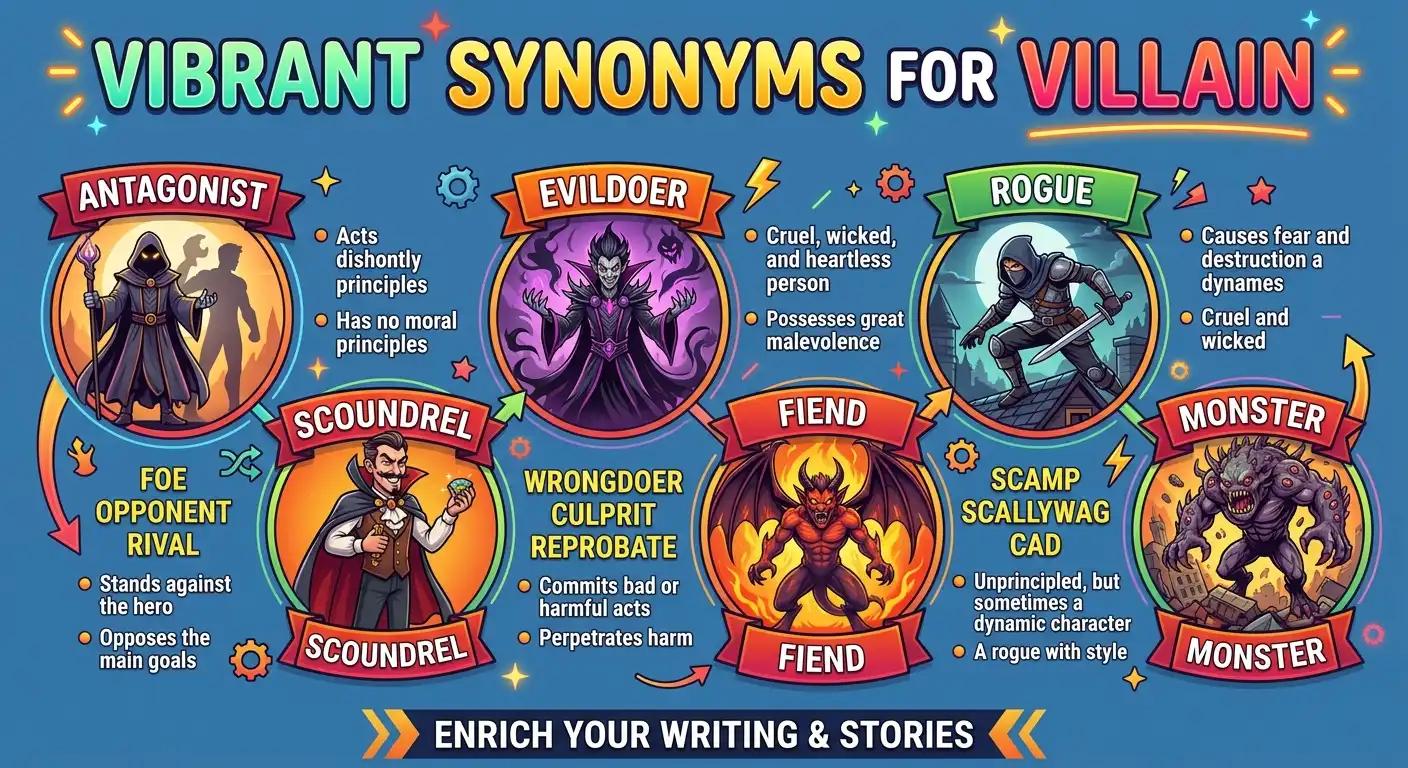
Learning exact synonyms for villain helps you describe story characters and bad actors with high precision. When you master different synonyms for villain, you can quickly upgrade your creative stories, book reviews, and school essays. Using clear synonyms for villain keeps your writing exciting and helps you avoid repeating the same words.
Imagine reading a story where the writer calls the evil character a villain on every single page. The story quickly becomes boring and loses its magic. Switching to precise choices like “antagonist,” “scoundrel,” or “rogue” gives every bad character a unique personality.
For instance, when a movie character breaks the rules to steal a hidden treasure, calling them an outlaw or miscreant explains their exact role right away.
The primary term synonyms for villain refers to alternative words for a wicked person, evil character, or main opponent in stories and real life. Expanding your list of synonyms for villain helps many groups of readers:
- Students analyze movie plots and book characters with better vocabulary.
- Bloggers write sharp film reviews that capture reader attention.
- Content writers improve search rankings using natural keyword options.
- Daily English users discuss books, news, and drama with total clarity.
“The right word gives every dark character a unforgettable voice.”
“A strong vocabulary turns simple storytelling into a masterclass.”
Linguistic Breakdown of “Villain”
Connotative Meaning
The word villain carries negative, dramatic, and dark connotations. It describes a person or character who causes harm, breaks laws, or works against the hero.
Etymology
- Origin: From Anglo-French vilain and Old French vilain (meaning farm laborer or peasant).
- Root Word: From Late Latin villanus (farm servant attached to a country house or villa).
- Historical Shift: The word originally meant a poor farmer. Over time, wealthy landowners used it as an insult. By the 14th century, it shifted to mean a wicked or low-class person.
Pronunciation
- US (IPA): /ˈvɪl.ən/
- UK (IPA): /ˈvɪl.ən/
Syllables & Affixation Pattern
- Syllables: 2 syllables (vil-lain)
- Base Structure: Root noun villain
- Grammatical Patterns:
- Noun: Villain
- Adjective form: Villainous
- Adverb form: Villainously
- Related Noun: Villainy
Comparison Table: Common Synonyms for Villain
| Keyword | Meaning | Usage Type | Context |
| Antagonist | A main force or character opposing the hero | Professional / Literary | Novels, Movies, & Plays |
| Bad guy | A person who does harmful or evil things | Casual / Conversational | Everyday Chat, Cartoons, & Casual Reviews |
| Rogue | A dishonest or dishonest but charming person | Expressive / Playful | Adventure Stories, Games, & Drama |
| Criminal | A person who breaks official laws | Formal / Legal | News Reports, Law, & True Crime |
| Evildoer | Someone who does immoral or wicked actions | Dramatic / Emotional | Fantasy, Fables, & Religious Texts |
| Scoundrel | A rogue with no moral principles | Old-fashioned / Casual | Classic Novels, Period Drama, & Jokes |
| Tyrant | A cruel ruler who uses power unfairly | Formal / Historical | History, Politics, & Epic Fiction |
26 Best Synonyms for Villain
1. Antagonist
- Pronunciation: US /ænˈtæɡ.ə.nɪst/ | UK /ænˈtæɡ.ən.ɪst/
- Meaning: An antagonist is the main person or character who opposes the primary hero in a story.
- Examples:
- The clever antagonist blocked the hero at every turn.
- Every great adventure novel needs a strong antagonist.
2. Bad guy
- Pronunciation: US /bæd ɡaɪ/ | UK /bæd ɡaɪ/
- Meaning: A bad guy is an informal term for a person who does evil or illegal things.
- Examples:
- My little brother likes playing the bad guy in video games.
- The police caught the bad guy before he could run away.
3. Rogue
- Pronunciation: US /roʊɡ/ | UK /rəʊɡ/
- Meaning: A rogue is a dishonest or mischievous person who breaks rules for fun or profit.
- Examples:
- The rogue tricked the shopkeeper and took the shiny gold coin.
- He played a charming rogue in the new pirate movie.
4. Scoundrel
- Pronunciation: US /ˈskaʊn.drəl/ | UK /ˈskaʊn.drəl/
- Meaning: A scoundrel is a wicked person who has no moral principles or honesty.
- Examples:
- That scoundrel cheated his business partner out of all his savings.
- The old king warned his daughter about the lying scoundrel.
5. Evildoer
- Pronunciation: US /ˈiː.vəlˌduː.ɚ/ | UK /ˈiː.vəlˌduː.ə/
- Meaning: An evildoer is someone who deliberately commits wicked or immoral acts.
- Examples:
- The superhero promised to protect the town from every evildoer.
- Fairytales always show the evildoer getting punished at the end.
6. Miscreant
- Pronunciation: US /ˈmɪs.kri.ənt/ | UK /ˈmɪs.kri.ənt/
- Meaning: A miscreant is a lawbreaker or bad person who behaves very badly.
- Examples:
- The principal called the miscreant into his office after class.
- Guards removed the miscreant from the quiet library room.
7. Criminal
- Pronunciation: US /ˈkrɪm.ə.nəl/ | UK /ˈkrɪm.ɪ.nəl/
- Meaning: A criminal is a person who breaks official city or country laws.
- Examples:
- The police tracked the dangerous criminal to an old storehouse.
- Stealing money from a bank makes someone a criminal.
8. Outlaw
- Pronunciation: US /ˈaʊt.lɑː/ | UK /ˈaʊt.lɔː/
- Meaning: An outlaw is a person who hides from the law after committing a crime.
- Examples:
- The wild west outlaw hid inside a dark mountain cave.
- Robin Hood lived as a famous outlaw inside the green forest.
9. Heavy
- Pronunciation: US /ˈhev.i/ | UK /ˈhev.i/
- Meaning: A heavy is a strong or tough person hired to play a bad guy role in movies.
- Examples:
- The actor played a scary heavy in the new action movie.
- Two big heavies guarded the door to the secret room.
10. Oppressor
- Pronunciation: US /əˈpres.ɚ/ | UK /əˈpres.ər/
- Meaning: An oppressor is a cruel ruler who treats people unfairly and takes away freedom.
- Examples:
- The brave workers rose up against the greedy oppressor.
- History books teach us how citizens defeated the harsh oppressor.
“Naming the darkness accurately helps us celebrate the light.”
11. Monster
- Pronunciation: US /ˈmɑːn.stɚ/ | UK /ˈmɒn.stər/
- Meaning: A monster is a very cruel or evil person who causes great harm to others.
- Examples:
- Anyone who hurts innocent animals is a complete monster.
- The movie monster lived inside an old abandoned castle.
12. Fiend
- Pronunciation: US /fiːnd/ | UK /fiːnd/
- Meaning: A fiend is an extremely wicked or cruel person with evil intentions.
- Examples:
- The evil fiend planned to turn off the city lights.
- She escaped from the fiend before he could harm her.
13. Tyrant
- Pronunciation: US /ˈtaɪ.rənt/ | UK /ˈtaɪ.rənt/
- Meaning: A tyrant is an unfair leader who uses power in a cruel way.
- Examples:
- The cruel tyrant demanded high taxes from poor farmers.
- Nobody dared to speak against the angry tyrant.
14. Wretch
- Pronunciation: US /retʃ/ | UK /retʃ/
- Meaning: A wretch is a wicked, unhappy, or despicable person.
- Examples:
- The miserable wretch stole bread from the market stall.
- The judge sent the dangerous wretch to prison.
15. Rascal
- Pronunciation: US /ˈræs.kəl/ | UK /ˈrɑː.skəl/
- Meaning: A rascal is a mischievous person who causes light trouble.
- Examples:
- The little rascal took a cookie before dinner time.
- That young rascal always plays harmless pranks on his friends.
16. Villainess
- Pronunciation: US /ˈvɪl.ən.əs/ | UK /ˈvɪl.ən.əs/
- Meaning: A villainess is a female evil character or wicked woman in a story.
- Examples:
- The dark queen is a famous animated villainess.
- The actress won an award for playing a scary villainess.
17. Arch-villain
- Pronunciation: US /ˌɑːrtʃˈvɪl.ən/ | UK /ˌɑːtʃˈvɪl.ən/
- Meaning: An arch-villain is the chicef or most powerful enemy in a story series.
- Examples:
- The superhero met his arch-villain on top of the tall tower.
- Stopping the arch-villain required the whole team working together.
18. Nemesis
- Pronunciation: US /ˈnem.ə.sɪs/ | UK /ˈnem.ə.sɪs/
- Meaning: A nemesis is a long-time rival or enemy that someone cannot defeat easily.
- Examples:
- The clever detective finally caught his main nemesis today.
- Bad weather proved to be the runner’s ultimate nemesis.
19. Culprit
- Pronunciation: US /ˈkʌl.prɪt/ | UK /ˈkʌl.prɪt/
- Meaning: A culprit is the specific person responsible for doing something wrong.
- Examples:
- The missing cake led us right to the young culprit.
- Police found the culprit using fingerprint clues.
20. Malefactor
- Pronunciation: US /ˈmæl.ə.fæk.tɚ/ | UK /ˈmæl.ɪ.fæk.tər/
- Meaning: A malefactor is a formal term for a person who does evil or wrong deeds.
- Examples:
- The court brought the malefactor to trial for his crimes.
- Ancient laws punished every malefactor severely.
21. Knave
- Pronunciation: US /neɪv/ | UK /neɪv/
- Meaning: A knave is an old-fashioned word for a dishonest or untrustworthy man.
- Examples:
- The deceitful knave stole the silver spoon from the table.
- The knight fought against the evil knave to save the village.
22. Nefarious actor
- Pronunciation: US /nəˈfer.i.əs ˈæk.tɚ/ | UK /nəˈfeə.ri.əs ˈæk.tər/
- Meaning: A nefarious actor is a formal term for a person or group doing wicked things.
- Examples:
- Cybersecurity teams block every nefarious actor from accessing user data.
- The agency stopped the nefarious actor before any damage occurred.
23. Lawbreaker
- Pronunciation: US /ˈlɑːˌbreɪ.kɚ/ | UK /ˈlɔːˌbreɪ.kər/
- Meaning: A lawbreaker is anyone who fails to obey city or country rules.
- Examples:
- The traffic officer gave a ticket to the careless lawbreaker.
- Society works best when lawbreakers face fair justice.
24. Offender
- Pronunciation: US /əˈfen.dɚ/ | UK /əˈfen.dər/
- Meaning: An offender is a person who breaks a rule or commits a crime.
- Examples:
- The judge ordered the young offender to clean the city park.
- Repeat offenders face longer prison terms under current laws.
25. Scamp
- Pronunciation: US /skæmp/ | UK /skæmp/
- Meaning: A scamp is a mischievous person or child who causes minor trouble.
- Examples:
- The playful scamp hid his sister’s shoes under the bed.
- Our dog is a little scamp when he wants extra snacks.
26. Sinner
- Pronunciation: US /ˈsɪn.ɚ/ | UK /ˈsɪn.ər/
- Meaning: A sinner is a person who breaks religious or moral standards.
- Examples:
- The preacher urged every sinner to seek forgiveness and change.
- Nobody is perfect, so every person can be a sinner at times.
Antonyms of “Villain”
Knowing opposite words helps you highlight heroes, good citizens, and brave helpers.
- Hero: A person admired for courage, outstanding achievements, or noble qualities.
- Protagonist: The main central character in a story, play, or movie.
- Protector: Someone who defends others from harm, danger, or evil.
- Saviour: A person who saves someone or something from danger or ruin.
- Guardian: A defender or keeper who protects innocent people.
- Benefactor: A helpful person who gives money or aid to good causes.
Prototype Meaning and Categorization of “Villain”
The primary idea of a villain centers on evil intent, conflict creation, lawbreaking, and harm. These 26 synonyms divide into four operational groups:
- Literary & Dramatic Roles: Antagonist, arch-villain, nemesis, villainess, heavy, rogue.
- Legal & Official Lawbreakers: Criminal, outlaw, culprit, miscreant, malefactor, lawbreaker, offender, nefarious actor.
- Extreme Evil & Cruelty: Monster, fiend, tyrant, oppressor, evildoer, scoundrel, wretch, knave, sinner.
- Light Mischief & Casual Terms: Bad guy, rascal, scamp.
Frequently Asked Questions (FAQs)
1. What is the most formal synonym for “villain”?
In formal, academic, or literary writing, “antagonist,” “malefactor,” or “nefarious actor” work best. They describe wrongdoers with total professional clarity.
2. What is the difference between an “antagonist” and a “villain”?
An antagonist is simply any force or character that opposes the main character. A villain specifically possesses evil or malicious intentions.
3. Which synonym for “villain” should I use in casual conversation?
For daily conversations, terms like “bad guy,” “rogue,” or “rascal” sound natural, friendly, and simple.
4. Can “rascal” or “scamp” mean a dangerous criminal?
No, “rascal” and “scamp” describe playful or mildly mischievous people. They are not used for serious or dangerous criminals.
5. Why is learning synonyms for “villain” helpful for storytellers?
Using different synonyms prevents repetitive writing, gives depth to characters, and matches the exact tone of your story or review.
6. How does using diverse synonyms for “villain” boost SEO?
Using varied vocabulary matches different user search queries, prevents keyword stuffing, and improves page rank on search engines.
Conclusion
Expanding your knowledge of synonyms for villain brings power, variety, and precision to your English communication. Replacing overused words with exact choices like antagonist, scoundrel, nemesis, or arch-villain makes your character descriptions far more memorable.
Whether you write creative stories, post blog reviews, compose school essays, or talk about movies with friends, having the right word builds instant confidence. Exact vocabulary removes dull phrasing and turns basic statements into captivating stories. Practice using these 26 synonyms today to upgrade your writing style.
“Mastering exact vocabulary turns simple thoughts into powerful expressions.”
“A rich vocabulary brings clarity, confidence, and authority to every story.”

Robert Hayes is an ESL educator and curriculum developer with over nine years of experience teaching English to beginners and intermediate learners across multiple countries ( Biography ).