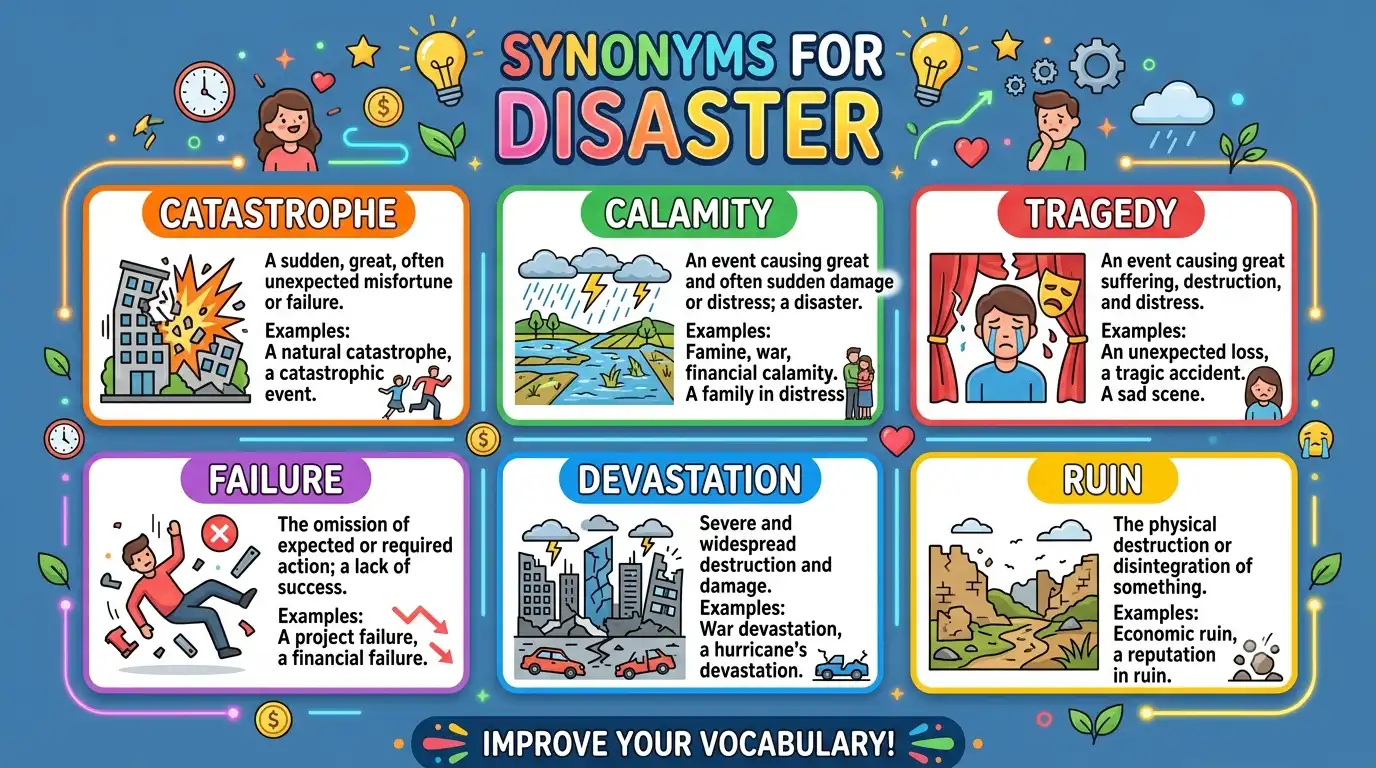
Finding rich synonyms for disaster helps you describe sudden troubles, major failures, and terrible events with complete precision. When you learn helpful synonyms for disaster, you can easily share feelings of loss, urgent crisis, and unexpected problems in your writing. Using distinct synonyms for disaster keeps your sentences active, prevents boring repetition, and improves your everyday English skills.
Imagine a sudden rainstorm ruining a big outdoor wedding party in seconds. Calling every bad situation a “disaster” three times in one short story feels dull to read. Switching to vivid choices like “catastrophe,” “calamity,” or “fiasco” paints a clear picture for your reader right away.
For example, when a baked cake burns inside the oven right before a dinner party, you can call the kitchen mistake a total fiasco. Using precise words helps your audience feel the exact stress or trouble you wish to share.
The phrase synonyms for disaster covers words that express physical damage, sudden bad luck, painful emotional loss, and major personal mistakes. Expanding your vocabulary with these terms gives great value to four key reader groups:
- Students describe historical events and personal stories clearly in school papers.
- Bloggers craft dramatic news updates and story posts that keep readers reading.
- Content writers attract organic search traffic using natural, descriptive language.
- Daily English users express feelings of shock and concern smoothly during conversations.
“Strong words give clear voice to life’s hardest moments.”
“Choosing the right descriptive word turns a simple mistake into a vivid story.”
Linguistic Breakdown of “Disaster”
Connotative Meaning
The word disaster carries deeply negative, urgent, alarming, and tragic connotations. It evokes images of widespread destruction, sudden misfortune, severe economic loss, or complete failure.
Etymology
- Origin: Derived from the 16th-century French word désastre or Italian disastro.
- Root Words: Greek prefix dus- (bad or ill) + astron (star).
- Historical Shift: Originally used in astrology to mean an unfavorable star alignment, then evolved to describe any major unexpected catastrophe.
Pronunciation
- US (IPA): /dɪˈzæs.tɚ/
- UK (IPA): /dɪˈzɑː.stə/
Syllables & Affixation Pattern
- Syllables: 3 syllables (di-sas-ter)
- Base Structure: Root word disaster
- Grammatical Patterns:
- Noun form: Disaster
- Adjective form: Disastrous
- Adverb form: Disastrously
Comparison Table: Common Synonyms for Disaster
| Keyword | Meaning | Usage Type | Context |
| Catastrophe | A sudden terrible event that causes great destruction | Formal / Serious | Natural events, big accidents, & history |
| Calamity | An event causing great damage or distress | Emotional / Grave | Personal tragedy, community loss, & floods |
| Fiasco | A total failure that looks embarrassing | Casual / Expressive | Failed events, bad dinners, & party plans |
| Tragedy | A very sad event involving death or suffering | Serious / Emotional | News stories, personal loss, & sudden illness |
| Debacle | A sudden and complete breakdown or defeat | Professional / Critical | Business failures, sport losses, & elections |
| Mishap | A minor unlucky accident or small mistake | Casual / Gentle | Daily life, dropped items, & minor delays |
| Crisis | A time of intense difficulty or danger | Formal / Urgent | Medical problems, money troubles, & politics |
50 Best Synonyms for Disaster
1. Catastrophe
- Pronunciation: US /kəˈtæs.trə.fi/ | UK /kəˈtæs.trə.fi/
- Meaning: Catastrophe means a sudden event that causes terrible damage and suffering.
- Examples:
- The sudden earthquake was a terrible catastrophe for the small island.
- A sudden system drop created a digital catastrophe for the bank.
2. Calamity
- Pronunciation: US /kəˈlæm.ə.t̬i/ | UK /kəˈlæm.ə.ti/
- Meaning: Calamity means a serious event that brings deep distress and destruction.
- Examples:
- The severe flood brought calamity to the entire farming valley.
- Losing all harvest crops was an economic calamity for the village.
3. Tragedy
- Pronunciation: US /ˈtrædʒ.ə.di/ | UK /ˈtrædʒ.ə.di/
- Meaning: Tragedy means a very sad event that causes great human pain.
- Examples:
- The sudden boat accident was a heartbreak and tragedy for the family.
- They mourned the tragedy of losing their historical home in a fire.
4. Misfortune
- Pronunciation: US /ˌmɪsˈfɔːr.tʃən/ | UK /ˌmɪsˈfɔː.tʃuːn/
- Meaning: Misfortune means bad luck that causes trouble or unwanted hardship.
- Examples:
- He faced great misfortune when his car broke down during the storm.
- Bad weather was a temporary misfortune for our weekend trip.
5. Cataclysm
- Pronunciation: US /ˈkæt.ə.klɪz.əm/ | UK /ˈkæt.ə.klɪz.əm/
- Meaning: Cataclysm means a violent natural event that changes things completely.
- Examples:
- The volcanic eruption was a cataclysm that buried the entire ancient city.
- Scientists studied the ancient cataclysm that wiped out large dinosaurs.
6. Debacle
- Pronunciation: US /dɪˈbɑː.kəl/ | UK /deɪˈbɑː.kəl/
- Meaning: Debacle means a complete and embarrassing failure or sudden retreat.
- Examples:
- The team suffered a total debacle in the championship game today.
- Their main product launch turned into a public marketing debacle.
7. Fiasco
- Pronunciation: US /fiˈæs.koʊ/ | UK /fiˈæs.kəʊ/
- Meaning: Fiasco means a complete failure that ends up looking foolish.
- Examples:
- The surprise birthday party became a funny fiasco when the power died.
- Burning the holiday dinner was an absolute fiasco for the young cook.
8. Crisis
- Pronunciation: US /ˈkraɪ.sɪs/ | UK /ˈkraɪ.sɪs/
- Meaning: Crisis means a dangerous situation that needs fast action and help.
- Examples:
- The city faced a water crisis after the main supply pipe broke.
- Doctors worked around the clock during the public health crisis.
9. Emergency
- Pronunciation: US /ɪˈmɝː.dʒən.si/ | UK /ɪˈmɜː.dʒən.si/
- Meaning: Emergency means a sudden unexpected event that requires immediate help.
- Examples:
- Call the emergency line if you see smoke near the dry forest.
- The hospital opened new rooms during the sudden medical emergency.
10. Adversity
- Pronunciation: US /ədˈvɝː.sə.t̬i/ | UK /ədˈvɜː.sə.ti/
- Meaning: Adversity means difficult conditions or continued bad luck in life.
- Examples:
- She showed great bravery while facing personal adversity in school.
- Working together helps communities overcome unexpected economic adversity.
11. Failure
- Pronunciation: US /ˈfeɪ.ljɚ/ | UK /ˈfeɪ.ljər/
- Meaning: Failure means a lack of success in doing something planned.
- Examples:
- Engine failure caused the old bus to stop on the bridge.
- The business failed because of a total failure to attract buyers.
12. Ruin
- Pronunciation: US /ˈruː.ɪn/ | UK /ˈruː.ɪn/
- Meaning: Ruin means complete destruction or loss of money and state.
- Examples:
- Heavy rain brought total ruin to the tomato crop this season.
- Poor planning led the company straight into financial ruin.
13. Mishap
- Pronunciation: US /ˈmɪs.hæp/ | UK /ˈmɪs.hæp/
- Meaning: Mishap means a small unlucky accident that causes mild trouble.
- Examples:
- A small kitchen mishap spilled milk all over the floor.
- We arrived late at the theater due to a minor driving mishap.
14. Blow
- Pronunciation: US /bloʊ/ | UK /bləʊ/
- Meaning: Blow means a sudden hard shock or unexpected painful event.
- Examples:
- Losing his job was a severe blow to his confidence.
- The bad news proved a heavy blow for the whole athletic team.
15. Reverse
- Pronunciation: US /rɪˈvɝːs/ | UK /rɪˈvɜːs/
- Meaning: Reverse means a change from good luck to sudden bad luck.
- Examples:
- The firm suffered a major financial reverse late last year.
- He bounced back quickly after experiencing a small career reverse.
16. Setback
- Pronunciation: US /ˈset.bæk/ | UK /ˈset.bæk/
- Meaning: Setback means a problem that delays progress or stops plans.
- Examples:
- Rainy weather caused a temporary setback for the construction crew.
- A leg injury was a major setback for the marathon runner.
17. Devastation
- Pronunciation: US /ˌdev.əˈsteɪ.ʃən/ | UK /ˌdev.əˈsteɪ.ʃən/
- Meaning: Devastation means great destruction and total damage across an area.
- Examples:
- The storm left a path of total devastation through the town.
- Citizens looked at the devastation with sadness and shock.
18. Hardship
- Pronunciation: US /ˈhɑːrd.ʃɪp/ | UK /ˈhɑːd.ʃɪp/
- Meaning: Hardship means difficult living conditions without enough food or money.
- Examples:
- The cold winter brought severe hardship to poor families.
- They survived years of economic hardship through hard work.
19. Wreck
- Pronunciation: US /rek/ | UK /rek/
- Meaning: Wreck means something destroyed or severely damaged by an accident.
- Examples:
- Tow trucks cleared the car wreck from the main highway.
- High sea waves made a complete wreck of the wooden pier.
20. Collapse
- Pronunciation: US /kəˈlæps/ | UK /kəˈlæps/
- Meaning: Collapse means a sudden falling down or complete failure of structure.
- Examples:
- The old bridge collapse caused serious traffic delays downtown.
- Overwork led to a complete physical collapse for the worker.
21. Breakdown
- Pronunciation: US /ˈbreɪk.daʊn/ | UK /ˈbreɪk.daʊn/
- Meaning: Breakdown means a failure of a system, machine, or relationship.
- Examples:
- A communication breakdown caused the group to miss the deadline.
- The car suffered an engine breakdown on the mountain road.
22. Crash
- Pronunciation: US /kræʃ/ | UK /kræʃ/
- Meaning: Crash means a sudden loud accident or sudden economic drop.
- Examples:
- The stock market crash wiped out many small investment accounts.
- Two vehicles were involved in a minor crash at the street corner.
23. Meltdown
- Pronunciation: US /ˈmelt.daʊn/ | UK /ˈmelt.daʊn/
- Meaning: Meltdown means a complete collapse or uncontrollable emotional breakdown.
- Examples:
- The tired toddler had a full temper meltdown at the store.
- The bank system suffered a digital meltdown during peak hours.
24. Washout
- Pronunciation: US /ˈwɑːʃ.aʊt/ | UK /ˈwɒʃ.aʊt/
- Meaning: Washout means a event ruined by rain or an complete total failure.
- Examples:
- The outdoor picnic was a total washout due to heavy storms.
- His attempt to play golf turned out to be a complete washout.
25. Trainwreck
- Pronunciation: US /ˈtreɪn.rek/ | UK /ˈtreɪn.rek/
- Meaning: Trainwreck means a messy situation that fails completely in public view.
- Examples:
- His chaotic speech on live news was a complete trainwreck.
- The movie project turned into a trainwreck after actors left.
“Clear and descriptive words bring light and comfort to every story.”
26. Mess
- Pronunciation: US /mes/ | UK /mes/
- Meaning: Mess means a dirty, disorganized, or troubled situation.
- Examples:
- The dog made a huge mess with the open trash bag.
- Her scheduled travel plans were in a complete mess after delays.
27. Downfall
- Pronunciation: US /ˈdaʊn.fɑːl/ | UK /ˈdaʊn.fɔːl/
- Meaning: Downfall means a sudden loss of power, health, or success.
- Examples:
- Greed was the main cause of the king’s ultimate downfall.
- Excessive spending brought about the quick downfall of the firm.
28. Destruction
- Pronunciation: US /dɪˈstrʌk.ʃən/ | UK /dɪˈstrʌk.ʃən/
- Meaning: Destruction means the act of tearing down or breaking something completely.
- Examples:
- The wild forest fire caused widespread destruction of homes.
- Heavy hammers led to the rapid destruction of the old wall.
29. Affliction
- Pronunciation: US /əˈflɪk.ʃən/ | UK /əˈflɪk.ʃən/
- Meaning: Affliction means something that causes intense pain, illness, or suffering.
- Examples:
- Chronic joint pain was a painful affliction for the elderly man.
- The medical team sought a cure for the rare local affliction.
30. Trial
- Pronunciation: US /ˈtraɪ.əl/ | UK /ˈtraɪ.əl/
- Meaning: Trial means a difficult experience that tests a person’s patience or strength.
- Examples:
- Moving to a foreign country was a tough personal trial for her.
- Faith helped the family stay hopeful through every hard trial.
31. Tribulation
- Pronunciation: US /ˌtrɪb.jəˈleɪ.ʃən/ | UK /ˌtrɪb.jəˈleɪ.ʃən/
- Meaning: Tribulation means a state of great trouble, grief, or deep distress.
- Examples:
- They faced severe trial and tribulation during the long war years.
- Stories of past tribulation inspired the community to build back.
32. Ruination
- Pronunciation: US /ˌruː.əˈneɪ.ʃən/ | UK /ˌruː.ɪˈneɪ.ʃən/
- Meaning: Ruination means the process or state of being destroyed completely.
- Examples:
- Neglect led to the gradual ruination of the historic castle.
- Bad financial choices brought complete ruination to the store.
33. Flop
- Pronunciation: US /flɑːp/ | UK /flɒp/
- Meaning: Flop means a complete movie, show, or business project failure.
- Examples:
- The expensive new science fiction movie was a huge box office flop.
- Her first online business idea ended up being a total flop.
34. Defeat
- Pronunciation: US /dɪˈfiːt/ | UK /dɪˈfiːt/
- Meaning: Defeat means losing a game, battle, fight, or competitive contest.
- Examples:
- The soccer team suffered a painful defeat in the final match.
- Accepting defeat graciously shows strong personal character.
35. Bust
- Pronunciation: US /bʌst/ | UK /bʌst/
- Meaning: Bust means a complete business collapse or an unsuccessful effort.
- Examples:
- The high tech investment turned out to be a total financial bust.
- Economic growth slowed down after the housing market bust.
36. Blunder
- Pronunciation: US /ˈblʌn.dɚ/ | UK /ˈblʌn.dər/
- Meaning: Blunder means a stupid or careless mistake that causes big trouble.
- Examples:
- Sending the private email to everyone was a serious blunder.
- A defense blunder cost the team an easy goal during the game.
37. Botch
- Pronunciation: US /bɑːtʃ/ | UK /bɒtʃ/
- Meaning: Botch means a poorly done task that ruins the final outcome.
- Examples:
- The inexperienced painter made a total botch of the kitchen walls.
- Fixing the plumbing turned into a complete botch job.
38. Misadventure
- Pronunciation: US /ˌmɪs.ədˈven.tʃɚ/ | UK /ˌmɪs.ədˈven.tʃər/
- Meaning: Misadventure means an unlucky event or bad accident during a journey.
- Examples:
- Their camping trip was filled with minor outdoor misadventure.
- The lost hiker returned home safe after a day of misadventure.
39. Casualty
- Pronunciation: US /ˈkæʒ.u.əl.ti/ | UK /ˈkæʒ.ju.əl.ti/
- Meaning: Casualty means a person hurt or killed, or a thing ruined by an event.
- Examples:
- The small neighborhood store was a casual casualty of high rent.
- Emergency staff reported no human casualty after the fire.
40. Havoc
- Pronunciation: US /ˈhæv.ək/ | UK /ˈhæv.ək/
- Meaning: Havoc means widespread confusion, disorder, and severe damage.
- Examples:
- High wind gusts wreaked havoc on power lines across the city.
- A mischievous puppy caused havoc in the neat living room.
41. Calamitous event
- Pronunciation: US /kəˈlæm.ə.t̬əs ɪˈvent/ | UK /kəˈlæm.ɪ.təs ɪˈvent/
- Meaning: Calamitous event means a terrible occurrence that destroys wealth or safety.
- Examples:
- The sea surge was a calamitous event for coastal homes.
- Insurance covers damage resulting from any sudden calamitous event.
42. Bad luck
- Pronunciation: US /bæd lʌk/ | UK /bæd lʌk/
- Meaning: Bad luck means unfortunate events that happen without direct fault.
- Examples:
- Getting a flat tire on your birthday is just bad luck.
- He blamed bad luck for missing his connecting morning flight.
43. Hard luck
- Pronunciation: US /hɑːrd lʌk/ | UK /hɑːd lʌk/
- Meaning: Hard luck means persistent difficult circumstances or unfortunate outcomes.
- Examples:
- The young family suffered a stretch of hard luck last year.
- He shared a story of hard luck during his job interview.
44. Downslide
- Pronunciation: US /ˈdaʊn.slaɪd/ | UK /ˈdaʊn.slaɪd/
- Meaning: Downslide means a steady fall toward worse conditions or lower failure.
- Examples:
- Company stock entered a long downslide after sales fell.
- Poor health marked the beginning of his general life downslide.
45. Trouble
- Pronunciation: US /ˈtrʌb.əl/ | UK /ˈtrʌb.əl/
- Meaning: Trouble means problems, worry, or difficulty that causes pain.
- Examples:
- Engine trouble forced the airplane to land at the nearest airport.
- Call your family right away if you get into any real trouble.
46. Nightmare
- Pronunciation: US /ˈnaɪt.mer/ | UK /ˈnaɪt.meər/
- Meaning: Nightmare means a frightening dream or a very unpleasant real situation.
- Examples:
- Finding a lost passport at the crowded airport was a total nightmare.
- Morning traffic delays turned the daily commute into a nightmare.
47. Disaster area
- Pronunciation: US /dɪˈzæs.tɚ ˈer.i.ə/ | UK /dɪˈzɑː.stə ˈeə.ri.ə/
- Meaning: Disaster area means a place damaged heavily or an extremely messy room.
- Examples:
- The storm-hit coast was officially declared a federal disaster area.
- Cleaning staff worked hard to fix the messy disaster area.
48. Disruption
- Pronunciation: US /dɪsˈrʌp.ʃən/ | UK /dɪsˈrʌp.ʃən/
- Meaning: Disruption means an interruption that prevents a system from working normally.
- Examples:
- Heavy snow caused severe transit disruption across the state.
- Power outages caused major work disruption at the office.
49. Pitfall
- Pronunciation: US /ˈpɪt.fɑːl/ | UK /ˈpɪt.fɔːl/
- Meaning: Pitfall means an unexpected danger, hidden trap, or common difficulty.
- Examples:
- Hidden fees are a common financial pitfall for online buyers.
- Experienced guides help travelers avoid every dangerous pitfall.
50. Mischance
- Pronunciation: US /ˌmɪsˈtʃæns/ | UK /ˌmɪsˈtʃɑːns/
- Meaning: Mischance means an unlucky occurrence or unfavorable instance of chance.
- Examples:
- By pure mischance, she dropped her house keys down the drain.
- The trip was delayed by an unexpected mischance at the station.
Antonyms of “Disaster”
Knowing opposite words helps you describe safe situations, massive successes, or joyful events accurately.
- Success: Achieving a desired result, goal, or planned outcome smoothly.
- Triumph: A great victory, achievement, or major joyful conquest.
- Blessing: Something that brings unexpected happiness, safety, or good fortune.
- Boon: A helpful thing or sudden benefit that brings great advantage.
- Miracle: A wonderful event that brings unexpected good luck or safety.
- Prosperity: A state of flourishing, good health, and financial gain.
- Windfall: A sudden piece of unexpected good luck or financial gain.
Prototype Meaning & Categorization of “Disaster”
The central idea of disaster focuses on uncontrolled destruction, heavy loss, sudden bad luck, and severe failure. Depending on your descriptive goals, these 50 synonyms divide into four main groups:
- Massive Destruction & Natural Events: Catastrophe, calamity, cataclysm, devastation, ruin, ruinous event, ruination, destruction, calamitous event, disaster area.
- Sudden Crisis & Urgent Danger: Crisis, emergency, breakdown, collapse, crash, meltdown, Havoc, disruption, pitfall, blow.
- Personal Failure & Mistakes: Debacle, fiasco, failure, trainwreck, washout, mess, downfall, flop, defeat, bust, blunder, botch, nightmare.
- Bad Luck & Personal Hardship: Misfortune, mishap, reverse, setback, adversity, hardship, wreck, affliction, trial, tribulation, misadventure, casualty, bad luck, hard luck, downslide, trouble, mischance.
Frequently Asked Questions (FAQs)
1. What is the most formal synonym for “disaster” in news reporting?
In formal news reporting and academic writing, terms like “catastrophe,” “calamity,” or “crisis” work best. They clearly state severity without using informal slang.
2. What is the difference between “disaster” and “fiasco”?
While “disaster” involves real harm, destruction, or tragedy, a “fiasco” describes an embarrassing or foolish failure where things go funny or wrong without serious bodily harm.
3. Can I use “mishap” to describe a severe earthquake?
No, “mishap” refers to small, minor accidents like dropping a cup or missing a bus. A severe earthquake should be called a “catastrophe” or “cataclysm.”
4. Which synonym for “disaster” is best for business failures?
In business contexts, words like “debacle,” “collapse,” “setback,” or “financial ruin” convey professional weight and accurate context.
5. Why is “nightmare” used as a synonym for “disaster”?
In informal daily English, people call confusing, frustrating, or scary situations a “nightmare” to show intense personal stress or total disorder.
6. How does using diverse vocabulary for “disaster” improve SEO?
Using varied vocabulary prevents keyword stuffing, addresses different user search queries, improves semantic topic depth, and keeps readers engaged on your page longer.
Conclusion
Expanding your collection of synonyms for disaster brings accuracy, power, and depth to your daily communication. Replacing basic words with exact choices like catastrophe, fiasco, debacle, or calamity ensures your message connects with every reader effectively.
Whether you are writing student essays, posting news blogs, drafting business reports, or chatting with friends, using exact vocabulary builds real confidence. Varied descriptive language removes repetitive phrasing and turns simple stories into powerful, memorable statements. Practice using these 50 synonyms today to share your thoughts with lasting impact.
“Clear and descriptive words bring light and comfort to every story.”
“Building a rich vocabulary allows you to paint vivid pictures with simple language.”

Robert Hayes is an ESL educator and curriculum developer with over nine years of experience teaching English to beginners and intermediate learners across multiple countries ( Biography ).