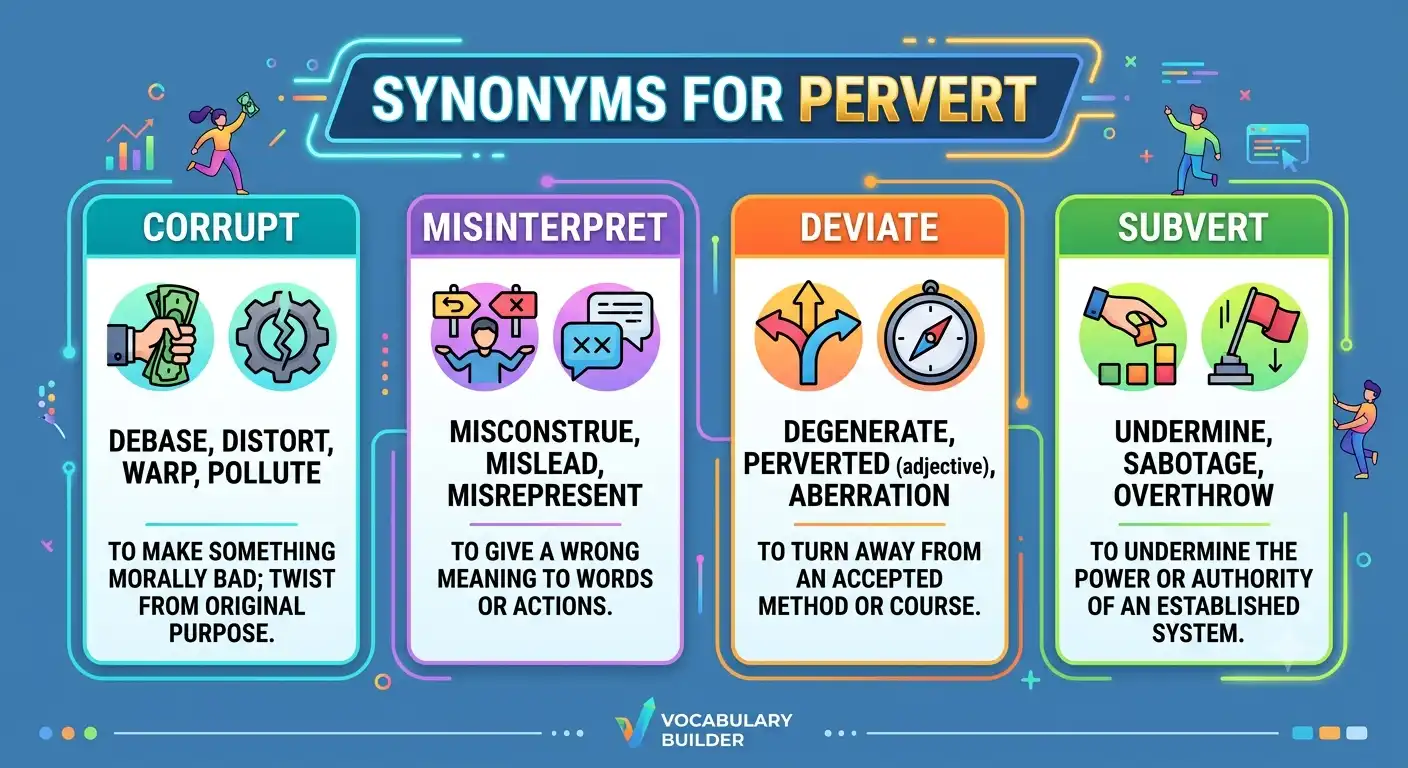
Finding useful synonyms for pervert allows you to describe distorted actions, altered truths, or corrupt behavior with exact accuracy. When you study synonyms for pervert, you learn how to discuss actions or ideas that turn away from what is original or right. Learning various synonyms for pervert helps you craft clearer essays, legal analyses, and everyday descriptions.
Imagine listening to a speech where someone takes a simple law and changes its meaning to win an argument. The speaker turns the facts upside down until the real message is lost. This situation is a clear real-life example of how someone can pervert the truth during a debate.
Understanding these vocabulary options brings major benefits to different writers and speakers:
- Students: Enhance your vocabulary scores by using precise terms in literature and history essays.
- Bloggers: Keep readers interested with clear, descriptive words across every article.
- Content Writers: Express subtle shades of meaning when analyzing complex stories or legal cases.
- Daily English Users: Choose the right word when describing twisted facts, bad habits, or altered plans.
“Truth is the only safe ground to stand upon.” – Elizabeth Cady Stanton
“To distort the truth is to corrupt the mind.” – Unknown
Technical & Linguistic Breakdown of “Pervert”
Connotative Meaning
As a verb, pervert carries a negative connotation, meaning to turn something away from its proper, original, or intended state (such as justice or truth). As a noun or adjective, it carries a strongly negative connotation, referring to a person or behavior that strays significantly from accepted moral or social standards.
Etymology of “Pervert”
- Prefix (Per-): Derived from Latin per- (meaning “thoroughly” or “away, astray”).
- Root (Vertere): Derived from Latin vertere (meaning “to turn”).
- Historical Emergence: Entered Middle English in the 14th century as a verb meaning “to turn away from the right path” or “corrupt.” The noun form developed later in the late 19th century.
Pronunciation (IPA)
- Verb Pronunciation: US: /pərˈvɜːrt/ | UK: /pəˈvɜːt/
- Noun Pronunciation: US: /ˈpɜːrvɜːrt/ | UK: /ˈpɜːvɜːt/
Syllables & Structure
- Syllables: 2 Syllables (per – vert)
- Stress Pattern: Verb stress on second syllable (per-VERT); Noun stress on first syllable (PER-vert).
Affixation Pattern
- Base Form: Verb / Noun (pervert)
- Adjective Form: Perverted
- Noun Derivative: Perversion / Perverter
- Adverb Derivative: Pervertedly
Quick Comparison Table of Key Synonyms
| Keyword | Meaning | Usage Type | Context |
| Distort | Change facts or shapes so they are not true | Formal / Casual | News stories, art, legal claims |
| Corrupt | Turn something good into something bad | Formal / Professional | Politics, computer data, morals |
| Warp | Bend or twist out of original form | Casual / Technical | Wood, mindsets, logical arguments |
| Subvert | Secretly weaken or destroy an established system | Formal / Political | Governments, rules, traditions |
| Twist | Change the meaning of words to confuse people | Casual / Everyday | Arguments, stories, news reports |
| Deviant | Differing strongly from normal standards | Formal / Scientific | Social studies, psychology, behavior |
| Misrepresent | Give a false or misleading account of something | Professional / Formal | Contracts, journalism, court cases |
50 Best Synonyms for Pervert
1. Distort
- Pronunciation: US: /dɪˈstɔːrt/ | UK: /dɪˈstɔːt/
- Meaning: You change facts or shapes so they become untrue.
- Examples:
- Do not distort the facts to win the game.
- The bent glass will distort your reflection.
2. Corrupt
- Pronunciation: US: /kəˈrʌpt/ | UK: /kəˈrʌpt/
- Meaning: You turn something good or honest into something bad.
- Examples:
- Bad habits can corrupt a good plan.
- The computer virus will corrupt your files.
3. Warp
- Pronunciation: US: /wɔːrp/ | UK: /wɔːp/
- Meaning: You bend or twist something away from its natural shape.
- Examples:
- Too much water will warp the wooden door.
- Anger can warp a person’s judgment.
4. Subvert
- Pronunciation: US: /səbˈvɜːrt/ | UK: /səbˈvɜːt/
- Meaning: You secretly work to weaken or ruin a system.
- Examples:
- Lies can subvert trust between close friends.
- The group tried to subvert the new rule.
5. Twist
- Pronunciation: US: /twɪst/ | UK: /twɪst/
- Meaning: You change the meaning of words to trick someone.
- Examples:
- Please do not twist my words around.
- He tried to twist the truth during the meeting.
6. Debase
- Pronunciation: US: /dɪˈbeɪs/ | UK: /dɪˈbeɪs/
- Meaning: You reduce the quality or value of something.
- Examples:
- Cruel words can debase a good discussion.
- They tried to debase the value of the coin.
7. Misapply
- Pronunciation: US: /ˌmɪsəˈplaɪ/ | UK: /ˌmɪsəˈplaɪ/
- Meaning: You use a rule or tool in a wrong way.
- Examples:
- Do not misapply the law to small errors.
- He will misapply the budget if left alone.
8. Falsify
- Pronunciation: US: /ˈfɔːlsɪfaɪ/ | UK: /ˈfɔːlsɪfaɪ/
- Meaning: You alter information to make it false or fake.
- Examples:
- It is wrong to falsify official report notes.
- She did not falsify any test scores.
9. Taint
- Pronunciation: US: /teɪnt/ | UK: /teɪnt/
- Meaning: You spoil something by adding a small bad detail.
- Examples:
- One lie can taint your whole story.
- Dirt will taint the clean water supply.
10. Misrepresent
- Pronunciation: US: /ˌmɪsˌreprɪˈzent/ | UK: /ˌmɪsˌreprɪˈzent/
- Meaning: You give false details about what happened.
- Examples:
- Ads should not misrepresent product features.
- He tried to misrepresent his work hours.
11. Violate
- Pronunciation: US: /ˈvaɪəleɪt/ | UK: /ˈvaɪəleɪt/
- Meaning: You break a rule or disregard a boundary.
- Examples:
- Loud music will violate the quiet rules.
- Do not violate the trust of your team.
12. Contaminate
- Pronunciation: US: /kənˈtæmɪneɪt/ | UK: /kənˈtæmɪneɪt/
- Meaning: You make something dirty or dangerous by touching it.
- Examples:
- Chemicals can contaminate the fresh river.
- Bad ideas will contaminate the project.
13. Pollute
- Pronunciation: US: /pəˈluːt/ | UK: /pəˈluːt/
- Meaning: You make something unclean or unsafe for others.
- Examples:
- Smoke will pollute the clean mountain air.
- Rude remarks pollute the classroom atmosphere.
14. Vitiate
- Pronunciation: US: /ˈvɪʃieɪt/ | UK: /ˈvɪʃieɪt/
- Meaning: You ruin the legal force or quality of something.
- Examples:
- Errors can vitiate a legal contract.
- Fraud will vitiate the entire election.
15. Degrade
- Pronunciation: US: /dɪˈɡreɪd/ | UK: /dɪˈɡreɪd/
- Meaning: You lower the character or condition of something.
- Examples:
- Harsh weather will degrade the old stone wall.
- Insults only degrade the person who speaks them.
16. Garble
- Pronunciation: US: /ˈɡɑːrbl/ | UK: /ˈɡɑːbl/
- Meaning: You mix up a message until it makes no sense.
- Examples:
- Static will garble the phone conversation.
- Fear can garble your words during a speech.
17. Manipulate
- Pronunciation: US: /məˈnɪpjuleɪt/ | UK: /məˈnɪpjuleɪt/
- Meaning: You control facts or people in a sneaky way.
- Examples:
- He likes to manipulate numbers on the chart.
- She will not manipulate her friends for gain.
18. Tamper
- Pronunciation: US: /ˈtæmpər/ | UK: /ˈtæmpə/
- Meaning: You touch or change something without permission.
- Examples:
- Do not tamper with the safety locks.
- Someone tried to tamper with the evidence.
19. Defile
- Pronunciation: US: /dɪˈfaɪl/ | UK: /dɪˈfaɪl/
- Meaning: You ruin the purity or beauty of something.
- Examples:
- Trash will defile the beautiful public park.
- Lies defile an honest reputation.
20. Undermine
- Pronunciation: US: /ˌʌndərˈmaɪn/ | UK: /ˌʌndəˈmaɪn/
- Meaning: You weaken something gradually from the inside.
- Examples:
- Constant doubt will undermine your success.
- Gossip can undermine workplace harmony.
21. Alter
- Pronunciation: US: /ˈɔːltər/ | UK: /ˈɔːltə/
- Meaning: You change the appearance or nature of something.
- Examples:
- She needed to alter her dress for the party.
- Do not alter the original record details.
22. Misinterpret
- Pronunciation: US: /ˌmɪsɪnˈtɜːrprət/ | UK: /ˌmɪsɪnˈtɜːprət/
- Meaning: You understand a meaning in a wrong way.
- Examples:
- People easily misinterpret short text messages.
- He did not misinterpret the teacher’s instructions.
23. Divert
- Pronunciation: US: /daɪˈvɜːrt/ | UK: /daɪˈvɜːt/
- Meaning: You turn something away from its intended direction.
- Examples:
- Signs will divert traffic away from main street.
- Noise can divert your focus from study.
24. Bend
- Pronunciation: US: /bend/ | UK: /bend/
- Meaning: You stretch or alter a rule without fully breaking it.
- Examples:
- The referee decided to bend the time rule.
- Do not bend the facts to suit yourself.
25. Abuse
- Pronunciation: US: /əˈbjuːz/ | UK: /əˈbjuːz/
- Meaning: You use power or trust in a bad or harmful way.
- Examples:
- Leaders must not abuse their official power.
- He promised not to abuse his new privileges.
“Justice perverted is justice denied.” – Proverb
26. Deviant
- Pronunciation: US: /ˈdiːviənt/ | UK: /ˈdiːviənt/
- Meaning: Describing behavior that strays far from normal rules.
- Examples:
- The study examined deviant patterns in social groups.
- His deviant conduct caused concern at work.
27. Degenerate
- Pronunciation: US: /dɪˈdʒenərət/ | UK: /dɪˈdʒenərət/
- Meaning: Showing a decline in moral standards or quality.
- Examples:
- The debate began to degenerate into name-calling.
- He warned against degenerate social habits.
28. Transgressor
- Pronunciation: US: /trænzˈɡresər/ | UK: /trænzˈɡresə/
- Meaning: A person who steps over legal or moral boundaries.
- Examples:
- The transgressor paid a heavy fine in court.
- Every transgressor was asked to leave the room.
29. Miscreant
- Pronunciation: US: /ˈmɪskriənt/ | UK: /ˈmɪskriənt/
- Meaning: A person who behaves badly or breaks the law.
- Examples:
- The guard stopped the miscreant at the gate.
- Local police caught the miscreant quickly.
30. Renegade
- Pronunciation: US: /ˈrenɪɡeɪd/ | UK: /ˈrenɪɡeɪd/
- Meaning: Someone who deserts a cause to follow a different path.
- Examples:
- The renegade officer left his post at night.
- She proved to be a renegade in her field.
31. Dissenter
- Pronunciation: US: /dɪˈsentər/ | UK: /dɪˈsentə/
- Meaning: A person who disagrees with official opinions.
- Examples:
- One dissenter voted against the new policy.
- The dissenter spoke calmly to the board.
32. Outcast
- Pronunciation: US: /ˈaʊtkæst/ | UK: /ˈaʊtkɑːst/
- Meaning: A person who has been rejected by a group.
- Examples:
- The lonely boy felt like an outcast at school.
- Kindness helped the outcast feel welcome.
33. Nonconformist
- Pronunciation: US: /ˌnɑːnkənˈfɔːrmɪst/ | UK: /ˌnɒnkənˈfɔːmɪst/
- Meaning: Someone who refuses to follow established customs.
- Examples:
- An artist is often a nonconformist by nature.
- Her nonconformist ideas inspired the team.
34. Eccentric
- Pronunciation: US: /ɪkˈsentrɪk/ | UK: /ɪkˈsentrɪk/
- Meaning: A person with unusual or unconventional habits.
- Examples:
- The eccentric writer lived in a small cabin.
- His eccentric style made everyone smile.
35. Corrupter
- Pronunciation: US: /kəˈrʌptər/ | UK: /kəˈrʌptə/
- Meaning: Someone who causes others to act dishonestly.
- Examples:
- The judge removed the corrupter from the room.
- He was labeled a corrupter of youth.
36. Distorter
- Pronunciation: US: /dɪˈstɔːrtər/ | UK: /dɪˈstɔːtə/
- Meaning: A person who changes facts to mislead people.
- Examples:
- The reporter was called a distorter of truth.
- A distorter cannot be trusted with data.
37. Subverter
- Pronunciation: US: /səbˈvɜːrtər/ | UK: /səbˈvɜːtə/
- Meaning: Someone who works secretly to destroy rules.
- Examples:
- The subverter tried to ruin the project.
- Guards caught the subverter near the office.
38. Offender
- Pronunciation: US: /əˈfendər/ | UK: /əˈfendə/
- Meaning: A person who breaks a law or rule.
- Examples:
- The repeat offender faced a strict penalty.
- Each offender must apologize for the noise.
39. Malcontent
- Pronunciation: US: /ˈmælkəntent/ | UK: /ˈmælkəntent/
- Meaning: A person who is constantly dissatisfied with rules.
- Examples:
- The malcontent complained about every decision.
- One malcontent tried to disrupt the event.
40. Rebel
- Pronunciation: US: /ˈrebl/ | UK: /ˈrebl/
- Meaning: Someone who fights against authority or control.
- Examples:
- The young rebel demanded clear answers.
- Every rebel wanted positive change.
41. Misleader
- Pronunciation: US: /ˌmɪsˈliːdər/ | UK: /ˌmɪsˈliːdə/
- Meaning: A person who guides others in a wrong direction.
- Examples:
- Do not trust a known misleader with directions.
- The misleader gave false advice to the group.
42. Seducer
- Pronunciation: US: /sɪˈduːsər/ | UK: /sɪˈdjuːsə/
- Meaning: Someone who leads another person away from duty.
- Examples:
- The story featured a clever seducer character.
- He acted as a seducer of simple minds.
43. Contort
- Pronunciation: US: /kənˈtɔːrt/ | UK: /kənˈtɔːt/
- Meaning: You twist or strain something out of natural shape.
- Examples:
- Pain can contort a person’s face.
- Do not contort the message to cause panic.
44. Perverter
- Pronunciation: US: /pərˈvɜːrtər/ | UK: /pəˈvɜːtə/
- Meaning: Someone who turns truth or justice into error.
- Examples:
- He was known as a perverter of justice.
- The lawyer exposed the perverter in court.
45. Perverted
- Pronunciation: US: /pərˈvɜːrtɪd/ | UK: /pəˈvɜːtɪd/
- Meaning: Turned away from what is right, natural, or true.
- Examples:
- They had a perverted view of the situation.
- The story gave a perverted sense of facts.
46. Abnormal
- Pronunciation: US: /æbˈnɔːrml/ | UK: /æbˈnɔːml/
- Meaning: Different from what is usual or expected.
- Examples:
- Cold snow in summer is abnormal weather.
- The doctor checked his abnormal pulse rate.
47. Unnatural
- Pronunciation: US: /ʌnˈnætʃrəl/ | UK: /ʌnˈnætʃrəl/
- Meaning: Contrary to the ordinary course of nature.
- Examples:
- The bright sky had an unnatural glow.
- He spoke in an unnatural high voice.
48. Aberrant
- Pronunciation: US: /æˈberənt/ | UK: /æˈberənt/
- Meaning: Departing from an accepted standard or path.
- Examples:
- The computer showed aberrant readings today.
- Her aberrant behavior worried her friends.
49. Misguided
- Pronunciation: US: /ˌmɪsˈɡaɪdɪd/ | UK: /ˌmɪsˈɡaɪdɪd/
- Meaning: Having wrong ideas or poor judgment.
- Examples:
- He made a misguided choice during the game.
- Her misguided attempt caused a minor delay.
50. Depraved
- Pronunciation: US: /dɪˈpreɪvd/ | UK: /dɪˈpreɪvd/
- Meaning: Severely lacking moral goodness or decency.
- Examples:
- The villain showed a depraved heart in the movie.
- Crime leads to a depraved life.
Antonyms of “Pervert”
Learning direct opposites of “pervert” helps you contrast dishonest or distorted behavior with truth and integrity:
- Uphold: To support, preserve, or defend a law, truth, or standard.
- Purify: To remove bad elements and make something clean and good.
- Honest: Truthful and free from deceit or corrupt motives.
- Clarify: To make a statement or idea clear and easy to understand.
- Preserve: To keep something safe in its original, correct form.
- Rectify: To correct an error and set something right again.
Prototype Meaning and Categorization
To master synonyms for pervert, it helps to understand the core prototype of perversion and organize terms into clear categories based on context and intended meaning:
Core Prototype Definition
At its center, perverting refers to the deliberate process of turning something away from its natural, correct, legal, or moral path into a distorted or corrupt state.
1. Linguistic and Factual Distortion (Twisting Truth)
This category includes words used when someone alters words, facts, or data to mislead people or win an argument unfair manner.
- Primary Focus: Changing statements, garbling messages, and twisting facts.
- Key Synonyms: Distort, twist, falsify, misrepresent, garble, manipulate, alter.
- Common Contexts: Journalism, legal debates, courtrooms, and political speeches.
2. Moral and Systemic Corruption (Ruining Standards)
This category involves terms used when someone weakens, spoils, or ruins established rules, moral values, or official systems.
- Primary Focus: Degrading standards, spoiling purity, and undermining rules.
- Key Synonyms: Corrupt, subvert, debase, vitiate, degrade, undermine, taint.
- Common Contexts: Workplace policies, governance, social morals, and software systems.
3. Rule Violations and Misuse (Improper Actions)
These terms describe taking a tool, rule, or privilege and applying it incorrectly or abusively.
- Primary Focus: Misapplying guidelines, tampering with locks, and abusing power.
- Key Synonyms: Misapply, violate, tamper, abuse, contort, divert, bend.
- Common Contexts: Institutional management, refereeing, contract reviews, and security.
4. Nonconforming Personalities (Social Deviance)
This category applies to individuals or behaviors that stray away from accepted social standards or expectations.
- Primary Focus: Social nonconformity, eccentric behavior, or moral straying.
- Key Synonyms: Deviant, degenerate, transgressor, miscreant, nonconformist, aberrant.
- Common Contexts: Literary character analysis, psychology, sociology, and criminal justice studies.
Frequently Asked Questions (FAQs)
1. What is the most common synonym for pervert when talking about truth?
The most common daily synonyms when talking about altering facts are distort, twist, and misrepresent.
2. Can “pervert” be used as a legal term?
Yes, in law, to pervert the course of justice is a formal phrase meaning to prevent justice from being served correctly.
3. Is “subvert” different from “distort”?
Yes, distort means to change the shape or truth of something, while subvert means to actively weaken an entire system or authority from within.
4. What is the difference in pronunciation between the verb and noun form?
The verb pervert places stress on the second syllable (per-VERT), while the noun pervert places stress on the first syllable (PER-vert).
5. What is a good formal synonym for “pervert” in academic writing?
In formal or academic papers, words like subvert, vitiate, corrupt, or debase work extremely well.
6. How do I practice using these words correctly?
Try selecting 2 to 3 new words each week and use them in your writing, essay practice, or daily reading notes.
Conclusion
Expanding your vocabulary with accurate synonyms for pervert allows you to express exact shades of meaning in every piece of writing. Selecting precise words ensures that your points about distorted facts, corrupt systems, or improper actions remain clear and effective. Whether you are drafting a legal paper, writing a story, preparing a speech, or chatting with colleagues, rich word choices keep your communication powerful.
Replacing repetitive terms with alternatives like distort, subvert, debase, or misrepresent brings freshness and authority to your language. Consistent vocabulary building transforms your speaking and writing into a sharp tool for clear expression. Start incorporating 2 to 3 new synonyms into your notes, emails, and daily conversations this week.
“Words have energy and power with the ability to help, to heal, to hinder, to hurt, to harm, to humiliate and to humble.” – Yehuda Berg
“The limits of my language mean the limits of my world.” – Ludwig Wittgenstein

Robert Hayes is an ESL educator and curriculum developer with over nine years of experience teaching English to beginners and intermediate learners across multiple countries ( Biography ).