
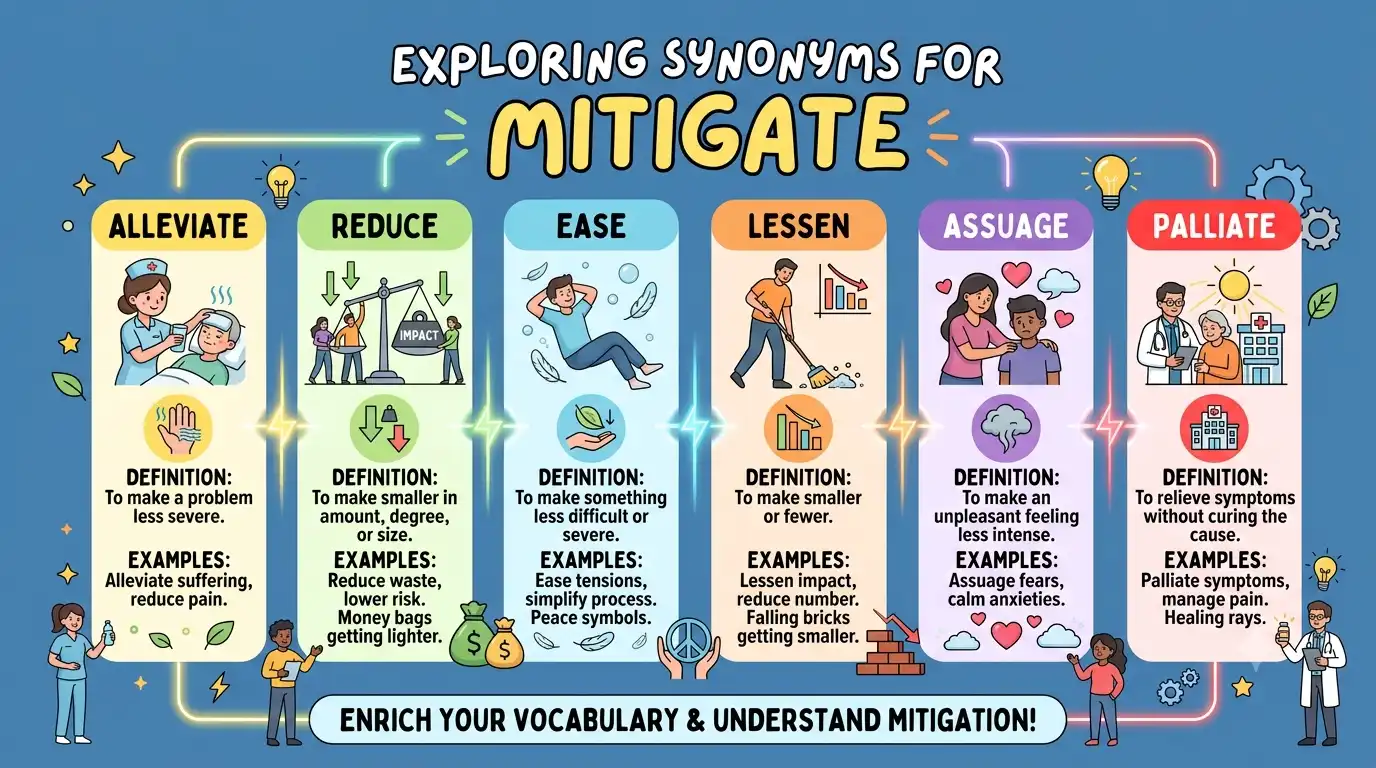
Finding exact synonyms for mitigate helps you describe solving problems, lessening harm, and easing pain with complete precision. Learning varied synonyms for mitigate allows you to explain risk management, personal care, and team strategies with confidence. Using strong synonyms for mitigate keeps your essays, blog posts, and daily talks clear and engaging.
Imagine a storm coming toward a small coastal town before a long holiday weekend. Local workers build sand walls and clear drain pipes to reduce flooding. Instead of calling every safety action simple “fixing,” using distinct words like alleviating, softening, or moderating paints a clear picture.
For instance, when a doctor gives medicine to reduce fever, you can say they are alleviating symptoms. Knowing exact synonyms for mitigate gives great benefits to four main groups:
- Students write better essays and explain risk factors clearly in school work.
- Bloggers craft engaging guides that keep readers reading for longer periods.
- Content writers rank higher on search engines using natural, clear vocabulary.
- Daily English users speak with confidence and handle tough talks calmly.
“Taking quick action to ease trouble turns big problems into manageable tasks.”
“A precise vocabulary helps you explain solutions, safety, and care with complete clarity.”
Linguistic Breakdown of “Mitigate”
Connotative Meaning
The word mitigate carries thoughtful, protective, helpful, and strategic connotations. It suggests making a bad situation less painful, reducing severe harm, or softening harsh impacts.
Etymology
- Origin: Derived from Latin mitigatus, past participle of mitigare (meaning to make soft or mild).
- Root Words: Mitis (soft, mild) + agere (to do or make).
- Historical Shift: Originally used to describe softening hard physical objects, then expanded to reducing human pain, and later applied to legal, environmental, and business risk management.
Pronunciation
- US (IPA): /ˈmɪt̬.ə.ɡeɪt/
- UK (IPA): /ˈmɪt.ɪ.ɡeɪt/
Syllables & Affixation Pattern
- Syllables: 3 syllables (mit-i-gate)
- Base Structure: Verb root mitigate
- Grammatical Patterns:
- Present Tense: Mitigate / Mitigates
- Past Tense: Mitigated
- Noun Form: Mitigation
Comparison Table: Common Synonyms for Mitigate
| Keyword | Meaning | Usage Type | Context |
| Alleviate | Making pain or hardship easier to bear | Formal / Caring | Health, Medicine, & Social Work |
| Reduce | Making something smaller in size or degree | Practical / General | Daily Tasks, Budgets, & Shopping |
| Lessen | Decreasing the strength or amount of something | Natural / Casual | Weather, Stress, & Everyday Worries |
| Ease | Freeing someone from pain, worry, or trouble | Gentle / Personal | Friendships, Family, & Caregiving |
| Soften | Making a harsh impact or bad news milder | Thoughtful / Emotional | Business Talks & Sensitive News |
| Moderate | Keeping something within safe or reasonable limits | Formal / Strategic | Weather, Debates, & Teamwork |
| Assuage | Calming strong fears or satisfying deep hunger | Formal / Expressive | Doubts, Guilt, & Emotional Care |
50 Best Synonyms for Mitigate
1. Alleviate
- Pronunciation: US /əˈliː.vi.eɪt/ | UK /əˈliː.vi.eɪt/
- Meaning: Alleviate means making pain, sorrow, or hard work easier to endure.
- Examples:
- Resting in a quiet room helps alleviate your headache.
- The new team helper helped alleviate our heavy workload.
2. Reduce
- Pronunciation: US /rɪˈduːs/ | UK /rɪˈdʒuːs/
- Meaning: Reduce means making something smaller in size, amount, or degree.
- Examples:
- Turning down the music will reduce the loud noise.
- Eating smaller meals helps reduce daily stomach pain.
3. Lessen
- Pronunciation: US /ˈles.ən/ | UK /ˈles.ən/
- Meaning: Lessen means making a bad feeling or risk become smaller.
- Examples:
- Wearing a warm coat will lessen your chance of catching a cold.
- Clear instructions help lessen student confusion during tests.
4. Ease
- Pronunciation: US /iːz/ | UK /iːz/
- Meaning: Ease means making pain, tension, or difficult work much lighter.
- Examples:
- Drinking warm tea helps ease a sore throat fast.
- Friendly words can ease anxiety before a big speech.
5. Soften
- Pronunciation: US /ˈsɑː.fən/ | UK /ˈsɒf.ən/
- Meaning: Soften means making bad news or hard impacts milder and less harsh.
- Examples:
- Thick floor mats soften the fall for young gymnasts.
- He tried to soften the bad news with a gentle smile.
6. Relieve
- Pronunciation: US /rɪˈliːv/ | UK /rɪˈliːv/
- Meaning: Relieve means removing or stopping pain, worry, or heavy duty.
- Examples:
- The doctor gave medicine to relieve her knee pain.
- Taking a short walk helps relieve daily stress.
7. Moderate
- Pronunciation: US /ˈmɑː.də.reɪt/ | UK /ˈmɒd.ər.eɪt/
- Meaning: Moderate means keeping strength or feelings within safe and calm limits.
- Examples:
- The cool sea breeze helped moderate the summer heat.
- Leaders must moderate their tone during heated discussions.
8. Assuage
- Pronunciation: US /əˈsweɪdʒ/ | UK /əˈsweɪdʒ/
- Meaning: Assuage means making unpleasant feelings like fear or guilt much calmer.
- Examples:
- Her kind words helped assuage his deep fears.
- The quiet apology worked to assuage her hurt feelings.
9. Diminish
- Pronunciation: US /dɪˈmɪn.ɪʃ/ | UK /dɪˈmɪn.ɪʃ/
- Meaning: Diminish means causing something to become smaller or less important.
- Examples:
- Cloud cover began to diminish the bright sunlight.
- Proper care will diminish the risk of machine damage.
10. Lighten
- Pronunciation: US /ˈlaɪ.tən/ | UK /ˈlaɪ.tən/
- Meaning: Lighten means making a heavy burden or sad mood less heavy.
- Examples:
- Sharing the farm chores will lighten our dad’s work.
- A good joke helps lighten the mood in a quiet room.
11. Curb
- Pronunciation: US /kɝːb/ | UK /kɜːb/
- Meaning: Curb means controlling or holding back something harmful from growing larger.
- Examples:
- New traffic laws help curb reckless driving on city streets.
- Drinking water helps curb your urge for sweet snacks.
12. Dampen
- Pronunciation: US /ˈdæm.pən/ | UK /ˈdæm.pən/
- Meaning: Dampen means making a feeling or sound less strong or active.
- Examples:
- Heavy rain could not dampen their excitement for the game.
- Special curtains help dampen street noise at night.
13. Muffle
- Pronunciation: US /ˈmʌf.əl/ | UK /ˈmʌf.əl/
- Meaning: Muffle means deadening a sound to make it quieter and less clear.
- Examples:
- He used a soft pillow to muffle his loud cough.
- Thick glass windows muffle the sounds of traffic outside.
14. Cushion
- Pronunciation: US /ˈkʊʃ.ən/ | UK /ˈkʊʃ.ən/
- Meaning: Cushion means protecting someone from the full force of a hard blow.
- Examples:
- Savings help cushion families against unexpected repair bills.
- Soft grass helps cushion the fall during soccer practice.
15. Pacify
- Pronunciation: US /ˈpæs.ə.faɪ/ | UK /ˈpæs.ɪ.faɪ/
- Meaning: Pacify means bringing peace and calm to an angry or upset person.
- Examples:
- The parent tried to pacify the crying baby with a toy.
- Fast service helped pacify the upset customer at the store.
16. Soothe
- Pronunciation: US /suːð/ | UK /suːð/
- Meaning: Soothe means gently calming pain, anger, or nervous feelings.
- Examples:
- Soft piano music helps soothe a tired mind.
- Aloe lotion works to soothe dry skin after swimming.
17. Quiet
- Pronunciation: US /ˈkwaɪ.ət/ | UK /ˈkwaɪ.ət/
- Meaning: Quiet means causing noise, fear, or public protest to become calm.
- Examples:
- The teacher raised her hand to quiet the noisy class.
- Good news helped quiet worries about company job losses.
18. Temper
- Pronunciation: US /ˈtem.pɚ/ | UK /ˈtem.pər/
- Meaning: Temper means making something less severe by adding a balancing force.
- Examples:
- You should temper your bold claims with clear facts.
- Justice must temper strict rules with real mercy.
19. Palliate
- Pronunciation: US /ˈpæl.i.eɪt/ | UK /ˈpæl.i.eɪt/
- Meaning: Palliate means reducing the bad effects of sickness without curing it.
- Examples:
- Medical care helps palliate symptoms for elder patients.
- Temporary fixes only palliate the deeper water leak issue.
20. Allay
- Pronunciation: US /əˈleɪ/ | UK /əˈleɪ/
- Meaning: Allay means putting fears, doubts, or pain completely at rest.
- Examples:
- The doctor’s report helped allay her medical worries.
- Facts and data will allay public fears about safety.
“Wise planning softens hard times long before the storm arrives.”
21. Subdue
- Pronunciation: US /səbˈduː/ | UK /səbˈdʒuː/
- Meaning: Subdue means bringing strong feelings or loud noise under quiet control.
- Examples:
- Soft lighting helped subdue the bright energy of the room.
- Firefighters worked hard to subdue the forest fire fast.
22. Minimize
- Pronunciation: US /ˈmɪn.ə.maɪz/ | UK /ˈmɪn.ɪ.maɪz/
- Meaning: Minimize means reducing something harmful down to the smallest possible amount.
- Examples:
- Wearing seatbelts helps minimize the risk of injury.
- Good planning will minimize wasted time during our move.
23. Lower
- Pronunciation: US /ˈloʊ.ɚ/ | UK /ˈləʊ.ər/
- Meaning: Lower means moving something down in level, price, or strength.
- Examples:
- Eating less salt helps lower high blood pressure.
- The store decided to lower prices for winter clothes.
24. Attenuate
- Pronunciation: US /əˈten.ju.eɪt/ | UK /əˈten.ju.eɪt/
- Meaning: Attenuate means weakening the force, effect, or value of something.
- Examples:
- Earplugs attenuate loud construction noises on the road.
- Distance can attenuate the strength of radio signals.
25. Tone down
- Pronunciation: US /toʊn daʊn/ | UK /təʊn daʊn/
- Meaning: Tone down means making speech or color less strong or harsh.
- Examples:
- Please tone down your loud voice while inside the library.
- The painter decided to tone down the bright yellow wall.
26. Cool down
- Pronunciation: US /kuːl daʊn/ | UK /kuːl daʊn/
- Meaning: Cool down means letting heat, anger, or excitement become quiet and calm.
- Examples:
- Stepping outside helps you cool down after an argument.
- Athletes stretch after running to cool down their muscles.
27. Slacken
- Pronunciation: US /ˈslæk.ən/ | UK /ˈslæk.ən/
- Meaning: Slacken means making speed, effort, or tension slower or looser.
- Examples:
- The rain began to slacken after two heavy hours.
- Do not slacken your pace when approaching the finish line.
28. Decrease
- Pronunciation: US /dɪˈkriːs/ | UK /dɪˈkriːs/
- Meaning: Decrease means making an amount or degree become steadily smaller.
- Examples:
- Regular exercise helps decrease the chance of heart trouble.
- Sales tend to decrease during rainy winter months.
29. Calm
- Pronunciation: US /kɑːm/ | UK /kɑːm/
- Meaning: Calm means stopping excitement, anger, or storm activity.
- Examples:
- Deep breathing can calm your heart rate quickly.
- The captain worked hard to calm frightened boat passengers.
30. Mollify
- Pronunciation: US /ˈmɑː.lə.faɪ/ | UK /ˈmɒl.ɪ.faɪ/
- Meaning: Mollify means softening anger and making someone feel far less upset.
- Examples:
- The manager gave a gift card to mollify the customer.
- A simple apology helped mollify his hurt feelings.
31. Smooth over
- Pronunciation: US /smuːð ˈoʊ.vɚ/ | UK /smuːð ˈəʊ.vər/
- Meaning: Smooth over means making arguments or problems seem minor and settled.
- Examples:
- She tried to smooth over the misunderstanding between friends.
- Diplomat team talks helped smooth over trade issues fast.
32. Abate
- Pronunciation: US /əˈbeɪt/ | UK /əˈbeɪt/
- Meaning: Abate means becoming less strong or widespread over time.
- Examples:
- We waited for the storm wind to abate before driving.
- The loud noise began to abate as night fell.
33. Mute
- Pronunciation: US /mjuːt/ | UK /mjuːt/
- Meaning: Mute means silencing or dampening sound, color, or deep emotion.
- Examples:
- Please mute your microphone while the speaker presents.
- Warm grey coats mute bright primary outfit colors.
34. Check
- Pronunciation: US /tʃek/ | UK /tʃek/
- Meaning: Check means stopping or slowing down the growth of something harmful.
- Examples:
- Early treatments check the spread of garden pests.
- Good habits help check the growth of bad spending.
35. Restrain
- Pronunciation: US /rɪˈstreɪn/ | UK /rɪˈstreɪn/
- Meaning: Restrain means keeping an action or emotion under firm control.
- Examples:
- He had to restrain his anger during the long debate.
- Fence barriers restrain dogs from jumping into gardens.
36. Blunt
- Pronunciation: US /blʌnt/ | UK /blʌnt/
- Meaning: Blunt means reducing the sharp point, force, or edge of an impact.
- Examples:
- Thick rubber pads blunt the impact of heavy tools.
- Kind words help blunt the sharp sting of criticism.
37. Dull
- Pronunciation: US /dʌl/ | UK /dʌl/
- Meaning: Dull means making physical pain or sharp feelings less intense.
- Examples:
- Pain pills help dull the ache after tooth surgery.
- Soft music can dull the noise of city traffic.
38. Ease up
- Pronunciation: US /iːz ʌp/ | UK /iːz ʌp/
- Meaning: Ease up means reducing speed, pressure, or harsh effort gradually.
- Examples:
- Drivers should ease up on gas pedals near school zones.
- The rain started to ease up as morning arrived.
39. Soft-pedal
- Pronunciation: US /ˌsɑːftˈped.əl/ | UK /ˌsɒftˈped.əl/
- Meaning: Soft-pedal means treating an issue lightly so it seems less serious.
- Examples:
- The news host tried to soft-pedal the budget losses.
- Do not soft-pedal safety rules in manufacturing plants.
40. Moderate down
- Pronunciation: US /ˈmɑː.də.reɪt daʊn/ | UK /ˈmɒd.ər.eɪt daʊn/
- Meaning: Moderate down means lowering energy levels to reach a calm state.
- Examples:
- Athletes moderate down their pace during warmups.
- We must moderate down expectations for quick earnings.
41. Take the edge off
- Pronunciation: US /teɪk ðə edʒ ɑːf/ | UK /teɪk ði e dʒ ɒf/
- Meaning: Take the edge off means making sharp pain, hunger, or cold milder.
- Examples:
- A light snack will take the edge off your hunger.
- A hot drink helps take the edge off chilly morning air.
42. Cut back
- Pronunciation: US /kʌt bæk/ | UK /kʌt bæk/
- Meaning: Cut back means reducing expenses, size, or food consumption carefully.
- Examples:
- Families try to cut back on dining out to save cash.
- Pruning trees helps cut back dead branches safely.
43. De-escalate
- Pronunciation: US /ˌdiːˈes.kə.leɪt/ | UK /ˌdiːˈes.kə.leɪt/
- Meaning: De-escalate means reducing the intensity of a conflict or anger.
- Examples:
- Calm words help de-escalate heated arguments fast.
- Guards worked to de-escalate crowd tension at gates.
44. Quiet down
- Pronunciation: US /ˈkwaɪ.ət daʊn/ | UK /ˈkwaɪ.ət daʊn/
- Meaning: Quiet down means becoming peaceful, still, or less noisy over time.
- Examples:
- The wind began to quiet down after sunset.
- Students quiet down when the teacher enters class.
45. Shield
- Pronunciation: US /ʃiːld/ | UK /ʃiːld/
- Meaning: Shield means protecting someone from harm, danger, or painful impact.
- Examples:
- Sunglasses shield your eyes from bright sun glare.
- Good roofs shield homes from heavy mountain rain.
46. Neutralize
- Pronunciation: US /ˈnuː.trə.laɪz/ | UK /ˈnjuː.trə.laɪz/
- Meaning: Neutralize means stopping the harmful effect of something completely.
- Examples:
- Baking soda helps neutralize strong stove odor.
- Cold water will neutralize acid burns on skin.
47. Suppress
- Pronunciation: US /səˈpres/ | UK /səˈpres/
- Meaning: Suppress means preventing a feeling, cough, or action from developing.
- Examples:
- Cough drops help suppress dry throat tickles fast.
- He tried to suppress a yawn during the meeting.
48. Settle
- Pronunciation: US /ˈset.əl/ | UK /ˈset.əl/
- Meaning: Settle means bringing order, calmness, or resolution to upset feelings.
- Examples:
- Mint tea can settle an upset stomach quickly.
- Talking things out will settle family disputes easily.
49. Slack
- Pronunciation: US /slæk/ | UK /slæk/
- Meaning: Slack means loosening speed, tightness, or strict pressure.
- Examples:
- Rope workers slack the lines to ease tension.
- Rain cause farm work to slack during winter.
50. Dilute
- Pronunciation: US /daɪˈluːt/ | UK /daɪˈluːt/
- Meaning: Dilute means making a liquid or message weaker by adding items.
- Examples:
- Add extra water to dilute strong lemon juice.
- Too many details dilute the main story idea.
Antonyms of “Mitigate”
Knowing opposite words helps you describe making problems worse or increasing harm:
- Aggravate: Making an injury, problem, or offense far worse than before.
- Exacerbate: Increasing the severity, bitterness, or danger of a situation.
- Intensify: Making something grow stronger, sharper, or more extreme.
- Worsen: Causing a bad health state or problem to decline further.
- Heighten: Raising the level of fear, tension, or public concern.
- Inflame: Exciting strong anger, swelling, or violent emotion in people.
Prototype Meaning & Categorization of “Mitigate”
The core concept of mitigate centers on lessening severity, calming distress, protecting health, and reducing risk. These 50 synonyms fall into four natural operational groups:
- Easing Pain & Health Support: Alleviate, relieve, soothe, ease, assuage, palliate, allay, dull, take the edge off, settle, neutralize.
- Reducing Size & Control: Reduce, lessen, diminish, curb, minimize, lower, decrease, cut back, check, restrain, suppress, dilute.
- Softening Force & Protection: Soften, cushion, dampen, muffle, temper, attenuate, blunt, shield, soft-pedal.
- Calming Anger & Conflict: Moderate, pacify, quiet, subdue, tone down, cool down, slacken, calm, mollify, smooth over, abate, mute, ease up, moderate down, de-escalate, quiet down, slack.
Frequently Asked Questions (FAQs)
1. What is the most common formal synonym for “mitigate”?
In formal and professional writing, words like “alleviate,” “diminish,” or “moderate” work best. They show clear purpose without sounding informal.
2. What is the difference between “mitigate” and “alleviate”?
Mitigate usually focuses on reducing risks, harsh impacts, or damages. Alleviate focuses directly on easing physical pain, mental suffering, or personal hardship.
3. Which synonym for “mitigate” is best for business reports?
In corporate risk settings, choices like “minimize,” “de-escalate,” “reduce,” or “cushion” sound professional and focused on results.
4. Can “pacify” be used for physical injuries?
No, “pacify” refers strictly to calming angry people, upset children, or loud social groups through peaceful actions.
5. Is “take the edge off” appropriate for formal essays?
No, “take the edge off” is a conversational idiom. Use “mitigate,” “alleviate,” or “attenuate” when drafting academic essays.
6. How does using varied synonyms for “mitigate” improve SEO?
Using precise synonyms prevents keyword overuse, satisfies diverse user search intent, deepens semantic topic relevance, and keeps readers reading longer.
Conclusion
Expanding your collection of synonyms for mitigate brings clarity, gentleness, and strength to your everyday communication. Replacing repetitive terms with exact choices like alleviate, soften, assuage, or de-escalate ensures your message lands with real power every single time.
Whether you write business emails, publish online blogs, draft class essays, or speak in daily talks, choosing precise vocabulary builds instant confidence. Bright, simple language removes fluff and turns basic sentences into clear statements of care and strategy. Start practicing these 50 synonyms today to elevate your English writing and speaking skills!
“Clear words help ease worries and bring quiet comfort to every listener.”
“Mastering exact vocabulary turns simple thoughts into powerful expressions.”

Robert Hayes is an ESL educator and curriculum developer with over nine years of experience teaching English to beginners and intermediate learners across multiple countries ( Biography ).