Finding dynamic synonyms for indecisive helps you describe hesitation and mixed feelings with exact clarity. When you search for synonyms for indecisive, you learn how to talk about people who struggle to make firm choices. Using different synonyms for indecisive makes your daily conversations, essays, and business messages far more engaging.
Standing in front of a giant dinner menu at a crowded restaurant can feel overwhelming. You look at pizza, then pasta, then salad, changing your mind every few seconds while the waiter waits patiently. This simple moment is a classic real-life example of feeling indecisive.
Learning these word options helps people across many areas of life:
- Students: Improve your essay scores by replacing repeated words with rich vocabulary.
- Bloggers: Keep your readers engaged with fresh, expressive language on every page.
- Content Writers: Craft empathetic emails, distinct character traits, and clear product reviews.
- Daily English Users: Pick the exact right word for casual talks, family repairs, or office updates.
“When you have to make a choice and don’t make it, that is in itself a choice.” – William James
“Indecision is the thief of opportunity.” – Marcus Tullius Cicero
Technical & Linguistic Breakdown of “Indecisive”
Connotative Meaning
The term indecisive usually carries a mildly negative or neutral connotation. It suggests a lack of confidence, weakness, or trouble making up one’s mind. However, in careful or critical contexts, it can carry a positive or defensive connotation when it shows caution and careful thought before acting.
Etymology of “Indecisive”
- Prefix (In-): Derived from Latin in- (meaning “not” or “opposite of”).
- Root (Decide): Derived from Latin decidere (meaning “to cut off” or “determine”).
- Suffix (-ive): Derived from Latin -ivus (forming adjectives that express a tendency or quality).
- Historical Emergence: Formed in English during the 17th century to describe something that does not settle a question or a person who cannot choose.
Pronunciation (IPA)
- US IPA: /ˌɪndɪˈsaɪsɪv/
- UK IPA: /ˌɪndɪˈsaɪsɪv/
Syllables & Structure
- Syllables: 4 Syllables (in – de – ci – sive)
- Stress Pattern: Primary stress on the third syllable (in-de-CI-sive).
Affixation Pattern
- Base Form: Adjective (indecisive)
- Noun Derivative: Indecisiveness / Indecision
- Adverb Derivative: Indecisively
- Opposite Form: Decisive
Quick Comparison Table of Key Synonyms
| Keyword | Meaning | Usage Type | Context |
| Hesitant | Pausing before acting because of doubt | Casual / Formal | Daily choices, speaking, public events |
| Irresolute | Lacking firm purpose or determination | Formal / Literary | Career path, leadership, major plans |
| Wavering | Changing between two choices constantly | Emotional / Casual | Relationships, personal choices |
| Ambivalent | Having two opposing feelings at once | Professional / Emotional | Work decisions, complex feelings |
| Wishy-washy | Weak and lacking strong character or tone | Casual / Informal | Personal opinions, casual plans |
| Dithering | Acting nervously and failing to decide | Informal / Casual | Shopping, quick tasks, daily chores |
| Tentative | Done without full confidence or certainty | Professional / Formal | Work schedules, initial offers |
50 Best Synonyms for Indecisive
1. Hesitant
- Pronunciation: US: /ˈhezɪtənt/ | UK: /ˈhezɪtənt/
- Meaning: You pause before acting because you feel unsure.
- Examples:
- She felt hesitant about stepping onto the stage.
- He gave a hesitant answer to the teacher’s question.
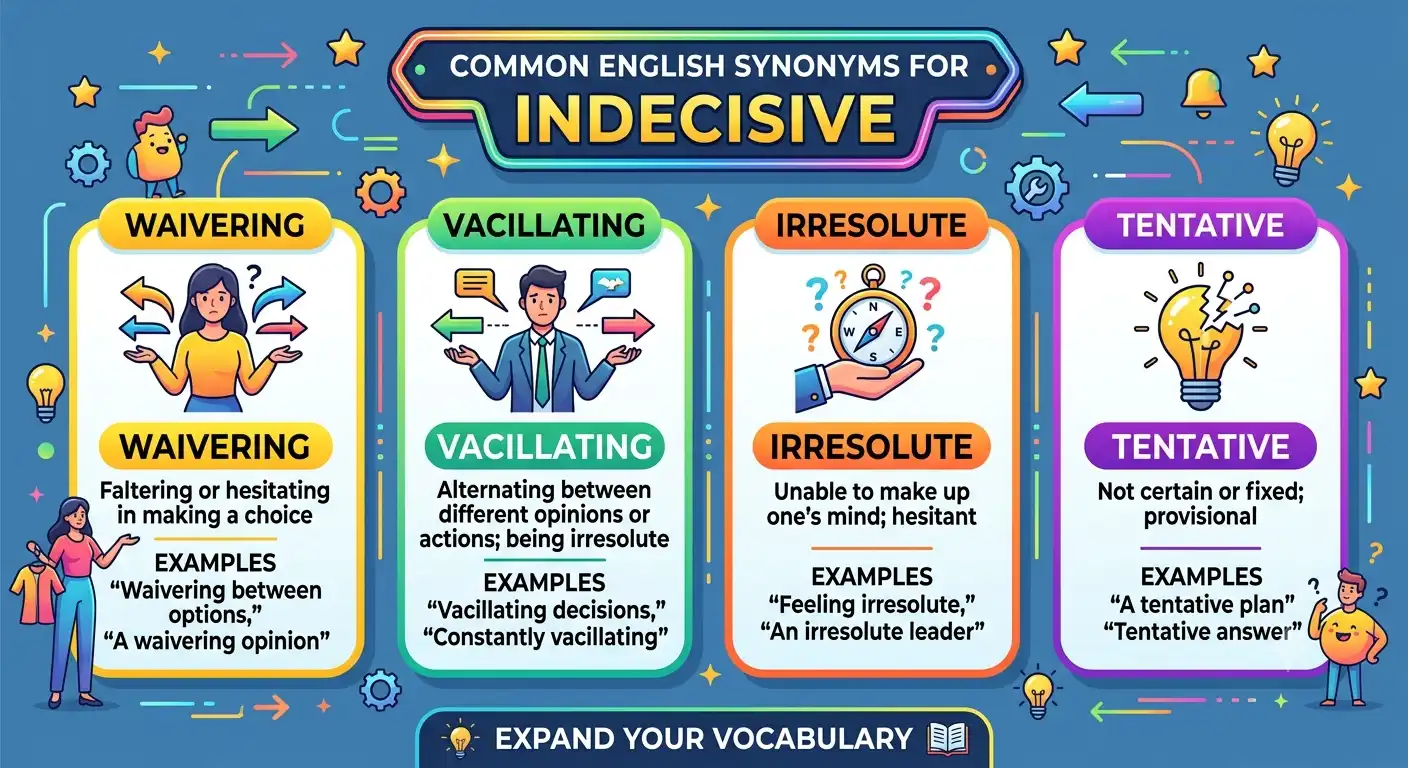
2. Irresolute
- Pronunciation: US: /ɪˈrezəluːt/ | UK: /ɪˈrezəluːt/
- Meaning: You lack the firm purpose needed to make a choice.
- Examples:
- The irresolute leader could not make a quick rule.
- She remained irresolute about moving to a new city.
3. Uncertain
- Pronunciation: US: /ʌnˈsɜːrtn/ | UK: /ʌnˈsɜːtn/
- Meaning: You do not know the exact answer or path forward.
- Examples:
- Mark felt uncertain about which path to take.
- They are uncertain about tomorrow’s weather.
4. Unsure
- Pronunciation: US: /ˌʌnˈʃʊr/ | UK: /ˌʌnˈʃɔː/
- Meaning: You lack full confidence in what you think or do.
- Examples:
- She was unsure about buying the red dress.
- He gave an unsure nod to his friend.
5. Wavering
- Pronunciation: US: /ˈweɪvərɪŋ/ | UK: /ˈweɪvərɪŋ/
- Meaning: You shift back and forth between two different opinions.
- Examples:
- His wavering support hurt the team’s chance to win.
- She stood wavering near the front door.
6. Doubtful
- Pronunciation: US: /ˈdaʊtfl/ | UK: /ˈdaʊtfl/
- Meaning: You feel strong doubt about a statement or plan.
- Examples:
- He was doubtful about the new safety rule.
- She gave him a doubtful look across the room.
7. Vacillating
- Pronunciation: US: /ˈvæsəleɪtɪŋ/ | UK: /ˈvæsəleɪtɪŋ/
- Meaning: You keep changing your mind from one thought to another.
- Examples:
- Her vacillating mood made planning the trip hard.
- The boss remained vacillating on the budget.
8. Undecided
- Pronunciation: US: /ˌʌndɪˈsaɪdɪd/ | UK: /ˌʌndɪˈsaɪdɪd/
- Meaning: You have not made a final choice yet.
- Examples:
- Voters were undecided until the very last day.
- She is undecided about her college major.
9. Ambivalent
- Pronunciation: US: /æmˈbɪvələnt/ | UK: /æmˈbɪvələnt/
- Meaning: You have mixed or opposing feelings about something.
- Examples:
- He felt ambivalent about accepting the new job.
- She has an ambivalent feeling about winter weather.
10. Tentative
- Pronunciation: US: /ˈtentətɪv/ | UK: /ˈtentətɪv/
- Meaning: You plan something provisionally without full certainty.
- Examples:
- They made a tentative plan to meet for lunch.
- She took a tentative step onto the thin ice.
11. Divided
- Pronunciation: US: /dɪˈvaɪdɪd/ | UK: /dɪˈvaɪdɪd/
- Meaning: You feel pulled in two different directions at once.
- Examples:
- Her loyalty was divided between her two best friends.
- The committee was divided on the main vote.
12. Fickle
- Pronunciation: US: /ˈfɪkl/ | UK: /ˈfɪkl/
- Meaning: You change your feelings or interests very quickly.
- Examples:
- Fashion trends can be very fickle each year.
- He was too fickle to stick with one hobby.
13. Unsettled
- Pronunciation: US: /ʌnˈsetld/ | UK: /ʌnˈsetld/
- Meaning: You feel calm and quiet doubt that prevents a firm decision.
- Examples:
- The sudden news left everyone feeling unsettled.
- They reached an unsettled agreement late at night.
14. Fluctuating
- Pronunciation: US: /ˈflʌktʃueɪtɪŋ/ | UK: /ˈflʌktʃueɪtɪŋ/
- Meaning: Your opinions move up and down continuously.
- Examples:
- Gas prices remain fluctuating every week.
- Her fluctuating energy made work difficult today.
15. Halfhearted
- Pronunciation: US: /ˌhæfˈhɑːrtɪd/ | UK: /ˌhɑːfˈhɑːtɪd/
- Meaning: You act without real effort or strong interest.
- Examples:
- He gave a halfhearted wave as the bus left.
- She made a halfhearted attempt to clean her desk.
16. Wishy-washy
- Pronunciation: US: /ˈwɪʃi wɑːʃi/ | UK: /ˈwɪʃi wɒʃi/
- Meaning: You lack strong determination or clear direction.
- Examples:
- Nobody likes a wishy-washy answer during an interview.
- Her wishy-washy tone confused the group.
17. Dithering
- Pronunciation: US: /ˈdɪðərɪŋ/ | UK: /ˈdɪðərɪŋ/
- Meaning: You waste time acting nervous instead of choosing.
- Examples:
- Stop dithering and pick a movie to watch.
- He was dithering outside the store door.
18. Faltering
- Pronunciation: US: /ˈfɔːltərɪŋ/ | UK: /ˈfɔːltərɪŋ/
- Meaning: You lose strength or purpose during an action.
- Examples:
- She spoke in a quiet, faltering voice.
- The runner made a faltering step near the finish line.
19. Shilly-shallying
- Pronunciation: US: /ˈʃɪli ʃæliɪŋ/ | UK: /ˈʃɪli ʃæliɪŋ/
- Meaning: You spend time taking forever to make up your mind.
- Examples:
- We cannot spend all day shilly-shallying on lunch.
- His shilly-shallying cost the team valuable time.
20. Double-minded
- Pronunciation: US: /ˌdʌbl ˈmaɪndɪd/ | UK: /ˌdʌbl ˈmaɪndɪd/
- Meaning: You hold two conflicting opinions at the exact same time.
- Examples:
- Being double-minded makes choosing a career hard.
- She felt double-minded about moving away.
21. Questioning
- Pronunciation: US: /ˈkwestʃənɪŋ/ | UK: /ˈkwestʃənɪŋ/
- Meaning: You feel doubt about the truth or value of something.
- Examples:
- He had a questioning look on his face.
- She gave a questioning reply to the proposal.
22. Suspended
- Pronunciation: US: /səˈspendɪd/ | UK: /səˈspendɪd/
- Meaning: You keep a decision waiting without taking final action.
- Examples:
- The court kept the final ruling suspended.
- Judgment remains suspended until more facts appear.
23. Debating
- Pronunciation: US: /dɪˈbeɪtɪŋ/ | UK: /dɪˈbeɪtɪŋ/
- Meaning: You think carefully about different options before deciding.
- Examples:
- She was debating whether to buy the used car.
- They spent hours debating the dinner plan.
24. Confused
- Pronunciation: US: /kənˈfjuːzd/ | UK: /kənˈfjuːzd/
- Meaning: You are unable to think clearly or understand a choice.
- Examples:
- The complex instructions left him completely confused.
- She looked confused when faced with two roads.
25. Perplexed
- Pronunciation: US: /pərˈplekst/ | UK: /pəˈplekst/
- Meaning: You feel puzzled because something is hard to understand.
- Examples:
- The scientist felt perplexed by the unexpected test results.
- She sat with a perplexed smile on her face.
“Uncertainty is the only certainty there is, and knowing how to live with insecurity is the only security.” – John Allen Paulos
26. Ambiguous
- Pronunciation: US: /æmˈbɪɡjuəs/ | UK: /æmˈbɪɡjuəs/
- Meaning: You give a statement that has more than one clear meaning.
- Examples:
- His ambiguous message left everyone wondering.
- She gave an ambiguous sign with a nod.
27. Equivocal
- Pronunciation: US: /ɪˈkwɪvəkəl/ | UK: /ɪˈkwɪvəkəl/
- Meaning: You use unclear words on purpose to avoid choosing.
- Examples:
- The manager offered an equivocal answer to the staff.
- Her equivocal stance upset both sides of the group.
28. Puzzled
- Pronunciation: US: /ˈpʌzld/ | UK: /ˈpʌzld/
- Meaning: You feel confused because you do not understand why something happens.
- Examples:
- He looked puzzled when the key did not fit the lock.
- She gave a puzzled reply to his sudden question.
29. Agnostic
- Pronunciation: US: /æɡˈnɑːstɪk/ | UK: /æɡˈnɒstɪk/
- Meaning: You hold no firm belief or preference on a subject.
- Examples:
- The engineer was agnostic about which tool to use.
- She remained agnostic on the political debate.
30. Torn
- Pronunciation: US: /tɔːrn/ | UK: /tɔːn/
- Meaning: You feel pulled strongly between two attractive choices.
- Examples:
- He was torn between staying home and going out.
- She felt torn about which friend to invite.
31. Fence-sitting
- Pronunciation: US: /ˈfens sɪtɪŋ/ | UK: /ˈfens sɪtɪŋ/
- Meaning: You refuse to take a side in an argument or choice.
- Examples:
- His constant fence-sitting annoyed both political teams.
- Stop your fence-sitting and vote for one plan.
32. Variable
- Pronunciation: US: /ˈveriəbl/ | UK: /ˈveəriəbl/
- Meaning: You change your choices frequently based on conditions.
- Examples:
- Her mood was variable throughout the morning.
- The wind direction remained variable all afternoon.
33. Uncommitted
- Pronunciation: US: /ˌʌnkəˈmɪtɪd/ | UK: /ˌʌnkəˈmɪtɪd/
- Meaning: You refuse to promise your support to any side.
- Examples:
- The player remained uncommitted to any university.
- They are uncommitted to the current project plan.
34. Unfixed
- Pronunciation: US: /ˌʌnˈfɪkst/ | UK: /ˌʌnˈfɪkst/
- Meaning: You leave a choice or arrangement open to change.
- Examples:
- The date for the party remains unfixed for now.
- Her schedule was unfixed during the holiday week.
35. Unresolved
- Pronunciation: US: /ˌʌnrɪˈzɑːlvd/ | UK: /ˌʌnrɪˈzɒlvd/
- Meaning: You leave a problem without a clear solution or ending.
- Examples:
- The main argument was left unresolved at the meeting.
- She felt uneasy with unresolved personal questions.
36. Changeable
- Pronunciation: US: /ˈtʃeɪndʒəbl/ | UK: /ˈtʃeɪndʒəbl/
- Meaning: You easily shift from one opinion or choice to another.
- Examples:
- Spring weather is famously changeable in this valley.
- His changeable mind made ordering food difficult.
37. Inconclusive
- Pronunciation: US: /ˌɪnkənˈkluːsɪv/ | UK: /ˌɪnkənˈkluːsɪv/
- Meaning: You do not produce a clear or final result.
- Examples:
- The blood test results proved inconclusive today.
- They ended the meeting with an inconclusive vote.
38. Pendulous
- Pronunciation: US: /ˈpendʒələs/ | UK: /ˈpendjələs/
- Meaning: You hang loosely and swing back and forth in choice.
- Examples:
- His pendulous thoughts swung between hope and fear.
- She kept a pendulous mind on the investment decision.
39. Noncommittal
- Pronunciation: US: /ˌnɑːnkəˈmɪtl/ | UK: /ˌnɒnkəˈmɪtl/
- Meaning: You give a neutral response that avoids picking a side.
- Examples:
- The official gave a noncommittal answer to news reporters.
- She offered a noncommittal shrug to his offer.
40. Hesitative
- Pronunciation: US: /ˈhezɪteɪtɪv/ | UK: /ˈhezɪtətɪv/
- Meaning: You show a habitual tendency to pause before taking action.
- Examples:
- He took a hesitative step forward into the dark hallway.
- Her hesitative style delayed the whole project.
41. Skeptical
- Pronunciation: US: /ˈskeptɪkl/ | UK: /ˈskeptɪkl/
- Meaning: You doubt whether a claim or choice is really good.
- Examples:
- She was skeptical about the fast claims in the ad.
- He gave a skeptical nod to the salesman’s pitch.
42. Hovering
- Pronunciation: US: /ˈhʌvərɪŋ/ | UK: /ˈhɒvərɪŋ/
- Meaning: You remain near a choice without picking it fully.
- Examples:
- He was hovering between two great career options.
- She stood hovering near the checkout line.
43. Unpersuaded
- Pronunciation: US: /ˌʌnpərˈsweɪdɪd/ | UK: /ˌʌnpəˈsweɪdɪd/
- Meaning: You remain unconvinced by arguments given to you.
- Examples:
- The judge remained unpersuaded by the lawyer’s plea.
- She left the store unpersuaded by the sales pitch.
44. Oscillating
- Pronunciation: US: /ˈɑːsɪleɪtɪŋ/ | UK: /ˈɒsɪleɪtɪŋ/
- Meaning: You swing back and forth repeatedly between choices.
- Examples:
- His opinions were oscillating like a pendulum.
- She felt oscillating feelings about moving abroad.
45. Capricious
- Pronunciation: US: /kəˈprɪʃəs/ | UK: /kəˈprɪʃəs/
- Meaning: You make sudden and unpredictable changes of mind.
- Examples:
- The king was known for his capricious rules.
- Her capricious taste made shopping exhausting.
46. Unsteady
- Pronunciation: US: /ʌnˈstedi/ | UK: /ʌnˈstedi/
- Meaning: You lack firm balance or constant strength in your choice.
- Examples:
- He took an unsteady step toward the microphone.
- Her unsteady focus made work take twice as long.
47. Undetermined
- Pronunciation: US: /ˌʌndɪˈtɜːrmɪnd/ | UK: /ˌʌndɪˈtɜːmɪnd/
- Meaning: You have not settled or calculated a choice yet.
- Examples:
- The exact cause of the crash remains undetermined.
- Their travel plans stay undetermined for summer.
48. Disoriented
- Pronunciation: US: /dɪsˈɔːrientɪd/ | UK: /dɪsˈɔːrientɪd/
- Meaning: You lose your sense of direction or mental sense.
- Examples:
- He felt disoriented when he woke up in the dark room.
- The huge maze left the visitors completely disoriented.
49. Split
- Pronunciation: US: /splɪt/ | UK: /splɪt/
- Meaning: You feel evenly divided in your choice or support.
- Examples:
- The jury was split on the final decision.
- She felt split between buying shoes or a jacket.
50. Volatile
- Pronunciation: US: /ˈvɑːlətl/ | UK: /ˈvɒlətaɪl/
- Meaning: Your opinions change rapidly and unpredictably.
- Examples:
- Stock market prices were very volatile this month.
- His volatile mood kept everyone on guard.
Antonyms of “Indecisive”
Understanding direct opposites of “indecisive” helps you contrast firm action with hesitation:
- Decisive: Able to make clear decisions quickly and confidently.
- Resolute: Admirable in maintaining a firm, unwavering purpose.
- Determined: Firmly focused on reaching a goal without giving up.
- Certain: Completely confident about a fact or choice without doubt.
- Firm: Unyielding and strong when making decisions or taking a stance.
- Unwavering: Remaining steady, strong, and constant at all times.
Prototype Meaning and Categorization
To master synonyms for indecisive, it helps to understand the core prototype of indecision and organize terms into clear categories based on intent, expression style, and social context:
Core Prototype Definition
At its center, being indecisive refers to a mental or emotional state where a person struggles to choose between two or more options due to fear of making a mistake, lack of information, or conflicting desires.
1. Temporary Hesitation (Short-Term Pausing)
This category includes words used when someone pauses briefly before taking action or speaking.
- Primary Focus: Brief pauses and momentary doubt.
- Key Synonyms: Hesitant, tentative, doubtful, unsure, uncertain.
- Common Contexts: Answering questions, daily shopping, casual talks, and fast choices.
2. Emotional Conflict (Opposing Internal Feelings)
This category involves terms used when a person holds strong, equal feelings for two opposite choices at the same time.
- Primary Focus: Deep internal conflict and emotional division.
- Key Synonyms: Ambivalent, torn, divided, double-minded, split.
- Common Contexts: Career choices, personal relationships, moving to a new city, and life goals.
3. Continuous Mind-Changing (Fluctuating Decisions)
These terms describe people whose thoughts swing back and forth repeatedly without landing on a conclusion.
- Primary Focus: Unsteady, changing thoughts and nervous delaying.
- Key Synonyms: Wavering, vacillating, dithering, shilly-shallying, oscillating, fluctuating.
- Common Contexts: Group planning, long debates, menu choices, and shopping trips.
4. Strategic or Official Delay (Formal Neutrality)
This category applies when someone intentionally avoids picking a side to protect themselves or stay neutral.
- Primary Focus: Deliberate neutrality, legal caution, or polite hedging.
- Key Synonyms: Fence-sitting, noncommittal, uncommitted, equivocal, suspended, unresolved.
- Common Contexts: Political debates, corporate PR releases, legal reviews, and formal interviews.
Frequently Asked Questions (FAQs)
1. What is the most common synonym for indecisive?
The most common daily synonyms for indecisive are unsure, uncertain, and hesitant.
2. Is “wishy-washy” formal or informal?
The term wishy-washy is an informal slang word. It is best used in casual conversations rather than academic writing or business emails.
3. What is the difference between “indecisive” and “ambivalent”?
Being indecisive means you cannot pick a choice. Being ambivalent means you have strong, opposite feelings about an option at the same time.
4. Can “tentative” be used in business settings?
Yes, tentative is a great professional word (e.g., “We set a tentative date for the meeting”).
5. What is a good formal replacement for “indecisive”?
In formal writing, words like irresolute, vacillating, inconclusive, or noncommittal work very well.
6. How do I practice using these vocabulary words every day?
Try picking 2 to 3 new words every week and use them in your emails, journal notes, or daily family conversations.
Conclusion
Expanding your vocabulary with dynamic synonyms for indecisive significantly boosts your overall English skills. Selecting exact words allows you to express subtle shades of meaning with precision. Whether you are writing an academic paper, drafting a professional email, posting on a blog, or chatting with friends, using rich word options makes your point crystal clear.
Replacing repetitive phrases with alternatives like hesitant, ambivalent, irresolute, or tentative keeps your writing fresh and engaging. Consistent practice transforms your vocabulary into an effortless tool for effective communication. Start using 2 to 3 new words this week in your daily conversations, emails, and notes.
“Doubt kills more dreams than failure ever will.” – Suzy Kassem
“In any moment of decision, the best thing you can do is the right thing. The worst thing you can do is nothing.” – Theodore Roosevelt

Robert Hayes is an ESL educator and curriculum developer with over nine years of experience teaching English to beginners and intermediate learners across multiple countries ( Biography ).