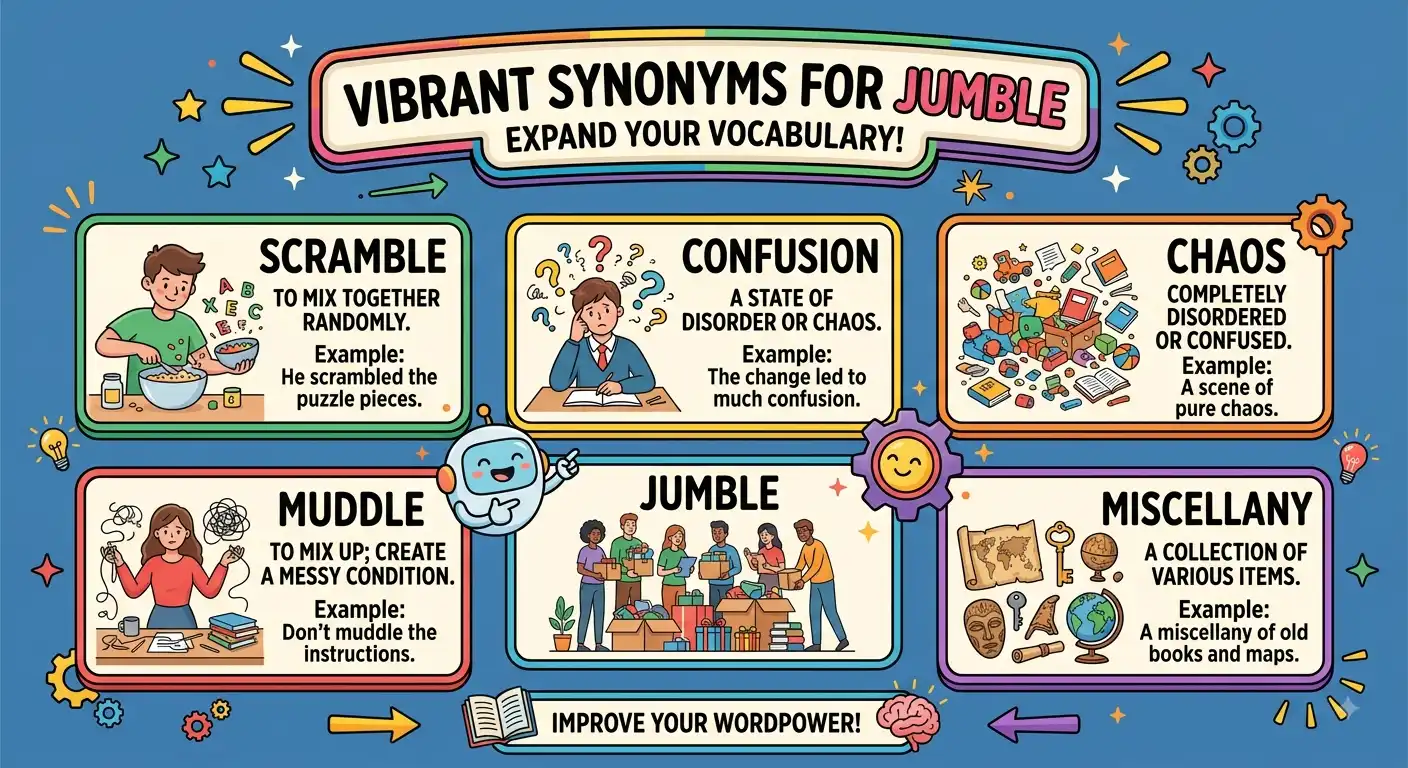
Finding accurate synonyms for jumble helps you describe messy items, confused thoughts, and mixed-up ideas clearly. Learning diverse synonyms for jumble gives you better words to express disorganization in your daily work and writing. Using precise synonyms for jumble keeps your language clear and makes your sentences easy to read.
Imagine walking into a room where clothes, books, and toys cover the entire floor. Calling every messy situation a simple “mess” makes your speech feel plain and repetitive. Switching to exact terms like “clutter,” “tangle,” or “muddle” adds instant detail to your descriptions.
For instance, when your computer desktop is full of random files, you can call it a digital hodgepodge. Choosing specific words like “disorder” or “mixture” helps listeners picture the exact scene right away.
The term jumble means an untidy collection of things or a confused state of mind. Expanding your knowledge of synonyms for jumble supports many groups of readers:
- Students write clearer essays when describing chaotic historical events or stories.
- Bloggers create vivid descriptions that keep readers engaged.
- Content writers improve search rankings by using varied, natural phrasing.
- Daily English users speak with confidence and clarity in everyday conversations.
“Clear word choices turn chaotic descriptions into simple, beautiful statements.”
“A rich vocabulary helps you describe mixed-up situations with exact precision.”
Linguistic Breakdown of “Jumble”
Connotative Meaning
The word jumble carries neutral to mildly negative connotations. It implies lack of order, temporary confusion, or an unstructured mix of items.
Etymology
- Origin: Derived from Middle English jumbelen (meaning to mix together confusedly).
- Root Words: Likely a blend of jump and tumble.
- Historical Shift: First used in the 1500s to describe physical shaking, later evolving to mean any messy mix of physical items or thoughts.
Pronunciation
- US (IPA): /ˈdʒʌm.bəl/
- UK (IPA): /ˈdʒʌm.bəl/
Syllables & Affixation Pattern
- Syllables: 2 syllables (jum-ble)
- Base Structure: Root noun/verb jumble
- Grammatical Patterns:
- Active Verb Form: Jumbles / Jumbled / Jumbling
- Noun Form: A jumble of things
- Adjective Form: Jumbled
Comparison Table: Common Synonyms for Jumble
| Keyword | Meaning | Usage Type | Context |
| Clutter | An untidy collection of objects | Casual / Practical | Bedrooms, Desks, & Home Spaces |
| Disorder | A state of missing organization | Formal / Analytical | Classrooms, Offices, & Reports |
| Muddle | A confused or messy situation | Conversational | Daily Plans, Thoughts, & Schedule |
| Tangle | A twisted mass of threads or lines | Descriptive | Wires, Hair, & Ropes |
| Hodgepodge | A random mix of different items | Expressive / Fun | Crafts, Recipes, & Decor |
| Chaos | Total lack of order or control | Dramatic / Serious | Traffic, Storms, & Big Events |
| Scramble | A hurried mix or struggle | Dynamic | Sports, Rush Hour, & Games |
50 Best Synonyms for Jumble
1. Muddle
- Pronunciation: US /ˈmʌd.əl/ | UK /ˈmʌd.əl/
- Meaning: Muddle means a confused or messy state of things or ideas.
- Examples:
- Her notes were in a complete muddle after the lecture.
- The schedule got into a muddle due to rain.
2. Clutter
- Pronunciation: US /ˈklʌt̬.ɚ/ | UK /ˈklʌt.ər/
- Meaning: Clutter means a lot of untidy items filling up a space.
- Examples:
- Please clean the clutter off your study desk.
- Old boxes created clutter in the small hallway.
3. Mix-up
- Pronunciation: US /ˈmɪks.ʌp/ | UK /ˈmɪks.ʌp/
- Meaning: Mix-up means a mistake caused by confusion between things.
- Examples:
- A simple mix-up caused our package to arrive late.
- There was a mix-up regarding the meeting location.
4. Mess
- Pronunciation: US /mes/ | UK /mes/
- Meaning: Mess means an untidy, dirty, or disorganized condition.
- Examples:
- The kids left a big mess in the living room.
- Cooking dinner left a mess on the counter.
5. Tangle
- Pronunciation: US /ˈtæŋ.ɡəl/ | UK /ˈtæŋ.ɡəl/
- Meaning: Tangle means a twisted and knotted mass of thread or wire.
- Examples:
- My phone charger cable is in a tight tangle.
- The wind created a tangle in her long hair.
6. Scramble
- Pronunciation: US /ˈskræm.bəl/ | UK /ˈskræm.bəl/
- Meaning: Scramble means a hurried and confused movement or mix.
- Examples:
- There was a scramble for seats on the morning bus.
- He made a quick scramble to find his missing keys.
7. Disorder
- Pronunciation: US /dɪsˈɔːr.dɚ/ | UK /dɪsˈɔː.dər/
- Meaning: Disorder means a complete lack of order or regular arrangement.
- Examples:
- The library books were in complete disorder on the table.
- Strong wind caused disorder in the outdoor garden.
8. Chaos
- Pronunciation: US /ˈkeɪ.ɑːs/ | UK /ˈkeɪ.ɒs/
- Meaning: Chaos means a total state of confusion without any control.
- Examples:
- The power outage caused chaos at the intersection.
- The classroom turned into chaos when the bell rang.
9. Hodgepodge
- Pronunciation: US /ˈhɑːdʒ.pɑːdʒ/ | UK /ˈhɒdʒ.pɒdʒ/
- Meaning: Hodgepodge means a random collection of completely different things.
- Examples:
- The soup was a hodgepodge of vegetables and spices.
- His art display was a colorful hodgepodge of pictures.
10. Mashup
- Pronunciation: US /ˈmæʃ.ʌp/ | UK /ˈmæʃ.ʌp/
- Meaning: Mashup means a mixture made by combining two or more things.
- Examples:
- The DJ played an exciting mashup of two songs.
- The dinner menu was a fun mashup of food styles.
“Using the right word turns everyday confusion into clear understanding.”
11. Disarray
- Pronunciation: US /ˌdɪs.əˈreɪ/ | UK /ˌdɪs.əˈreɪ/
- Meaning: Disarray means a messy state of organizational breakdown.
- Examples:
- The bedroom fell into disarray during the busy week.
- The files on his computer were in total disarray.
12. Shuffle
- Pronunciation: US /ˈʃʌf.əl/ | UK /ˈʃʌf.əl/
- Meaning: Shuffle means a change in the order of items by mixing them.
- Examples:
- Give the deck of playing cards a quick shuffle.
- A staff shuffle changed who runs the project team.
13. Confusion
- Pronunciation: US /kənˈfjuː.ʒən/ | UK /kənˈfjuː.ʒən/
- Meaning: Confusion means a state where things are unclear or mixed up.
- Examples:
- Bad directions led to confusion among the drivers.
- Her explanation cleared up all the classroom confusion.
14. Blunder
- Pronunciation: US /ˈblʌn.dɚ/ | UK /ˈblʌn.dər/
- Meaning: Blunder means a careless mistake that creates trouble.
- Examples:
- A minor spelling blunder changed the entire message.
- Dropping the tray was an embarrassing blunder.
15. Medley
- Pronunciation: US /ˈmed.li/ | UK /ˈmed.li/
- Meaning: Medley means a varied mix of different elements or tunes.
- Examples:
- The band played a medley of popular songs.
- The restaurant served a fresh fruit medley.
16. Mixture
- Pronunciation: US /ˈmɪks.tʃɚ/ | UK /ˈmɪks.tʃər/
- Meaning: Mixture means a substance formed by mixing different things together.
- Examples:
- Stir the cake mixture until it becomes soft.
- The air contained a mixture of sweet smells.
17. Mishmash
- Pronunciation: US /ˈmɪʃ.mæʃ/ | UK /ˈmɪʃ.mæʃ/
- Meaning: Mishmash means a confused or random collection of items.
- Examples:
- The movie script was a strange mishmash of ideas.
- Her house decor is a mishmash of styles.
18. Tumult
- Pronunciation: US /ˈtuː.mʌlt/ | UK /ˈtjuː.mʌlt/
- Meaning: Tumult means a noisy and confused state of crowd activity.
- Examples:
- A great tumult arose when the sports game ended.
- The city street was full of noise and tumult.
19. Hash
- Pronunciation: US /hæʃ/ | UK /hæʃ/
- Meaning: Hash means a mess made by mixing things poorly together.
- Examples:
- He made a total hash of repairing the door handle.
- The late changes turned the document into a hash.
20. Litter
- Pronunciation: US /ˈlɪt̬.ɚ/ | UK /ˈlɪt.ər/
- Meaning: Litter means trash or untidy items left lying around.
- Examples:
- Please pick up your litter after picnic lunch.
- Paper litter covered the floor of the train station.
21. Snarl
- Pronunciation: US /snɑːrl/ | UK /snɑːl/
- Meaning: Snarl means a complicated knot of wires, threads, or traffic.
- Examples:
- Heavy snow caused a big traffic snarl downtown.
- The fishing line was caught in a bad snarl.
22. Stir
- Pronunciation: US /stɝː/ | UK /stɜː/
- Meaning: Stir means a state of quick, mixed activity or excitement.
- Examples:
- The news created a sudden stir in the small town.
- His unexpected arrival caused a big stir at school.
23. Blend
- Pronunciation: US /blend/ | UK /blend/
- Meaning: Blend means a smooth combination of different things together.
- Examples:
- The drink was a tasty blend of apple and orange juice.
- The house decor features a blend of modern colors.
24. Combination
- Pronunciation: US /ˌkɑːm.bəˈneɪ.ʃən/ | UK /ˌkɒm.bɪˈneɪ.ʃən/
- Meaning: Combination means two or more things joined together into one.
- Examples:
- Yellow and blue make a classic color combination.
- Success comes from a combination of skill and work.
25. Patchwork
- Pronunciation: US /ˈpætʃ.wɝːk/ | UK /ˈpætʃ.wɜːk/
- Meaning: Patchwork means something made of many different pieces joined together.
- Examples:
- The quilt was a lovely patchwork of colorful cloth.
- The city park is a patchwork of small gardens.
26. Potpourri
- Pronunciation: US /ˌpoʊ.pəˈriː/ | UK /ˌpəʊ.pʊˈriː/
- Meaning: Potpourri means an interesting collection of varied items or songs.
- Examples:
- The store offered a potpourri of unique local gifts.
- The album is a potpourri of musical choices.
27. Disorganization
- Pronunciation: US /dɪsˌɔːr.ɡən.əˈzeɪ.ʃən/ | UK /dɪsˌɔː.ɡən.aɪˈzeɪ.ʃən/
- Meaning: Disorganization means a complete lack of planning or system.
- Examples:
- Poor planning led to disorganization during the event.
- She fixed her disorganization by making a daily list.
28. Agitation
- Pronunciation: US /ˌædʒ.əˈteɪ.ʃən/ | UK /ˌædʒ.ɪˈteɪ.ʃən/
- Meaning: Agitation means a stirred up state of movement or feelings.
- Examples:
- She felt a bit of agitation before giving her speech.
- The water showed agitation as the boat passed by.
29. Commotion
- Pronunciation: US /kəˈmoʊ.ʃən/ | UK /kəˈməʊ.ʃən/
- Meaning: Commotion means noisy and sudden confused activity in a place.
- Examples:
- A loud noise outside caused commotion in the hallway.
- The barking dog created a commotion in the yard.
30. Turmoil
- Pronunciation: US /ˈtɝː.mɔɪl/ | UK /ˈtɜː.mɔɪl/
- Meaning: Turmoil means a state of great disturbance, confusion, or uncertainty.
- Examples:
- The sudden storm threw the boat harbor into turmoil.
- Her mind was in turmoil about making the choice.
31. Welter
- Pronunciation: US /ˈwel.t̬ɚ/ | UK /ˈwel.tər/
- Meaning: Welter means a large and confusing number of different things.
- Examples:
- The desk was covered in a welter of papers.
- He faced a welter of options for his summer job.
32. Assemblage
- Pronunciation: US /əˈsem.blɪdʒ/ | UK /əˈsem.blɪdʒ/
- Meaning: Assemblage means a collection of things or people brought together.
- Examples:
- An assemblage of old cars filled the museum hall.
- The museum displayed an assemblage of historic tools.
33. Aggregation
- Pronunciation: US /ˌæɡ.rəˈɡeɪ.ʃən/ | UK /ˌæɡ.rɪˈɡeɪ.ʃən/
- Meaning: Aggregation means a total group of combined items or facts.
- Examples:
- The report is an aggregation of regional market data.
- The website shows an aggregation of current news stories.
34. Collection
- Pronunciation: US /kəˈlek.ʃən/ | UK /kəˈlek.ʃən/
- Meaning: Collection means a group of objects gathered together in one place.
- Examples:
- He has a valuable collection of old stamps.
- She brought her collection of shells to school.
35. Variety
- Pronunciation: US /vəˈraɪ.ə.t̬i/ | UK /vəˈraɪ.ə.ti/
- Meaning: Variety means many different types of things in one group.
- Examples:
- The market sells a wide variety of fresh apples.
- We enjoy doing a variety of fun weekend hobbies.
36. Assortment
- Pronunciation: US /əˈsɔːrt.mənt/ | UK /əˈsɔːt.mənt/
- Meaning: Assortment means a group of different things of the same general type.
- Examples:
- The bakery offers a delicious assortment of cookies.
- He bought an assortment of colorful painting pens.
37. Miscellany
- Pronunciation: US /ˈmɪs.əl.eɪ.ni/ | UK /mɪˈsel.ə.ni/
- Meaning: Miscellany means a group of various items that are not connected.
- Examples:
- The top drawer contains a miscellany of old keys.
- The book is a miscellany of short fairy tales.
38. Compound
- Pronunciation: US /ˈkɑːm.paʊnd/ | UK /ˈkɒm.paʊnd/
- Meaning: Compound means something created by combining two or more parts.
- Examples:
- Salt is a simple chemical compound of two elements.
- The new word is a compound of two short roots.
39. Composite
- Pronunciation: US /kəmˈpɑː.zət/ | UK /ˈkɒm.pə.zɪt/
- Meaning: Composite means made up of separate parts combined into one unit.
- Examples:
- The team built a composite board using wood fibers.
- The police created a composite drawing of the runner.
40. Fusion
- Pronunciation: US /ˈfjuː.ʒən/ | UK /ˈfjuː.ʒən/
- Meaning: Fusion means the joining of different things to form a single unit.
- Examples:
- The cafe serves a fusion of Italian and Asian dishes.
- Modern jazz is a creative fusion of music styles.
41. Amalgam
- Pronunciation: US /əˈmæl.ɡəm/ | UK /əˈmæl.ɡəm/
- Meaning: Amalgam means a combination or mix of various separate elements.
- Examples:
- The city culture is an amalgam of many traditions.
- His writing style is an amalgam of old stories.
42. Entanglement
- Pronunciation: US /ɪnˈtæŋ.ɡəl.mənt/ | UK /ɪnˈtæŋ.ɡəl.mənt/
- Meaning: Entanglement means a complicated relationship or a tangled state.
- Examples:
- The long ropes suffered a deep entanglement on deck.
- He tried to avoid any personal argument or entanglement.
43. Knot
- Pronunciation: US /nɑːt/ | UK /nɒt/
- Meaning: Knot means a tight mass formed by tying string or rope.
- Examples:
- Untie the hard knot in your shoe line carefully.
- The fishing line turned into a messy knot.
44. Intermixture
- Pronunciation: US /ˌɪn.t̬ɚˈmɪks.tʃɚ/ | UK /ˌɪn.təˈmɪks.tʃər/
- Meaning: Intermixture means a complex state of elements mixed together.
- Examples:
- The paint showed an intermixture of red and gold.
- The story displays an intermixture of joy and sadness.
45. Rummage
- Pronunciation: US /ˈrʌm.ɪdʒ/ | UK /ˈrʌm.ɪdʒ/
- Meaning: Rummage means a disorganized search among a messy group of items.
- Examples:
- She found her missing ring after a quick rummage.
- The closet held a rummage of old school clothes.
46. Botch
- Pronunciation: US /bɑːtʃ/ | UK /bɒtʃ/
- Meaning: Botch means a poorly done task that creates a mess.
- Examples:
- Trying to paint the chair alone was a complete botch.
- He made a botch of setting up the new tent.
47. Smorgasbord
- Pronunciation: US /ˈsmɔːr.ɡəs.bɔːrd/ | UK /ˈsmɔː.ɡəs.bɔːd/
- Meaning: Smorgasbord means a wide range of different items or choices available.
- Examples:
- The website offers a smorgasbord of free games.
- The hotel menu provides a smorgasbord of dishes.
48. Gallimaufry
- Pronunciation: US /ˌɡæl.əˈmɔː.fri/ | UK /ˌɡæl.ɪˈmɔː.fri/
- Meaning: Gallimaufry means a confused or strange mix of random things.
- Examples:
- The shop sold a gallimaufry of antique home items.
- His essay was a gallimaufry of unrelated facts.
49. Shuffle-up
- Pronunciation: US /ˈʃʌf.əl.ʌp/ | UK /ˈʃʌf.əl.ʌp/
- Meaning: Shuffle-up means an action of reorganizing or mixing items quickly.
- Examples:
- A quick shuffle-up of seating helped students focus.
- The coach ordered a shuffle-up of team roles.
50. Cross-breed
- Pronunciation: US /ˈkrɑːs.briːd/ | UK /ˈkrɒs.briːd/
- Meaning: Cross-breed means something produced by joining two distinct types.
- Examples:
- The new music genre is a cross-breed of pop and folk.
- The farm grew a cross-breed of sweet summer corn.
Antonyms of “Jumble”
Knowing opposite terms helps you describe neatness, organization, and clear structure accurately.
- Order: A state where everything is arranged neatly in its proper place.
- System: An organized scheme or plan used to keep things clear.
- Arrangement: The systematic placement or ordering of objects.
- Neatness: The quality of being tidy, clean, and well-organized.
- Organization: The state of being structured, clear, and easy to manage.
- Harmony: A balanced state where all parts fit together smoothly.
Prototype Meaning & Categorization of “Jumble”
The primary concept of jumble revolves around untidy physical groups, mental confusion, blended mixtures, and disrupted order. Depending on your intent, these 50 synonyms divide into four main operational categories:
- Physical Untidiness & Clutter: Clutter, mess, tangle, litter, snarl, knot, rummage, disarray, botch, welter.
- Mental Confusion & Disruption: Muddle, mix-up, disorder, chaos, blunder, confusion, agitation, commotion, turmoil, disorganization, entanglement.
- Random Mixtures & Combination: Hodgepodge, mashup, medley, mixture, mishmash, hash, blend, combination, patchwork, potpourri, compound, composite, fusion, amalgam, intermixture, cross-breed.
- Collections & Varied Groups: Shuffle, tumult, stir, assemblage, aggregation, collection, variety, assortment, miscellany, smorgasbord, gallimaufry, shuffle-up.
Frequently Asked Questions (FAQs)
1. What is the most common synonym for “jumble”?
The most common everyday synonym for “jumble” is “mess” or “clutter.” Both words describe untidy physical items clearly and simply.
2. Can “jumble” be used as both a noun and a verb?
Yes, “jumble” works as both. As a noun, it means a messy pile (a jumble of cables). As a verb, it means to mix items up (don’t jumble those papers).
3. What is the difference between “jumble” and “chaos”?
A jumble is usually a simple, untidy collection of physical objects or mild thoughts. Chaos describes total, uncontrollable disruption or panic in a large situation.
4. Which synonym for “jumble” is best for formal writing?
In formal essays or professional reports, use terms like “disorder,” “disarray,” or “disorganization.” They sound polished and professional.
5. Is “hodgepodge” appropriate for academic essays?
“Hodgepodge” is slightly informal. In academic writing, replace it with formal words like “amalgam,” “composite,” or “miscellany.”
6. How does learning synonyms for “jumble” help SEO?
Using varied synonyms prevents word repetition, matches different user search queries, and shows search engines that your content is rich and comprehensive.
Conclusion
Expanding your collection of synonyms for jumble brings clarity, freshness, and precision to your language. Replacing repetitive terms with exact choices like muddle, clutter, disarray, or hodgepodge ensures your message lands with lasting impact every single time.
Whether you write business emails, post online blogs, draft school essays, or talk with friends, using exact words builds instant confidence. Rich vocabulary removes boring repetition and transforms simple observations into engaging descriptions. Practice using these 50 synonyms today to share your ideas with total clarity.
“Choosing precise words turns messy descriptions into clear, compelling thoughts.”
“Mastering simple synonyms brings lasting confidence to every conversation.”

Robert Hayes is an ESL educator and curriculum developer with over nine years of experience teaching English to beginners and intermediate learners across multiple countries ( Biography ).