
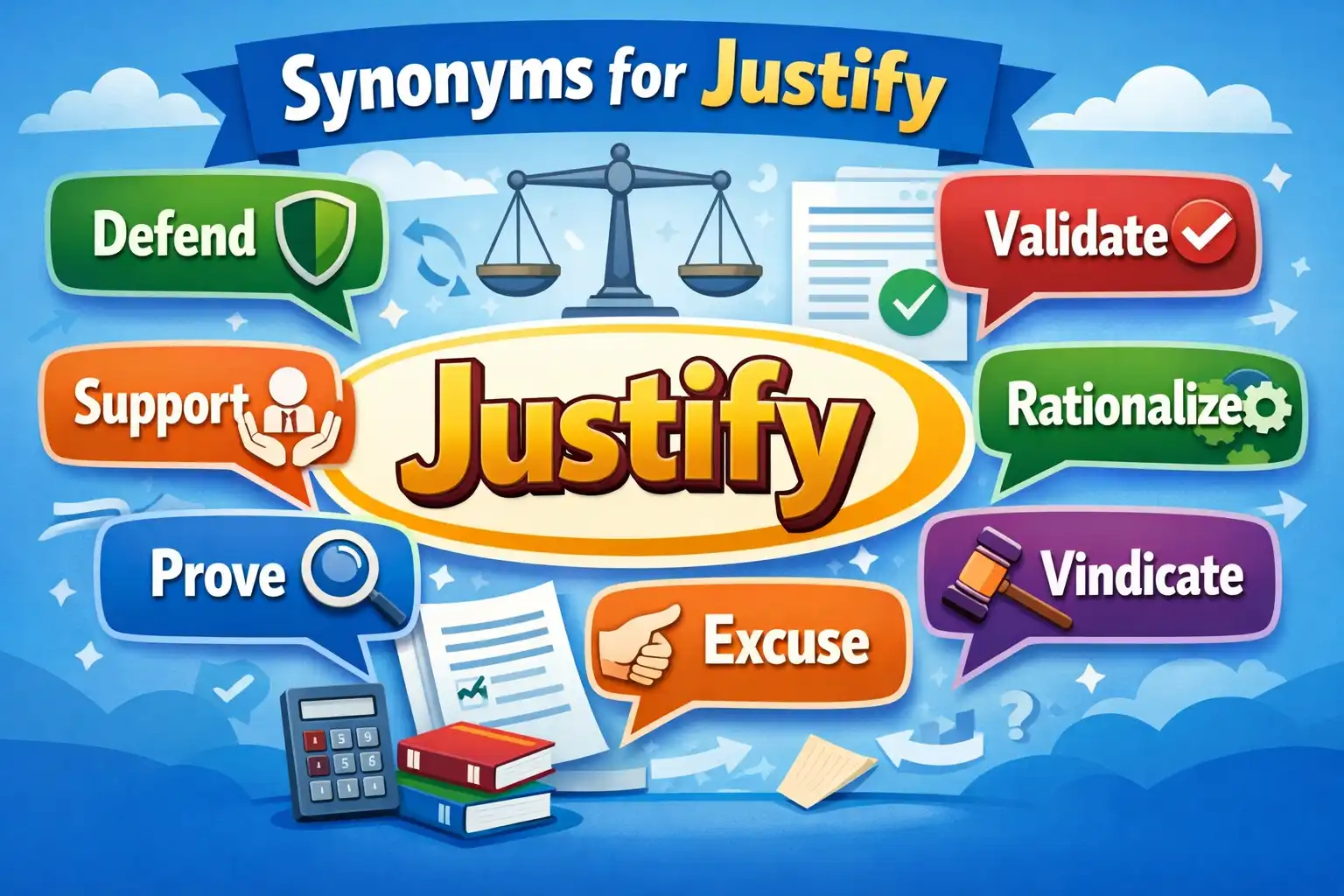
When you want to explain why an action or belief is right, you look for strong synonyms for justify. Finding the perfect synonyms for justify helps you show that your choices are fair and reasonable. Learning these synonyms for justify makes your arguments much stronger and clearer.
Imagine standing in front of your boss, trying to explain why your team spent extra money on a new software tool. You need to prove this choice was smart. If you keep saying “I want to justify this,” your explanation sounds boring and repetitive. Instead, you need different words to make your point sound professional and convincing.
Think of a simple real-life example: a child explaining why they ate the last cookie. They try to justify it by saying they were very hungry. In very simple English, to justify means to show or prove that something is right, fair, or honest.
“Words have the power to change minds, and finding the right way to support your ideas is the key to clear communication.” — Anonymous
Knowing different ways to express this concept is incredibly helpful for many reasons:
- Students: It helps you write better essays, defend your ideas, and get higher grades.
- Bloggers: It keeps your readers happy with fresh, exciting words.
- Content Writers: It makes your copy sound professional, authoritative, and convincing.
- Daily English Users: It helps you explain your everyday choices clearly to friends and family.
“To speak well is to show the truth of your actions with simple, strong words.” — Linguistic Proverb
Linguistic Profile of “Justify”
- Connotative Meaning: Generally positive or neutral. It carries ideas of truth, fairness, justice, and logical thinking. Sometimes, in casual speech, it can carry a slightly defensive tone (like making excuses).
- Etymology:
- Root: From Latin justus (meaning “just” or “righteous”) combined with facere (meaning “to do” or “to make”).
- Latin Word: justificare (meaning “to act justly” or “to make righteous”).
- French Influence: Passed through Old French as justifier in the 14th century before entering Middle English.
- Pronunciation:
- US IPA:
/ˈdʒʌs.tə.faɪ/ - UK IPA:
/ˈdʒʌs.tɪ.faɪ/
- US IPA:
- Syllables: jus-ti-fy (3 syllables, stress on the first syllable).
- Affixation Pattern:
- Root: Just (Adjective)
- Suffix: -ify (Verb-forming suffix meaning “to make” or “to cause to become”).
Comparison of Key Synonyms
| Keyword | Meaning | Usage Type | Context |
|---|---|---|---|
| Justify | Show that an action is fair, right, or reasonable. | Professional / Formal | Workplace, legal issues, or personal choices. |
| Defend | Protect an idea from being attacked by others. | Emotional / Professional | Arguments, debates, or personal beliefs. |
| Prove | Show that something is completely true using facts. | Professional / Formal | Science, school essays, or courtroom trials. |
| Support | Help hold up an idea or make it stronger. | Casual / Professional | Team meetings, writing, or friendships. |
| Rationalize | Try to find a logical reason for an action, sometimes to excuse it. | Emotional / Casual | Self-reflection or explaining bad habits. |
| Vindicate | Clear someone from blame and prove they were right. | Formal / Emotional | Legal cases or personal reputation. |
| Validate | Confirm that someone’s feelings or ideas are acceptable. | Emotional / Professional | Therapy, relationships, or data checks. |
“A single word can build a bridge of understanding, while the right synonym can make your truth undeniable.” — Writing Mastery Guide
50 Synonyms for Justify
1. Defend
- Pronunciation: US:
/dɪˈfend/| UK:/dɪˈfend/ - Meaning: You protect an idea or choice from being attacked by others.
- Examples:
- I will defend my choice to study art.
- She had to defend her plan to the boss.
2. Prove
- Pronunciation: US:
/pruːv/| UK:/pruːv/ - Meaning: You use facts to show that something is completely true.
- Examples:
- Can you prove that your idea works?
- The test results prove he was right.
3. Support
- Pronunciation: US:
/səˈpɔːrt/| UK:/səˈpɔːt/ - Meaning: You give help or bring facts to make an idea stronger.
- Examples:
- I have facts to support my story.
- Please support your answer with an example.
4. Validate
- Pronunciation: US:
/ˈvæl.ə.deɪt/| UK:/ˈvæl.ɪ.deɪt/ - Meaning: You show that an idea or feeling is acceptable and real.
- Examples:
- Her kind words helped validate my feelings.
- We need to validate the new plan.
5. Explain
- Pronunciation: US:
/ɪkˈspleɪn/| UK:/ɪkˈspleɪn/ - Meaning: You make something clear by giving details about it.
- Examples:
- Let me explain why I was late.
- He can explain his choices easily.
6. Warrant
- Pronunciation: US:
/ˈwɔːr.ənt/| UK:/ˈwɒr.ənt/ - Meaning: You show that a specific action is necessary or deserved.
- Examples:
- The small mistake does not warrant a big fight.
- Does this situation warrant a phone call?
7. Rationalize
- Pronunciation: US:
/ˈræʃ.nə.laɪz/| UK:/ˈræʃ.nə.laɪz/ - Meaning: You find a logical reason for something, even if it seems wrong.
- Examples:
- She tried to rationalize buying the expensive bag.
- Do not try to rationalize bad behavior.
8. Vindicate
- Pronunciation: US:
/ˈvɪn.də.keɪt/| UK:/ˈvɪn.dɪ.keɪt/ - Meaning: You prove that someone is free from blame.
- Examples:
- The new evidence will vindicate him completely.
- She felt vindicated when the truth came out.
9. Substantiate
- Pronunciation: US:
/səbˈstæn.ʃi.eɪt/| UK:/səbˈstæn.ʃi.eɪt/ - Meaning: You provide solid evidence to prove that something is true.
- Examples:
- You must substantiate your claims with data.
- There is no proof to substantiate that rumor.
10. Verify
- Pronunciation: US:
/ˈver.ə.faɪ/| UK:/ˈver.ɪ.faɪ/ - Meaning: You check to make sure that something is correct.
- Examples:
- Please verify your email address.
- They verified the facts before writing the news.
11. Confirm
- Pronunciation: US:
/kənˈfɝːm/| UK:/kənˈfɜːm/ - Meaning: You state that something is definitely true or planned.
- Examples:
- The doctor can confirm your appointment.
- Her smile seemed to confirm the good news.
12. Uphold
- Pronunciation: US:
/ʌpˈhoʊld/| UK:/ʌpˈhəʊld/ - Meaning: You support a decision or rule to keep it active.
- Examples:
- The judge will uphold the original decision.
- We must uphold the rules of the game.
13. Corroborate
- Pronunciation: US:
/kəˈrɑːb.ə.reɪt/| UK:/kəˈrɒb.ə.reɪt/ - Meaning: You give matching information to support another person’s story.
- Examples:
- My friend will corroborate my story.
- Two witnesses were there to corroborate the event.
14. Back
- Pronunciation: US:
/bæk/| UK:/bæk/ - Meaning: You give support or approval to an idea.
- Examples:
- The team decided to back the new project.
- I will back your decision no matter what.
15. Back up
- Pronunciation: US:
/bæk ʌp/| UK:/bæk ʌp/ - Meaning: You prove that something is true by offering extra help or facts.
- Examples:
- Can you back up that claim with files?
- He brought photos to back up his story.
16. Exonerate
- Pronunciation: US:
/ɪɡˈzɑː.nə.reɪt/| UK:/ɪɡˈzɒn.ə.reɪt/ - Meaning: You show that someone is not guilty of a mistake or crime.
- Examples:
- The DNA test will exonerate the prisoner.
- I want to exonerate my friend from blame.
17. Excuse
- Pronunciation: US:
/ɪkˈskjuːz/| UK:/ɪkˈskjuːz/ - Meaning: You forgive a small mistake or explain why it happened.
- Examples:
- Nothing can excuse his rude behavior.
- Please excuse my messy room.
18. Clarify
- Pronunciation: US:
/ˈklær.ə.faɪ/| UK:/ˈklær.ɪ.faɪ/ - Meaning: You make something clear and easy to understand.
- Examples:
- Let me clarify what I meant.
- Can you clarify this step for us?
19. Legitimize
- Pronunciation: US:
/ləˈdʒɪt̬.ə.maɪz/| UK:/ləˈdʒɪt.ɪ.maɪz/ - Meaning: You make something seem acceptable, lawful, or correct.
- Examples:
- The new law will legitimize their business.
- Do not try to legitimize bad actions.
20. Establish
- Pronunciation: US:
/ɪˈstæb.lɪʃ/| UK:/ɪˈstæb.lɪʃ/ - Meaning: You show or prove something so clearly that it is accepted.
- Examples:
- We need to establish the facts first.
- They established their innocence in court.
21. Demonstrate
- Pronunciation: US:
/ˈdem.ən.streɪt/| UK:/ˈdem.ən.streɪt/ - Meaning: You show how something works or prove it by action.
- Examples:
- Let me demonstrate how this tool works.
- Her actions demonstrate her kind heart.
22. Authenticate
- Pronunciation: US:
/ɑːˈθen.t̬ə.keɪt/| UK:/ɔːˈθen.tɪ.keɪt/ - Meaning: You prove that something is real and not a fake copy.
- Examples:
- An expert must authenticate the old painting.
- The bank needs to authenticate your signature.
23. Endorse
- Pronunciation: US:
/ɪnˈdɔːrs/| UK:/ɪnˈdɔːs/ - Meaning: You state publicly that you support an action or plan.
- Examples:
- The famous actor decided to endorse the brand.
- I cannot endorse this dangerous plan.
24. Sanction
- Pronunciation: US:
/ˈsæŋk.ʃən/| UK:/ˈsæŋk.ʃən/ - Meaning: You give official permission for an action.
- Examples:
- The school did not sanction the extra trip.
- They cannot sanction activities without a permit.
25. Approve
- Pronunciation: US:
/əˈpruːv/| UK:/əˈpruːv/ - Meaning: You think that something is good, correct, or acceptable.
- Examples:
- My parents approve of my new friends.
- The boss must approve the budget first.
26. Authorize
- Pronunciation: US:
/ˈɑː.θə.raɪz/| UK:/ˈɔː.θə.raɪz/ - Meaning: You give official power or permission to do something.
- Examples:
- Only the manager can authorize this change.
- I did not authorize anyone to use my card.
27. Absolve
- Pronunciation: US:
/əbˈzɑːlv/| UK:/əbˈzɒlv/ - Meaning: You free someone from guilt, blame, or duty.
- Examples:
- The priest will absolve him of his sins.
- This note does not absolve you from your duties.
28. Clear
- Pronunciation: US:
/klɪr/| UK:/klɪə/ - Meaning: You prove that someone is not guilty of a bad deed.
- Examples:
- The new evidence will clear her name.
- They want to clear up the misunderstanding.
29. Account for
- Pronunciation: US:
/əˈkaʊnt fɔːr/| UK:/əˈkaʊnt fɔː/ - Meaning: You give a logical explanation for how something happened.
- Examples:
- How do you account for the missing money?
- Bad weather can account for the delay.
30. Attest
- Pronunciation: US:
/əˈtest/| UK:/əˈtest/ - Meaning: You say that something is true because you saw it yourself.
- Examples:
- I can attest to his honest character.
- Many people can attest to her hard work.
31. Make a case for
- Pronunciation: US:
/meɪk ə keɪs fɔːr/| UK:/meɪk ə keɪs fɔː/ - Meaning: You present reasons to show why something should be done.
- Examples:
- We need to make a case for a higher budget.
- She made a strong case for staying home.
32. Bear out
- Pronunciation: US:
/ber aʊt/| UK:/beə aʊt/ - Meaning: You support or confirm a fact or story.
- Examples:
- The data will bear out our main theory.
- His story is not borne out by the facts.
33. Document
- Pronunciation: US:
/ˈdɑː.kjə.ment/| UK:/ˈdɒk.jə.ment/ - Meaning: You record facts to prove that something happened.
- Examples:
- We must document every step of the study.
- The reporter went to document the event.
34. Plead
- Pronunciation: US:
/pliːd/| UK:/pliːd/ - Meaning: You give an explanation or defense in a very earnest way.
- Examples:
- He chose to plead ignorance of the law.
- She will plead her cause to the board.
35. Advocate
- Pronunciation: US:
/ˈæd.və.keɪt/| UK:/ˈæd.və.keɪt/ - Meaning: You speak or write in support of an idea or person.
- Examples:
- We should advocate for cleaner parks.
- He likes to advocate for student rights.
36. Countenance
- Pronunciation: US:
/ˈkaʊn.t̬ən.əns/| UK:/ˈkaʊn.tɪ.nəns/ - Meaning: You accept, support, or approve of an action.
- Examples:
- The school will not countenance cheating.
- She refused to countenance their rude jokes.
37. Ground
- Pronunciation: US:
/ɡraʊnd/| UK:/ɡraʊnd/ - Meaning: You base an idea or argument on firm reasons or facts.
- Examples:
- You must ground your thesis in real research.
- Her beliefs are grounded in truth.
38. Base
- Pronunciation: US:
/beɪs/| UK:/beɪs/ - Meaning: You build your ideas using a specific set of facts.
- Examples:
- I base my choices on cold facts.
- You should base your essay on the book.
39. Assert
- Pronunciation: US:
/əˈsɝːt/| UK:/əˈsɜːt/ - Meaning: You state an idea with confidence so that people believe you.
- Examples:
- He continued to assert his innocence.
- She asserted that the plan was safe.
40. Certify
- Pronunciation: US:
/ˈsɝː.t̬ə.faɪ/| UK:/ˈsɜː.tɪ.faɪ/ - Meaning: You state in an official way that something is correct.
- Examples:
- The lab will certify that the food is safe.
- Can you certify that these figures are true?
41. Maintain
- Pronunciation: US:
/meɪnˈteɪn/| UK:/meɪnˈteɪn/ - Meaning: You express firmly that something is true, even when doubted.
- Examples:
- She maintained her story during the test.
- He maintains that he did nothing wrong.
42. Shield
- Pronunciation: US:
/ʃiːld/| UK:/ʃiːld/ - Meaning: You protect a person or an action from bad opinions or blame.
- Examples:
- They tried to shield him from the bad news.
- Her excuse helped shield her from punishment.
43. Guard
- Pronunciation: US:
/ɡɑːrd/| UK:/ɡɑːd/ - Meaning: You protect an idea or right to keep it safe from attacks.
- Examples:
- We must guard our freedom of speech.
- She guarded her secrets very carefully.
44. Protect
- Pronunciation: US:
/prəˈtekt/| UK:/prəˈtekt/ - Meaning: You keep an idea or choice safe from being hurt or ruined.
- Examples:
- He wanted to protect his good reputation.
- The new rule will protect worker rights.
45. Buttress
- Pronunciation: US:
/ˈbʌt.rəs/| UK:/ˈbʌt.rəs/ - Meaning: You make an argument stronger by adding more support.
- Examples:
- Use quotes to buttress your main points.
- The expert witness helped buttress our case.
46. Sponsor
- Pronunciation: US:
/ˈspɑːn.sɚ/| UK:/ˈspɒn.sə/ - Meaning: You support an activity by giving money or public approval.
- Examples:
- The company will sponsor our local team.
- She agreed to sponsor the new school project.
47. Cosign
- Pronunciation: US:
/ˈkoʊ.saɪn/| UK:/ˈkəʊ.saɪn/ - Meaning: You agree with and support another person’s actions or ideas.
- Examples:
- I will happily cosign your brilliant idea.
- My parents had to cosign the loan.
48. Plead for
- Pronunciation: US:
/pliːd fɔːr/| UK:/pliːd fɔː/ - Meaning: You ask for support or mercy in a very earnest way.
- Examples:
- The team had to plead for more time.
- He went to plead for his job.
49. Declare
- Pronunciation: US:
/dɪˈkler/| UK:/dɪˈkleə/ - Meaning: You state something clearly and loudly so everyone knows.
- Examples:
- They will declare the winner tonight.
- She declared that her choices were fair.
50. Exculpate
- Pronunciation: US:
/ˈek.skəl.peɪt/| UK:/ˈek.skʌl.peɪt/ - Meaning: You show that someone is free from blame or guilt.
- Examples:
- They hope the new clues will exculpate him.
- No excuse can exculpate her from this error.
Antonyms of Justify
If you do not want to defend or prove an action, you might do the opposite. Here are the main antonyms for the word “justify”:
- Condemn: To state clearly that someone or something is completely wrong or bad.
- Oppose: To fight against an idea, plan, or choice.
- Disprove: To show that an idea is false using clear facts.
- Invalidate: To make an argument or document weak, officialy useless, or wrong.
- Blame: To say that someone is the cause of something bad that happened.
Prototype Meaning and Categorization
- Linguistic Category: Transitive Verb (requires a direct object, such as justifying an action, a choice, or a cost).
- Semantic Category: Verbs of Cognitive Defense and Logical Verification.
- Prototype Meaning: The central, perfect example of “justify” is a person presenting strong, logical, and truthful reasons to a skeptical listener to prove that a specific choice was correct, fair, and reasonable.
Frequently Asked Questions (FAQ)
1. What is the easiest synonym for justify?
The easiest and most common synonyms are prove and explain. These words are very simple to use in daily conversations and mean almost the same thing when you are trying to make someone understand your actions.
2. Can “justify” mean to align text?
Yes! In computer design and writing programs, to “justify” text means to line up the words so that both the left and right edges of the page are straight and neat.
3. Is “rationalize” the same as “justify”?
Not exactly. While both words mean finding reasons for an action, “rationalize” often has a negative meaning. It means you are trying to make excuses for a bad habit or mistake, while “justify” usually means showing a real, fair reason.
4. When should I use “substantiate” instead of “justify”?
You should use “substantiate” when you are writing a formal essay, a science report, or a business plan. It means you have physical evidence, like charts, numbers, or facts, to prove your point.
5. What does it mean to justify your actions?
It means that you are explaining the reasons behind what you did so that other people can understand and agree that your actions were correct, fair, or necessary.
6. What is the opposite of justify?
The direct opposite of justify is condemn or blame. Instead of showing that an action is right, these words show that an action is completely wrong.
Conclusion
Learning a wide variety of synonyms for justify is one of the quickest ways to upgrade your communication skills. By expanding your vocabulary, you can easily explain your thoughts without sounding repetitive. It makes your writing, blogging, speaking, and everyday communication sound highly professional, logical, and clear.
We highly encourage you to practice these newly learned words in your daily life. Try using “validate” when talking to a friend about their feelings, or “substantiate” in your next school essay or business email. The more you use these words in your everyday conversations, the more natural and confident your English will sound!
“Vocabulary is the canvas on which we paint our thoughts; make yours vibrant.” — Creative Expression Journal
“To change your words is to change your reach; let your voice be clear and strong.” — The Eloquent Speaker

Robert Hayes is an ESL educator and curriculum developer with over nine years of experience teaching English to beginners and intermediate learners across multiple countries ( Biography ).