Have you ever tried to build a toy but the instructions made no sense? You probably felt confused and wanted a simple description of what to do. An explanation is just that—it is a statement that makes something clear and easy to understand.
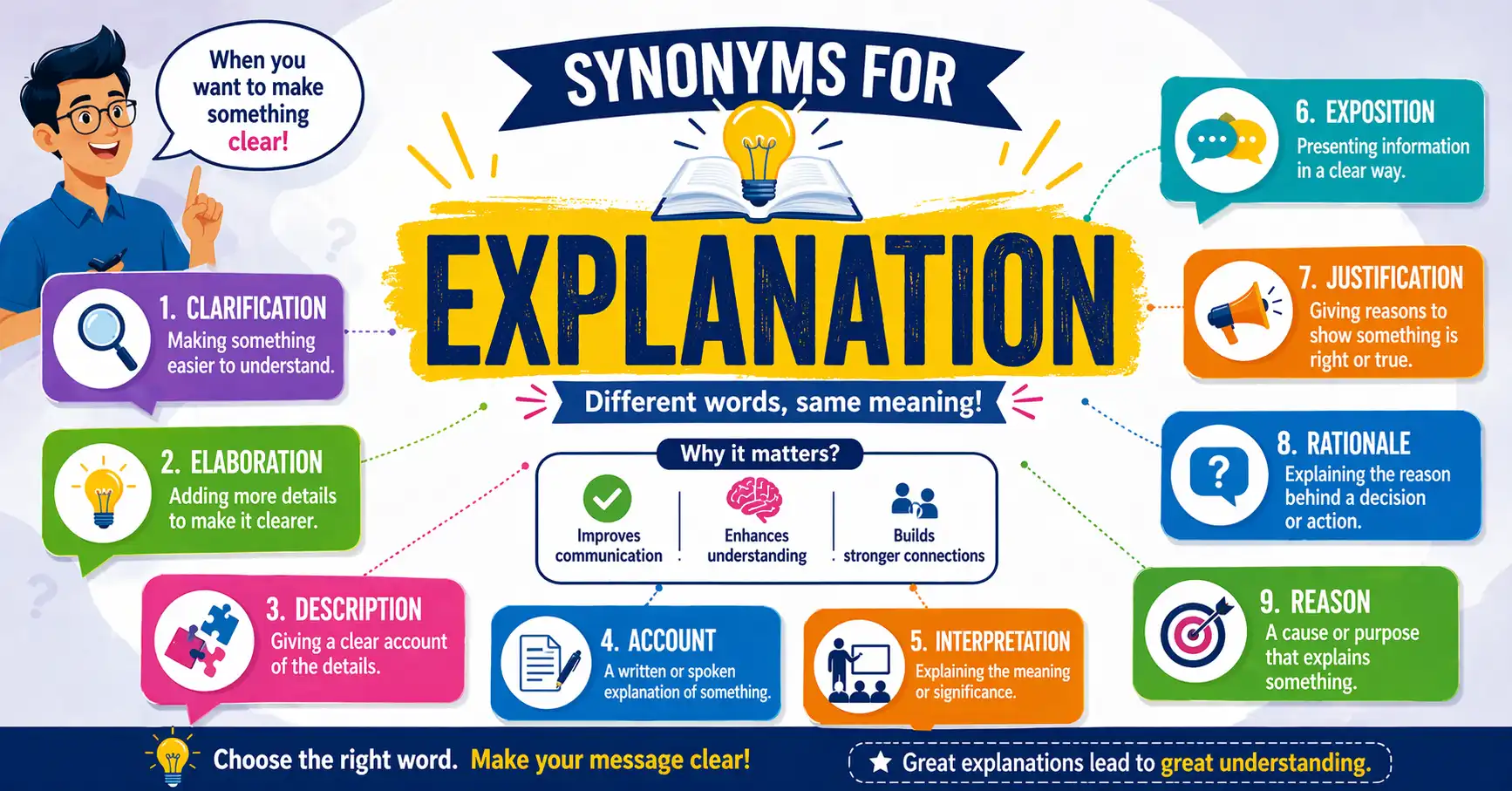
Knowing many synonyms for explanation is highly useful for students, bloggers, content writers, and daily English users. When you use different words instead of repeating yourself, your writing flows much better and keeps readers happy. Learning these fresh synonyms for explanation makes your essays, blog posts, and emails far more exciting. Let us look at fifty excellent synonyms for explanation to upgrade your writing style today!
Clarification
Meaning:
- This word means making something clear and easier to understand.
Examples:
- Can you give me a quick clarification on this rule?
- The teacher offered a helpful clarification about the homework.
Description
Meaning:
- This word means telling what someone or something is like using words.
Examples:
- He gave a vivid description of the lost dog.
- Her description of the beach made me want to go there.
Account
Meaning:
- This word is a report or story about something that happened.
Examples:
- She wrote a detailed account of her summer trip.
- The news gave an honest account of the event.
Definition
Meaning:
- This word tells the exact meaning of a word or idea.
Examples:
- I looked up the definition of the word in the dictionary.
- The book gives a clear definition of love.
Interpretation
Meaning:
- This word is how someone understands or explains the meaning of something.
Examples:
- Every reader has a different interpretation of the poem.
- Her interpretation of the painting was very unique.
Exposition
Meaning:
- This word is a full and detailed explanation of an idea or theory.
Examples:
- The essay starts with a long exposition of the main topic.
- We listened to his clear exposition of the new plan.
Details
Meaning:
- This word refers to small pieces of information that explain a situation.
Examples:
- She shared all the juicy details of the party.
- Please give us the exact details of the meeting time.
Breakdown
Meaning:
- This word means dividing information into smaller and simpler parts to explain it.
Examples:
- The coach gave us a breakdown of the game plan.
- Here is a simple breakdown of how much money we spent.
Analysis
Meaning:
- This word is a careful study of something to explain how it works.
Examples:
- The scientist wrote a deep analysis of the clean water.
- Her analysis of the market helped our small business grow.
Justification
Meaning:
- This word is a reason or explanation that shows why something is right.
Examples:
- He had no justification for being so late to school.
- She gave a good justification for her career change.
Excuse
Meaning:
- This word is an explanation given to defend or forgive a mistake.
Examples:
- His weak excuse did not make the teacher happy.
- She has a good excuse for missing the class today.
Defense
Meaning:
- This word is an explanation used to protect someone from blame or attack.
Examples:
- The lawyer made a strong defense of the young man.
- He spoke in defense of his favorite video game.
Statement
Meaning:
- This word is something that you say or write to give information.
Examples:
- The company released a public statement about the problem.
- Her simple statement cleared up all the confusion.
Report
Meaning:
- This word is a written or spoken description of an event or topic.
Examples:
- I must write a book report for my English class.
- The weather report says it will rain tomorrow morning.
Rundown
Meaning:
- This word means a quick and simple summary of facts or events.
Examples:
- Give me a quick rundown of the morning news.
- She gave the boss a rundown of the project status.
Summary
Meaning:
- This word is a short statement that gives the main points of something.
Examples:
- The writer put a quick summary at the end of the chapter.
- He gave a five-minute summary of the long movie.
Recap
Meaning:
- This word is a short retelling of what has already happened.
Examples:
- Let us do a quick recap of our last lesson.
- The TV host gave a recap of the previous episode.
Outline
Meaning:
- This word is a simple plan that shows the main parts of an idea.
Examples:
- I made a basic outline before writing my essay.
- The boss drew an outline of the new project on the board.
Translation
Meaning:
- This word is changing words from one language to another to make them clear.
Examples:
- She read the English translation of the French book.
- This app gives a quick translation of foreign words.
Illustration
Meaning:
- This word is an example or picture that helps explain something.
Examples:
- The story has a lovely illustration on every page.
- He used a drawing as an illustration of his idea.
Demonstration
Meaning:
- This word is showing how something works by doing it yourself.
Examples:
- The cook gave a live demonstration of how to bake bread.
- We watched a safety demonstration before our flight.
Narrative
Meaning:
- This word is a story or account of events that happened.
Examples:
- Her personal narrative was very moving to read.
- The movie has a simple and fun narrative.
Version
Meaning:
- This word is a description of an event from one person’s point of view.
Examples:
- His version of the fight was different from hers.
- She told her version of the story to the police.
Answer
Meaning:
- This word is what you say or write to solve a question or problem.
Examples:
- He found the correct answer to the hard math question.
- Her polite answer made everyone smile.
Solution
Meaning:
- This word is the answer to a problem or how to fix a bad situation.
Examples:
- We need to find a fast solution to this leaking pipe.
- Her smart solution saved the team a lot of time.
Clue
Meaning:
- This word is a piece of information that helps solve a puzzle or mystery.
Examples:
- The detective found a key clue near the open window.
- This hint is a helpful clue for our game.
Key
Meaning:
- This word is the main thing that explains or solves a secret or problem.
Examples:
- Hard work is the main key to success.
- She found the key to understanding the science lesson.
Light
Meaning:
- This word means making something easy to understand by sharing new facts.
Examples:
- The new evidence shed light on the old mystery.
- Her words threw light on why she was so sad.
Meaning
Meaning:
- This word is the idea or message that a thing represents.
Examples:
- I do not know the meaning of this hard sign.
- The red rose has a deep meaning of love.
Sense
Meaning:
- This word means the clear understanding or value of something.
Examples:
- His explanation made perfect sense to the children.
- There is no sense in arguing about the game rules.
Commentary
Meaning:
- This word is a set of spoken or written notes that explain a book or event.
Examples:
- The DVD has an interesting commentary by the director.
- We listened to the sports commentary on the radio.
Note
Meaning:
- This word is a short piece of writing used to explain or remember something.
Examples:
- The teacher left a helpful note on my test paper.
- He wrote a quick note to explain where he went.
Footnote
Meaning:
- This word is a small note at the bottom of a page that gives extra information.
Examples:
- The author added a footnote to explain the old word.
- I read the footnote to understand where the fact came from.
Briefing
Meaning:
- This word is a short meeting where people get instructions or facts.
Examples:
- The captain gave the soldiers a quick briefing before the mission.
- We attended a morning briefing about the safety rules.
Feedback
Meaning:
- This word is helpful comments or advice about how well you did something.
Examples:
- The coach gave me useful feedback on my running style.
- I love getting constructive feedback on my blog posts.
Review
Meaning:
- This word is a careful report that looks at and judges something.
Examples:
- He wrote a glowing review of the new restaurant.
- Let us do a quick review of the book chapters.
Lecture
Meaning:
- This word is a formal talk given to teach people about a subject.
Examples:
- The professor gave a long lecture on world history.
- I fell asleep during the boring science lecture.
Lesson
Meaning:
- This word is a period of time where you learn something new from a teacher.
Examples:
- Today we had a great lesson about solar power.
- The driving lesson was very fun and safe.
Guide
Meaning:
- This word is a book or person that shows you how to do something.
Examples:
- This tourist guide shows all the cool spots in town.
- She used a step-by-step guide to bake the cake.
Tip
Meaning:
- This word is a small but useful piece of advice or information.
Examples:
- My dad gave me a great tip for fixing the bike.
- Here is a quick tip to keep your garden green.
Roadmap
Meaning:
- This word is a detailed plan that shows how to reach a goal.
Examples:
- The company has a clear roadmap for the next five years.
- This guide is a great roadmap to learning coding.
Sketch
Meaning:
- This word can be a quick and simple description without many details.
Examples:
- He gave us a brief sketch of the new movie plot.
- She drew a quick sketch of the project timeline.
Elaboration
Meaning:
- This word is the act of adding more details to explain something fully.
Examples:
- Your short essay needs some elaboration to make it clear.
- She offered further elaboration on her business plan.
Explication
Meaning:
- This word is a detailed analysis or explanation of a text or idea.
Examples:
- He wrote an explication of the famous poem.
- The teacher gave a clear explication of the science concept.
Reasoning
Meaning:
- This word is the process of thinking about things in a clear and logical way.
Examples:
- I do not understand your reasoning behind this choice.
- She explained the reasoning for her decision to leave.
Blueprint
Meaning:
- This word is a detailed plan or model that explains how to build something.
Examples:
- The architect showed us the blueprint of the school.
- Here is the blueprint for our new website design.
Instruction
Meaning:
- This word is a statement that tells you how to do or use something.
Examples:
- Please read the instruction before using the new camera.
- She followed every instruction to assemble the table.
Disclosure
Meaning:
- This word is making new or secret information known to others.
Examples:
- The full disclosure of the facts shocked the public.
- We are waiting for the disclosure of the official report.
Declaration
Meaning:
- This word is an official or formal statement that explains something clearly.
Examples:
- The president made a solemn declaration of peace.
- Her declaration of love surprised all of us.
Comment
Meaning:
- This word is a spoken or written remark that explains or gives an opinion.
Examples:
- The teacher left a helpful comment on my art project.
- She made a kind comment about his new haircut.
Why Learning Synonyms Improves Your Writing
Learning synonyms for explanation is a wonderful way to boost your writing, blogging, speaking, and daily communication. When you avoid repeating the same words, your audience stays engaged and interested. We encourage you to practice using these fifty words in your next emails, school essays, and daily conversations. You will quickly see how easy it is to make your English sound clear, exciting, and highly professional!

Robert Hayes is an ESL educator and curriculum developer with over nine years of experience teaching English to beginners and intermediate learners across multiple countries ( Biography ).