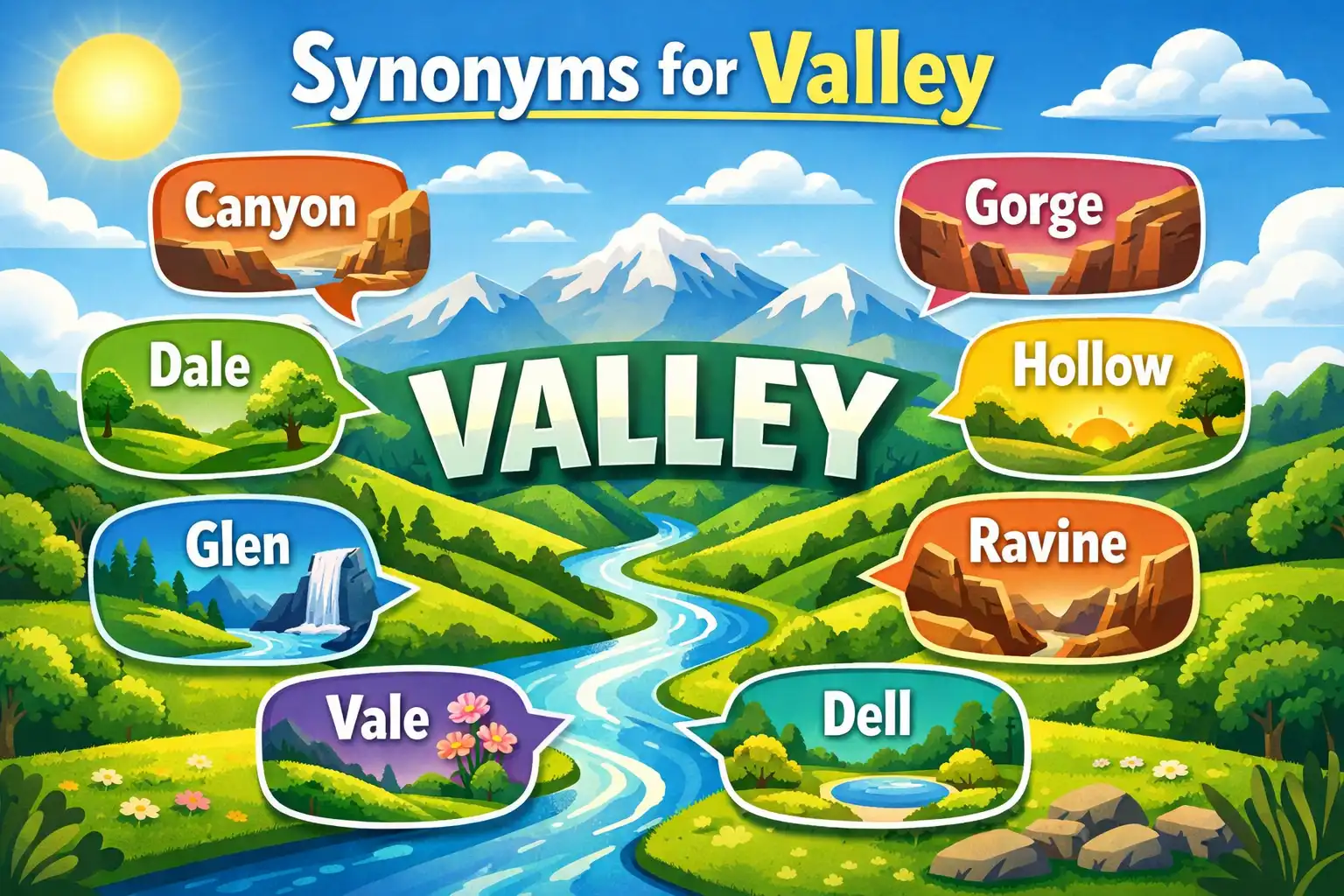
When you picture a low area of land tucked safely between hills or mountains, the first word that pops into your head is probably valley. But using the exact same word over and over can make your writing feel flat. Learning a rich variety of synonyms for valley helps you paint much better pictures with your words, whether you are describing a spooky mountain pass, a sunny meadow, or a deep river canyon. Finding the right synonyms for valley gives your English an instant upgrade.
Imagine a writer trying to describe a fantasy kingdom, but they use the word “valley” five times in a single page. It gets boring fast! Now, imagine replacing those with words like glen, dale, or gorge. The whole scene suddenly comes alive. A valley is simply a low stretch of land between higher land like hills. Understanding different synonyms for valley is incredibly useful for students who want to ace their essays, bloggers aiming to hook readers, content writers building vivid worlds, and daily English users who want to express themselves more clearly and dynamically.
“Words create worlds. Choosing the right name for a landscape changes how a reader feels the breeze.”
“Do not settle for a small vocabulary when the earth itself offers so many shapes and names for its beauty.”
Connotative Meaning of Valley
While the literal definition is a low land between hills, the word valley often carries a psychological or emotional connotation of safety, peace, fertility, and seclusion. It can also represent a low point in life (e.g., “the valley of despair”) before climbing back up the mountain.
Linguistic Profile of Valley
- Etymology: Derived from the Old French valee, which comes from the Latin vallis (meaning low land or valley).
- Pronunciation (US & UK): /ˈvæl.i/
- Syllables: 2 syllables (val-ley)
- Affixation Pattern: Root word valley (can take suffixes like -s for plurals or -like for adjectives).
Keyword Comparison Table
| Keyword | Meaning | Usage Type | Context |
| Valley | Low land between hills or mountains | Professional / Casual | Geography, daily conversation, nature writing |
| Vale | A peaceful, low valley | Literary / Emotional | Poetry, classic stories, romantic descriptions |
| Glen | A very narrow, hidden valley | Casual / Warm | Scottish landscapes, magical or secluded woods |
| Dale | A broad, open valley | Casual / Professional | British countryside, farming, open fields |
| Canyon | A deep valley with very steep rock sides | Professional / Casual | Dry climates, desert travel, geology |
| Gorge | A very narrow valley with a river | Professional / Casual | Adventure sports, rivers, steep cliffs |
50 Synonyms for Valley
1. Vale
- Pronunciation: /veɪl/ (US & UK)
- Meaning: A quiet and peaceful valley often mentioned in old stories and poems.
- Examples:
- The cozy village sat quietly in the green vale.
- Sheep walked slowly across the beautiful vale.
2. Glen
- Pronunciation: /ɡlen/ (US & UK)
- Meaning: A small, narrow valley that is hidden and full of trees.
- Examples:
- We found a clear blue stream inside the quiet glen.
- Birds sing loudly in this hidden glen every morning.
3. Dale
- Pronunciation: /deɪl/ (US & UK)
- Meaning: A large, wide valley with open fields and no thick woods.
- Examples:
- The sun shines brightly across the open dale.
- They love to walk through the grassy dale in summer.
4. Canyon
- Pronunciation: /ˈkæn.jən/ (US & UK)
- Meaning: A deep valley with very tall and steep rock walls.
- Examples:
- The big river cuts right through the red canyon.
- We stood at the top and looked down into the deep canyon.
5. Gorge
- Pronunciation: /ɡɔːrdʒ/ (US & UK)
- Meaning: A very narrow valley with steep rocky sides and a rushing river at the bottom.
- Examples:
- A strong wooden bridge goes over the deep gorge.
- Water rushes fast through the narrow gorge.
6. Ravine
- Pronunciation: /rəˈviːn/ (US & UK)
- Meaning: A deep, narrow valley formed by flowing water over a long time.
- Examples:
- Watch your step near the edge of the muddy ravine.
- Rainwater quickly fills the deep ravine in the woods.
7. Chasm
- Pronunciation: /ˈkæz.əm/ (US & UK)
- Meaning: A giant, deep opening in the earth that forms a scary valley.
- Examples:
- The earthquake left a huge chasm in the middle of the field.
- You cannot jump across such a wide chasm.
8. Gulch
- Pronunciation: /ɡʌltʃ/ (US & UK)
- Meaning: A small, dry valley with steep sides carved by sudden floods.
- Examples:
- The cowboy rode his horse down into the dry gulch.
- We found old gold coins hidden in the rocky gulch.
9. Basin
- Pronunciation: /ˈbeɪ.sən/ (US & UK)
- Meaning: A large, low dip in the land where water drains into the center.
- Examples:
- The wide basin holds water from all the nearby hills.
- Farms cover the rich soil of the mountain basin.
10. Hollow
- Pronunciation: /ˈhɑːl.oʊ/ (US) / /ˈhɒl.əʊ/ (UK)
- Meaning: A small, cozy valley nestled low between rolling hills.
- Examples:
- Our old family cabin sits right in the quiet hollow.
- Fog always rolls into the grassy hollow at night.
11. Depresssion
- Pronunciation: /dɪˈpreʃ.ən/ (US & UK)
- Meaning: A place on the ground that sinks lower than the land around it.
- Examples:
- Water gathered in the small depression after the rain storm.
- The grassy depression is a great spot to sit.
12. Dingle
- Pronunciation: /ˈdɪŋ.ɡəl/ (US & UK)
- Meaning: A small, deep valley filled with lots of pretty trees.
- Examples:
- The children played games down in the shady dingle.
- Wild flowers grow beautifully inside the quiet dingle.
13. Strath
- Pronunciation: /stræθ/ (US & UK)
- Meaning: A wide mountain valley with a lazy river running through it.
- Examples:
- The long strath looks very pretty from the mountain top.
- Cows graze freely along the flat land of the strath.
14. Coulee
- Pronunciation: /ˈkuː.li/ (US & UK)
- Meaning: A dry, shallow valley that was made by melting ice long ago.
- Examples:
- The dirt road winds slowly through the dry coulee.
- Bushy plants grow along the walls of the coulee.
15. Glade
- Pronunciation: /ɡleɪd/ (US & UK)
- Meaning: An open, grassy space inside a low forest valley.
- Examples:
- Deer love to rest in the sunny glade.
- We set up our small camp in the middle of the glade.
16. Rift
- Pronunciation: /rɪft/ (US & UK)
- Meaning: A long valley made when the earth cracks and pulls apart.
- Examples:
- Deep lakes form inside the giant rift valley.
- The land split open to create a long rift.
17. Flume
- Pronunciation: /fluːm/ (US & UK)
- Meaning: A very narrow valley with water running fast between rock walls.
- Examples:
- Cold mountain water runs quickly down the rocky flume.
- The hikers walked along the edge of the deep flume.
18. Trench
- Pronunciation: /trentʃ/ (US & UK)
- Meaning: A long, narrow, and deep dip cut into the earth.
- Examples:
- The heavy rains dug a deep trench in the dirt.
- A deep ocean trench sits far beneath the waves.
19. Bottomland
- Pronunciation: /ˈbɑːt.əm.lænd/ (US) / /ˈbɒt.əm.lænd/ (UK)
- Meaning: Low, flat land near a river that gets flooded easily.
- Examples:
- The soil in the bottomland is excellent for growing corn.
- Trees grow thick along the wet bottomland.
20. Bottom
- Pronunciation: /ˈbɑːt.əm/ (US) / /ˈbɒt.əm/ (UK)
- Meaning: The lowest part of a valley near a stream or creek.
- Examples:
- We built a small barn down in the river bottom.
- The grass stays greenest at the bottom of the hill.
“Nature speaks in shapes, and the valley is her way of offering shelter to the weary traveler.”
21. Notch
- Pronunciation: /nɑːtʃ/ (US) / /nɒtʃ/ (UK)
- Meaning: A narrow V-shaped pass or valley high up between two mountains.
- Examples:
- The cool wind blows hard through the mountain notch.
- You can see the blue sky through the high notch.
22. Pass
- Pronunciation: /pæs/ (US) / /pɑːs/ (UK)
- Meaning: A low valley path that allows people to cross over a mountain range.
- Examples:
- Snow fills the high mountain pass during the winter months.
- The cars drove carefully through the narrow mountain pass.
23. Defile
- Pronunciation: /dɪˈfaɪl/ (US & UK)
- Meaning: A very narrow valley path where people can only walk in a single line.
- Examples:
- The soldiers marched slowly through the dark defile.
- Rock walls rose up high on both sides of the defile.
24. Gully
- Pronunciation: /ˈɡʌl.i/ (US & UK)
- Meaning: A small ditch valley formed by rushing soil and heavy water.
- Examples:
- The heavy rain cut a dirty gully beside the road.
- Be careful not to trip in the deep gully.
25. Slime
- Pronunciation: /slaɪm/ (US & UK)
- Meaning: A rare, old word for a muddy, low-lying coastal slip or valley.
- Examples:
- The low coastal slime filled with water at high tide.
- The valley path turned into a muddy slime after the storm.
26. Lowland
- Pronunciation: /ˈloʊ.lənd/ (US) / /ˈləʊ.lənd/ (UK)
- Meaning: Land that stays low and flat compared to nearby mountains.
- Examples:
- The green lowland is perfect for raising dairy cows.
- Mist covers the cold lowland early in the morning.
27. Swale
- Pronunciation: /sweɪl/ (US & UK)
- Meaning: A shallow, wet dip in the land that catches extra rainwater.
- Examples:
- Tall green grass grows best in the damp swale.
- The golf ball rolled directly into the grassy swale.
28. Coomb
- Pronunciation: /kuːm/ (US & UK)
- Meaning: A short, round valley with steep sides, common in Southern England.
- Examples:
- A small flock of sheep rested inside the quiet coomb.
- The trail circles around the rim of the deep coomb.
29. Clough
- Pronunciation: /klʌf/ (US & UK)
- Meaning: A steep, rough valley or ravine that often has a small stream.
- Examples:
- Water trickles down the stones of the quiet clough.
- We climbed up the side of the rocky clough.
30. Gill
- Pronunciation: /ɡɪl/ (US & UK)
- Meaning: A small, deep valley or ravine with a stream running through wood.
- Examples:
- The stream rushes loudly down the rocky gill.
- Ferns cover the dark walls of the quiet gill.
31. Slack
- Pronunciation: /slæk/ (US & UK)
- Meaning: A low, dip-like valley between two sand dunes or soft hills.
- Examples:
- We found shelter from the beach wind in the slack.
- Plants start to grow inside the sandy mountain slack.
32. Draw
- Pronunciation: /drɔː/ (US & UK)
- Meaning: A shallow, natural valley that slopes up toward higher ground.
- Examples:
- The deer ran quickly up the grassy draw.
- Rainwater flows down the draw during summer storms.
33. Arroyyo
- Pronunciation: /əˈrɔɪ.oʊ/ (US & UK)
- Meaning: A dry desert valley that instantly turns into a river during heavy rain.
- Examples:
- Never camp inside a dry arroyo because of sudden floods.
- The sun baked the mud cracks inside the empty arroyo.
34. Barranca
- Pronunciation: /bəˈræŋ.kə/ (US & UK)
- Meaning: A deep, steep-sided ravine or dry valley common in Spanish areas.
- Examples:
- The horse stopped directly at the edge of the steep barranca.
- Cactus plants grow along the sides of the deep barranca.
35. Corrie
- Pronunciation: /ˈkɔːr.i/ (US) / /ˈkɒr.i/ (UK)
- Meaning: A round, bowl-shaped valley high up on the side of a mountain.
- Examples:
- A tiny blue lake sits perfectly inside the mountain corrie.
- Snow stays frozen in the cold corrie all year long.
36. Cirque
- Pronunciation: /sɜːrk/ (US & UK)
- Meaning: A steep, half-open bowl valley made by moving mountain ice sheets.
- Examples:
- The climbers rested inside the rocky mountain cirque.
- Tall granite walls surround the beautiful mountain cirque.
37. Box Canyon
- Pronunciation: /bɑːks ˈkæn.jən/ (US) / /bɒks ˈkæn.jən/ (UK)
- Meaning: A steep canyon valley that drops down and ends in a solid wall.
- Examples:
- The path inside the box canyon has no way out.
- We turned around at the end of the narrow box canyon.
38. Floodplain
- Pronunciation: /ˈflʌd.pleɪn/ (US & UK)
- Meaning: Flat valley land next to a river that floods when it rains hard.
- Examples:
- Houses should not be built on the wide floodplain.
- The muddy floodplain is full of tall green reeds.
39. Hanging Valley
- Pronunciation: /ˈhæŋ.ɪŋ ˈvæl.i/ (US & UK)
- Meaning: A high valley that ends abruptly with a cliff dropping to a lower valley.
- Examples:
- A massive waterfall drops directly out of the hanging valley.
- We looked up from below at the beautiful hanging valley.
40. Interval
- Pronunciation: /ˈɪn.tər.vəl/ (US & UK)
- Meaning: Low, rich river land situated between hills or mountain ridges.
- Examples:
- The farmers grew crops on the wide mountain interval.
- A dirt path runs smoothly through the green interval.
41. Sinkhole
- Pronunciation: /ˈsɪŋk.hoʊl/ (US) / /ˈsɪŋk.həʊl/ (UK)
- Meaning: A low, bowl-shaped valley formed when the underground rock collapses.
- Examples:
- The ground gave way to create a deep sinkhole.
- Trees grew inside the old, stable limestone sinkhole.
42. Karst Valley
- Pronunciation: /kɑːrst ˈvæl.i/ (US & UK)
- Meaning: A unique valley made by water dissolving soft limestone bedrock over time.
- Examples:
- The karst valley is full of hidden caves and streams.
- Strange rock pillars rise out of the deep karst valley.
43. Pocket Valley
- Pronunciation: /ˈpɑːk.ɪt ˈvæl.i/ (US) / /ˈpɒk.ɪt ˈvæl.i/ (UK)
- Meaning: A tiny, enclosed valley that is blocked by mountains on almost all sides.
- Examples:
- A small farm was hidden inside the quiet pocket valley.
- No roads lead into this secret pocket valley.
44. U-Shaped Valley
- Pronunciation: /juː-ʃeɪpt ˈvæl.i/ (US & UK)
- Meaning: A wide valley with a flat bottom carved out by an ancient glacier.
- Examples:
- Glaciers carved this giant U-shaped valley millions of years ago.
- The U-shaped valley has very flat ground to walk on.
45. V-Shaped Valley
- Pronunciation: /viː-ʃeɪpt ˈvæl.i/ (US & UK)
- Meaning: A sharp, narrow valley with steep sides carved out by a fast river.
- Examples:
- A fast river still cuts deeper into the V-shaped valley.
- The walls of the V-shaped valley are very hard to climb.
46. Wady
- Pronunciation: /ˈwɑː.di/ (US) / /ˈwɒd.i/ (UK)
- Meaning: A desert valley or riverbed that remains completely dry until a heavy rain.
- Examples:
- The dry wady filled with deep water in minutes.
- We walked along the sandy floor of the empty wady.
47. Sunkland
- Pronunciation: /ˈsʌŋk.lænd/ (US & UK)
- Meaning: A large area of valley land that sank down during an earthquake.
- Examples:
- The forest became a swampy sunkland after the big shake.
- Water pools deeply across the low sunkland surface.
48. Water Gap
- Pronunciation: /ˈwɔː.tər ɡæp/ (US & UK)
- Meaning: A low valley pass where a river cuts directly through a mountain ridge.
- Examples:
- The train tracks run safely through the natural water gap.
- The wide water gap offers a great view of the river.
49. Wind Gap
- Pronunciation: /wɪnd ɡæp/ (US & UK)
- Meaning: A high, dry mountain valley pass where a river used to flow long ago.
- Examples:
- The ancient river dried up, leaving a rocky wind gap behind.
- Strong gusts of wind howl through the empty wind gap.
50. Dale-land
- Pronunciation: /deɪl-lænd/ (US & UK)
- Meaning: An old-fashioned term for an area filled with many beautiful valleys.
- Examples:
- The travelers journeyed across the green and rolling dale-land.
- Cottages dot the hillsides of the historic dale-land.
Antonyms of Valley
- Mountain: A giant, high landmass rising steeply above its surroundings.
- Hill: A naturally raised area of land, smaller than a mountain.
- Peak: The pointed top of a mountain or ridge.
- Ridge: A long, narrow hilltop or mountain range.
- Plateau: A wide, flat area of land raised high above the surrounding ground.
Prototype Meaning and Categorization
The core mental prototype of a valley is a low, green, fertile stretch of land between two higher geographic features (like hills or mountains) that usually contains a freshwater source like a creek or river.
- Category: Geographic Landforms / Topography / Earth Science Terms.
Frequently Asked Questions
What is the most common synonym for valley?
The most common synonyms are vale, glen, and dale for peaceful landscapes, and canyon or gorge for deep, rocky landscapes.
Can “glen” be used for any valley?
Not quite. A glen specifically refers to a small, narrow, deep valley that is heavily wooded or secluded, typically associated with Scotland.
What is the difference between a canyon and a valley?
A valley is a general term for any low land between hills. A canyon is a very specific type of valley that is exceptionally deep with nearly vertical rocky cliffs.
Is “vale” a formal word?
Vale is an older, poetic, and literary word. It is rarely used in daily conversation but is popular in literature and song lyrics.
How does a gorge differ from a ravine?
A gorge is almost entirely rocky and has a river running through it, while a ravine is slightly wider and usually carved by water over time, often containing mud and loose dirt.
Conclusion
Expanding your linguistic toolkit by learning various synonyms for valley is a phenomenal way to scale up your communication abilities. For students, changing up your word choices helps you write compelling essays that stand out to your teachers. For bloggers and digital content writers, painting precise visual pictures with specific descriptive words keeps your audience engaged and clicking through your articles. Even in everyday conversations or professional emails, avoiding repetitive language shows high intelligence and clear thinking.
“A change in words is a change in perspective; don’t just write about the world, illustrate it.”
“The difference between the right word and the almost right word is the difference between lightning and a lightning bug.”
“Expand your speech, expand your world. Every new word opens a brand new door.”
Practice introducing these fresh terms into your daily life. Try using glen next time you tell a story about a hike, or write canyon instead of a generic low point in your next piece of creative writing!

Robert Hayes is an ESL educator and curriculum developer with over nine years of experience teaching English to beginners and intermediate learners across multiple countries ( Biography ).