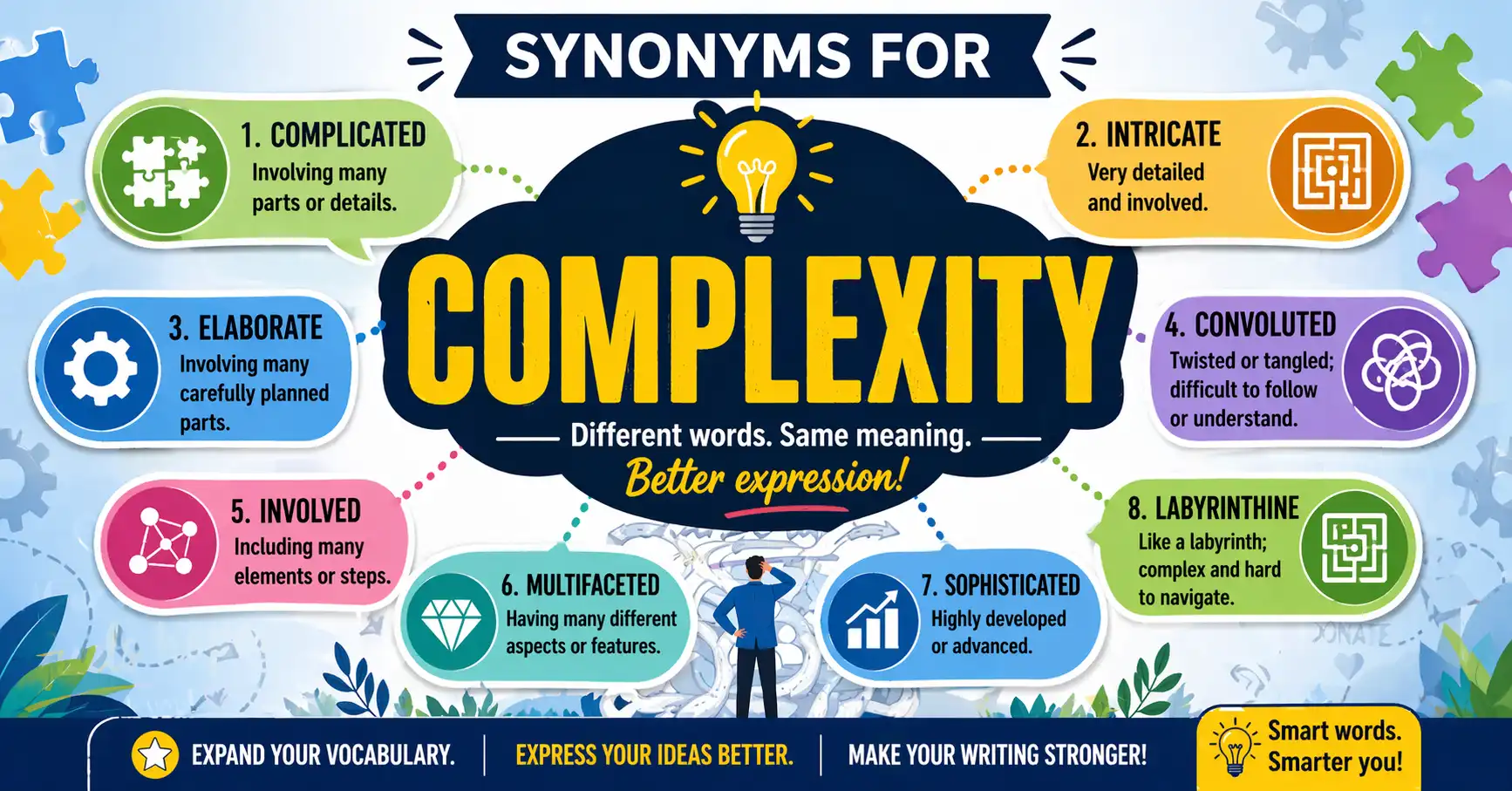
Do you ever feel stuck when trying to describe a situation that has too many moving parts? Imagine trying to explain how a smartphone works or why the plot of your favorite movie is so hard to follow. You might find synonyms for complexity, yourself repeating the same word over and over again. Learning different synonyms for complexity is a game-changer.
The word complexity simply means that something is not simple. It has many connected pieces, steps, or details that make it hard to understand all at once.
It helps students write better essays without sounding repetitive. For bloggers and content writers, it keeps readers hooked. Even in daily conversations, using the right word makes you sound clear and smart. Let’s dive into a massive list of synonyms for complexity that you can start using today.
1. Intricacy
Meaning: This means something has many small and detailed parts.
Examples:
- The intricacy of the watch made it hard to fix.
- I love the intricacy of the pattern on this dress.
2. Complication
Meaning: This is a new problem or detail that makes a situation harder.
Examples:
- There was a complication with our travel plans.
- The doctor explained the complication in simple words.
3. Convolution
Meaning: This means something is twisted, wound up, or very confusing to follow.
Examples:
- The convolution of the storyline confused the viewers.
- I got lost in the convolution of the old streets.
4. Density
Meaning: This means there is a lot of information or material packed closely together.
Examples:
- The density of the textbook made it hard to read quickly.
- We struggled to get through the density of the jungle.
5. Elaborateness
Meaning: This means something is planned or made with great care and many details.
Examples:
- The elaborateness of the party decorations surprised everyone.
- I marveled at the elaborateness of the palace design.
6. Entanglement
Meaning: This is a messy situation where things are tied or tangled together.
Examples:
- The wires were in a messy entanglement behind the TV.
- He wanted to avoid any financial entanglement with the company.
7. Involutedness
Meaning: This means something is curled inward or made very difficult to understand.
Examples:
- The involutedness of his essay made it hard to grade.
- We laughed at the involutedness of the legal rules.
8. Knottiness
Meaning: This means a problem is full of difficult points, just like a knot in a rope.
Examples:
- The knottiness of the math puzzle kept me up all night.
- Teachers help students handle the knottiness of tough topics.
9. Labyrinthineness
Meaning: This means a place or an idea feels like a huge, confusing maze.
Examples:
- The labyrinthineness of the ancient cave scared the hikers.
- I hate the labyrinthineness of big hospital buildings.
10. Multiplicity
Meaning: This means there is a very large number or variety of things.
Examples:
- There is a multiplicity of choices on the food menu.
- She handles a multiplicity of tasks at her job every day.
11. Perplexity
Meaning: This is the feeling of being confused because something is complicated.
Examples:
- She looked at the strange map with total perplexity.
- The sudden change in the weather caused great perplexity.
12. Sophistication
Meaning: This means a system or machine is highly advanced and well-developed.
Examples:
- The sophistication of the new software helps our business grow.
- I admire the sophistication of modern medical tools.
13. Tangledness
Meaning: This means things are mixed up together in a wild and messy way.
Examples:
- The tangledness of the old yarn made it useless.
- We need to fix the tangledness of these computer cords.
14. Tortuousness
Meaning: This means a path or a long story has many twists, turns, and tricks.
Examples:
- The tortuousness of the mountain road made me feel sick.
- I could not follow the tortuousness of his long explanation.
15. Daedal
Meaning: This means something is made with unusual skill and complex patterns.
Examples:
- The artist created a daedal design on the glass vase.
- Nature shows its daedal beauty in the structure of a leaf.
16. Gordian Knot
Meaning: This is a term for a huge, messy problem that seems impossible to solve.
Examples:
- Fixing the local traffic system is a real Gordian knot.
- The team finally cut through the Gordian knot of the project.
17. Hardness
Meaning: This means something takes a lot of effort, skill, or thought to do.
Examples:
- The hardness of the test surprised the entire class.
- She overcame the hardness of learning a new language.
18. Abstruseeness
Meaning: This means an idea is hidden so deep that it is hard to grasp.
Examples:
- The abstruseeness of the philosophy book bored the students.
- He explained the abstruseeness of science in a fun way.
19. Multifariousness
Meaning: This means having many different types of parts or duties all at once.
Examples:
- The multifariousness of her hobbies keeps her busy.
- We love the multifariousness of cultures in this big city.
20. Nuance
Meaning: This is a very small, subtle difference in meaning, feeling, or color.
Examples:
- You must listen closely to hear the nuance in her voice.
- The actor picked up every nuance of the character.
21. Subtlety
Meaning: This means a quality is fine, delicate, and not completely obvious.
Examples:
- The subtlety of the flavor made the soup taste amazing.
- I appreciate the subtlety of the artist’s paint strokes.
22. Difficulty
Meaning: This is something that is not easy to do or deal with.
Examples:
- We ran into a major difficulty during the science experiment.
- He climbed the steep hill without any real difficulty.
23. Maze
Meaning: This is a confusing network of paths or a messy mix of ideas.
Examples:
- The old office building was a total maze of doors.
- I got lost in a maze of rules at the bank.
24. Web
Meaning: This is a complex network of connected things, like a spider’s home.
Examples:
- The police uncovered a complex web of lies.
- The internet is a massive web of useful information.
25. Puzzle
Meaning: This is a situation, game, or toy that tests your cleverness.
Examples:
- Her sudden departure remains a total puzzle to us.
- This crossword puzzle is much harder than the last one.
26. Network
Meaning: This is a large system of lines or people that cross and connect.
Examples:
- The train network covers the entire country.
- She built a great network of friends at college.
27. Structure
Meaning: This is the way that parts are put together to build something.
Examples:
- The structure of the building is safe and strong.
- We learned about the sentence structure in English class.
28. Arrangement
Meaning: This is the specific plan or way things are placed together.
Examples:
- I love the flower arrangement on the dinner table.
- We made an arrangement to meet up next week.
29. Organization
Meaning: This is a neat and orderly group or system of moving parts.
Examples:
- The organization of the event took a lot of work.
- Her desk has an amazing system of organization.
30. Snarl
Meaning: This is a tangled mass of hair, threads, or even traffic.
Examples:
- The traffic snarl delayed our bus for two hours.
- She brushed the bad snarl out of her long hair.
31. Jungle
Meaning: This is a wild, messy, or crowded place that is hard to navigate.
Examples:
- The city market was a jungle of sounds and smells.
- My messy bedroom feels like a jungle right now.
32. Mesh
Meaning: This is a net-like structure where many threads or paths cross over.
Examples:
- The screen door has a fine wire mesh to keep bugs out.
- Their lives became a close mesh of shared interests.
33. Matrix
Meaning: This is an environment or grid system in which something develops.
Examples:
- The data was arranged in a clear matrix on the screen.
- Culture forms the matrix of our daily human behavior.
34. Scheme
Meaning: This is a large, organized plan or system for doing something.
Examples:
- The color scheme of the living room is very bright.
- They came up with a clever scheme to save money.
35. Skein
Meaning: This is a length of thread wound in a loose coil, or a confused mix.
Examples:
- She bought a blue skein of yarn to knit a scarf.
- He tried to untangle the skein of his complicated thoughts.
36. Anatomy
Meaning: This is the detailed inner structure or study of how something is made.
Examples:
- We studied the anatomy of a honeybee in science class.
- The book looks at the anatomy of a successful business.
37. Texture
Meaning: This is how the surface of something feels, or how it is put together.
Examples:
- The smooth texture of the silk felt nice on my skin.
- The music has a rich texture with many instruments playing.
38. Makeup
Meaning: This is the combination of qualities or parts that form something.
Examples:
- The genetic makeup of plants determines how they grow.
- A friendly attitude is part of his personal makeup.
39. Configuration
Meaning: This is the specific shape or arrangement of different parts.
Examples:
- We changed the configuration of the chairs for the meeting.
- The computer configuration allows it to run very fast.
40. Architecture
Meaning: This is the design, style, and structure of a building or system.
Examples:
- I love the ancient architecture of the churches in Rome.
- The software architecture is stable and easy to update.
41. Design
Meaning: This is a planned drawing or pattern that shows how something works.
Examples:
- The new car design uses much less gasoline.
- She draws a beautiful design on her notebook pages.
42. Pattern
Meaning: This is a regular, repeated arrangement of shapes, colors, or events.
Examples:
- The weather pattern shows that it rains every June.
- I like the striped pattern on your new shirt.
43. System
Meaning: This is a set of connected things or parts working together smoothly.
Examples:
- The cooling system keeps the food fresh in the fridge.
- Our school uses a new system to track student grades.
44. Setup
Meaning: This is the way that something is organized, ready, or arranged to work.
Examples:
- The computer setup on his desk looks amazing.
- I like the quick setup of this pop-up camping tent.
45. Profile
Meaning: This is the outline, structure, or set of characteristics of something.
Examples:
- The company has a high public profile in the tech world.
- This tool shows the detailed speed profile of the machine.
46. Compound
Meaning: This is a mix made of two or more separate elements or parts.
Examples:
- Water is a chemical compound of hydrogen and oxygen.
- The problem became a compound of stress and lack of sleep.
47. Aggregate
Meaning: This is a whole formed by combining several different elements.
Examples:
- The aggregate score of the two games decided the winner.
- Our website traffic is an aggregate of many small sources.
48. Ensemble
Meaning: This is a group of items or people viewed as a whole working together.
Examples:
- The jazz ensemble played beautiful music at the park.
- Her clothing ensemble looked perfect for a job interview.
49. Blend
Meaning: This is a mixture of different things that combine nicely together.
Examples:
- This hot tea is a delicious blend of lemon and mint.
- The movie is a perfect blend of action and comedy.
50. Synthesis
Meaning: This is the act of combining separate ideas or objects into a single system.
Examples:
- The essay was a brilliant synthesis of different opinions.
- His music style is a synthesis of rock and folk sounds.
Conclusion
Learning these synonyms for complexity is the secret to unlocking your writing potential. When you expand your vocabulary, your blogging, speaking, and essays become much more exciting to read. You no longer have to rely on the same boring words over and over again. Try using a few of these fresh terms in your next email, school assignment, or daily conversation to see how much clearer your communication becomes!

Robert Hayes is an ESL educator and curriculum developer with over nine years of experience teaching English to beginners and intermediate learners across multiple countries ( Biography ).