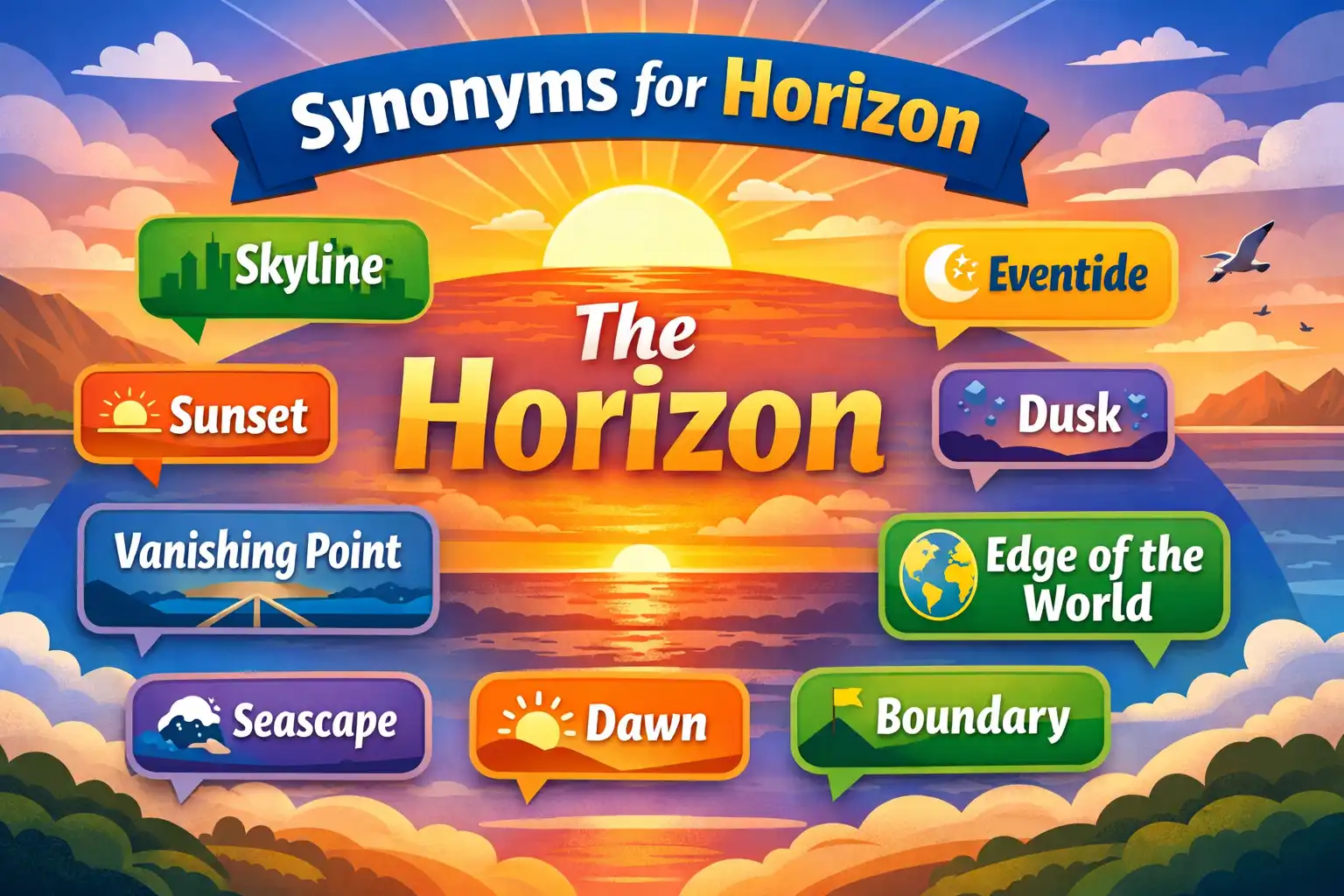
When you look out at the world, the line where the sky meets the earth is a beautiful view. Finding the right synonyms for horizon helps you describe this boundary perfectly. Using different synonyms for horizon makes your writing more descriptive, whether you are writing a story or an essay. Learning these synonyms for horizon expands your vocabulary and prevents your language from sounding repetitive.
Imagine standing on a quiet beach at 5:00 AM. The dark sky slowly changes to a bright orange, and you see a thin line where the ocean touches the clouds. That line is the horizon. It represents the edge of what you can see right now, but it also represents the beginning of something new. In everyday life, we use this word when we travel to a new city, start a new job, or learn a new skill.
“The horizon is the fine line that separates our current achievements from our future possibilities.”
For students, these vocabulary alternatives help you get better grades on essays by avoiding repetitive words. Bloggers and content writers can use these terms to paint vivid pictures for readers and keep them engaged. For daily English users, changing up your vocabulary helps you express deep feelings and clear thoughts during casual conversations.
“We all look at the same sky, but our individual horizons change based on how far we are willing to walk.”
Linguistic Breakdown of Horizon
- Connotative Meaning: Beyond the physical line where the earth meets the sky, “horizon” represents the limits of a person’s knowledge, experience, interest, or future opportunities.
- Etymology:
- Origin: Ancient Greek word orizon kyklos, which means “bounding circle.”
- Old French: Entered French as orizon.
- Late Middle English: Adopted into English in the late 14th century.
- Pronunciation:
- US IPA: /həˈraɪzən/
- UK IPA: /həˈraɪz(ə)n/
- Syllables: ho-ri-zon (3 syllables)
- Affixation Pattern: Root word with no active prefixes or suffixes. It forms adjectives like horizontal (root + -al) and horizonless (root + -less).
Word Comparison Table
| Keyword | Meaning | Usage Type | Context |
|---|---|---|---|
| Horizon | The line where the sky meets the land or sea. | Professional / Neutral | Daily use, nature writing, goal setting. |
| Skyline | The outline of land and buildings against the sky. | Visual / Neutral | City descriptions, travel blogs. |
| Vista | A beautiful view, especially from a high place. | Emotional / Literary | Travel, real estate, creative writing. |
| Boundary | A real or imaginary line that marks the edge of something. | Formal / Professional | Workplace rules, math, geography. |
| Outlook | A person’s point of view or general attitude toward life. | Casual / Professional | Mental health, business planning. |
| Periphery | The outer edge or boundary of an area. | Formal | Scientific writing, medical, academic. |
50 Synonyms for Horizon
1. Skyline
- Pronunciation: US: /ˈskaɪˌlaɪn/ | UK: /ˈskaɪlaɪn/
- Meaning: The shape of buildings and land against the sky.
- Examples:
- The New York skyline looks beautiful at night.
- I can see the mountain skyline from my bedroom window.
2. Vista
- Pronunciation: US: /ˈvɪstə/ | UK: /ˈvɪstə/
- Meaning: A beautiful view of a large area of land.
- Examples:
- We stopped at the top of the hill to admire the green vista.
- This balcony offers a lovely vista of the valley.
3. Outlook
- Pronunciation: US: /ˈaʊtˌlʊk/ | UK: /ˈaʊtlʊk/
- Meaning: A view from a specific place looking out.
- Examples:
- The room has a pleasant outlook over the garden.
- From this high cliff, the outlook is completely open.
4. Prospect
- Pronunciation: US: /ˈprɑːspɛkt/ | UK: /ˈprɒspɛkt/
- Meaning: A wide view of the landscape below you.
- Examples:
- The house stands on a hill with a fine prospect of the sea.
- They enjoyed the open prospect from the castle tower.
5. Scope
- Pronunciation: US: /skoʊp/ | UK: /skəʊp/
- Meaning: The whole area that you can see or deal with.
- Examples:
- The wide scope of the desert surprised the travelers.
- This map shows the full scope of the national park.
6. Range of Vision
- Pronunciation: US: /reɪndʒ ʌv ˈvɪʒən/ | UK: /reɪndʒ ɒv ˈvɪʒən/
- Meaning: The space or distance that your eyes can see.
- Examples:
- The thick fog reduced my range of vision to five feet.
- A deer stepped directly into my range of vision.
7. Line of Sight
- Pronunciation: US: /laɪn ʌv saɪt/ | UK: /laɪn ɒv saɪt/
- Meaning: An imaginary straight line from your eyes to an object.
- Examples:
- Keep the children in your line of sight while they swim.
- A large tree blocked my line of sight to the stage.
8. Boundary
- Pronunciation: US: /ˈbaʊndəri/ | UK: /ˈbaʊndri/
- Meaning: The edge line that shows where a place ends.
- Examples:
- The river forms a natural boundary between the two farms.
- We walked all the way to the park boundary.
9. Verge
- Pronunciation: US: /vɜːrdʒ/ | UK: /vɜːdʒ/
- Meaning: The edge or border of a piece of land.
- Examples:
- The sun hid just behind the verge of the hills.
- We stood on the verge of the deep canyon.
10. Limit
- Pronunciation: US: /ˈlɪmɪt/ | UK: /ˈlɪmɪt/
- Meaning: The farthest point or edge of something.
- Examples:
- We rode our bicycles to the very limit of the town.
- The eye cannot see past the limit of the sea.
11. Periphery
- Pronunciation: US: /pəˈrɪfəri/ | UK: /pəˈrɪfəri/
- Meaning: The outer edge of an area or object.
- Examples:
- I saw some small houses on the periphery of the city.
- The guard walked around the periphery of the camp.
12. Border
- Pronunciation: US: /ˈbɔːrdər/ | UK: /ˈbɔːdə/
- Meaning: The line where one area ends and another begins.
- Examples:
- We planted colorful flowers along the border of the yard.
- The ocean forms the western border of our country.
13. Margin
- Pronunciation: US: /ˈmɑːrdʒɪn/ | UK: /ˈmɑːdʒɪn/
- Meaning: The empty space or area near the outer edge.
- Examples:
- Birds love to nest along the margin of the lake.
- We sat down to rest at the margin of the woods.
14. Rim
- Pronunciation: US: /rɪm/ | UK: /rɪm/
- Meaning: The outside circular edge of something round.
- Examples:
- The sun began to peek over the rim of the canyon.
- He stood carefully on the rim of the old volcano.
15. Fringe
- Pronunciation: US: /frɪndʒ/ | UK: /frɪndʒ/
- Meaning: The outer edge that is far from the center.
- Examples:
- They set up their tents on the fringe of the desert.
- Trees grew thickly along the fringe of the field.
16. Bounds
- Pronunciation: US: /baʊndz/ | UK: /baʊndz/
- Meaning: The legal or physical limits of a specific space.
- Examples:
- The soccer ball bounced out of the bounds of the field.
- You must not walk beyond the bounds of the school.
17. Extent
- Pronunciation: US: /ɪkˈstɛnt/ | UK: /ɪkˈstɛnt/
- Meaning: The total area or distance that something covers.
- Examples:
- From the airplane, we saw the full extent of the forest.
- The true extent of the valley is hidden by clouds.
18. Compass
- Pronunciation: US: /ˈkʌmpəs/ | UK: /ˈkʌmpəs/
- Meaning: The total area or range that is within view.
- Examples:
- The mountain range lay within the compass of our vision.
- He tried to hold the vast view in the compass of his mind.
19. Purview
- Pronunciation: US: /ˈpɜːrvjuː/ | UK: /ˈpɜːvjuː/
- Meaning: The range or limit of what you can see or understand.
- Examples:
- The faraway ships were outside the purview of our small telescope.
- That bright star falls directly within the purview of my lens.
20. Sweep
- Pronunciation: US: /swiːp/ | UK: /swiːp/
- Meaning: A long, wide, and continuous curve of land.
- Examples:
- The grand sweep of the bay took our breath away.
- We watched the wide sweep of the plains from the train.
21. Panorama
- Pronunciation: US: /ˌpænəˈræmə/ | UK: /ˌpænəˈrɑːmə/
- Meaning: A view of a wide area in all directions around you.
- Examples:
- The top of the tower gives a full panorama of the city.
- We took a photo of the mountain panorama at sunrise.
22. Background
- Pronunciation: US: /ˈbækˌɡraʊnd/ | UK: /ˈbækɡraʊnd/
- Meaning: The part of a picture or view that is farthest away.
- Examples:
- You can see blue hills in the background of the painting.
- The ocean serves as a lovely background for our photos.
23. Distance
- Pronunciation: US: /ˈdɪstəns/ | UK: /ˈdɪstəns/
- Meaning: The sweet space that is very far away from you.
- Examples:
- A lone sailboat appeared out in the blue distance.
- The mountains faded into the distance as we drove away.
24. Offing
- Pronunciation: US: /ˈɔːfɪŋ/ | UK: /ˈɒfɪŋ/
- Meaning: The part of the deep sea that you can see from the shore.
- Examples:
- A large fishing boat was visible in the offing.
- Storm clouds are gathering out in the offing tonight.
25. Sea Line
- Pronunciation: US: /siː laɪn/ | UK: /siː laɪn/
- Meaning: The clean line where the ocean meets the open sky.
- Examples:
- The sun dipped low right below the straight sea line.
- We watched the birds fly along the distant sea line.
26. Vanishing Point
- Pronunciation: US: /ˈvænɪʃɪŋ pɔɪnt/ | UK: /ˈvænɪʃɪŋ pɔɪnt/
- Meaning: The point where parallel lines seem to meet far away.
- Examples:
- The straight highway seemed to disappear at the vanishing point.
- The train tracks run all the way to the vanishing point.
27. Perimeter
- Pronunciation: US: /pəˈrɪmɪtər/ | UK: /pəˈrɪmɪtə/
- Meaning: The continuous line that goes around the outside of a shape.
- Examples:
- They built a wooden fence around the perimeter of the park.
- We walked along the perimeter of the empty field.
28. Confines
- Pronunciation: US: /ˈkɑːnfaɪnz/ | UK: /ˈkɒnfaɪnz/
- Meaning: The outer limits or borders of a particular place.
- Examples:
- The children played safely within the confines of the yard.
- Please do not step outside the confines of the camp.
29. Skirt
- Pronunciation: US: /skɜːrt/ | UK: /skɜːt/
- Meaning: The outer edge or border of an area or town.
- Examples:
- A small dirt road runs along the skirt of the woods.
- We drove around the southern skirt of the quiet village.
30. Terminus
- Pronunciation: US: /ˈtɜːrmɪnəs/ | UK: /ˈtɜːmɪnəs/
- Meaning: The very end point of a path or piece of land.
- Examples:
- This rocky cliff is the terminus of our long hiking trail.
- We finally reached the geographic terminus of the valley.
31. Brink
- Pronunciation: US: /brɪŋk/ | UK: /brɪŋk/
- Meaning: The extreme edge of land before a steep drop.
- Examples:
- The curious boy stood near the brink of the deep pool.
- A lone tree grows right on the brink of the cliff.
32. Breadth
- Pronunciation: US: /brɛdθ/ | UK: /brɛtθ/
- Meaning: The wide distance from one side of a view to the other.
- Examples:
- The grand breadth of the ocean filled him with peace.
- We looked out across the entire breadth of the green valley.
33. Reach
- Pronunciation: US: /riːtʃ/ | UK: /riːtʃ/
- Meaning: The farthest distance that a person can see or touch.
- Examples:
- The islands are beyond the reach of human eyesight.
- The vast desert lands extend past the reach of our map.
34. Extremity
- Pronunciation: US: /ɪkˈstrɛmɪti/ | UK: /ɪkˈstrɛmɪti/
- Meaning: The furthest point or very end of something big.
- Examples:
- We walked out to the furthest extremity of the sandy beach.
- The lighthouse marks the northern extremity of the small island.
35. Scenery
- Pronunciation: US: /ˈsiːnəri/ | UK: /ˈsiːnəri/
- Meaning: The beautiful general appearance of a natural landscape view.
- Examples:
- The mountain scenery in this state is absolutely beautiful.
- We stopped our car often to look at the countryside scenery.
36. Outskirts
- Pronunciation: US: /ˈaʊtˌskɜːrts/ | UK: /ˈaʊtskɜːts/
- Meaning: The outer parts of a town or a large city.
- Examples:
- They bought a cozy house on the outskirts of London.
- The new factory was built on the quiet outskirts of town.
37. Threshold
- Pronunciation: US: /ˈθrɛʃhoʊld/ | UK: /ˈθrɛʃhəʊld/
- Meaning: The line or point where a new area begins.
- Examples:
- The explorers stood on the threshold of a new continent.
- We crossed the threshold of the dark forest with care.
38. Termination
- Pronunciation: US: /ˌtɜːrmɪˈneɪʃən/ | UK: /ˌtɜːmɪˈneɪʃən/
- Meaning: The final boundary line where something comes to an end.
- Examples:
- The termination of the property line is marked by a stone wall.
- Follow this path until you reach its natural termination at the lake.
39. Frame of Reference
- Pronunciation: US: /freɪm ʌv ˈrɛfərəns/ | UK: /freɪm ɒv ˈrɛfrəns/
- Meaning: The boundary of what you can perceive or notice around you.
- Examples:
- The massive mountain filled our whole frame of reference.
- Keep your camera steady within this specific frame of reference.
40. Outer Limit
- Pronunciation: US: /ˈaʊtər ˈlɪmɪt/ | UK: /ˈaʊtə ˈlɪmɪt/
- Meaning: The farthest possible edge of an area or space.
- Examples:
- The spaceship traveled to the outer limit of the solar system.
- We hiked to the outer limit of the safe mountain path.
41. Field of Vision
- Pronunciation: US: /fiːld ʌv ˈvɪʒən/ | UK: /fiːld ɒv ˈvɪʒən/
- Meaning: The entire area that a person can see without turning their head.
- Examples:
- A large bird flew quickly across my field of vision.
- The tall trees blocked a big part of my field of vision.
42. Flank
- Pronunciation: US: /flæŋk/ | UK: /flæŋk/
- Meaning: The side or outer edge of a large land feature.
- Examples:
- The sun sank slowly behind the western flank of the mountain.
- A small path winds along the rocky flank of the hill.
43. Borderline
- Pronunciation: US: /ˈbɔːrdərˌlaɪn/ | UK: /ˈbɔːdəlaɪn/
- Meaning: A dividing line that sits between two distinct spaces.
- Examples:
- We walked right along the borderline of the two state parks.
- The stone fence serves as a clear borderline for the cows.
44. Landline
- Pronunciation: US: /ˈlændˌlaɪn/ | UK: /ˈlændlaɪn/
- Meaning: The visual line where flat land meets the open sky.
- Examples:
- The farm buildings look like tiny dots on the distant landline.
- A beautiful orange glow appeared above the flat landline.
45. Edge
- Pronunciation: US: /ɛdʒ/ | UK: /ɛdʒ/
- Meaning: The outer point where something ends and another thing begins.
- Examples:
- Don’t sit too close to the sharp edge of the rock.
- We walked down to the water’s edge to collect seashells.
46. Frontier
- Pronunciation: US: /frʌnˈtɪr/ | UK: /frʌnˈtɪə/
- Meaning: The extreme edge of settled land or known space.
- Examples:
- The early pioneers traveled out across the wild western frontier.
- Deep space is often called the final frontier for humans.
47. Line of Demarcation
- Pronunciation: US: /laɪn ʌv ˌdiːmɑːrˈkeɪʃən/ | UK: /laɪn ɒv ˌdiːmɑːˈkeɪʃən/
- Meaning: A clear line that marks a boundary or separates two areas.
- Examples:
- The fence acts as a line of demarcation between our yards.
- The river forms a distinct line of demarcation on the map.
48. Sweep of the Eye
- Pronunciation: US: /swiːp ʌv ði aɪ/ | UK: /swiːp ɒv ði aɪ/
- Meaning: The entire wide view you can take in with a single glance.
- Examples:
- The whole valley was visible in one grand sweep of the eye.
- Her sweep of the eye took in the blue ocean and the sand.
49. Sideline
- Pronunciation: US: /ˈsaɪdˌlaɪn/ | UK: /ˈsaɪdlaɪn/
- Meaning: The outer lines that show the side boundaries of a space.
- Examples:
- The coach stood just past the sideline of the field.
- We watched the parade from the sideline of the main street.
50. Extreme Boundary
- Pronunciation: US: /ɪkˈstriːm ˈbaʊndəri/ | UK: /ɪkˈstriːm ˈbaʊndri/
- Meaning: The absolute farthest edge of a geographic region or view.
- Examples:
- The mountain range marks the extreme boundary of our kingdom.
- They traveled past the extreme boundary of the desert map.
“To write well is to constantly push back the borders of your own language and discover new verbal landscapes.”
Antonyms of Horizon
If you want to say the exact opposite of a wide, open view, you can use these words:
- Center: The middle point of an area, far away from the edges.
- Interior: The inside part of a country, building, or space.
- Core: The central or innermost part of an object or region.
- Heart: The deepest or central part of a place (e.g., the heart of the city).
- Enclosure: An area that is completely sealed or surrounded by walls.
Prototype Meaning and Categorization
In linguistics, the prototype meaning of “horizon” belongs to the spatial geometry and visual perception categories. It is categorized as a continuous noun that establishes a reference point for human orientation. It serves as a mental tool to separate what is visible from what is hidden, which is why it easily transitions into abstract categories like “human knowledge” and “future goals.”
Frequently Asked Questions
What is the most common synonym for horizon?
The most common synonym is skyline when you are talking about cities or mountains, and vista or view when you are talking about open nature scenes.
Can horizon mean a goal or a future plan?
Yes. In casual and professional English, people say “new horizons” to mean new opportunities, career goals, or fresh life experiences.
What is the difference between a horizon and a skyline?
A horizon is the natural line where the earth or sea meets the sky. A skyline is the specific shape that buildings, houses, or mountains make against that sky.
Is horizon a formal word?
It is a neutral word. You can use it freely in casual conversations, creative stories, business meetings, and scientific reports.
What does “on the horizon” mean?
This is a popular English idiom. It means that something is going to happen very soon, such as a new project, a storm, or a big life change.
Conclusion
Expanding your vocabulary by learning new words changes how you connect with the world. When you use diverse terms instead of repeating the same old words, your writing becomes instantly more alive. For bloggers and content creators, using creative language keeps your readers glued to the page and improves your search engine rankings. For students, it shows teachers that you understand the deep nuances of the English language, leading to better essay grades.
Do not let your language stay inside a tiny box. Try using these fresh words in your next work email, school paper, or casual chat with a close friend. The more you practice, the more natural these terms will feel to you.
“Words are the vehicles of our thoughts; the larger your vocabulary, the further your mind can travel.”
“Never settle for ordinary words when you have a whole universe of language waiting to be explored.”

Robert Hayes is an ESL educator and curriculum developer with over nine years of experience teaching English to beginners and intermediate learners across multiple countries ( Biography ).