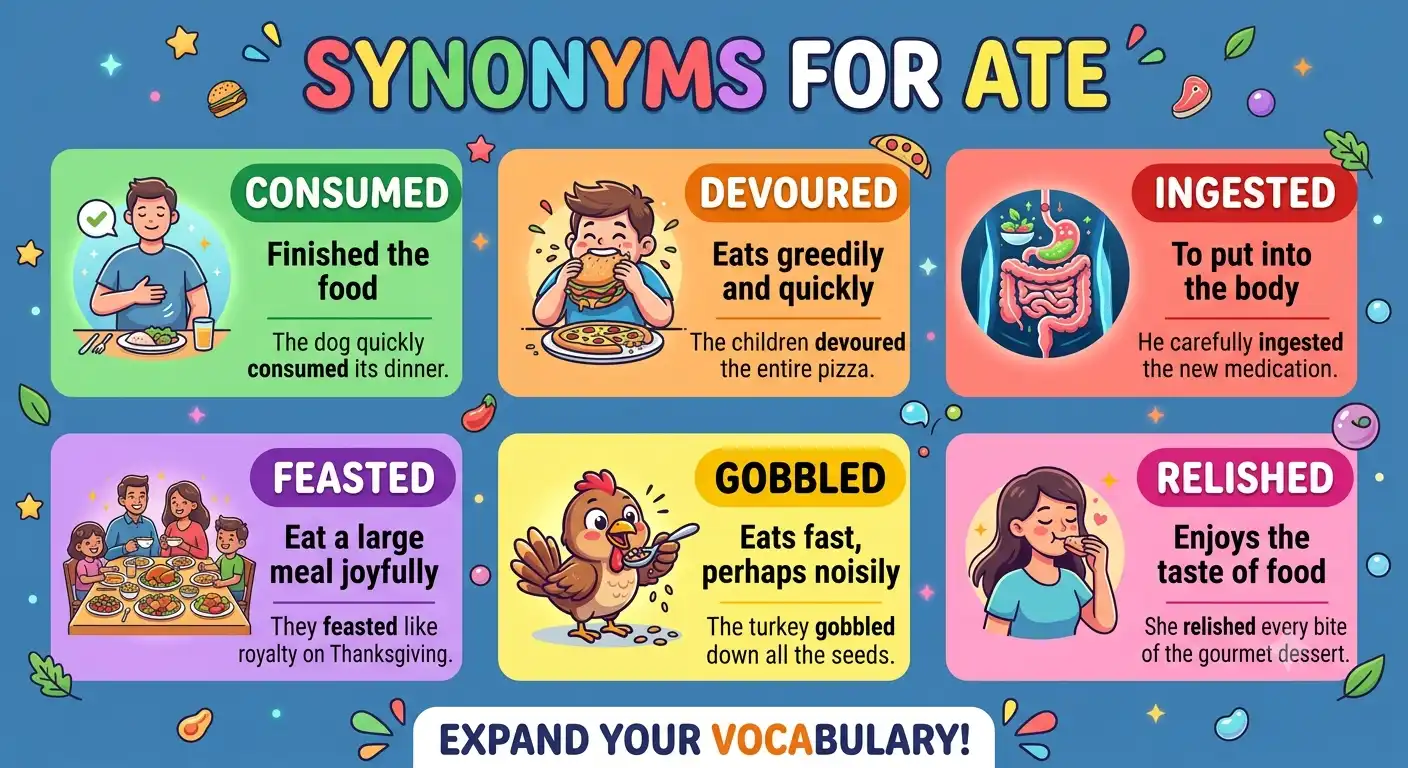
Finding exact synonyms for ate helps you describe meals, food habits, and dining experiences with great clarity. Learning different synonyms for ate allows you to make your stories, school essays, and daily chats far more colorful. Using clear synonyms for ate keeps your language lively, precise, and easy for everyone to read.
Imagine sitting down with your family for a warm Sunday dinner. Instead of telling your friends that you simply “ate” your favorite meal, saying you devoured a pizza or dined on fresh pasta paints a clear mental picture. Choosing precise words helps your listener feel the exact mood of your meal.
When someone enjoys food, they might say they ate a quick breakfast before heading to work. The word ate means that a person or animal took in food through the mouth and swallowed it. Understanding varied synonyms for ate offers major benefits to four key groups:
- Students write descriptive stories and get higher marks on English papers.
- Bloggers write appetizing food reviews that keep readers scrolling.
- Content writers rank higher in search results with natural vocabulary.
- Daily English users express everyday experiences smoothly without repeating words.
“The right word turns a routine meal description into a vivid story.”
“A rich vocabulary lets you share simple daily moments with total clarity.”
Linguistic Breakdown of “Ate”
Connotative Meaning
The word ate has a neutral connotation on its own. Depending on the synonym you choose, it can sound polite, greedy, rushed, or informal. In modern slang, “ate” can also mean doing something with great success or style.
Etymology
- Origin: Derived from Old English æt (past tense of etan).
- Root Words: Proto-Germanic *ēt and Proto-Indo-European *ed- (meaning to eat).
- Historical Shift: The word has maintained its core meaning of consuming food for over a thousand years, while expanding into figurative speech today.
Pronunciation
- US (IPA): /eɪt/
- UK (IPA): /et/ or /eɪt/
Syllables & Affixation Pattern
- Syllables: 1 syllable (ate)
- Base Structure: Irregular past tense form of the verb eat
- Grammatical Patterns:
- Past Tense Verb: Ate
- Present Verb: Eat
- Past Participle: Eaten
- Continuous Verb: Eating
Comparison Table: Common Synonyms for Ate
| Keyword | Meaning | Usage Type | Context |
| Devoured | Ate quickly because of intense hunger | Expressive / Enthusiastic | Meals after long workouts, fast dining |
| Dined | Ate a formal or relaxed meal | Formal / Professional | Fancy restaurants, holiday family dinners |
| Munched | Ate steady bites with crunching sounds | Casual / Daily | Snack time, eating popcorn at movies |
| Nibbled | Ate very small bites slowly | Casual / Gentle | Light breakfasts, tasting appetizers |
| Consumed | Took in food, drink, or energy fully | Technical / Official | Health reports, science papers, nutrition |
| Gobbled | Ate fast and noisily in large swallows | Casual / Playful | Kids eating sweets, quick lunch breaks |
| Savored | Ate slowly to enjoy every flavor | Emotional / Descriptive | Wine tasting, gourmet desserts, treats |
50 Best Synonyms for Ate
1. Devoured
- Pronunciation: US /dɪˈvaʊ.ɚd/ | UK /dɪˈvaʊ.əd/
- Meaning: Devoured means ate food very quickly because you were hungry.
- Examples:
- The hungry dog devoured the bowl of food in two minutes.
- We devoured the warm pie right after coming home.
2. Consumed
- Pronunciation: US /kənˈsuːmd/ | UK /kənˈsjuːmd/
- Meaning: Consumed means ate or drank something completely.
- Examples:
- He consumed a large bowl of soup during lunch.
- Athletes consumed plenty of water after the big race.
3. Dined
- Pronunciation: US /daɪnd/ | UK /daɪnd/
- Meaning: Dined means ate a nice formal meal with family or friends.
- Examples:
- They dined at a quiet seaside cafe last night.
- Our family dined together on Christmas evening.
4. Gobbled
- Pronunciation: US /ˈɡɑː.bəld/ | UK /ˈɡɒb.əld/
- Meaning: Gobbled means ate food fast and in big gulps.
- Examples:
- The boy gobbled his sandwich so he could go play.
- She gobbled down her breakfast before the school bus arrived.
5. Munched
- Pronunciation: US /mʌntʃt/ | UK /mʌntʃt/
- Meaning: Munched means ate crunchy food with steady bites.
- Examples:
- We munched fresh popcorn while watching the movie.
- She munched on a ripe apple during her work break.
6. Scarfed
- Pronunciation: US /skɑːrft/ | UK /skɑːft/
- Meaning: Scarfed means ate food very fast without stopping.
- Examples:
- He scarfed down three slices of pizza after practice.
- The kids scarfed their ice cream before it melted.
7. Nibbled
- Pronunciation: US /ˈnɪb.əld/ | UK /ˈnɪb.əld/
- Meaning: Nibbled means ate tiny bits of food very slowly.
- Examples:
- The little mouse nibbled on a piece of cheese.
- She nibbled her toast while reading the morning news.
8. Swallowed
- Pronunciation: US /ˈswɑː.loʊd/ | UK /ˈswɒl.əʊd/
- Meaning: Swallowed means passed food down your throat into your stomach.
- Examples:
- He swallowed his food quickly and asked for water.
- She chewed her fruit carefully before she swallowed.
9. Ingested
- Pronunciation: US /ɪnˈdʒes.tɪd/ | UK /ɪnˈdʒes.tɪd/
- Meaning: Ingested means took food or liquid into the body.
- Examples:
- The doctor checked if the child ingested any bad seeds.
- Birds ingested small berries from the garden bushes.
10. Gorged
- Pronunciation: US /ɡɔːrdʒd/ | UK /ɡɔːdʒd/
- Meaning: Gorged means ate a huge amount of food until very full.
- Examples:
- We gorged on sweet berries at the fruit farm.
- The guests gorged themselves at the party table.
“Matching the exact word to how you ate makes your writing pop.”
11. Bolted
- Pronunciation: US /boʊl.tɪd/ | UK /bəʊl.tɪd/
- Meaning: Bolted means swallowed food very fast without chewing well.
- Examples:
- He bolted his cereal so he would not be late.
- Do not bolt your food or your stomach will hurt.
12. Chowed
- Pronunciation: US /tʃaʊd/ | UK /tʃaʊd/
- Meaning: Chowed means ate food in a hearty and informal way.
- Examples:
- The workers chowed down on hot burgers at noon.
- We chowed on tacos during the weekend game.
13. Downed
- Pronunciation: US /daʊnd/ | UK /daʊnd/
- Meaning: Downed means ate or drank something quickly in one go.
- Examples:
- She downed a glass of fresh milk after her walk.
- He downed two boiled eggs before starting his shift.
14. Polished off
- Pronunciation: US /ˈpɑː.lɪʃt ɑːf/ | UK /ˈpɒl.ɪʃt ɒf/
- Meaning: Polished off means finished eating all the food completely.
- Examples:
- They polished off the entire chocolate cake in one night.
- I polished off my salad before the main meal came.
15. Tasted
- Pronunciation: US /ˈteɪ.stɪd/ | UK /ˈteɪ.stɪd/
- Meaning: Tasted means ate a small sample of food to try it.
- Examples:
- Chef tasted the hot soup before serving the guests.
- She tasted the strawberry jam on a plain cracker.
16. Grazed
- Pronunciation: US /ɡreɪzd/ | UK /ɡreɪzd/
- Meaning: Grazed means ate small snacks slowly throughout the day.
- Examples:
- We grazed on nuts and fruit all afternoon.
- The cattle grazed peacefully on the green grass.
17. Wolfed
- Pronunciation: US /wʊlft/ | UK /wʊlft/
- Meaning: Wolfed means ate food greedily like a hungry animal.
- Examples:
- The boy wolfed down his dinner to watch the cartoon.
- He wolfed his lunch in under three minutes.
18. Relished
- Pronunciation: US /ˈrel.ɪʃt/ | UK /ˈrel.ɪʃt/
- Meaning: Relished means ate and enjoyed food with great delight.
- Examples:
- She relished every single bite of the warm pastry.
- They relished the fresh seafood by the beach.
19. Savored
- Pronunciation: US /ˈseɪ.vɚd/ | UK /ˈseɪ.vəd/
- Meaning: Savored means ate food slowly to enjoy the full taste.
- Examples:
- He savored the dark chocolate melt on his tongue.
- We savored our meal while listening to soft music.
20. Feasted
- Pronunciation: US /ˈfiː.stɪd/ | UK /ˈfiː.stɪd/
- Meaning: Feasted means ate a big and wonderful meal with delight.
- Examples:
- The family feasted on roast turkey and sweet pies.
- Villagers feasted together during the harvest festival.
21. Dispatched
- Pronunciation: US /dɪˈspætʃt/ | UK /dɪˈspætʃt/
- Meaning: Dispatched means finished eating food with fast efficiency.
- Examples:
- He quickly dispatched his plate of rice and chicken.
- The team dispatched their meal and returned to work.
22. Demolished
- Pronunciation: US /dɪˈmɑː.lɪʃt/ | UK /dɪˈmɒl.ɪʃt/
- Meaning: Demolished means ate a large portion of food until nothing remained.
- Examples:
- The teenagers demolished four large pizzas after swimming.
- She completely demolished her bowl of fruit salad.
23. Inhaled
- Pronunciation: US /ɪnˈheɪld/ | UK /ɪnˈheɪld/
- Meaning: Inhaled means ate food so quickly it seemed like breathing it in.
- Examples:
- He was so hungry that he basically inhaled his lunch.
- The runner inhaled a banana right after crossing the finish line.
24. Gulped
- Pronunciation: US /ɡʌlpt/ | UK /ɡʌlpt/
- Meaning: Gulped means swallowed food or drink quickly in big amounts.
- Examples:
- She gulped down her soup because it was getting cold.
- The boy gulped his food and ran out to play.
25. Packed away
- Pronunciation: US /pækt əˈweɪ/ | UK /pækt əˈweɪ/
- Meaning: Packed away means ate a surprisingly large amount of food.
- Examples:
- The little boy packed away three full pancakes.
- Uncle John packed away a huge plate of pasta.
26. Slurped
- Pronunciation: US /slɝːpt/ | UK /slɜːpt/
- Meaning: Slurped means ate or drank wet food with loud sounds.
- Examples:
- He slurped his hot noodle soup with joy.
- The child slurped the remaining melted ice cream.
27. Banqueted
- Pronunciation: US /ˈbæŋ.kwə.tɪd/ | UK /ˈbæŋ.kwɪ.tɪd/
- Meaning: Banqueted means ate at a grand and special celebration dinner.
- Examples:
- Royal guests banqueted inside the palace hall.
- They banqueted in honor of the winning sports team.
28. Supped
- Pronunciation: US /sʌpt/ | UK /sʌpt/
- Meaning: Supped means ate an evening meal or light supper.
- Examples:
- They supped on hot broth and fresh bread by the fire.
- She supped quietly in her room before bed.
29. Breakfasted
- Pronunciation: US /ˈbrek.fə.stɪd/ | UK /ˈbrek.fə.stɪd/
- Meaning: Breakfasted means ate the first meal of the morning.
- Examples:
- We breakfasted on pancakes and fresh orange juice.
- The travelers breakfasted early at the country inn.
30. Lunched
- Pronunciation: US /lʌntʃt/ | UK /lʌntʃt/
- Meaning: Lunched means ate a middle-of-the-day meal.
- Examples:
- Business partners lunched at a nearby city restaurant.
- She lunched on a tuna sandwich in the garden.
31. Partook
- Pronunciation: US /pɑːrˈtʊk/ | UK /pɑːˈtʊk/
- Meaning: Partook means joined others in eating a meal or snack.
- Examples:
- Guests partook of tea and light biscuits.
- He partook in the wedding feast with great joy.
32. Nourished
- Pronunciation: US /ˈnɝː.ɪʃt/ | UK /ˈnʌr.ɪʃt/
- Meaning: Nourished means ate healthy food to make the body strong.
- Examples:
- She nourished her body with fresh greens and soups.
- The warm stew nourished the cold travelers.
33. Tucked into
- Pronunciation: US /tʌkt ˈɪn.tuː/ | UK /tʌkt ˈɪn.tuː/
- Meaning: Tucked into means started eating food with great eagerness.
- Examples:
- They tucked into the hot meal as soon as it arrived.
- He tucked into his roast dinner with a big smile.
34. Bit
- Pronunciation: US /bɪt/ | UK /bɪt/
- Meaning: Bit means cut into food using your teeth.
- Examples:
- She bit into the juicy red apple with a loud crunch.
- He bit his sandwich and passed the rest to his friend.
35. Digested
- Pronunciation: US /daɪˈdʒes.tɪd/ | UK /daɪˈdʒes.tɪd/
- Meaning: Digested means processed food inside the stomach after eating.
- Examples:
- He rested on the couch while his stomach digested lunch.
- The body digested the simple meal with ease.
36. Bitten
- Pronunciation: US /ˈbɪt.ən/ | UK /ˈbɪt.ən/
- Meaning: Bitten means taken a bite out of food using teeth.
- Examples:
- Someone had already bitten into the soft bread roll.
- She showed the apple that had been bitten.
37. Cleared
- Pronunciation: US /klɪrd/ | UK /klɪəd/
- Meaning: Cleared means ate every piece of food off a plate.
- Examples:
- The hungry boy cleared his entire plate in minutes.
- She cleared her dinner bowl before asking for dessert.
38. Finished
- Pronunciation: US /ˈfɪn.ɪʃt/ | UK /ˈfɪn.ɪʃt/
- Meaning: Finished means completed eating a meal or food item.
- Examples:
- Have you finished your breakfast yet?
- He finished his meal and wiped his mouth with a napkin.
39. Hammered
- Pronunciation: US /ˈhæm.ɚd/ | UK /ˈhæm.əd/
- Meaning: Hammered means ate a lot of food quickly and heavily.
- Examples:
- The team hammered down burgers after winning the cup.
- We hammered the buffet table until we were stuffed.
40. Sunk
- Pronunciation: US /sʌŋk/ | UK /sʌŋk/
- Meaning: Sunk means pushed teeth into food or put away a meal easily.
- Examples:
- He sunk his teeth into the thick steak slice.
- She sunk a whole bowl of noodles in minutes.
41. Chomped
- Pronunciation: US /tʃɑːmpt/ | UK /tʃɒmpt/
- Meaning: Chomped means chewed food forcefully with loud bites.
- Examples:
- The horse chomped on fresh carrot sticks.
- He chomped his celery stick during the break.
42. Feasted upon
- Pronunciation: US /ˈfiː.stɪd əˈpɑːn/ | UK /ˈfiː.stɪd əˈpɒn/
- Meaning: Feasted upon means ate a magnificent dish with delight.
- Examples:
- They feasted upon roast chicken and fresh breads.
- The king feasted upon delicate sweets at the banquet.
43. Grazed on
- Pronunciation: US /ɡreɪzd ɑːn/ | UK /ɡreɪzd ɒn/
- Meaning: Grazed on means ate light snacks slowly over time.
- Examples:
- We grazed on fruit slices while working on the computer.
- She grazed on roasted almonds all through the trip.
44. Snacked
- Pronunciation: US /snækt/ | UK /snækt/
- Meaning: Snacked means ate small amounts of light food between main meals.
- Examples:
- He snacked on grapes after finishing school.
- They snacked on cheese crackers before dinner time.
45. Slayed
- Pronunciation: US /sleɪd/ | UK /sleɪd/
- Meaning: Slayed means performed or handled something with total success (slang).
- Examples:
- She totally slayed that outfit at the party.
- The singer slayed her stage performance tonight.
46. Absorbed
- Pronunciation: US /əbˈzɔːrbd/ | UK /əbˈzɔːbd/
- Meaning: Absorbed means took in food nutrients into the body.
- Examples:
- Her body absorbed the vitamins from the fresh fruit.
- The plant absorbed water and liquid food from soil.
47. Snarfed
- Pronunciation: US /snɑːrft/ | UK /snɑːft/
- Meaning: Snarfed means ate or drank something very greedily and fast.
- Examples:
- He snarfed down the chocolate cookies in secret.
- She snarfed her lunch so she could catch the bus.
48. Feasted on
- Pronunciation: US /ˈfiː.stɪd ɑːn/ | UK /ˈfiː.stɪd ɒn/
- Meaning: Feasted on means enjoyed a large meal with great pleasure.
- Examples:
- We feasted on homemade pasta at grandma’s house.
- They feasted on fresh fish caught from the lake.
49. Dined on
- Pronunciation: US /daɪnd ɑːn/ | UK /daɪnd ɒn/
- Meaning: Dined on means ate specific food items during a formal meal.
- Examples:
- The guests dined on grilled salmon and roasted corn.
- We dined on warm soup on a chilly night.
50. Filled up
- Pronunciation: US /fɪld ʌp/ | UK /fɪld ʌp/
- Meaning: Filled up means ate enough food to become completely satisfied.
- Examples:
- He filled up on warm bread before the main dish came.
- Eat a healthy breakfast so you fill up for the day.
Antonyms of “Ate”
Knowing words with opposite meanings helps you describe fasting, appetite loss, or food refusal clearly:
- Fasted: Deliberately abstained from eating food for a period of time.
- Starved: Suffered from severe lack of food or extreme hunger.
- Refused: Declined to take or eat food offered to you.
- Vomited: Ejected food from the stomach back through the mouth.
- Dieted: Limited food intake carefully to lose weight or stay healthy.
- Abstained: Chose not to eat or consume specific foods.
Prototype Meaning & Categorization of “Ate”
The primary concept of ate centers around taking food into the body, processing it, or enjoying a meal. These 50 synonyms divide into four natural functional groups:
- Fast, Greedy, & Energetic Eating: Devoured, gobbled, scarfed, gorged, bolted, chowed, downed, wolfed, inhaled, gulped, packed away, demolished, hammered, snarfed.
- Formal, Relaxed, & Social Dining: Dined, feasted, banqueted, supped, breakfasted, lunched, partook, dined on, feasted on, feasted upon.
- Slow, Light, & Casual Nibbling: Munched, nibbled, tasted, grazed, slurped, grazed on, snacked, bit, chomped, fill up.
- Physical, Medical, & Slang Meanings: Consumed, swallowed, ingested, relished, savored, dispatched, polished off, nourished, digested, bitten, cleared, finished, sunk, slayed, absorbed, tucked into.
Frequently Asked Questions (FAQs)
1. What is the most common formal synonym for “ate”?
In formal writing and reports, terms like “consumed,” “dined,” or “partook” serve as ideal choices.
2. Can “ate” be used as slang?
Yes! In modern slang, saying someone “ate” or “ate that up” means they did something exceptionally well, such as performing or dressing stylishly.
3. What is the difference between “gobbled” and “nibbled”?
Gobbled means eating very fast in big gulps. Nibbled means taking tiny, slow bites.
4. Which synonym for “ate” works best for food blogs?
For food reviews and culinary blogging, words like “savored,” “relished,” “feasted,” or “tasted” add rich description.
5. What is the difference between “dined” and “chowed”?
Dined refers to a polite, formal, or quiet meal. Chowed is an informal, casual slang word for eating heartily.
6. How does using diverse synonyms for “ate” help SEO?
Using varied vocabulary prevents repetitive text, matches diverse search queries, and keeps readers engaged on your page longer.
Conclusion
Expanding your knowledge of synonyms for ate brings energy, precision, and variety to your writing. Replacing a plain word with specific choices like devoured, dined, munched, or savored ensures your reader visualizes the exact scene you want to share.
Whether you write student essays, publish food blog posts, send daily work emails, or chat with friends, picking exact vocabulary builds instant confidence. Bright, clear language removes boring repetition and transforms simple notes into engaging stories. Start practicing these 50 synonyms today to elevate your English communication!
“Clear choices in everyday words bring life to every story you tell.”
“Mastering exact vocabulary turns simple thoughts into powerful expressions.”

Robert Hayes is an ESL educator and curriculum developer with over nine years of experience teaching English to beginners and intermediate learners across multiple countries ( Biography ).