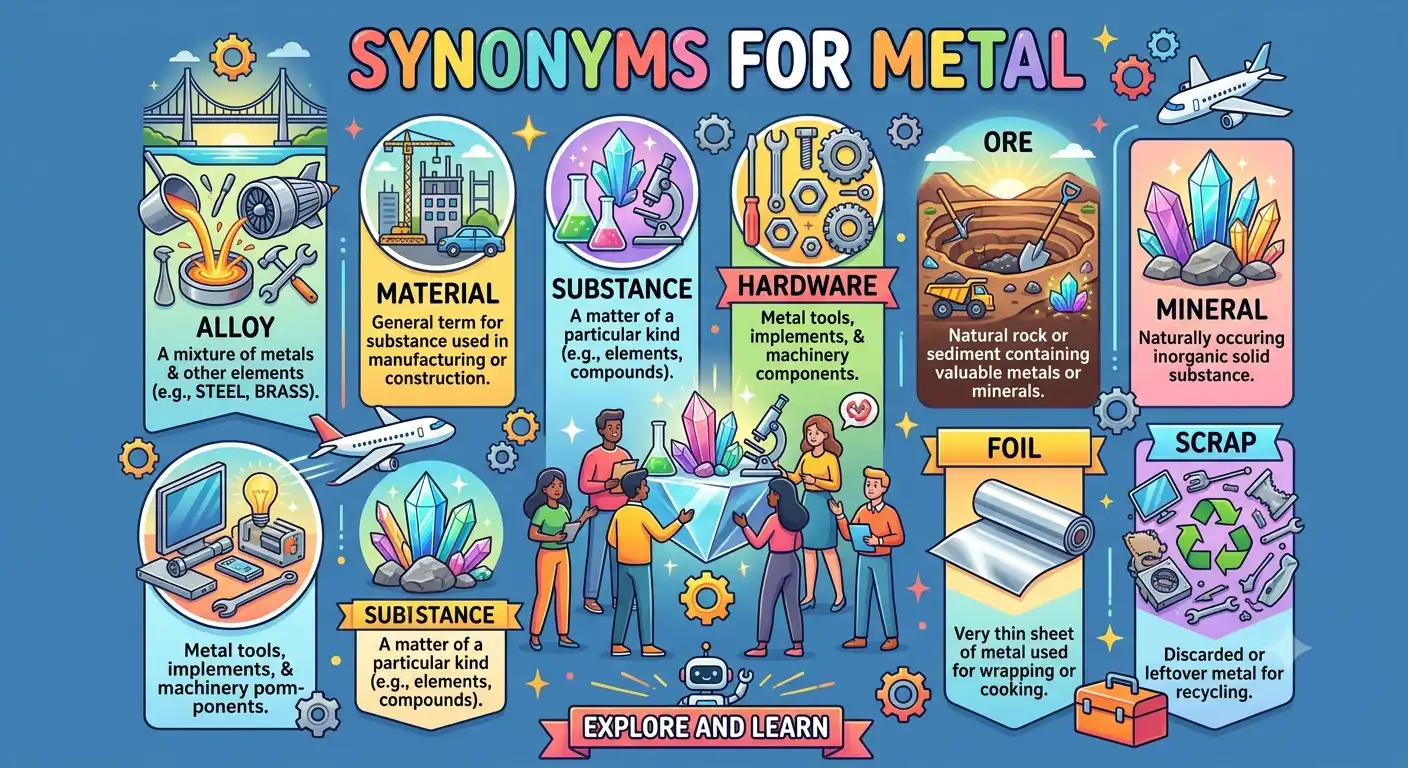
Finding exact synonyms for metal helps you describe raw materials, building supplies, and personal strength with great clarity. Learning different synonyms for metal allows you to make your stories, school essays, and daily talks far more vivid. Using clear synonyms for metal keeps your language strong, precise, and easy for every reader to follow.
Imagine walking past a busy city construction site on a bright morning. A builder carries heavy steel beams while a repair team replaces bright copper pipes in a new home. Instead of calling every hard material plain “metal,” using distinct words like alloy, hardware, or ironwork paints an exact mental picture.
For instance, when a blacksmith crafts a sturdy gate, you can say they shaped custom ironwork. Understanding varied synonyms for metal offers major benefits to four key groups:
- Students write detailed science reports and earn higher grades in English class.
- Bloggers write engaging DIY guides and product reviews that keep readers on the page.
- Content writers rank higher in search results by using natural, descriptive words.
- Daily English users share ideas clearly in personal and workplace conversations.
“The right word turns a basic description into a clear mental picture.”
“A precise vocabulary gives strength, clarity, and authority to your words.”
Linguistic Breakdown of “Metal”
Connotative Meaning
The word metal carries strong, durable, and practical connotations. It suggests physical hardness, shiny surfaces, electrical conduction, and industrial utility. Figuratively, it also connects to personal bravery, grit, and resilience under pressure.
Etymology
- Origin: Derived from Old French metal and Latin metallum (meaning metal, mine, or quarry).
- Root Words: Greek metallon (meaning mine, quarry, or mineral wealth).
- Historical Shift: Originally meant a mine or extracted mineral, then shifted to describe shiny, malleable elements, and later expanded to describe inner strength (mettle).
Pronunciation
- US (IPA): /ˈmet̬.əl/
- UK (IPA): /ˈmet.əl/
Syllables & Affixation Pattern
- Syllables: 2 syllables (met-al)
- Base Structure: Noun root metal
- Grammatical Patterns:
- Noun: Metal / Metals
- Adjective: Metallic
- Verb Form: Metalize / Metalizing
Comparison Table: Common Synonyms for Metal
| Keyword | Meaning | Usage Type | Context |
| Alloy | A mixture of two or more combined metals | Technical / Professional | Manufacturing, Engineering, & Chemistry |
| Ore | Raw rock containing valuable natural minerals | Industrial / Scientific | Mining, Geology, & Natural Resources |
| Steel | A strong, hard alloy of iron and carbon | Industrial / Daily | Construction, Tools, & Building Work |
| Hardware | Physical metal tools, fasteners, and fixtures | Practical / Commercial | Home Improvement, Repair, & Stores |
| Mettle | Inner courage, stamina, and personal strength | Emotional / Figurative | Sports, Challenges, & Personal Character |
| Element | A pure chemical substance found on the periodic table | Academic / Technical | Science Class, Chemistry, & Research |
| Armor | Protective metal covering used for safety in battle | Historical / Descriptive | History, Gaming, & Protective Gear |
50 Best Synonyms for Metal
1. Alloy
- Pronunciation: US /ˈæl.ɔɪ/ | UK /ˈæl.ɔɪ/
- Meaning: Alloy means a solid material made by melting two or more metals together.
- Examples:
- Brass is a useful alloy made from copper and zinc.
- The factory uses a strong aluminum alloy to build light airplanes.
2. Ore
- Pronunciation: US /ɔːr/ | UK /ɔː/
- Meaning: Ore means natural rock that holds valuable minerals or metals inside.
- Examples:
- Miners dug deep into the earth to extract iron ore.
- The company processes raw ore to extract pure silver.
3. Steel
- Pronunciation: US /stiːl/ | UK /stiːl/
- Meaning: Steel means a heavy and tough material made from iron and carbon.
- Examples:
- Workers raised high steel beams to build the city skyscraper.
- Kitchen knives made of stainless steel stay sharp for years.
4. Hardware
- Pronunciation: US /ˈhɑːrd.wer/ | UK /ˈhɑːd.weər/
- Meaning: Hardware means solid metal tools, nails, screws, and building parts.
- Examples:
- He bought heavy brass hinges at the local hardware store.
- Secure all loose wooden boards with sturdy metal hardware.
5. Ironwork
- Pronunciation: US /ˈaɪ.ɚn.wɝːk/ | UK /ˈaɪ.ən.wɜːk/
- Meaning: Ironwork means items or structures crafted artfully out of iron.
- Examples:
- The old mansion had beautiful ironwork on its front gate.
- Blacksmiths created custom ironwork for the balcony railing.
6. Element
- Pronunciation: US /ˈel.ə.mənt/ | UK /ˈel.ɪ.mənt/
- Meaning: Element means a simple chemical substance that cannot be broken down further.
- Examples:
- Gold is a dense chemical element found in nature.
- Students memorized every shiny element on the periodic table chart.
7. Mineral
- Pronunciation: US /ˈmɪn.ɚ.əl/ | UK /ˈmɪn.ər.əl/
- Meaning: Mineral means a natural solid substance formed under the ground.
- Examples:
- Quartz is a common mineral found in many rocks.
- The cave walls sparkled with rich mineral deposits.
8. Brass
- Pronunciation: US /bræs/ | UK /brɑːs/
- Meaning: Brass means a bright yellow alloy made from copper and zinc.
- Examples:
- She polished the shiny brass door handle until it gleamed.
- Musicians played loud tunes on their brass trumpets.
9. Bronze
- Pronunciation: US /brɑːnz/ | UK /brɒnz/
- Meaning: Bronze means a reddish-brown alloy made mostly of copper and tin.
- Examples:
- The runner received a shiny bronze medal for third place.
- An ancient bronze statue stood in the middle of the plaza.
10. Copper
- Pronunciation: US /ˈkɑː.pɚ/ | UK /ˈkɒp.ər/
- Meaning: Copper means a soft reddish metal that conducts electricity very well.
- Examples:
- Electricians used long copper wires inside the kitchen walls.
- Rain water flowed smoothly down the rust-free copper pipe.
“Choosing precise terms turns simple descriptions into engaging storytelling.”
11. Iron
- Pronunciation: US /ˈaɪ.ɚn/ | UK /ˈaɪ.ən/
- Meaning: Iron means a common magnetic metal used to make tough tools and structures.
- Examples:
- The heavy iron skillet cooked the pancakes evenly.
- Cast iron fences surround the historic park garden.
12. Sheet metal
- Pronunciation: US /ʃiːt ˈmet̬.əl/ | UK /ʃiːt ˈmet.əl/
- Meaning: Sheet metal means metal formed into thin and flat pieces.
- Examples:
- The mechanic cut sheet metal to repair the damaged car roof.
- Roofers installed sheet metal panels to protect the shed.
13. Wire
- Pronunciation: US /ˈwaɪ.ɚ/ | UK /ˈwaɪ.ər/
- Meaning: Wire means a long thin strand of flexible drawn metal.
- Examples:
- He wrapped thin steel wire around the garden fence posts.
- Copper wire carries electricity into every room of the house.
14. Foil
- Pronunciation: US /fɔɪl/ | UK /fɔɪl/
- Meaning: Foil means metal hammered or rolled into a paper-thin sheet.
- Examples:
- Wrap the leftover warm bread in aluminum foil.
- Shiny gold foil covered the expensive chocolate box.
15. Plate
- Pronunciation: US /pleɪt/ | UK /pleɪt/
- Meaning: Plate means a flat rigid sheet of smooth metal.
- Examples:
- Thick steel plate covered the floor of the heavy truck.
- The ship builder welded armor plate onto the boat sides.
16. Ingot
- Pronunciation: US /ˈɪŋ.ɡət/ | UK /ˈɪŋ.ɡət/
- Meaning: Ingot means a block of steel or gold cast into a simple shape.
- Examples:
- Bank guards stored each heavy gold ingot inside the vault.
- Workers poured molten silver into a brick-shaped ingot mold.
17. Rod
- Pronunciation: US /rɑːd/ | UK /rɒd/
- Meaning: Rod means a straight round bar made of solid metal.
- Examples:
- The curtain hung from a long brushed-nickel rod.
- Builders placed a steel rod inside the concrete column.
18. Bar
- Pronunciation: US /bɑːr/ | UK /bɑː/
- Meaning: Bar means a solid long piece of rigid metal material.
- Examples:
- Heavy iron bars protected the basement windows from outside.
- He lifted a steel bar during his daily weight workout.
19. Slab
- Pronunciation: US /slæb/ | UK /slæb/
- Meaning: Slab means a thick and broad flat piece of solid metal or stone.
- Examples:
- Cranes lifted a massive slab of raw iron into the factory furnace.
- The workshop floor rested on a thick metal slab.
20. Mettle
- Pronunciation: US /ˈmet̬.əl/ | UK /ˈmet.əl/
- Meaning: Mettle means inner courage, spirit, and strength of character.
- Examples:
- The tough storm tested the true mettle of the young sailors.
- She showed great mettle by finishing the long mountain trail.
21. Courage
- Pronunciation: US /ˈkɝː.ɪdʒ/ | UK /ˈkʌr.ɪdʒ/
- Meaning: Courage means brave strength to face danger, pain, or difficulty without fear.
- Examples:
- The brave firefighter showed deep courage during the rescue.
- It takes real courage to stand up and speak your mind.
22. Grit
- Pronunciation: US /ɡrɪt/ | UK /ɡrɪt/
- Meaning: Grit means firm courage and passion to finish hard long-term goals.
- Examples:
- Her grit helped her complete her degree while working night shifts.
- The athlete showed true grit in the final minutes of the race.
23. Fortitude
- Pronunciation: US /ˈfɔːr.t̬ə.tuːd/ | UK /ˈfɔː.tɪ.tjuːd/
- Meaning: Fortitude means emotional strength and patience when enduring hard times.
- Examples:
- They faced tough financial times with remarkable fortitude.
- Physical fortitude helps endurance runners finish long races.
24. Armor
- Pronunciation: US /ˈɑːr.mɚ/ | UK /ˈɑː.mər/
- Meaning: Armor means strong metal suit worn to protect the body in combat.
- Examples:
- Knights wore heavy steel armor into battle long ago.
- The military vehicle was covered in thick protective armor.
25. Shield
- Pronunciation: US /ʃiːld/ | UK /ʃiːld/
- Meaning: Shield means a handheld piece of metal armor used to block attacks.
- Examples:
- The guard blocked incoming arrows using his iron shield.
- Police officers carried clear riot shields for personal protection.
26. Chainmail
- Pronunciation: US /ˈtʃeɪn.meɪl/ | UK /ˈtʃeɪn.meɪl/
- Meaning: Chainmail means flexible armor made from small interlocking metal rings.
- Examples:
- Medieval soldiers wore flexible chainmail under their heavy coats.
- Divers wear stainless steel chainmail suits to protect against sharks.
27. Lead
- Pronunciation: US /led/ | UK /led/
- Meaning: Lead means a heavy and soft dull-gray metallic element.
- Examples:
- X-ray rooms use dense lead aprons for radiation protection.
- Old fishing weights were made from heavy gray lead.
28. Gold
- Pronunciation: US /ɡoʊld/ | UK /ɡəʊld/
- Meaning: Gold means a valuable soft yellow metal used for jewelry and coins.
- Examples:
- She wore a shiny gold ring on her left hand.
- The winning athlete proudly held up his gold medal.
29. Silver
- Pronunciation: US /ˈsɪl.vɚ/ | UK /ˈsɪl.vər/
- Meaning: Silver means a shiny white precious metal used in coins and mirrors.
- Examples:
- We polished the antique silver spoons before holiday dinner.
- The sleek silver car sparkled in the afternoon sunlight.
30. Platinum
- Pronunciation: US /ˈplæt̬.nəm/ | UK /ˈplæt.ɪ.nəm/
- Meaning: Platinum means a rare silvery-white metal that resists corrosion extremely well.
- Examples:
- Jewelers use durable platinum to set valuable diamond rings.
- The catalytic converter contains small traces of platinum.
31. Titanium
- Pronunciation: US /taɪˈteɪ.ni.əm/ | UK /taɪˈteɪ.ni.əm/
- Meaning: Titanium means a very strong, lightweight, and rust-resistant metallic element.
- Examples:
- Modern spacecraft use titanium parts because they stay strong under heat.
- He wore lightweight titanium glass frames on his face.
32. Aluminum
- Pronunciation: US /əˈluː.mə.nəm/ | UK /ˌæl.jəˈmɪn.i.əm/
- Meaning: Aluminum means a lightweight silvery metal used for soda cans and foil.
- Examples:
- Workers loaded light aluminum ladders onto the work truck.
- Drink companies recycle millions of aluminum cans each year.
33. Zinc
- Pronunciation: US /zɪŋk/ | UK /zɪŋk/
- Meaning: Zinc means a bluish-white metal used to coat steel against rust.
- Examples:
- Steel pipes receive a protective layer of zinc during galvanizing.
- Sunscreen lotion contains safe minerals made from zinc oxide.
34. Tin
- Pronunciation: US /tɪn/ | UK /tɪn/
- Meaning: Tin means a soft silvery metal used to line food cans.
- Examples:
- Grandma stored her homemade cookies inside a decorative tin box.
- Solder wire contains a mix of tin and copper.
35. Nickel
- Pronunciation: US /ˈnɪk.əl/ | UK /ˈnɪk.əl/
- Meaning: Nickel means a hard silvery-white metal used in coins and stainless alloys.
- Examples:
- Shiny nickel plating covered the bathroom water faucet.
- Modern battery cells require high-grade refined nickel.
36. Chrome
- Pronunciation: US /kroʊm/ | UK /krəʊm/
- Meaning: Chrome means shiny chromium metal coating used for trim and decoration.
- Examples:
- The classic motorcycle sported bright chrome bumpers and handles.
- She cleaned the chrome fixtures in the modern bathroom.
37. Pewter
- Pronunciation: US /ˈpjuː.t̬ɚ/ | UK /ˈpjuː.tər/
- Meaning: Pewter means a gray alloy made mostly of tin mixed with copper.
- Examples:
- They served cider in traditional hand-crafted pewter mugs.
- The antique shop sold small decorative pewter figurines.
38. Stainless steel
- Pronunciation: US /ˌsteɪn.ləs ˈstiːl/ | UK /ˌsteɪn.ləs ˈstiːl/
- Meaning: Stainless steel means a rust-resistant steel alloy containing chromium.
- Examples:
- The kitchen features sleek stainless steel appliances throughout.
- Surgeons use sterile instruments made of high-grade stainless steel.
39. Scrap metal
- Pronunciation: US /skræp ˈmet̬.əl/ | UK /skræp ˈmet.əl/
- Meaning: Scrap metal means leftover or discarded metal pieces ready for recycling.
- Examples:
- The yard bought old car bodies for recycling scrap metal.
- Workers sorted copper and aluminum into scrap metal bins.
40. Casting
- Pronunciation: US /ˈkæs.tɪŋ/ | UK /ˈkɑː.stɪŋ/
- Meaning: Casting means an object shaped by pouring liquid metal into a mold.
- Examples:
- The engine block is a solid iron casting made at the factory.
- The foundry inspects every heavy bronze casting for cracks.
41. Forging
- Pronunciation: US /ˈfɔːr.dʒɪŋ/ | UK /ˈfɔː.dʒɪŋ/
- Meaning: Forging means a metal part shaped by heating and hammering.
- Examples:
- The smith created a tough steel forging for the axe head.
- High-stress engine valves require precise steel forging.
42. Fixture
- Pronunciation: US /ˈfɪks.tʃɚ/ | UK /ˈfɪks.tʃər/
- Meaning: Fixture means a piece of metal equipment fixed securely in place.
- Examples:
- We replaced the old brass lighting fixture in the hallway.
- The plumber tightened the stainless steel sink fixture.
43. Fastener
- Pronunciation: US /ˈfæs.nɚ/ | UK /ˈfɑː.snər/
- Meaning: Fastener means a hardware item like a bolt or screw that joins parts.
- Examples:
- Tighten every steel fastener before turning on the machine.
- Stainless steel fasteners hold the outdoor deck railing securely.
44. Cable
- Pronunciation: US /ˈkeɪ.bəl/ | UK /ˈkeɪ.bəl/
- Meaning: Cable means a thick strong rope made of twisted steel wires.
- Examples:
- A heavy steel cable held the elevator safely in place.
- Suspension bridges hang from massive steel cables overhead.
45. Rebar
- Pronunciation: US /ˈriː.bɑːr/ | UK /ˈriː.bɑː/
- Meaning: Rebar means steel bars used to reinforce concrete structures.
- Examples:
- Construction crews laid steel rebar before pouring the concrete floor.
- Strong rebar prevents the bridge foundation from cracking.
46. Steelwork
- Pronunciation: US /ˈstiːl.wɝːk/ | UK /ˈstiːl.wɜːk/
- Meaning: Steelwork means structural steel beams and frames used in building.
- Examples:
- Painters coated the outdoor steelwork with anti-rust paint.
- Engineers checked the structural steelwork of the new stadium.
47. Metalwork
- Pronunciation: US /ˈmet̬.əl.wɝːk/ | UK /ˈmet.əl.wɜːk/
- Meaning: Metalwork means the art or process of shaping items from metal.
- Examples:
- The museum displayed ancient Roman gold metalwork.
- Students learned basic welding and sheet metalwork in trade school.
48. Hardness
- Pronunciation: US /ˈhɑːrd.nəs/ | UK /ˈhɑːd.nəs/
- Meaning: Hardness means the quality of being firm, solid, and difficult to scratch.
- Examples:
- Titanium is prized in engineering for its extreme surface hardness.
- The tool maker tested the hardness of the heat-treated steel blade.
49. Toughness
- Pronunciation: US /ˈtʌf.nəs/ | UK /ˈtʌf.nəs/
- Meaning: Toughness means the physical ability to absorb impacts without breaking.
- Examples:
- Steel alloys are selected for their high structural toughness.
- The helmet armor showed incredible toughness during safety tests.
50. Heavy metal
- Pronunciation: US /ˌhev.i ˈmet̬.əl/ | UK /ˌhev.i ˈmet.əl/
- Meaning: Heavy metal means a dense metallic element or a loud rock music genre.
- Examples:
- Environmental scientists test water for toxic heavy metal content.
- The band played loud heavy metal music at the weekend concert.
Antonyms of “Metal”
Knowing opposite terms helps you describe delicate, non-metallic, or weak materials clearly:
- Nonmetal: An element or material that lacks metallic properties like shine or conductivity.
- Plastic: A synthetic lightweight material shaped easily when warm.
- Wood: The natural fibrous organic material derived from tree trunks.
- Glass: A brittle transparent material made by melting sand and minerals.
- Fabric: A soft woven material made from cloth or synthetic fibers.
- Weakness: A lack of physical strength, resistance, or personal grit.
Prototype Meaning & Categorization of “Metal”
The core concept of metal centers on hard physical materials, extracted minerals, structural supplies, and figurative courage. These 50 synonyms divide into four natural functional groups:
- Pure Elements & Extracted Minerals: Ore, element, mineral, copper, iron, lead, gold, silver, platinum, titanium, aluminum, zinc, tin, nickel, heavy metal.
- Manufactured Alloys & Industrial Forms: Alloy, steel, sheet metal, wire, foil, plate, ingot, rod, bar, slab, bronze, brass, chrome, pewter, stainless steel, scrap metal, casting, forging.
- Hardware, Supplies, & Structural Parts: Hardware, ironwork, armor, shield, chainmail, fixture, fastener, cable, rebar, steelwork, metalwork.
- Figurative Strength & Material Properties: Mettle, courage, grit, fortitude, hardness, toughness.
Frequently Asked Questions (FAQs)
1. What is the most common technical synonym for “metal”?
In scientific and manufacturing contexts, terms like “element,” “alloy,” or “ore” serve as exact technical choices depending on purity.
2. What is the difference between “metal” and “mettle”?
Metal refers to physical metallic substances like iron or gold. Mettle is a homophone that refers to inner courage, stamina, and personal character.
3. Which synonym for “metal” works best for construction writing?
For construction and trade blogs, terms like “steelwork,” “hardware,” “rebar,” or “sheet metal” convey clear practical detail.
4. Can “brass” or “bronze” be used as direct synonyms for metal?
Yes! Both brass and bronze are specific types of metallic alloys, making them ideal descriptive synonyms when referring to specific objects.
5. Why is “grit” listed as a synonym for metal?
“Metal” is often used figuratively to describe inner strength and determination. Words like “grit,” “courage,” and “fortitude” match this figurative intent.
6. How does using varied synonyms for “metal” improve SEO?
Using accurate synonyms prevents repetitive phrasing, matches diverse search queries, and signals high topical depth (Semantic SEO) to search engines.
Conclusion
Expanding your knowledge of synonyms for metal brings precision, variety, and strength to your daily communication. Replacing a repetitive word with exact choices like alloy, hardware, steelwork, or grit ensures your message lands with authority every single time.
Whether you are writing academic essays, building DIY blogs, drafting business reports, or chatting in daily conversations, choosing exact vocabulary builds instant confidence. Bright, clear language removes unnecessary fluff and turns simple sentences into engaging content. Start practicing these 50 synonyms today to elevate your English writing and speaking skills!
“Clear word choices bring quiet strength and authority to every message.”
“Mastering exact vocabulary turns simple thoughts into powerful expressions.”

Robert Hayes is an ESL educator and curriculum developer with over nine years of experience teaching English to beginners and intermediate learners across multiple countries ( Biography ).