Do you struggle to understand or use simple English words in daily conversations or writing? You are not alone. Many ESL beginners find it difficult to build a strong foundation because they don’t know where to start. That’s exactly where basic English vocabulary with example sentences becomes essential.
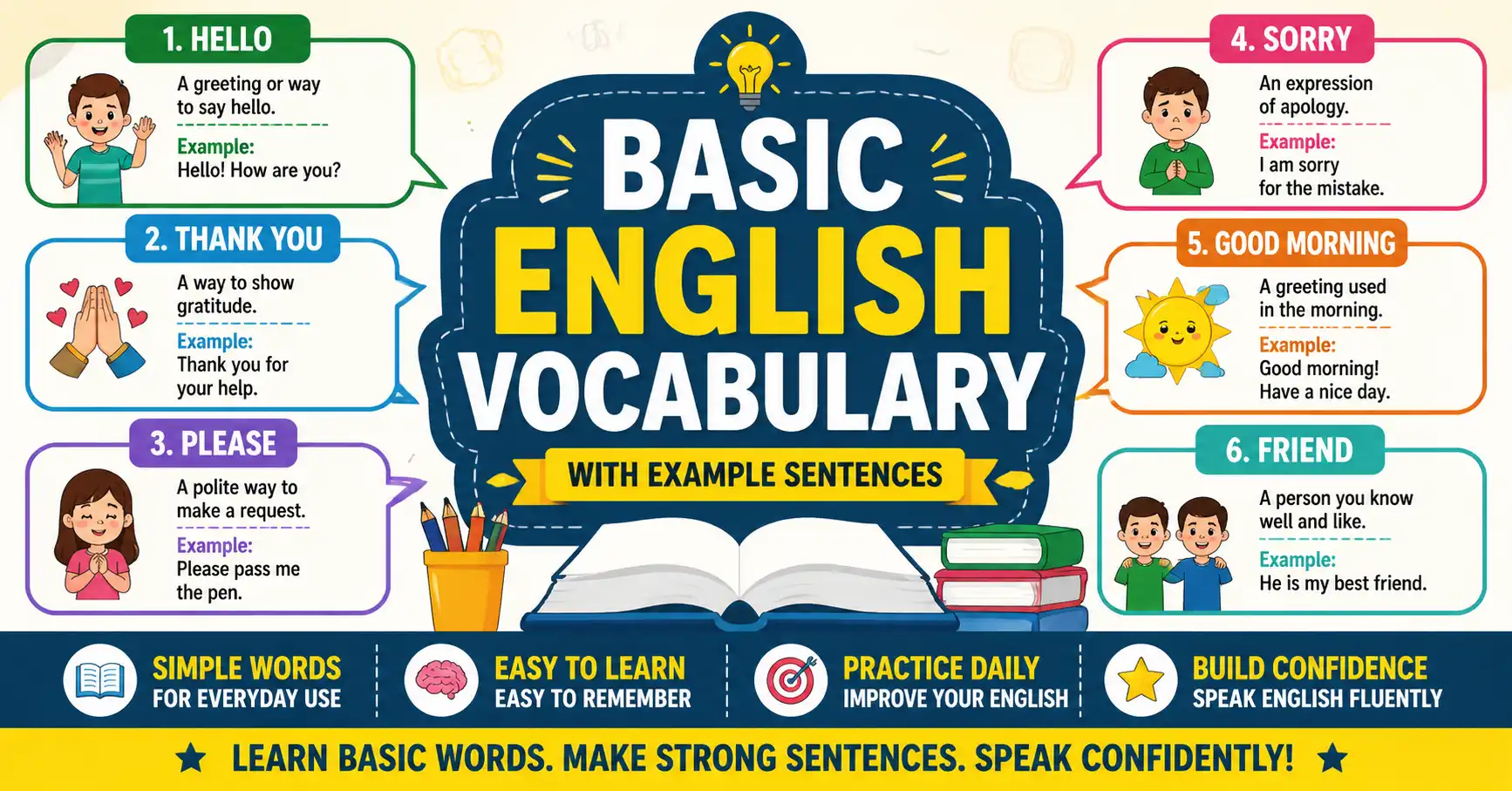
In this guide, you will learn common everyday words, their meanings, and how to use them correctly in sentences. Instead of memorizing long word lists, you will see how each word works in real situations. This makes learning faster and more effective.
As an ESL educator with 9 years of experience, I’ve seen students improve quickly when they focus on practical usage rather than theory. This article will give you clear explanations, useful synonyms, and real-life examples to help you build confidence in English.
Quick Answer:
Basic English vocabulary with example sentences means learning simple, commonly used English words along with sentences that show how to use them correctly in real-life situations. This method helps you understand meaning, context, and usage at the same time, making it easier to speak and write naturally.
What does “basic English vocabulary” mean?
Basic English vocabulary refers to the most common words used in everyday communication. These include words like go, make, eat, happy, and big. They are essential for beginners because they form the foundation of speaking, reading, and writing.
In ESL learning, these words are often part of A1–A2 level vocabulary. According to international language standards such as CEFR, mastering basic vocabulary is the first step toward fluency.
Why example sentences matter
Learning words alone is not enough. You need context.
Example sentences:
- Show how words are used naturally
- Help you remember meaning faster
- Improve grammar and sentence structure
ESL Note:
When you learn a word, always learn at least one sentence with it. This builds real communication skills, not just memory.
Complete Synonyms List
Here are simple synonyms related to common basic vocabulary concepts:
- Simple → Easy
- Big → Large
- Small → Tiny
- Happy → Glad
- Fast → Quick
- Start → Begin
- End → Finish
- Help → Assist
- Make → Create
- Get → Receive
These synonyms are important because they expand your vocabulary without making learning too difficult.
Comparison Table
| Word | Simple Meaning | Best Used When | Avoid When |
| Big | Large size | Talking casually | Formal writing |
| Large | Bigger than average | Academic writing | Casual speech |
| Happy | Feeling good | Daily conversation | Formal essays |
| Glad | Slightly formal happy | Emails, polite tone | Informal chat |
| Start | Begin something | Everyday speech | Academic essays |
| Begin | Formal start | Essays, reports | Casual talk |
Formal vs Informal Synonyms
| Informal Word | Formal Equivalent |
| Get | Obtain |
| Help | Assist |
| Buy | Purchase |
| Ask | Inquire |
| Tell | Inform |
| Start | Commence |
According to academic writing conventions, formal words are preferred in essays and exams like IELTS.
IELTS Tip:
Using slightly more formal vocabulary (like assist instead of help) can improve your Lexical Resource score.
Real Example Sentences
Here are practical examples of basic English vocabulary with example sentences:
- I eat breakfast at 8 a.m. every day.
- She is very happy today.
- They go to school by bus.
- He makes a cake for his sister.
- The dog is very big.
- I get a message from my friend.
- We start the class at 9 o’clock.
- She helps her mother at home.
These sentences are short, clear, and easy to remember—perfect for beginners.
When to Use vs When NOT to Use
When to Use Basic Vocabulary
Use basic English vocabulary when:
- You are a beginner (A1–A2 level)
- Speaking in daily conversations
- Writing simple emails or messages
- Learning sentence structure
When NOT to Use Basic Vocabulary
Avoid relying only on basic vocabulary when:
- Writing academic essays
- Taking IELTS or formal exams
- Communicating in professional settings
In these cases, you should gradually replace simple words with more precise vocabulary.
Common Mistakes Writers Make
Many ESL learners make these common errors:
1. Memorizing without context
Students learn words but don’t know how to use them in sentences.
2. Overusing simple words
Using “very big” instead of “huge” limits vocabulary growth.
3. Mixing formal and informal words
Example: “I got information” (informal) in an academic essay.
4. Incorrect sentence structure
Example: “She happy” instead of “She is happy.”
In our experience helping writers, students improve faster when they practice writing 3–5 sentences daily using new vocabulary.
Tips and Best Practices
Here are proven strategies to master basic English vocabulary with example sentences:
1. Learn words in groups
Study related words together:
- Food: eat, drink, cook
- Travel: go, come, arrive
2. Use repetition
Repeat words daily in speaking and writing.
3. Create your own sentences
Don’t copy—write personal examples.
4. Practice speaking
Say sentences out loud to improve fluency.
5. Keep a vocabulary notebook
Write:
- Word
- Meaning
- Example sentence
ESL Note:
Short, simple sentences are better than long, confusing ones. Focus on clarity first.
Frequently Asked Questions
Q1: What is basic English vocabulary?
A: Basic English vocabulary includes common everyday words used in simple communication. These words help beginners understand and express ideas clearly. They form the foundation for speaking, reading, and writing in English at beginner levels like A1 and A2.
Q2: Why are example sentences important in learning vocabulary?
A: Example sentences show how a word is used in context. They help you understand meaning, grammar, and correct usage. This makes learning more practical and improves your ability to use words naturally in conversations and writing.
Q3: How many basic English words should beginners learn?
A: Beginners should focus on 1,000 to 2,000 common words. These cover most daily conversations. Learning these with example sentences ensures better retention and allows learners to communicate effectively in simple situations.
Q4: Can I use basic vocabulary in IELTS writing?
A: Yes, but only partially. Basic vocabulary is useful for clarity, but higher-level words are needed for better scores. According to IELTS band descriptors, varied vocabulary improves your Lexical Resource score significantly.
Q5: How can I remember vocabulary easily?
A: The best way is to learn words with sentences, repeat them daily, and use them in speaking or writing. Creating personal examples helps your brain connect meaning with real-life usage, improving memory retention.
Q6: What is the difference between basic and advanced vocabulary?
A: Basic vocabulary includes simple, commonly used words, while advanced vocabulary involves more precise and formal terms. Basic words are used in daily communication, whereas advanced words are essential for academic and professional writing.
CONCLUSION
Building strong English skills starts with mastering the basics. By learning basic English vocabulary with example sentences, you gain both understanding and practical usage. This approach helps you speak clearly, write confidently, and improve faster.
Remember, consistency matters more than speed. Practice daily, use real sentences, and gradually expand your vocabulary.
You might also want to read our guide on daily English words for beginners to continue improving.
Keep learning—you are making real progress every day.

Robert Hayes is an ESL educator and curriculum developer with over nine years of experience teaching English to beginners and intermediate learners across multiple countries ( Biography ).