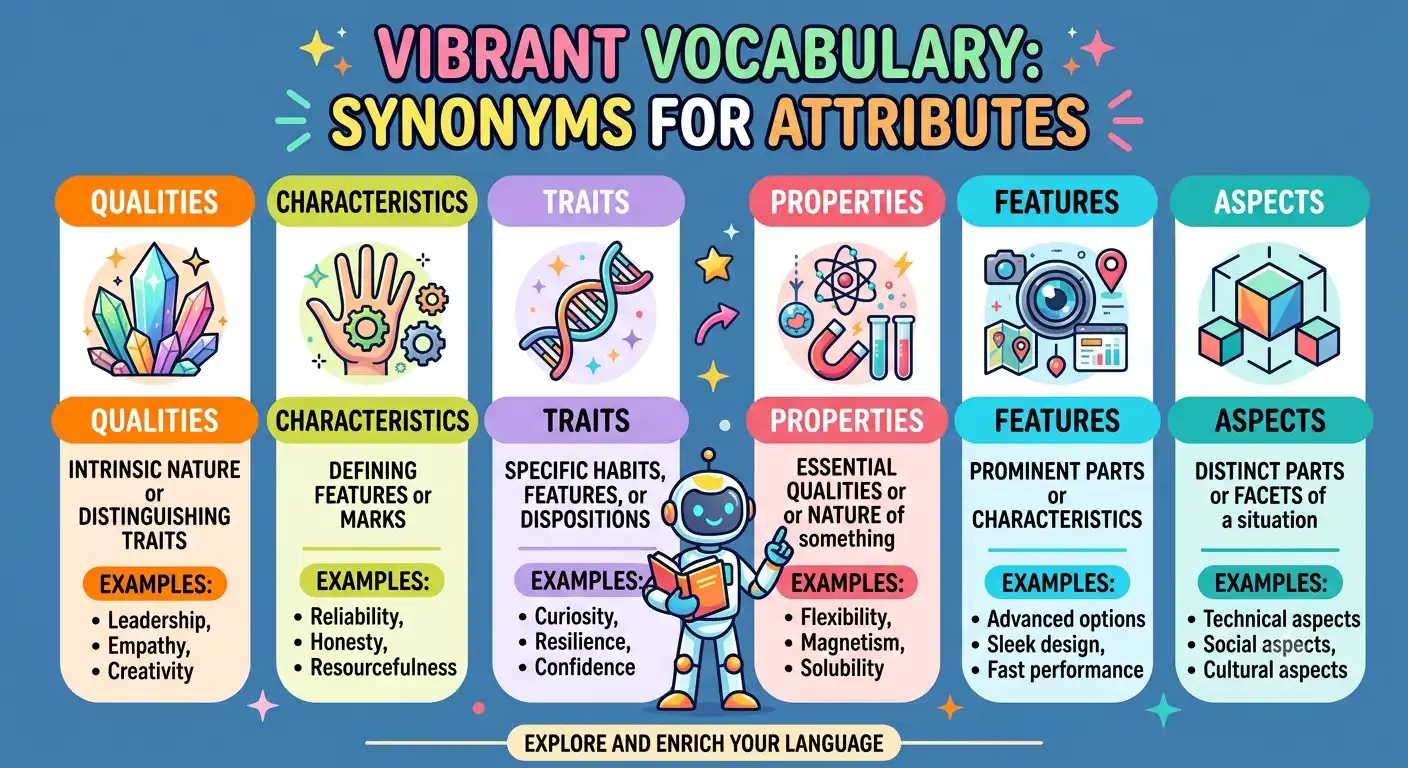
Finding clear synonyms for attributes helps you describe human traits and object features with high precision. When you search for synonyms for attributes, you learn how to talk about personal qualities, physical details, or data fields in simple words. Using different synonyms for attributes makes your everyday writing and speaking far more accurate.
Imagine meeting a new teammate at your workplace. You notice that she arrives on time, listens to everyone, and solves hard problems with a calm smile. These helpful personal qualities are her best human attributes. Knowing the right words helps you describe her personality clearly to your boss or team.
Learning these vocabulary options is helpful for many reasons:
- Students: Improve your essay scores by replacing repeated words with rich vocabulary.
- Bloggers: Keep your readers engaged with fresh, dynamic language on every page.
- Content Writers: Craft punchy headlines and distinct personality tones for brand stories.
- Daily English Users: Choose the exact right word for casual chats, family talks, or office meetings.
“Good character is built by positive attributes that we practice every single day.” – Unknown
“The small details of a person often reveal their greatest strengths.” – Unknown
Technical & Linguistic Breakdown of “Attributes”
Connotative Meaning
The word attributes carries a neutral or positive connotation. As a noun, it refers to the special features, characteristics, or qualities that belong to a person, place, or thing. In technical contexts like computer science, it refers to specific data fields or properties of an object.
Etymology of “Attributes”
- Latin Root: Derived from Classical Latin attributus (meaning “assigned or assigned to”).
- Base Verb: From Latin attribuere (meaning “to assign, yield, or bestow”).
- French Entry: Adopted into Middle French as attribut.
- English Entry: Entered the English language in the late 1300s as a verb, and later in the 1500s as a noun describing physical or mental characteristics.
Pronunciation (IPA)
- US IPA: Noun: /ˈæt.rɪ.bjuːts/ | Verb: /əˈtrɪb.juːts/
- UK IPA: Noun: /ˈæt.rɪ.bjuːts/ | Verb: /əˈtrɪb.juːts/
Syllables & Structure
- Syllables: 3 Syllables (at – tri – butes)
- Stress Pattern: Primary stress on the first syllable for the noun (AT-tri-butes). Primary stress on the second syllable for the verb (at-TRIB-utes).
Affixation Pattern
- Base Form: Attribute
- Prefix: ad- (changed to at-, meaning “to” or “toward”)
- Root: tribuere (meaning “to pay, assign, or grant”)
- Plural Form: Attributes
Quick Comparison Table of Key Synonyms
| Keyword | Meaning | Usage Type | Context |
| Traits | Personal qualities that define character | Casual / Formal | Personality, genetics, human behavior |
| Qualities | Good or bad characteristics of a thing | Professional / Casual | Products, personal worth, food |
| Features | Noticeable parts or capabilities | Commercial / Casual | Technology, faces, products |
| Characteristics | Special qualities that belong to one item | Formal / Technical | Science, writing, character study |
| Properties | Built-in physical behaviors or values | Scientific / Formal | Physics, real estate, coding |
| Aspects | Specific parts or sides of a topic | Formal / Professional | Projects, opinions, life choices |
| Factors | Elements that cause a result | Formal / Academic | Business, decisions, math |
| Virtues | Good moral qualities in a person | Emotional / Formal | Moral choices, values, religion |
50 Best Synonyms for Attributes
1. Traits
- Pronunciation: US: /treɪts/ | UK: /treɪts/
- Meaning: These are special qualities that make up a person’s character.
- Examples:
- Kindness is one of her best personal traits.
- Good leaders share common personality traits.
2. Qualities
- Pronunciation: US: /ˈkwɑːlətiz/ | UK: /ˈkwɒlɪtiz/
- Meaning: These are features that show how good or special something is.
- Examples:
- Honest work shows strong moral qualities.
- This phone has many top physical qualities.
3. Features
- Pronunciation: US: /ˈfiːtʃərz/ | UK: /ˈfiːtʃəz/
- Meaning: These are important parts or abilities of a product or face.
- Examples:
- The new app includes helpful safety features.
- His smile is one of his best facial features.
4. Characteristics
- Pronunciation: US: /ˌkærəktəˈrɪstɪks/ | UK: /ˌkærəktəˈrɪstɪks/
- Meaning: These are typical qualities that help identify a specific group or item.
- Examples:
- Bright colors are key characteristics of tropical birds.
- She studied the physical characteristics of rock samples.
5. Properties
- Pronunciation: US: /ˈprɑːpərtiz/ | UK: /ˈprɒpətiz/
- Meaning: These are special physical facts or features belonging to a material.
- Examples:
- Heat changes the chemical properties of water.
- Gold has rare physical properties that make it shine.
6. Aspects
- Pronunciation: US: /ˈæspekts/ | UK: /ˈæspekts/
- Meaning: These are distinct parts, sides, or views of a single topic.
- Examples:
- We must look at all aspects of the problem.
- Safety is the most important of all project aspects.
7. Elements
- Pronunciation: US: /ˈelɪmənts/ | UK: /ˈelɪmənts/
- Meaning: These are basic parts that form a larger idea or object.
- Examples:
- Trust and respect are vital elements of friendship.
- The story contains exciting elements of surprise.
8. Factors
- Pronunciation: US: /ˈfæktərz/ | UK: /ˈfæktəz/
- Meaning: These are facts or details that influence a final choice or outcome.
- Examples:
- Hard work and luck were key factors in his success.
- Price is one of the major factors in buying a car.
9. Details
- Pronunciation: US: /ˈdiːteɪlz/ | UK: /ˈdiːteɪlz/
- Meaning: These are small items or facts that make up a whole picture.
- Examples:
- Pay close attention to small design details.
- The report lists all the necessary financial details.
10. Marks
- Pronunciation: US: /mɑːrks/ | UK: /mɑːks/
- Meaning: These are visible signs that show who made or owns something.
- Examples:
- Polite words are the true marks of good manners.
- Clean lines are distinct marks of modern art.
11. Hallmarks
- Pronunciation: US: /ˈhɔːlmɑːrks/ | UK: /ˈhɔːlmɑːks/
- Meaning: These are clear signs that show high quality or true identity.
- Examples:
- Honesty and clarity are hallmarks of good writing.
- Deep flavor is one of the hallmarks of great tea.
12. Virtues
- Pronunciation: US: /ˈvɜːrtʃuːz/ | UK: /ˈvɜːtʃuːz/
- Meaning: These are good moral habits and noble human qualities.
- Examples:
- Patience and kindness are essential virtues.
- She praised the moral virtues of her young students.
13. Distinctions
- Pronunciation: US: /dɪˈstɪŋkʃnz/ | UK: /dɪˈstɪŋkʃnz/
- Meaning: These are special qualities that make one item different from others.
- Examples:
- The chef noted key distinctions between the two spices.
- Her high grades brought her special academic distinctions.
14. Facets
- Pronunciation: US: /ˈfæsɪts/ | UK: /ˈfæsɪts/
- Meaning: These are different sides or views of a complex subject or gem.
- Examples:
- She explored all facets of the diamond industry.
- Life has many unique facets to enjoy every day.
15. Components
- Pronunciation: US: /kəmˈpoʊnənts/ | UK: /kəmˈpəʊnənts/
- Meaning: These are individual parts that combine to make a working machine or system.
- Examples:
- An engine has many small moving components.
- Fresh foods are healthy components of a good meal.
16. Peculiarities
- Pronunciation: US: /pɪˌkjuːliˈærətiz/ | UK: /pɪˌkjuːliˈærətiz/
- Meaning: These are strange or unusual qualities that belong to a single person or thing.
- Examples:
- Every language has its own unique peculiarities.
- He laughed at the funny peculiarities of his pet cat.
17. Quirks
- Pronunciation: US: /kwɜːrks/ | UK: /kwɜːks/
- Meaning: These are small, unusual habits or features in personality.
- Examples:
- We love our old friend despite his small quirks.
- The old car has a few mechanical quirks.
18. Points
- Pronunciation: US: /pɔɪnts/ | UK: /pɔɪnts/
- Meaning: These are specific facts or qualities worth noting in a speech or item.
- Examples:
- The speaker made several strong points today.
- Her speech covered all key points clearly.
19. Parameters
- Pronunciation: US: /pəˈræmɪtərz/ | UK: /pəˈræmɪtəz/
- Meaning: These are set limits or rules that define how something works.
- Examples:
- We must work within strict safety parameters.
- The test defines precise measurement parameters.
20. Specifications
- Pronunciation: US: /ˌspesɪfɪˈkeɪʃnz/ | UK: /ˌspesɪfɪˈkeɪʃnz/
- Meaning: These are exact lists of requirements and measurements for a product.
- Examples:
- Read the technical specifications before buying the computer.
- The builder followed all house specifications.
21. Fields
- Pronunciation: US: /fiːldz/ | UK: /fiːldz/
- Meaning: These are specific boxes or categories used to store data points.
- Examples:
- Fill in all required data fields on the web form.
- The database stores user information in custom fields.
22. Signs
- Pronunciation: US: /saɪns/ | UK: /saɪns/
- Meaning: These are clear indicators that show the presence of a quality.
- Examples:
- Quiet confidence is one of the signs of experience.
- Dark clouds are natural signs of coming rain.
23. Indicators
- Pronunciation: US: /ˈɪndɪkeɪtərz/ | UK: /ˈɪndɪkeɪtəz/
- Meaning: These are measurable facts that show the condition or health of a system.
- Examples:
- High test scores are positive indicators of learning.
- Sales numbers act as key economic indicators.
24. Tokens
- Pronunciation: US: /ˈtoʊkənz/ | UK: /ˈtəʊkənz/
- Meaning: These are small objects or actions that represent a quality or feeling.
- Examples:
- They exchanged gifts as tokens of long friendship.
- She offered flowers as small tokens of thanks.
25. Symbols
- Pronunciation: US: /ˈsɪmblz/ | UK: /ˈsɪmblz/
- Meaning: These are shapes or items that stand for a deeper quality or idea.
- Examples:
- The white dove is a universal symbol of peace.
- The crown serves as a strong symbol of royal power.
“Clear language builds understanding, and choosing exact words shows true clarity.” – Unknown
26. Emblems
- Pronunciation: US: /ˈembləmz/ | UK: /ˈembləmz/
- Meaning: These are special designs or signs that represent a group or quality.
- Examples:
- The shield serves as an emblem of courage.
- School uniforms display official team emblems.
27. Particulars
- Pronunciation: US: /pərˈtɪkjələrz/ | UK: /pəˈtɪkjələz/
- Meaning: These are specific individual facts or details about a situation.
- Examples:
- The lawyer noted all legal particulars of the contract.
- We need to know the exact particulars of your event.
28. Specialties
- Pronunciation: US: /ˈspeʃəltiz/ | UK: /ˈspeʃəltiz/
- Meaning: These are unique talents or features that someone excels in.
- Examples:
- Baking sweet cakes is one of her culinary specialties.
- The doctor has several surgical specialties.
29. Merits
- Pronunciation: US: /ˈmerɪts/ | UK: /ˈmerɪts/
- Meaning: These are good qualities that deserve praise and approval.
- Examples:
- Judge the artwork based on its own merits.
- Her proposal has many clear financial merits.
30. Strengths
- Pronunciation: US: /streŋkθs/ | UK: /streŋθs/
- Meaning: These are strong positive qualities that give an advantage.
- Examples:
- Listening well is one of her greatest strengths.
- Team members shared their personal strengths.
31. Dimensions
- Pronunciation: US: /daɪˈmenʃnz/ | UK: /dɪˈmenʃnz/
- Meaning: These are measurable sizes or deep aspects of a character.
- Examples:
- The book explores many moral dimensions of choices.
- Check the room dimensions before ordering a couch.
32. Essentials
- Pronunciation: US: /ɪˈsenʃlz/ | UK: /ɪˈsenʃlz/
- Meaning: These are basic necessary qualities that cannot be removed.
- Examples:
- Fresh water and clean air are basic essentials for life.
- Honesty is one of the absolute essentials in business.
33. Fundamentals
- Pronunciation: US: /ˌfʌndəˈmentlz/ | UK: /ˌfʌndəˈmentlz/
- Meaning: These are central rules or features on which a system is built.
- Examples:
- Practice the fundamentals of good writing every day.
- He taught his team the fundamentals of basketball.
34. Idiosyncrasies
- Pronunciation: US: /ˌɪdioʊˈsɪŋkrəsiz/ | UK: /ˌɪdiəˈsɪŋkrəsiz/
- Meaning: These are unique personal habits or peculiar traits in an individual.
- Examples:
- Every writer has a few personal idiosyncrasies.
- We learned to love the old house and its idiosyncrasies.
35. Dispositions
- Pronunciation: US: /ˌdɪspəˈzɪʃnz/ | UK: /ˌdɪspəˈzɪʃnz/
- Meaning: These are natural habits of mind and mood in a person.
- Examples:
- Friendly dogs have calm and happy dispositions.
- She faces hard days with cheerful dispositions.
36. Characters
- Pronunciation: US: /ˈkærəktərz/ | UK: /ˈkærəktəz/
- Meaning: These are combination patterns of moral traits in people.
- Examples:
- Hard times reveal the true characters of leaders.
- Her quiet actions reflect strong moral characters.
37. Natures
- Pronunciation: US: /ˈneɪtʃərz/ | UK: /ˈneɪtʃəz/
- Meaning: These are deep inner qualities that determine how things act.
- Examples:
- Gentle natures make people easy to talk to.
- Wild animals follow their basic hunting natures.
38. Tempers
- Pronunciation: US: /ˈtempərz/ | UK: /ˈtempəz/
- Meaning: These are emotional states or tendencies of mind.
- Examples:
- Calm tempers help keep peace during meetings.
- Good workers maintain cool tempers under stress.
39. Assets
- Pronunciation: US: /ˈæsets/ | UK: /ˈæsets/
- Meaning: These are valuable qualities or skills that help a person succeed.
- Examples:
- Her quick mind is one of her biggest assets.
- Strong computer skills are great assets for office work.
40. Credentials
- Pronunciation: US: /krəˈdenʃlz/ | UK: /krəˈdenʃlz/
- Meaning: These are qualities, achievements, or documents that prove ability.
- Examples:
- The new doctor has impressive professional credentials.
- She shared her academic credentials during the job interview.
41. Values
- Pronunciation: US: /ˈvæljuːz/ | UK: /ˈvæljuːz/
- Meaning: These are core beliefs and deep moral priorities that guide choices.
- Examples:
- Shared personal values hold families together.
- The company promotes strong social values.
42. Habits
- Pronunciation: US: /ˈhæbɪts/ | UK: /ˈhæbɪts/
- Meaning: These are regular behaviors or traits practiced without much thought.
- Examples:
- Reading daily is one of his best study habits.
- Good eating habits help keep your body strong.
43. Manners
- Pronunciation: US: /ˈmænərz/ | UK: /ˈmænəz/
- Meaning: These are social behaviors that show respect for other people.
- Examples:
- Polite manners make a great first impression.
- She taught her young children polite table manners.
44. Angles
- Pronunciation: US: /ˈæŋɡlz/ | UK: /ˈæŋɡlz/
- Meaning: These are specific ways of looking at a subject or feature.
- Examples:
- View the news story from all possible angles.
- The camera captures the building from creative angles.
45. Ingredients
- Pronunciation: US: /ɪnˈɡriːdiənts/ | UK: /ɪnˈɡriːdiənts/
- Meaning: These are basic parts that make up a mixture or successful plan.
- Examples:
- Focus and practice are key ingredients for success.
- Mix all food ingredients in a large clean bowl.
46. Sides
- Pronunciation: US: /saɪdz/ | UK: /saɪdz/
- Meaning: These are different positions or emotional aspects of a personality.
- Examples:
- He showed a caring side during the crisis.
- Every complex issue has two distinct sides.
47. Items
- Pronunciation: US: /ˈaɪtəmz/ | UK: /ˈaɪtəmz/
- Meaning: These are individual single objects or facts in a list.
- Examples:
- Check off all necessary items on your list.
- The store displays many useful home items.
48. Capabilities
- Pronunciation: US: /ˌkeɪpəˈbɪlətiz/ | UK: /ˌkeɪpəˈbɪlɪtiz/
- Meaning: These are built-in abilities or potential skills to perform tasks.
- Examples:
- The system has strong processing capabilities.
- Show your full work capabilities during the test.
49. Inclinations
- Pronunciation: US: /ˌɪnklɪˈneɪʃnz/ | UK: /ˌɪnklɪˈneɪʃnz/
- Meaning: These are natural tendencies or feelings toward acting a certain way.
- Examples:
- She followed her natural creative inclinations.
- He has friendly inclinations toward new neighbors.
50. Singularities
- Pronunciation: US: /ˌsɪŋɡjəˈlærətiz/ | UK: /ˌsɪŋɡjəˈlærətiz/
- Meaning: These are rare or unique traits that set something apart.
- Examples:
- Scientists study the rare singularities of deep space.
- The art gallery displays works with distinct singularities.
Antonyms of “Attributes”
Understanding direct opposites helps you contrast real qualities with missing or fake features:
- Abstractions: Ideas or concepts that have no physical features or real traits.
- Omissions: Missing elements or traits that were left out intentionally or by accident.
- Absences: The state of lacking specific characteristics or details.
- Nonentities: Things that have no real qualities, existence, or importance.
- Blankness: Having no marked traits, features, or noticeable characteristics.
- Uniformity: A state where everything looks identical, with no unique distinguishing features.
Prototype Meaning and Categorization of Attributes
To master these synonyms for attributes, it helps to organize the words into distinct written categories based on human behavior, physical properties, business data, and moral principles:
Core Prototype Definition
At its core, “attribute” represents a specific quality, property, or feature that belongs to a person, place, system, or object. It defines what something is like or how it behaves.
1. Human Character and Personality (Behavioral Traits)
This category includes words used when “attributes” refers to human behavior, habits, emotional tendencies, and social actions.
- Primary Focus: Personal habits, social actions, emotional styles, and individual character.
- Key Synonyms: Traits, qualities, habits, manners, dispositions, natures, tempers, inclinations, quirks, peculiarities, idiosyncrasies.
- Common Contexts: Job interviews, psychology essays, book reviews, and casual descriptions of friends.
2. Physical Features and Technical Details (Product & Material Specifications)
This category focuses on tangible elements, physical properties, equipment features, and technical details.
- Primary Focus: Material qualities, hardware parts, visible marks, and machine features.
- Key Synonyms: Features, properties, characteristics, components, details, specifications, marks, hallmarks, dimensions, essentials.
- Common Contexts: Tech reviews, user manuals, architecture, engineering reports, and shopping guides.
3. Business Data and System Parameters (Digital & Logical Fields)
These terms apply when “attributes” refers to digital fields, logical categories, database variables, or measurable indicators.
- Primary Focus: Database fields, web inputs, measurable markers, and operational limits.
- Key Synonyms: Fields, parameters, indicators, items, factors, aspects, facets, particulars, capabilities, indicators.
- Common Contexts: Software development, database management, web design, and financial analysis.
4. Moral Virtues and Value Assets (Personal & Professional Worth)
This category involves terms describing high moral standards, positive personal strengths, and earned credentials.
- Primary Focus: High moral values, personal achievements, professional strengths, and inner worth.
- Key Synonyms: Virtues, merits, strengths, assets, credentials, values, distinctions, specialties, emblems, symbols, tokens.
- Common Contexts: Leadership awards, academic transcripts, resume writing, and motivational speeches.
Frequently Asked Questions (FAQs)
1. What is the most common synonym for attributes?
The most common everyday synonyms for attributes are traits (for human personality) and features or qualities (for objects and products).
2. What is the difference between “traits” and “features”?
You use traits to describe human behavior and personality (e.g., honesty is a good trait). You use features to describe physical parts or tech abilities (e.g., the camera has nice features).
3. How is “attribute” used as a verb?
As a verb (pronounced at-TRIB-ute), it means to credit or assign cause to something (e.g., “We attribute our team success to hard daily practice”).
4. What does “attributes” mean in HTML or programming?
In HTML and computer programming, attributes are special data values added inside a code tag to set properties or behavior for an element.
5. Which synonym for attributes should I use in business resumes?
In professional resumes, use strong corporate terms like strengths, credentials, assets, qualities, or capabilities.
6. Can “attributes” refer to bad qualities?
Yes. An attribute can be any defining characteristic, whether positive (like patience) or negative (like impatience).
Conclusion
Learning dynamic synonyms for attributes will greatly enhance your daily English skills. Expanding your vocabulary allows you to choose precise words that match your exact tone and context. Whether you are writing an academic essay, drafting a blog post, sending a work email, or chatting with friends, using diverse words makes your communication sound natural and clear.
When you replace repetitive words with options like traits, features, qualities, or hallmarks, your sentences become far more vivid for readers. Practice integrating 2 to 3 new words every week into your daily conversations, emails, and journal entries. With consistent practice, choosing the right vocabulary word will become second nature.
“Rich vocabulary opens new doors to clear expression and deep human understanding.” – Unknown
“Speak with clear words, and your true thoughts will always shine through.” – Unknown

Robert Hayes is an ESL educator and curriculum developer with over nine years of experience teaching English to beginners and intermediate learners across multiple countries ( Biography ).