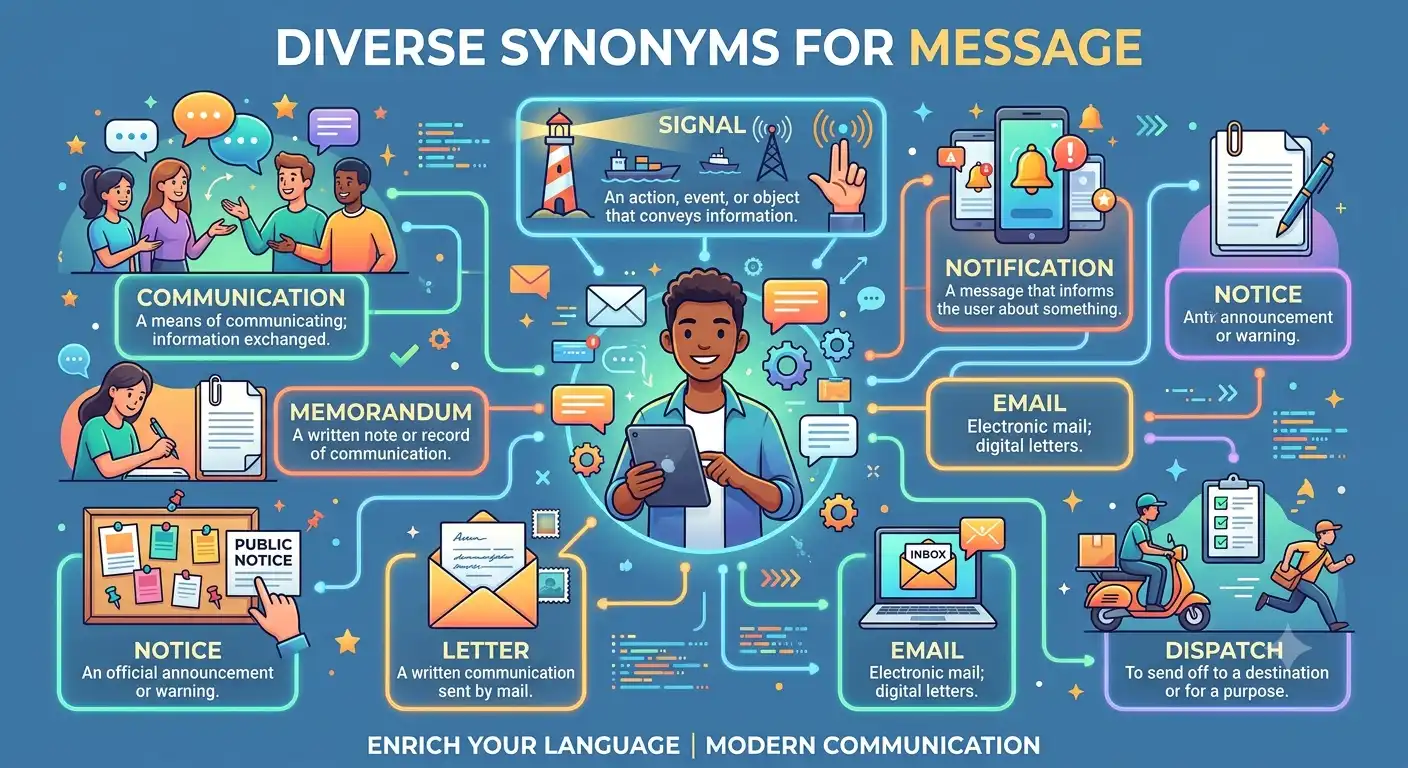
Finding exact synonyms for message helps you communicate your ideas clearly and quickly. Learning diverse synonyms for message allows you to write better emails, texts, and school essays. Using precise synonyms for message keeps your daily writing fresh, engaging, and easy to understand.
Imagine a manager sending four emails in one morning to her team. If she calls every single note a “message,” her writing feels repetitive and boring. Switching to clear terms like “memo,” “update,” or “directive” makes her intent clear right away.
For example, when a friend leaves a quick sticky note on your kitchen table, that note acts as a short written message. Choosing specific words helps your reader understand the exact form and purpose of your words.
A message is any piece of information, news, or thought sent from one person or group to another. Expanding your knowledge of synonyms for message helps four main groups:
- Students write better reports and literary papers for English class.
- Bloggers craft lively posts that keep readers interested.
- Content writers improve search rankings with natural vocabulary.
- Daily English users express thoughts clearly in casual and professional chats.
“The right word turns a basic note into a powerful connection.”
“A rich vocabulary helps you share thoughts with total clarity and ease.”
Linguistic Breakdown of “Message”
Connotative Meaning
The word message carries neutral to warm connotations. It can mean a quick personal note, a formal work document, a digital text, or the underlying moral lesson of a story.
Etymology
- Origin: Derived from Old French message, coming from Medieval Latin missaticum.
- Root Words: Latin mittere (meaning to send or to throw forward).
- Historical Shift: Originally meant an official errand or spoken news sent by a runner, then grew to cover written notes, digital texts, and abstract ideas.
Pronunciation
- US (IPA): /ˈmes.ɪdʒ/
- UK (IPA): /ˈmes.ɪdʒ/
Syllables & Affixation Pattern
- Syllables: 2 syllables (mes-sage)
- Base Structure: Root mess + Noun suffix -age (collection, state, or process)
- Grammatical Patterns:
- Noun form: Message
- Verb form: Message / Messaging
- Adjective form: Messaged
Comparison Table: Common Synonyms for Message
| Keyword | Meaning | Usage Type | Context |
| Note | A short written record or brief thought | Casual / Informal | Sticky notes, desk reminders, and quick updates |
| Memo | An official internal note sent to coworkers | Formal / Professional | Corporate offices, business teams, and agencies |
| A digital letter sent over the internet | Professional / Daily | Work requests, newsletters, and online chats | |
| Dispatch | An urgent official message sent with speed | Technical / Official | Military operations, news rooms, and rescue teams |
| Signal | An action or sound used to send information | Visual / Non-verbal | Traffic lights, radio waves, and hand signs |
| Bulletin | A short public statement giving fresh news | Public / Media | School alerts, news flashes, and weather reports |
| Moral | The deep lesson taught by a story or event | Expressive / Literary | Fables, movies, books, and life lessons |
50 Best Synonyms for Message
1. Note
- Pronunciation: US /noʊt/ | UK /nəʊt/
- Meaning: A note is a brief written message used to remind someone of something.
- Examples:
- Mom left a sweet note on the kitchen counter.
- I wrote a short note to thank my teacher.
2. Letter
- Pronunciation: US /ˈlet̬.ɚ/ | UK /ˈlet.ər/
- Meaning: A letter is a written message sent in an envelope by post or hand.
- Examples:
- She received a long letter from her pen pal in Japan.
- The mayor sent a formal letter to the local school board.
3. Memo
- Pronunciation: US /ˈmem.oʊ/ | UK /ˈmem.əʊ/
- Meaning: A memo is a short official note sent to people within an office.
- Examples:
- The boss sent a quick memo about the new work hours.
- Please read the safety memo before using the machine.
4. Email
- Pronunciation: US /ˈiː.meɪl/ | UK /ˈiː.meɪl/
- Meaning: An email is a digital message sent from one computer or phone to another.
- Examples:
- I sent an email to reserve our hotel room.
- Check your inbox for my morning email.
5. Text
- Pronunciation: US /tekst/ | UK /tekst/
- Meaning: A text is a short electronic message sent to a mobile phone.
- Examples:
- Send me a text when you arrive at the park.
- She got a friendly text from her classmate.
6. Dispatch
- Pronunciation: US /dɪˈspætʃ/ | UK /dɪˈspætʃ/
- Meaning: A dispatch is an official message sent quickly to report urgent news.
- Examples:
- The news reporter sent a dispatch from the scene.
- The police officer received an urgent radio dispatch.
7. Communication
- Pronunciation: US /kəˌmjuː.nəˈkeɪ.ʃən/ | UK /kəˌmjuː.nɪˈkeɪ.ʃən/
- Meaning: A communication is any message or news shared between people.
- Examples:
- Clear communication helps team members work well together.
- We received an official communication from the main bank.
8. Signal
- Pronunciation: US /ˈsɪɡ.nəl/ | UK /ˈsɪɡ.nəl/
- Meaning: A signal is a gesture, sound, or light used to convey a message.
- Examples:
- The referee gave a hand signal to stop the game.
- A red light is a clear signal to stop your car.
9. Bulletin
- Pronunciation: US /ˈbʊl.ə.t̬ɪn/ | UK /ˈbʊl.ə.tɪn/
- Meaning: A bulletin is a quick public report containing important fresh news.
- Examples:
- The radio station played a special weather bulletin.
- Read the daily bulletin posted near the school door.
10. Notice
- Pronunciation: US /ˈnoʊ.t̬ɪs/ | UK /ˈnəʊ.tɪs/
- Meaning: A notice is a written message displayed publicly to inform people.
- Examples:
- The landlord pinned a notice on the front door.
- We saw a notice about the upcoming library sale.
“Clear messages build trust and understanding in every conversation.”
11. Report
- Pronunciation: US /rɪˈpɔːrt/ | UK /rɪˈpɔːt/
- Meaning: A report is a spoken or written message that gives details about an event.
- Examples:
- The doctor gave a positive report about his health.
- Students handed in their science reports on Friday.
12. Statement
- Pronunciation: US /ˈsteɪt.mənt/ | UK /ˈsteɪt.mənt/
- Meaning: A statement is a formal message that gives facts or opinions clearly.
- Examples:
- The company president made a public statement today.
- Her statement answered all of our main questions.
13. Announcement
- Pronunciation: US /əˈnaʊns.mənt/ | UK /əˈnaʊns.mənt/
- Meaning: An announcement is a public message that shares important news.
- Examples:
- The principal made an announcement over the loudspeaker.
- They posted an announcement about their wedding date.
14. News
- Pronunciation: US /nuːz/ | UK /njuːz/
- Meaning: News is fresh information or messages about recent events.
- Examples:
- She shared the happy news with her whole family.
- Morning news travels fast across small towns.
15. Advice
- Pronunciation: US /ədˈvaɪs/ | UK /ədˈvaɪs/
- Meaning: Advice is a message containing helpful suggestions or guidance.
- Examples:
- My uncle gave me wise advice about starting college.
- Follow the doctor’s advice to recover quickly.
16. Word
- Pronunciation: US /wɝːd/ | UK /wɜːd/
- Meaning: Word is a spoken message or news passed from one person to another.
- Examples:
- Word reached the village that the storm had passed.
- Send word when you are ready to start.
17. Information
- Pronunciation: US /ˌɪn.fɚˈmeɪ.ʃən/ | UK /ˌɪn.fəˈmeɪ.ʃən/
- Meaning: Information is knowledge or facts shared through a message.
- Examples:
- The brochure provides useful information for tourists.
- Call the office if you need more information.
18. Cable
- Pronunciation: US /ˈkeɪ.bəl/ | UK /ˈkeɪ.bəl/
- Meaning: A cable is an old-fashioned message sent electronically by wire.
- Examples:
- The captain sent a cable to the ship’s home port.
- Historical archives keep copies of early ocean cables.
19. Wire
- Pronunciation: US /ˈwaɪ.ɚ/ | UK /ˈwaɪ.ər/
- Meaning: A wire is a fast message sent through telegraph systems long ago.
- Examples:
- The reporter sent an urgent wire to her editor.
- In the past, people sent wires for emergency news.
20. Telegram
- Pronunciation: US /ˈtel.ə.ɡræm/ | UK /ˈtel.ɪ.ɡræm/
- Meaning: A telegram is a printed paper message delivered from a telegraph office.
- Examples:
- Grandma saved the old telegram from her wedding day.
- The soldier received a telegram from home.
21. Line
- Pronunciation: US /laɪn/ | UK /laɪn/
- Meaning: A line is a very short written message or quick text note.
- Examples:
- Drop me a line when you land at the airport.
- He scribbled a quick line on the back of the card.
22. Voicemail
- Pronunciation: US /ˈvɔɪs.meɪl/ | UK /ˈvɔɪs.meɪl/
- Meaning: A voicemail is a recorded spoken message left on a phone.
- Examples:
- I left a voicemail on her cell phone this morning.
- Please listen to your voicemail to get the meeting time.
23. Communiqué
- Pronunciation: US /kəˈmjuː.nə.keɪ/ | UK /kəˈmjuː.nɪ.keɪ/
- Meaning: A communiqué is an official announcement issued to the press or public.
- Examples:
- World leaders released a joint communiqué after the summit.
- The government published a communiqué regarding trade.
24. Directive
- Pronunciation: US /dəˈrek.tɪv/ | UK /daɪˈrek.tɪv/
- Meaning: A directive is an official message that instructs people to take action.
- Examples:
- Staff members followed the safety directive immediately.
- The director issued a new directive about office supplies.
25. Missive
- Pronunciation: US /ˈmɪs.ɪv/ | UK /ˈmɪs.ɪv/
- Meaning: A missive is a formal or lengthy written letter or message.
- Examples:
- The king sent a secret missive to the general.
- She spent hours writing a heartfelt missive to her friend.
26. Memento
- Pronunciation: US /məˈmen.toʊ/ | UK /məˈmen.təʊ/
- Meaning: A memento is a physical object that carries a symbolic message or memory.
- Examples:
- This postcard serves as a fond memento of our trip.
- She kept the ribbon as a special memento.
27. Reminder
- Pronunciation: US /rɪˈmaɪn.dɚ/ | UK /rɪˈmaɪn.dər/
- Meaning: A reminder is a message meant to help you remember a duty or event.
- Examples:
- My phone sent a reminder about the dentist appointment.
- Set a quick reminder so you do not miss class.
28. Alert
- Pronunciation: US /əˈlɝːt/ | UK /əˈlɜːt/
- Meaning: An alert is an urgent message that warns of danger or important events.
- Examples:
- The city issued a flood alert during heavy rain.
- We got a phone alert about severe road traffic.
29. Circular
- Pronunciation: US /ˈsɝː.kjə.lɚ/ | UK /ˈsɜː.kjə.lər/
- Meaning: A circular is a printed message distributed to many people at once.
- Examples:
- The store mailed a promotional circular to local houses.
- School staff read the monthly safety circular.
30. Dispatch-note
- Pronunciation: US /dɪˈspætʃ noʊt/ | UK /dɪˈspætʃ nəʊt/
- Meaning: A dispatch-note is a delivery message showing items sent in a shipment.
- Examples:
- Check the dispatch-note to confirm your package items.
- The driver handed the clerk a signed dispatch-note.
31. Postcard
- Pronunciation: US /ˈpoʊst.kɑːrd/ | UK /ˈpəʊst.kɑːd/
- Meaning: A postcard is a card with a picture used for sending short vacation notes.
- Examples:
- He sent a colorful postcard from his beach trip.
- My collection includes postcards from ten countries.
32. Greeting
- Pronunciation: US /ˈɡriː.t̬ɪŋ/ | UK /ˈɡriː.tɪŋ/
- Meaning: A greeting is a message of welcome or good wishes sent to someone.
- Examples:
- She sent holiday greetings to all her relatives.
- Our host welcomed us with a warm verbal greeting.
33. Update
- Pronunciation: US /ˈʌp.deɪt/ | UK /ˈʌp.deɪt/
- Meaning: An update is a message giving the newest facts about a changing situation.
- Examples:
- The team leader shared a quick status update.
- We wait for an update on the flight schedule.
34. Transmission
- Pronunciation: US /trænˈsmɪʃ.ən/ | UK /trænzˈmɪʃ.ən/
- Meaning: A transmission is an electronic message sent via radio, TV, or satellite.
- Examples:
- Ground control received a radio transmission from the ship.
- Clear weather helps radio transmissions travel far.
35. Warning
- Pronunciation: US /ˈwɔːr.nɪŋ/ | UK /ˈwɔː.nɪŋ/
- Meaning: A warning is a protective message telling someone about possible danger.
- Examples:
- The road sign gave a clear warning about sharp curves.
- Listen to the safety warning before entering the cave.
36. Prompt
- Pronunciation: US /prɑːmpt/ | UK /prɒmpt/
- Meaning: A prompt is a message on a computer screen reminding you to act.
- Examples:
- Follow the screen prompt to enter your password.
- The pop-up prompt asked us to save the file.
37. Briefing
- Pronunciation: US /ˈbriː.fɪŋ/ | UK /ˈbriː.fɪŋ/
- Meaning: A briefing is a short meeting message giving instructions before a task.
- Examples:
- Pilots attended a morning briefing before takeoff.
- The manager gave a quick safety briefing to workers.
38. Transcript
- Pronunciation: US /ˈtræn.skrɪpt/ | UK /ˈtræn.skrɪpt/
- Meaning: A transcript is a written copy of a spoken message or interview.
- Examples:
- Court reporters typed a clear transcript of the trial.
- You can read the speech transcript on the news website.
39. Record
- Pronunciation: US /ˈrek.ɚd/ | UK /ˈrek.ɔːd/
- Meaning: A record is a permanent written document that preserves a message over time.
- Examples:
- The library holds historical records of the old town.
- Keep a clear record of all business sales.
40. Summary
- Pronunciation: US /ˈsʌm.ɚ.i/ | UK /ˈsʌm.ər.i/
- Meaning: A summary is a short message stating the main points of a longer text.
- Examples:
- The teacher asked for a one-page summary of the book.
- Read the executive summary at the start of the report.
41. Address
- Pronunciation: US /əˈdres/ | UK /əˈdres/
- Meaning: An address is a formal speech or spoken message delivered to an audience.
- Examples:
- The mayor gave an inspiring address at graduation.
- Thousands watched the president’s annual address.
42. Broadcast
- Pronunciation: US /ˈbrɑːd.kæst/ | UK /ˈbrɔːd.kɑːst/
- Meaning: A broadcast is a public message transmitted over radio or television.
- Examples:
- The evening news broadcast starts at six o’clock.
- Radio stations broadcast emergency alerts instantly.
43. Speech
- Pronunciation: US /spiːtʃ/ | UK /spiːtʃ/
- Meaning: A speech is a spoken message delivered to a group of listeners.
- Examples:
- Her contest speech won first prize in public speaking.
- The captain gave a motivating speech before the match.
44. Delivery
- Pronunciation: US /dɪˈlɪv.ɚ.i/ | UK /dɪˈlɪv.ər.i/
- Meaning: A delivery is the act or manner of passing a message to a recipient.
- Examples:
- His calm voice made the message delivery very effective.
- The courier made a fast delivery of the document.
45. Moral
- Pronunciation: US /ˈmɔːr.əl/ | UK /ˈmɒr.əl/
- Meaning: A moral is the hidden lesson or advice contained within a story.
- Examples:
- The moral of the fable is that slow and steady wins the race.
- Every good children’s story has a helpful moral.
46. Lesson
- Pronunciation: US /ˈles.ən/ | UK /ˈles.ən/
- Meaning: A lesson is an instructive message learned through experience or study.
- Examples:
- The trip taught us a valuable lesson about teamwork.
- History offers important lessons for modern leaders.
47. Theme
- Pronunciation: US /θiːm/ | UK /θiːm/
- Meaning: A theme is the central underlying idea or message of an artistic work.
- Examples:
- Friendship is the main theme of this adventure movie.
- The author explores the theme of honesty in her novel.
48. Meaning
- Pronunciation: US /ˈmiː.nɪŋ/ | UK /ˈmiː.nɪŋ/
- Meaning: Meaning is the true thought or significance conveyed by a message.
- Examples:
- I understood the real meaning behind her soft smile.
- What is the meaning of this unusual symbol?
49. Import
- Pronunciation: US /ˈɪm.pɔːrt/ | UK /ˈɪm.pɔːt/
- Meaning: Import refers to the deep weight or true significance of a message.
- Examples:
- Everyone understood the grave import of the judge’s words.
- The full import of the news sank in slowly.
50. Essence
- Pronunciation: US /ˈes.əns/ | UK /ˈes.əns/
- Meaning: Essence is the core idea or most basic message of a topic.
- Examples:
- Kindness is the true essence of her speech.
- The summary captures the essence of the long article.
Antonyms of “Message”
Knowing opposite concepts helps you describe silence, confusion, or lack of communication clearly:
- Silence: The complete absence of sound, speech, or written contact.
- Misunderstanding: A message that is interpreted incorrectly or unclearly.
- Censorship: The suppression or removal of messages and information.
- Suppression: Holding back news or stopping a message from reaching others.
- Noise: Random chatter or distortion that destroys the clarity of a message.
- Secret: Information that is hidden and deliberately not messaged to anyone.
Prototype Meaning & Categorization of “Message”
The core idea of a message revolves around sharing information, thoughts, instructions, or lessons. These 50 synonyms divide into four clear functional groups:
- Digital & Quick Communications: Note, email, text, line, voicemail, reminder, prompt, postcard, greeting, update, alert.
- Formal & Official Documents: Letter, memo, dispatch, bulletin, notice, report, statement, announcement, communiqué, directive, missive, circular, dispatch-note, transcript, record, briefing, summary.
- Spoken, Signal & Broadcast Media: Communication, signal, news, advice, word, information, cable, wire, telegram, transmission, warning, address, broadcast, speech, delivery.
- Symbolic, Moral & Abstract Ideas: Memento, moral, lesson, theme, meaning, import, essence.
Frequently Asked Questions (FAQs)
1. What is the most common formal synonym for “message”?
In business and academic writing, terms like “communication,” “memo,” or “statement” serve as ideal formal choices.
2. Can “moral” be used as a synonym for “message”?
Yes! When referring to books, movies, or fables, the “message” of the story is its moral or core lesson.
3. What is the difference between a “memo” and a “letter”?
A memo is a short note shared internally within an office or group. A letter is a more formal message sent outside to a specific person or organization.
4. Which synonym for “message” works best for phone apps?
For digital messaging and mobile apps, words like “text,” “alert,” or “update” fit best.
5. What is the difference between “dispatch” and “bulletin”?
A dispatch is an urgent report sent directly to official teams. A bulletin is a short public broadcast meant for everyone to hear.
6. How does using varied synonyms for “message” improve SEO?
Using diverse synonyms prevents word repetition, matches natural voice queries, and helps search engines connect your page with broader search intent.
Conclusion
Expanding your collection of synonyms for message brings precision, power, and variety to your writing. Replacing general words with specific choices like memo, bulletin, dispatch, or moral ensures your reader understands your exact intent every time.
Whether you are writing business emails, composing student essays, publishing blog posts, or chatting with friends, using exact vocabulary builds confidence. Clear language cuts through clutter and transforms routine ideas into memorable statements. Start practicing these 50 synonyms today to elevate your communication skills!
“Clear choices in words turn everyday ideas into powerful expressions.”
“Mastering vocabulary gives you the exact key to effective communication.”

Robert Hayes is an ESL educator and curriculum developer with over nine years of experience teaching English to beginners and intermediate learners across multiple countries ( Biography ).