Do you struggle to find the right words when speaking or writing in English? You are not alone. Many learners at A2–B1 level know basic words, but they repeat the same vocabulary again and again. This limits your fluency and makes your writing less interesting.
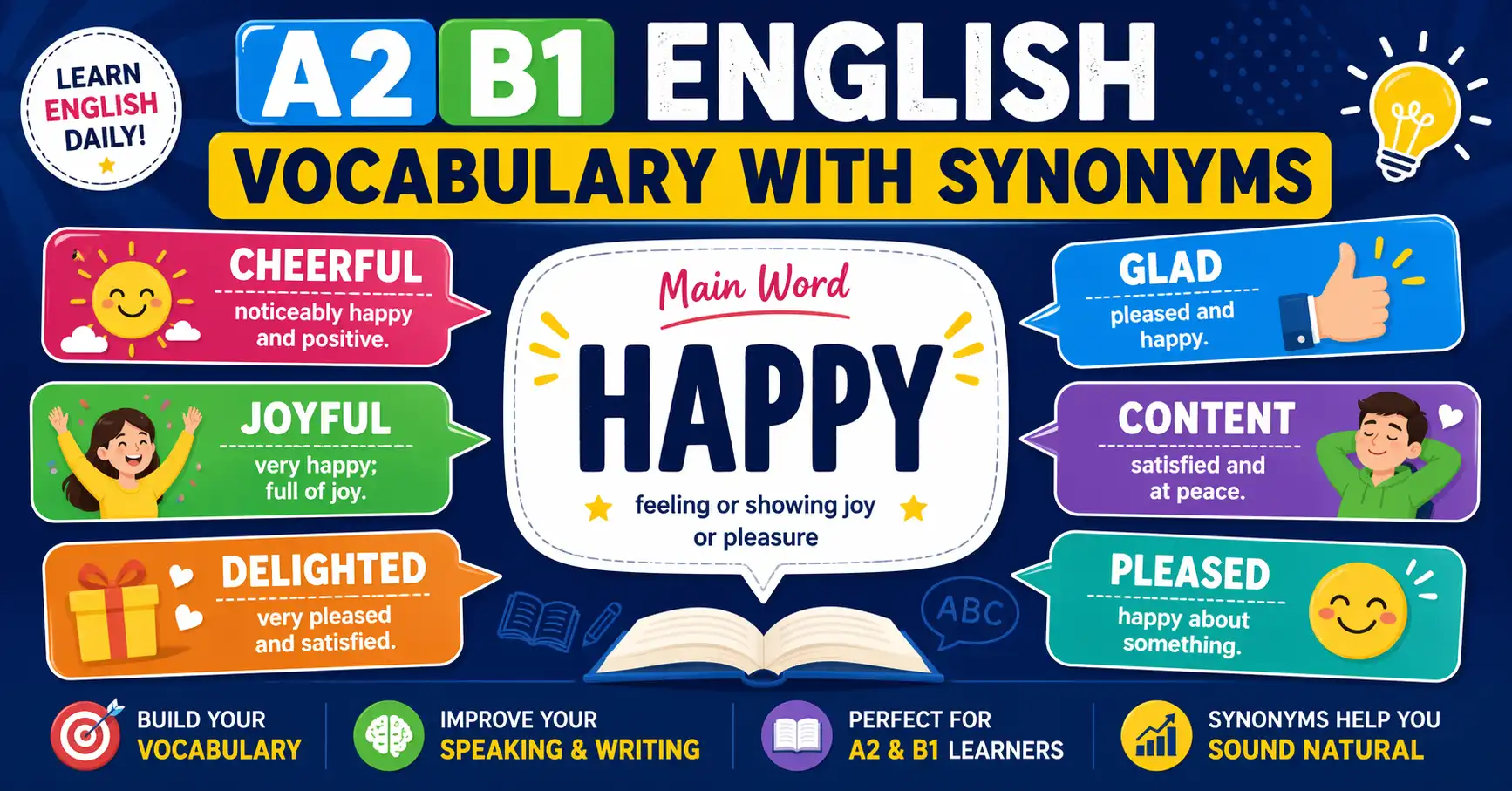
In this guide, you will learn A2 B1 English vocabulary with synonyms in a clear and practical way. You will see simple meanings, useful alternatives, and real examples you can use immediately. This is especially helpful if you are preparing for exams like IELTS or trying to improve everyday communication.
As an ESL learner, your goal is not just to learn more words—but to use them correctly. This article will help you understand when to use each synonym, when to avoid it, and how to sound more natural.
Quick Answer:
A2 B1 English vocabulary with synonyms means learning simple everyday words and their alternatives to improve communication. At this level, you focus on basic but useful words (like big, happy, important) and learn similar words (like large, glad, essential) to expand your speaking and writing skills naturally.
Section A: What does A2 B1 English vocabulary mean?
A2 and B1 are levels in the CEFR (Common European Framework of Reference for Languages).
- A2 (Elementary): You understand simple words and sentences
- B1 (Intermediate): You can express ideas with more detail and variety
In A2 B1 English vocabulary with synonyms, you learn:
- Common everyday words
- Simple alternative words (synonyms)
- How to use them correctly in context
Example:
- A2 word: big
- B1 synonym: large
👉 Both mean the same, but large sounds more formal.
Section B: Complete Synonyms List
Here are common A2 words and their useful B1-level synonyms:
| A2 Word | B1 Synonym |
| big | large |
| small | tiny |
| happy | glad |
| sad | unhappy |
| fast | quick |
| slow | gradual |
| important | essential |
| easy | simple |
| hard | difficult |
| good | great |
| bad | poor |
| help | assist |
ESL Note:
At A2 level, focus on understanding meaning. At B1, focus on choosing the right synonym for the situation.
Section C: Comparison Table
| Word | Simple Meaning | Best Used When | Avoid When |
| big | large size | everyday speech | formal essays |
| large | big size | academic writing | casual talk |
| happy | feeling good | informal use | formal writing |
| glad | pleased | polite speech | strong emotion |
| fast | quick speed | casual talk | formal writing |
| quick | done fast | general writing | scientific context |
Section D: Formal vs Informal Synonyms
| Informal Word | Formal Synonym |
| get | obtain |
| help | assist |
| buy | purchase |
| start | begin |
| end | conclude |
| fix | repair |
IELTS Tip:
Using formal synonyms correctly can improve your lexical resource score, especially in Writing Task 2.
Section E: Real Example Sentences
Here are practical examples using A2 B1 English vocabulary with synonyms:
- The house is very big, but the garden is small.
- She felt happy after hearing the good news.
- He gave a quick answer to the question.
- This is an important topic in the exam.
- The test was difficult, but I passed.
- They decided to begin the meeting early.
- The company will assist new employees.
- We need a large room for the event.
ESL Note:
Practice speaking these sentences aloud. This builds confidence and fluency.
Section F: When to Use vs When NOT to Use
When to Use Synonyms:
- To avoid repetition in writing
- To sound more natural in conversation
- To improve IELTS writing score
- To express ideas clearly
When NOT to Use Synonyms:
- When you are unsure of the meaning
- In beginner-level conversations (keep it simple)
- When synonyms change meaning slightly
👉 Example:
- cheap vs inexpensive (similar, but tone differs)
Section G: Common Mistakes Writers Make
Writers at A2–B1 level often make these errors:
1. Using synonyms without understanding meaning
❌ He is a large boy (sounds odd)
✔️ He is a big boy
2. Mixing formal and informal words
❌ I purchased a snack
✔️ I bought a snack
3. Overusing difficult words
Using advanced words incorrectly lowers clarity.
4. Direct translation from native language
This often creates unnatural sentences.
In our experience helping ESL learners:
Students improve faster when they learn synonyms in context, not as isolated words.
Section H: Tips and Best Practices
Here are simple strategies to master A2 B1 English vocabulary with synonyms:
1. Learn words in pairs
Example: big → large
2. Use a vocabulary notebook
Write:
- Word
- Synonym
- Example sentence
3. Practice daily speaking
Use new words in conversation.
4. Read simple texts
Notice how synonyms are used.
5. Focus on common words first
Do not try advanced vocabulary too early.
ESL Note:
Consistency is more important than difficulty. Small daily practice leads to big improvement.
Frequently Asked Questions
Q1: What is A2 B1 English vocabulary?
A: A2 B1 vocabulary includes basic to intermediate words used in daily communication. It focuses on simple meanings and gradually introduces synonyms to help learners express ideas more clearly and naturally in both speaking and writing.
Q2: Why are synonyms important for ESL learners?
A: Synonyms help you avoid repeating the same words. They improve fluency, make your writing more interesting, and help you sound more natural. They are also important for exams like IELTS, especially for vocabulary scores.
Q3: How many synonyms should I learn daily?
A: It is best to learn 3–5 synonyms daily. Focus on understanding meaning and usage instead of memorizing long lists. Practice using them in sentences to remember them better and avoid confusion.
Q4: Are synonyms always interchangeable?
A: No, synonyms are not always the same. Some have different tones or contexts. For example, child and kid mean similar things, but child is more formal. Always check how a word is used.
Q5: Can synonyms improve IELTS scores?
A: Yes, using synonyms correctly improves your lexical resource score. IELTS examiners look for vocabulary range and accuracy. However, incorrect use can lower your score, so practice carefully.
Q6: What is the best way to practice synonyms?
A: The best way is to use them in sentences, speaking practice, and short writing tasks. Reading simple articles and noticing word choices also helps you understand how synonyms work in real contexts.
CONCLUSION
Learning A2 B1 English vocabulary with synonyms is a powerful step in improving your English. It helps you communicate more clearly, avoid repetition, and sound more natural in both speaking and writing. By practicing regularly and focusing on real usage, you will build confidence quickly.
You do not need to learn hundreds of words at once. Start small. Stay consistent.
You might also want to read our guide on basic English adjectives with examples
Keep learning, keep practicing—you are making real progress every day.

Robert Hayes is an ESL educator and curriculum developer with over nine years of experience teaching English to beginners and intermediate learners across multiple countries ( Biography ).