Do you struggle to find the right words when speaking or writing in English? Many beginners feel stuck using the same basic vocabulary again and again. This can make your writing sound repetitive and limit your confidence.
That’s exactly why learning easy synonyms for beginners English is so important. Synonyms help you express ideas clearly, avoid repetition, and improve both speaking and writing skills. Whether you are preparing for IELTS, writing essays, or just trying to communicate better, knowing simple alternative words can make a big difference.
In this guide, you will learn beginner-friendly synonyms with clear meanings, practical examples, and tips you can use right away. We will also show you when to use each word—and when not to—so you don’t make common mistakes.
By the end, you will have a strong foundation of simple vocabulary that improves your fluency and confidence.
Quick Answer:
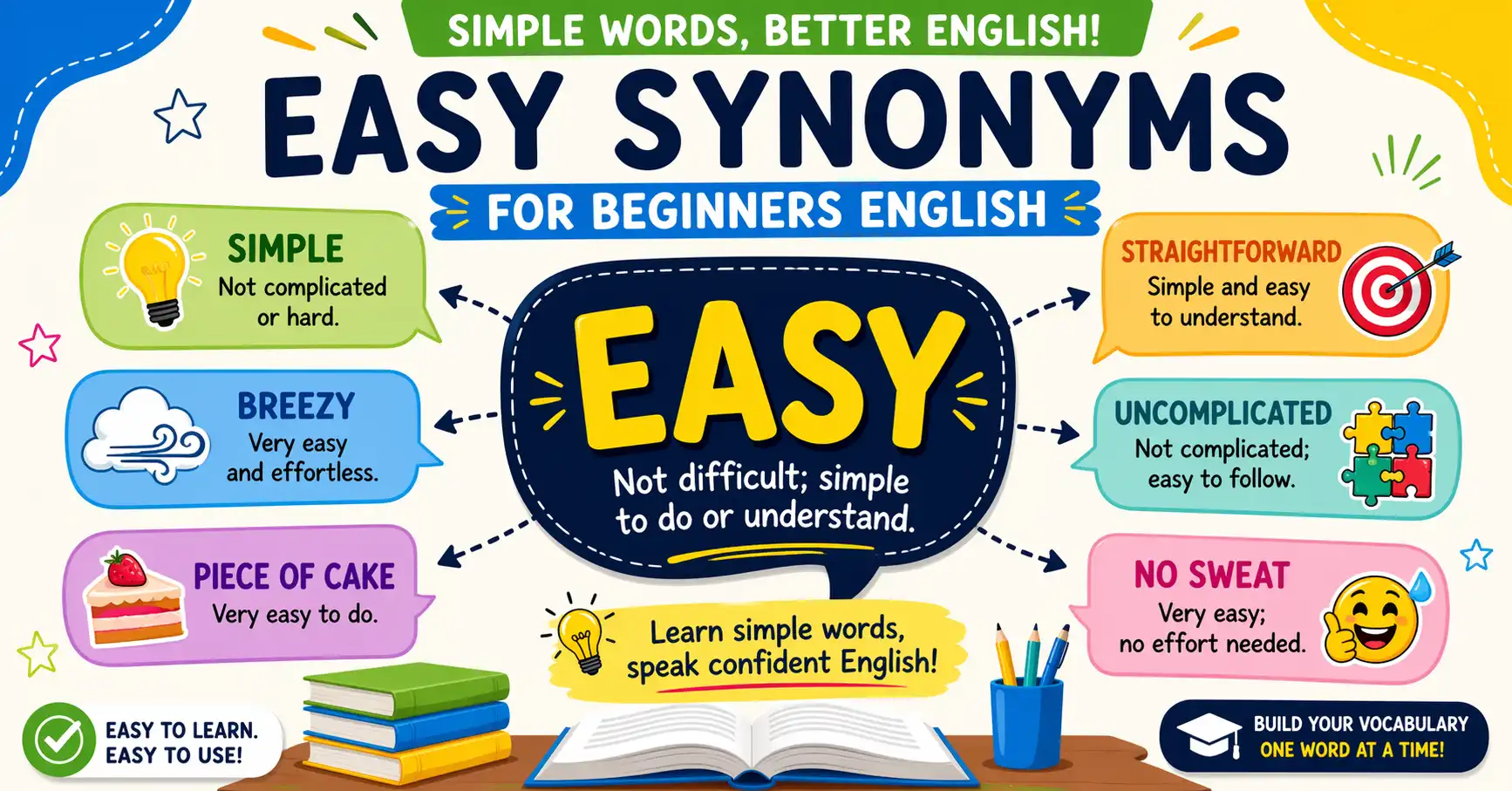
Easy synonyms for beginners English are simple alternative words like “big = large,” “happy = glad,” and “fast = quick.” These words help you avoid repetition and make your English clearer. Beginners should focus on commonly used synonyms that are easy to understand, pronounce, and use in daily conversations or basic writing tasks.
What Does “Easy Synonyms for Beginners English” Mean?
This phrase refers to simple, beginner-level words that have similar meanings and can be used instead of each other.
For example:
- “Happy” and “glad” mean almost the same
- “Big” and “large” are very similar
In ESL learning, especially at A1–B2 levels, synonyms are important because they:
- Improve vocabulary range
- Help you sound more natural
- Reduce repetition in speaking and writing
According to academic writing conventions, even basic essays should avoid repeating the same word too often. This is why synonyms are introduced early in IELTS preparation.
Complete Synonyms List (Beginner-Friendly)
Here are some of the most useful easy synonyms for beginners English:
- Big → Large
- Small → Little
- Happy → Glad
- Sad → Unhappy
- Fast → Quick
- Slow → Not fast / Gradual
- Good → Nice
- Bad → Poor
- Easy → Simple
- Hard → Difficult
- Start → Begin
- End → Finish
ESL Note:
Focus on learning 1–2 synonyms per day instead of memorizing long lists. This improves retention and real usage.
Comparison Table
| Word | Simple Meaning | Best Used When | Avoid When |
| Big | Large size | Speaking, writing | Formal reports (use “large”) |
| Happy | Feeling good | Daily conversation | Academic writing (use “pleased”) |
| Fast | Moving quickly | Informal speaking | Scientific writing |
| Easy | Not difficult | Instructions | Academic essays |
| Good | Positive quality | General use | Formal evaluation |
| Start | To begin | Conversation | Formal writing |
| End | To finish | Everyday speech | Academic tone |
Formal vs Informal Synonyms
| Informal Word | Formal Synonym |
| Big | Large |
| Happy | Pleased |
| Sad | Unhappy |
| Good | Positive |
| Bad | Negative |
| Start | Begin |
| End | Conclude |
IELTS Tip:
Using formal synonyms like “begin” instead of “start” can help improve your IELTS Writing band score, especially for Task 2 essays.
Real Example Sentences
Here are simple sentences using beginner synonyms:
- The house is big → The house is large.
- I feel happy today → I feel glad today.
- This test is easy → This test is simple.
- He runs fast → He runs quickly.
- The movie was good → The movie was nice.
- She felt sad → She felt unhappy.
- Let’s start now → Let’s begin now.
- The class will end soon → The class will finish soon.
ESL Note:
Try replacing one word in your daily sentences with a synonym. This builds confidence quickly.
When to Use vs When NOT to Use
When to Use:
- To avoid repeating the same word
- In simple conversations
- In basic writing tasks
- When you want clearer expression
NOT to Use:
- When the synonym changes meaning slightly
- In formal writing without checking tone
- When you are unsure of pronunciation
- When context requires a specific word
Example:
“Big mistake” is correct, but “large mistake” sounds less natural in conversation.
In our experience helping learners, many beginners try to replace every word with a synonym. This often creates unnatural sentences. Use synonyms carefully.
Common Mistakes Writers Make
1. Using synonyms incorrectly
Not all synonyms are exact matches.
Example: “Quick food” is wrong → say “fast food.”
2. Ignoring context
Some words only fit specific situations.
Example: “Large rain” ❌ → “heavy rain” ✔️
3. Overusing simple synonyms
Repeating “good,” “nice,” or “big” still limits vocabulary.
4. Mixing formal and informal words
Example: “The results were good and satisfactory” (awkward mix)
5. Memorizing without practice
Writers we work with often remember lists but cannot use words in real sentences.
Tips and Best Practices
1. Learn in pairs
Study words together:
- Big → Large
- Happy → Glad
2. Practice daily
Write 3 sentences using new synonyms.
3. Focus on common words first
Start with everyday vocabulary before advanced terms.
4. Use context
Learn how the word is used in a sentence, not just meaning.
5. Read simple English texts
Books and articles for beginners show natural usage.
ESL Note:
If you are preparing for IELTS, aim to replace basic words with slightly better synonyms, not advanced vocabulary. Clarity matters more than complexity.
Frequently Asked Questions
Q: What are the easiest synonyms for beginners?
A: The easiest synonyms are simple pairs like “big = large,” “happy = glad,” and “fast = quick.” These are commonly used in daily English and easy to understand, making them perfect for beginners learning vocabulary step by step.
Q: Why should beginners learn synonyms?
A: Synonyms help you avoid repeating the same words and improve your communication skills. They also make your writing sound more natural and are important for exams like IELTS, where vocabulary variety affects your score.
Q: Are all synonyms exactly the same?
A: No, most synonyms have small differences in meaning or usage. For example, “big” and “large” are similar, but not always interchangeable in every sentence. Context plays an important role in choosing the right word.
Q: How many synonyms should beginners learn daily?
A: Beginners should focus on learning 2–5 synonyms per day. This allows enough time to understand meanings, practice usage, and remember them effectively without feeling overwhelmed.
Q: Can synonyms improve IELTS writing scores?
A: Yes, using appropriate synonyms improves lexical resource, which is a key IELTS scoring criterion. However, accuracy is more important than complexity, so use simple, correct synonyms rather than difficult words incorrectly.
Q: What is the best way to practice synonyms?
A: The best method is to use synonyms in sentences. Write short paragraphs, speak aloud, and replace common words with alternatives. Regular practice helps you remember and use them naturally in real situations.
CONCLUSION
Learning easy synonyms for beginners English is one of the fastest ways to improve your vocabulary and confidence. By using simple alternative words, you can make your speech and writing more natural and less repetitive.
Remember to focus on common words, practice regularly, and always consider context. Small improvements in vocabulary can lead to big progress over time.
You might also want to read our guide on basic English vocabulary for daily use to continue building your skills.
Keep practicing—you’re improving every day.

Robert Hayes is an ESL educator and curriculum developer with over nine years of experience teaching English to beginners and intermediate learners across multiple countries ( Biography ).