Do you often struggle to find the right opposite word while speaking or writing in English? Many learners know basic vocabulary, but when it comes to expressing contrast clearly, they hesitate. That’s where a common English words and opposites list becomes essential.
In everyday conversations, essays, and exams like IELTS, using correct opposites helps you show clarity and range in your language. Without this skill, your writing may sound repetitive or incomplete. You might know “happy,” but what about using “miserable” instead of just “sad”?
In this guide, you’ll learn a structured and easy-to-understand list of common English words with their opposites. You’ll also see how to use them correctly, avoid common mistakes, and improve your vocabulary step by step.
Whether you are a beginner or improving your ESL skills, this article will give you practical tools you can use immediately.
Quick Answer:
A common English words and opposites list includes frequently used vocabulary paired with their antonyms (opposite meanings), such as “big–small,” “happy–sad,” and “fast–slow.” These pairs help learners understand contrast, improve sentence variety, and write more clearly in both academic and everyday English contexts.
What does “Common English Words and Opposites” mean?
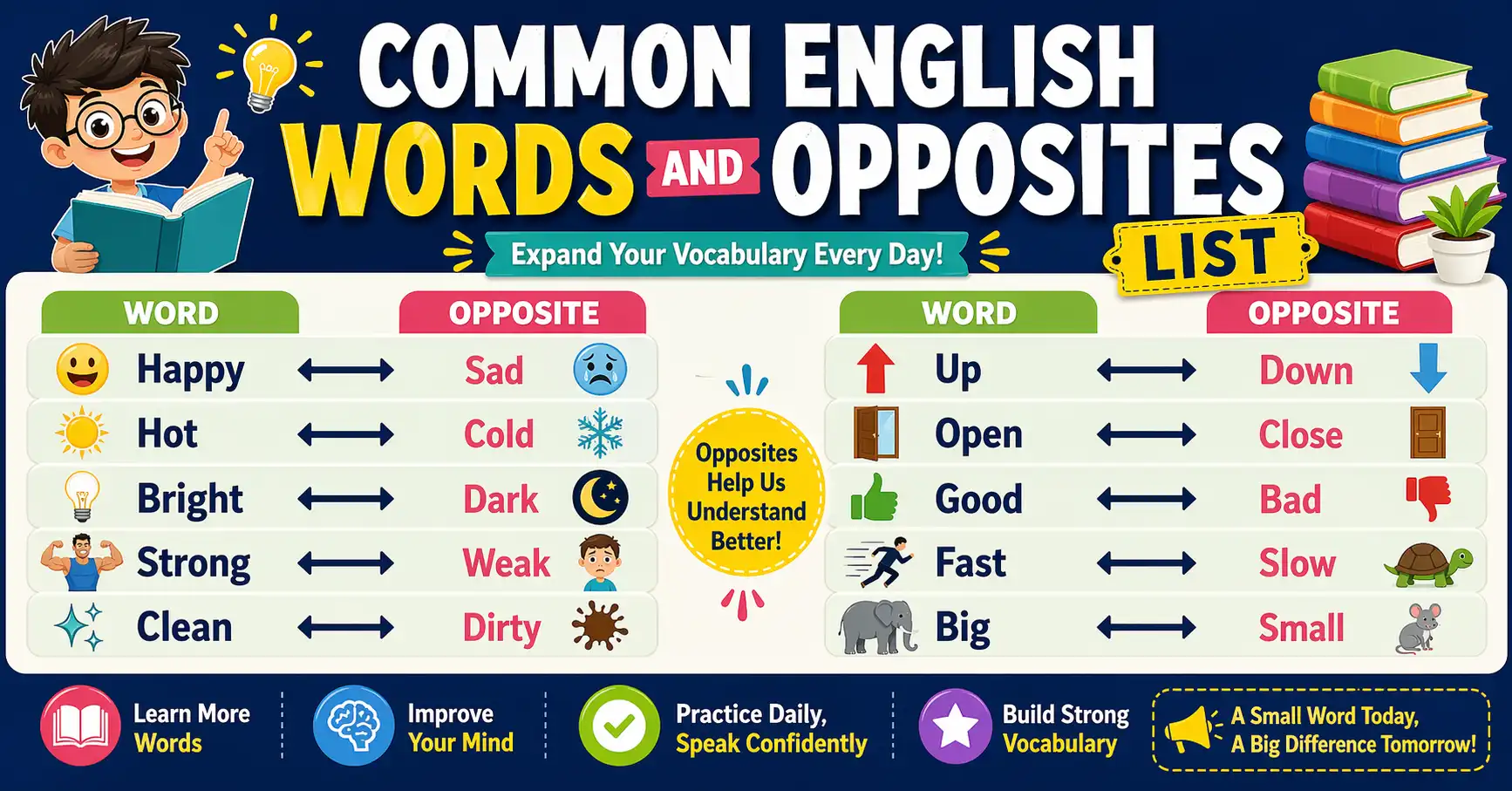
A common English words and opposites list refers to frequently used vocabulary paired with their antonyms—words that have opposite meanings.
For example:
- Hot ↔ Cold
- Easy ↔ Difficult
- Early ↔ Late
These word pairs are essential because they:
- Improve vocabulary range
- Help express contrast clearly
- Strengthen writing for exams like IELTS
ESL Note:
When you learn a new word, always learn its opposite too. This doubles your vocabulary instantly.
Complete Synonyms List (for “Common”)
Even though this article focuses on opposites, understanding synonyms of “common” helps expand your vocabulary.
Here are useful synonyms:
- Usual
- Typical
- Frequent
- Regular
- Everyday
- Normal
- Standard
- Familiar
- Routine
- Popular
Why this matters:
In academic writing, repeating “common” too often lowers your score. Using synonyms shows vocabulary range.
Comparison Table
| Word | Simple Meaning | Best Used When | Avoid When |
| Big | Large in size | Basic descriptions | Formal essays |
| Small | Little in size | Simple speech | Technical writing |
| Happy | Feeling good | Daily conversation | Formal tone |
| Sad | Feeling unhappy | Personal stories | Academic writing |
| Fast | Moving quickly | Informal writing | Scientific context |
| Slow | Not fast | General use | Precise data needed |
| Easy | Not difficult | Instructions | Academic writing |
| Difficult | Hard to do | Essays | Casual tone |
Formal vs Informal Synonyms
| Formal Word | Informal Equivalent |
| Depart | Leave |
| Purchase | Buy |
| Assist | Help |
| Difficult | Hard |
| Rapid | Fast |
| Inform | Tell |
| Require | Need |
| Obtain | Get |
IELTS Tip:
Using formal vocabulary like “assist” instead of “help” can increase your Lexical Resource score.
Real Example Sentences
Here are practical examples using common words and their opposites:
- The weather today is hot, but yesterday it was cold.
- This task is easy, but the exam was difficult.
- She felt happy after hearing the news, not sad anymore.
- The train is very fast, unlike the old one which was slow.
- He lives in a big house, not a small apartment.
- The meeting started early, not late.
- This road is safe, but the other one is dangerous.
- The instructions were clear, not confusing.
ESL Note:
Practice speaking these sentences aloud. It helps memory and pronunciation.
When to Use vs When NOT to Use
When to Use:
Use opposites when you want to:
- Show contrast clearly
- Compare two ideas
- Improve sentence variety
- Strengthen essays and arguments
When NOT to Use:
Avoid using simple opposites when:
- Writing formal academic essays (use precise words instead)
- The meaning is not exact (not all opposites are perfect pairs)
- Repetition makes writing sound basic
Example:
Instead of:
- “The situation is not good.”
Use:
- “The situation is poor.”
Common Mistakes Writers Make
Many ESL learners make these mistakes:
1. Using Incorrect Opposites
Example:
- Wrong: “Hot – Cool” (not exact opposite)
- Correct: “Hot – Cold”
2. Overusing Basic Words
Using “big/small” repeatedly instead of:
- Large / Tiny
- Huge / Minimal
3. Ignoring Context
Some opposites change depending on context:
- “Light” (not heavy) vs “Light” (brightness)
4. Direct Translation Errors
Learners translate from their native language, which can lead to incorrect opposites.
In our experience helping writers:
Students often memorize lists but don’t practice usage. Without context, they forget quickly.
Tips and Best Practices
Here are practical ways to master a common English words and opposites list:
1. Learn in Pairs
Always memorize:
- Word + Opposite together
2. Use Flashcards
Write:
- Front: Happy
- Back: Sad
3. Practice Daily Sentences
Create one sentence for each pair.
4. Group by Topic
Example:
- Emotions: happy/sad, angry/calm
- Size: big/small, tall/short
5. Read Simple Texts
Books and articles show real usage.
ESL Note:
Short daily practice (10 minutes) is more effective than long weekly study.
Frequently Asked Questions
Q1: What are common English words and opposites?
A: Common English words and opposites are frequently used vocabulary paired with their antonyms, such as “happy–sad” or “big–small.” These pairs help learners understand contrast and improve both speaking and writing clarity in everyday English.
Q2: Why should I learn opposites in English?
A: Learning opposites improves your vocabulary range and helps you express ideas more clearly. In exams like IELTS, using varied vocabulary—including antonyms—can improve your lexical score and make your writing more precise.
Q3: How can beginners learn opposites easily?
A: Beginners should learn words in pairs, use flashcards, and practice simple sentences daily. Grouping words by topic and repeating them regularly helps build memory and confidence in using opposites naturally.
Q4: Are all English words having exact opposites?
A: No, not all words have exact opposites. Some words have multiple meanings or no direct antonym. In such cases, you must choose a word that best fits the context rather than forcing an opposite.
Q5: What are the most common opposite word pairs?
A: Some common pairs include big–small, hot–cold, fast–slow, happy–sad, and early–late. These are widely used in everyday English and are essential for beginners to master first.
Q6: Can using opposites improve IELTS writing score?
A: Yes, using opposites correctly shows vocabulary range and improves clarity. According to IELTS band descriptors, lexical variety is important, and using antonyms effectively can help achieve a higher band score.
CONCLUSION
Learning a common English words and opposites list is one of the fastest ways to improve your vocabulary and writing skills. It helps you express contrast, avoid repetition, and communicate ideas clearly. By practicing word pairs, using them in sentences, and avoiding common mistakes, you can build strong language skills step by step.
You might also want to read our guide on basic English synonyms list to expand your vocabulary further.
Keep practicing daily—you’ll see real improvement sooner than you expect!

Robert Hayes is an ESL educator and curriculum developer with over nine years of experience teaching English to beginners and intermediate learners across multiple countries ( Biography ).