Introduction
Synonyms for writers are words that describe a person who writes, but each one carries its own shade of meaning. A synonym for writer like “novelist” points to fiction, while “journalist” points to news. Learning synonyms for writers helps you pick the exact word that fits your sentence instead of repeating “writer” again and again.
Picture this. You are editing a blog post, and the word “writer” shows up six times in three paragraphs. It reads flat. It feels tired. Your reader starts skimming instead of reading. This happens to almost every content creator at some point, and the fix is simple: a stronger vocabulary.
A synonym for writer is just a different word that means the same thing, but with its own flavor. “Author” sounds formal. “Wordsmith” sounds skilled and creative. “Scribbler” sounds playful or even a little humble. Once you know these options, your writing feels fresh instead of repetitive.
“The difference between a good writer and a great one is often just one better word.”
This skill matters for different people in different ways:
- Students use these words to sound sharper in essays and reports.
- Bloggers use them to keep posts lively and avoid boring repetition.
- Content writers use them to match tone — formal, casual, or creative — to the right project.
- Daily English users use them to sound more natural in conversation and writing.
Knowing many synonyms for writers is not just a vocabulary trick. It is a real writing skill. It shows control over language, and it keeps your reader interested from the first line to the last.
“Words are the writer’s only tools, so a writer should own many of them.”
Connotative Meaning, Etymology & Pronunciation
Connotative Meaning: The word “writer” often carries a feeling of creativity, intelligence, and skill. It can sound respected (as in “author”) or plain and neutral (as in “someone who writes”), depending on context.
Etymology (short history):
- Old English root: writan, meaning “to scratch” or “to draw a shape” (as marks were once scratched into wood or stone).
- Old English word writere meant “one who writes.”
- Middle English shaped it into “writer” as literacy and books spread.
- Modern English kept “writer” as the standard term for anyone who produces written work.
Pronunciation of “Writer”:
- US English (IPA): /ˈraɪ.tər/
- UK English (IPA): /ˈraɪ.tə/
Syllables: Writ-er (2 syllables)
Affixation Pattern: Base word “write” (verb) + suffix “-er” (a person who does the action) = “writer” (noun, meaning “a person who writes”).
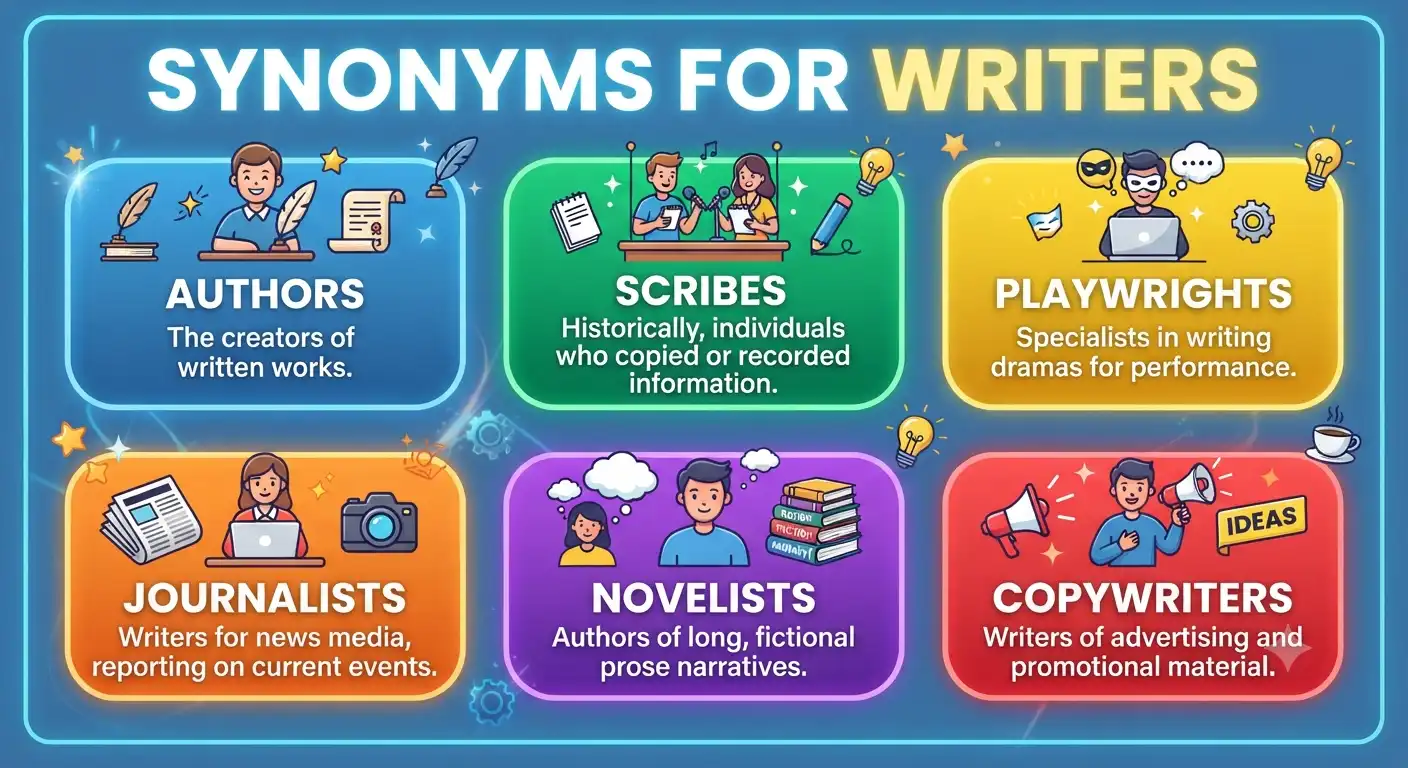
Comparison Table: Synonyms for Writers
| Keyword | Meaning | Usage Type | Context |
| Author | Person who creates a written work, often a book | Formal | Publishing, literature |
| Novelist | Person who writes novels | Formal | Fiction, literature |
| Blogger | Person who writes for a blog or website | Casual | Online, daily content |
| Journalist | Person who writes news reports | Professional | Media, news |
| Wordsmith | Person skilled with words | Creative | Content writing, marketing |
| Ghostwriter | Person who writes for someone else | Professional | Publishing, business |
| Poet | Person who writes poems | Creative/Emotional | Literature, art |
| Scribbler | Person who writes casually or quickly | Casual | Informal, humorous |
| Copywriter | Person who writes marketing text | Professional | Advertising, business |
| Bard | Poetic or old-fashioned term for a writer/poet | Emotional | Literature, storytelling |
50 Synonyms for Writers
1. Author
Pronunciation: US /ˈɔː.θər/ — UK /ˈɔː.θə/ Meaning: An author is a person who writes a book or a piece of writing. Examples:
- The author signed copies of her new novel at the bookstore.
- Every author has a unique writing voice.
2. Novelist
Pronunciation: US /ˈnɒv.əl.ɪst/ — UK /ˈnɒv.əl.ɪst/ Meaning: A novelist is a person who writes novels. Examples:
- The novelist spent three years finishing her latest book.
- His favorite novelist writes mystery stories.
3. Scribe
Pronunciation: US /skraɪb/ — UK /skraɪb/ Meaning: A scribe is a person who writes or copies documents by hand. Examples:
- In old times, a scribe copied books by hand.
- The scribe carefully wrote every letter of the scroll.
4. Wordsmith
Pronunciation: US /ˈwɜːrd.smɪθ/ — UK /ˈwɜːd.smɪθ/ Meaning: A wordsmith is someone who is very skilled at using words. Examples:
- She is a true wordsmith who makes simple ideas sound beautiful.
- The ad team hired a wordsmith to write the slogan.
5. Journalist
Pronunciation: US /ˈdʒɜːr.nəl.ɪst/ — UK /ˈdʒɜː.nəl.ɪst/ Meaning: A journalist is a person who writes news stories. Examples:
- The journalist reported live from the city center.
- A good journalist always checks facts before publishing.
6. Columnist
Pronunciation: US /ˈkɒl.əm.nɪst/ — UK /ˈkɒl.əm.nɪst/ Meaning: A columnist is a person who writes a regular column in a newspaper or magazine. Examples:
- The columnist shares her opinion every Sunday.
- His favorite columnist writes about sports.
7. Blogger
Pronunciation: US /ˈblɒg.ər/ — UK /ˈblɒg.ə/ Meaning: A blogger is a person who writes posts for a blog or website. Examples:
- The blogger posted a new travel guide today.
- She became a full-time blogger last year.
8. Essayist
Pronunciation: US /ˈeˌseɪ.ɪst/ — UK /ˈeˌseɪ.ɪst/ Meaning: An essayist is a person who writes essays. Examples:
- The essayist wrote about honesty and courage.
- Many students study this classic essayist in school.
9. Poet
Pronunciation: US /ˈpoʊ.ɪt/ — UK /ˈpəʊ.ɪt/ Meaning: A poet is a person who writes poems. Examples:
- The poet read her new poem aloud at the event.
- He wants to become a famous poet one day.
10. Playwright
Pronunciation: US /ˈpleɪ.raɪt/ — UK /ˈpleɪ.raɪt/ Meaning: A playwright is a person who writes plays for theater. Examples:
- The playwright wrote a comedy for the local theater.
- Her new play was written by a young playwright.
11. Screenwriter
Pronunciation: US /ˈskriːnˌraɪ.tər/ — UK /ˈskriːnˌraɪ.tə/ Meaning: A screenwriter is a person who writes scripts for movies or TV. Examples:
- The screenwriter won an award for the film’s script.
- She works as a screenwriter for a streaming show.
12. Copywriter
Pronunciation: US /ˈkɒp.iˌraɪ.tər/ — UK /ˈkɒp.iˌraɪ.tə/ Meaning: A copywriter is a person who writes text for ads and marketing. Examples:
- The copywriter wrote the headline for the new campaign.
- Our copywriter made the product sound exciting.
13. Storyteller
Pronunciation: US /ˈstɔːriˌtel.ər/ — UK /ˈstɔːriˌtel.ə/ Meaning: A storyteller is a person who tells or writes stories. Examples:
- The storyteller captured the whole room with his tale.
- Good writers are also good storytellers.
14. Biographer
Pronunciation: US /baɪˈɒg.rə.fər/ — UK /baɪˈɒg.rə.fə/ Meaning: A biographer is a person who writes the life story of someone else. Examples:
- The biographer spent years researching the singer’s life.
- Her new book was written by a well-known biographer.
15. Reporter
Pronunciation: US /rɪˈpɔːr.tər/ — UK /rɪˈpɔː.tə/ Meaning: A reporter is a person who writes or shares news stories. Examples:
- The reporter interviewed the mayor this morning.
- A reporter must always be accurate and fair.
16. Correspondent
Pronunciation: US /ˌkɒr.ɪˈspɒn.dənt/ — UK /ˌkɒr.ɪˈspɒn.dənt/ Meaning: A correspondent is a reporter who writes news from a specific place or topic. Examples:
- Our correspondent in London sent the latest update.
- The correspondent covers world politics for the channel.
17. Ghostwriter
Pronunciation: US /ˈgoʊstˌraɪ.tər/ — UK /ˈgəʊstˌraɪ.tə/ Meaning: A ghostwriter is a person who writes for someone else, without getting public credit. Examples:
- The celebrity hired a ghostwriter for her memoir.
- He works as a ghostwriter for busy business owners.
18. Lyricist
Pronunciation: US /ˈlɪr.ɪ.sɪst/ — UK /ˈlɪr.ɪ.sɪst/ Meaning: A lyricist is a person who writes the words for songs. Examples:
- The lyricist wrote a heartfelt song about home.
- She is the lyricist behind many popular songs.
19. Dramatist
Pronunciation: US /ˈdræm.ə.tɪst/ — UK /ˈdræm.ə.tɪst/ Meaning: A dramatist is a person who writes dramas or plays. Examples:
- The dramatist wrote a powerful play about war.
- Students studied the dramatist‘s most famous work.
20. Chronicler
Pronunciation: US /ˈkrɒn.ɪ.klər/ — UK /ˈkrɒn.ɪ.klə/ Meaning: A chronicler is a person who writes a record of events over time. Examples:
- The chronicler documented the town’s history for years.
- Old kingdoms had a chronicler to record important events.
21. Pamphleteer
Pronunciation: US /ˌpæm.flɪˈtɪr/ — UK /ˌpæm.flɪˈtɪə/ Meaning: A pamphleteer is a person who writes short political or opinion papers. Examples:
- The pamphleteer printed his ideas for the public to read.
- History remembers him as a bold pamphleteer.
22. Freelance Writer
Pronunciation: US /ˈfriːlæns ˈraɪ.tər/ — UK /ˈfriːlɑːns ˈraɪ.tə/ Meaning: A freelance writer is a person who writes for different clients instead of one company. Examples:
- She works as a freelance writer for several websites.
- Being a freelance writer gives him flexible hours.
23. Content Creator
Pronunciation: US /ˈkɒn.tent kriˈeɪ.tər/ — UK /ˈkɒn.tent kriˈeɪ.tə/ Meaning: A content creator is a person who makes written or visual content, often online. Examples:
- The content creator posts a new article every week.
- Brands often hire a content creator for social media.
24. Narrator
Pronunciation: US /ˈnær.eɪ.tər/ — UK /nəˈreɪ.tə/ Meaning: A narrator is a person who tells or writes the story in a book or film. Examples:
- The narrator guides the reader through the whole plot.
- Her voice as a narrator felt calm and clear.
25. Commentator
Pronunciation: US /ˈkɒm.ən.teɪ.tər/ — UK /ˈkɒm.ən.teɪ.tə/ Meaning: A commentator is a person who writes or gives opinions about events. Examples:
- The commentator shared his thoughts on the election.
- A sports commentator described every play of the game.
26. Critic
Pronunciation: US /ˈkrɪt.ɪk/ — UK /ˈkrɪt.ɪk/ Meaning: A critic is a person who writes reviews and judgments about books, films, or art. Examples:
- The critic praised the film’s strong story.
- A harsh critic can affect how people see a book.
27. Reviewer
Pronunciation: US /rɪˈvjuː.ər/ — UK /rɪˈvjuː.ə/ Meaning: A reviewer is a person who writes an opinion about a product, book, or service. Examples:
- The reviewer gave the restaurant five stars.
- She works as a book reviewer for a magazine.
28. Contributor
Pronunciation: US /kənˈtrɪb.jə.tər/ — UK /kənˈtrɪb.jə.tə/ Meaning: A contributor is a person who writes articles for a magazine, site, or book. Examples:
- He is a regular contributor to the travel magazine.
- The site invited a new contributor this month.
29. Penman
Pronunciation: US /ˈpen.mən/ — UK /ˈpen.mən/ Meaning: A penman is an old-fashioned word for a person who writes. Examples:
- The old letters were written by a skilled penman.
- He was known as a fine penman in his village.
30. Scrivener
Pronunciation: US /ˈskrɪv.ə.nər/ — UK /ˈskrɪv.ə.nə/ Meaning: A scrivener is an old term for a person who copies or writes documents. Examples:
- The scrivener wrote the legal papers by hand.
- A scrivener worked in every court in the old days.
31. Litterateur
Pronunciation: US /ˌlɪt.ər.əˈtɜːr/ — UK /ˌlɪt.ər.əˈtɜː/ Meaning: A litterateur is a person devoted to literature and writing as an art. Examples:
- The litterateur spent his life studying great novels.
- She is respected as a serious litterateur.
32. Wordslinger
Pronunciation: US /ˈwɜːrdˌslɪŋ.ər/ — UK /ˈwɜːdˌslɪŋ.ə/ Meaning: A wordslinger is an informal term for someone who writes quickly and skillfully. Examples:
- The freelance wordslinger finished five articles in a day.
- He calls himself a wordslinger, not just a writer.
33. Hack Writer
Pronunciation: US /hæk ˈraɪ.tər/ — UK /hæk ˈraɪ.tə/ Meaning: A hack writer is a person who writes quickly for money, often without much care. Examples:
- Some call him a hack writer, but his readers still love his work.
- The tight deadline turned every writer into a hack writer.
34. Bard
Pronunciation: US /bɑːrd/ — UK /bɑːd/ Meaning: A bard is a poetic or old term for a writer or poet, often one who tells stories aloud. Examples:
- The bard sang tales of old heroes.
- Shakespeare is often called “the bard” of English literature.
35. Fictionist
Pronunciation: US /ˈfɪk.ʃən.ɪst/ — UK /ˈfɪk.ʃən.ɪst/ Meaning: A fictionist is a person who writes fiction stories. Examples:
- The fictionist created a whole new fantasy world.
- Few readers know this fictionist also writes poetry.
36. Diarist
Pronunciation: US /ˈdaɪ.ər.ɪst/ — UK /ˈdaɪ.ər.ɪst/ Meaning: A diarist is a person who writes a diary or journal. Examples:
- The diarist wrote about daily life during the war.
- Her book was based on a teenage diarist‘s journal.
37. Memoirist
Pronunciation: US /ˈmem.wɑːr.ɪst/ — UK /ˈmem.wɑː.rɪst/ Meaning: A memoirist is a person who writes about their own life experiences. Examples:
- The memoirist shared her struggles with honesty.
- His book made him a well-known memoirist.
38. Speechwriter
Pronunciation: US /ˈspiːtʃˌraɪ.tər/ — UK /ˈspiːtʃˌraɪ.tə/ Meaning: A speechwriter is a person who writes speeches for someone else. Examples:
- The speechwriter prepared the president’s address.
- She works as a speechwriter for company leaders.
39. Technical Writer
Pronunciation: US /ˈtek.nɪ.kəl ˈraɪ.tər/ — UK /ˈtek.nɪ.kəl ˈraɪ.tə/ Meaning: A technical writer is a person who writes manuals and guides for products or software. Examples:
- The technical writer created the app’s user guide.
- Every software team needs a good technical writer.
40. Penwoman
Pronunciation: US /ˈpenˌwʊm.ən/ — UK /ˈpenˌwʊm.ən/ Meaning: A penwoman is an old-fashioned word for a woman who writes. Examples:
- She was praised as a skilled penwoman of her time.
- The letters reveal a talented penwoman behind them.
41. Wordcrafter
Pronunciation: US /ˈwɜːrdˌkræf.tər/ — UK /ˈwɜːdˌkrɑːf.tə/ Meaning: A wordcrafter is a person who shapes words carefully and skillfully. Examples:
- The wordcrafter turned a simple idea into a beautiful line.
- Good copywriters are true wordcrafters.
42. Belletrist
Pronunciation: US /ˈbel.ə.trɪst/ — UK /ˈbel.ə.trɪst/ Meaning: A belletrist is a writer who focuses on elegant, artistic writing. Examples:
- The belletrist wrote beautifully about small daily moments.
- Critics called her essays true belletrist work.
43. Fabulist
Pronunciation: US /ˈfæb.jə.lɪst/ — UK /ˈfæb.jʊ.lɪst/ Meaning: A fabulist is a person who writes fables or imaginative stories. Examples:
- The fabulist wrote a tale about a clever fox.
- Children loved the fabulist‘s animal stories.
44. Scribbler
Pronunciation: US /ˈskrɪb.lər/ — UK /ˈskrɪb.lə/ Meaning: A scribbler is an informal word for someone who writes, often quickly or casually. Examples:
- He jokingly calls himself a humble scribbler.
- The young scribbler filled notebooks with poems.
45. Inkslinger
Pronunciation: US /ˈɪŋkˌslɪŋ.ər/ — UK /ˈɪŋkˌslɪŋ.ə/ Meaning: An inkslinger is a slang term for a writer or journalist. Examples:
- The old newsroom was full of fast-typing inkslingers.
- She proudly calls herself an inkslinger for hire.
46. Quill Driver
Pronunciation: US /kwɪl ˈdraɪ.vər/ — UK /kwɪl ˈdraɪ.və/ Meaning: A quill driver is an old, playful term for a writer. Examples:
- The letters were signed by an unknown quill driver.
- He called himself a modern quill driver with a laptop.
47. Man of Letters
Pronunciation: US /mæn əv ˈlet.ərz/ — UK /mæn əv ˈlet.əz/ Meaning: A man of letters is an old term for a well-read and skilled writer. Examples:
- He was respected as a true man of letters.
- The professor is known as a man of letters in his city.
48. Anthologist
Pronunciation: US /ænˈθɒl.ə.dʒɪst/ — UK /ænˈθɒl.ə.dʒɪst/ Meaning: An anthologist is a person who writes or collects works into one book. Examples:
- The anthologist gathered the best short stories of the year.
- Her role as an anthologist brought new writers attention.
49. Compiler
Pronunciation: US /kəmˈpaɪ.lər/ — UK /kəmˈpaɪ.lə/ Meaning: A compiler is a person who gathers and writes information together into one piece. Examples:
- The compiler organized years of research into one report.
- She worked as a compiler for the history book.
50. Prose Writer
Pronunciation: US /proʊz ˈraɪ.tər/ — UK /prəʊz ˈraɪ.tə/ Meaning: A prose writer is a person who writes in normal sentence form, not poetry. Examples:
- The prose writer published her first novel this year.
- He prefers being a prose writer over a poet.
Antonyms of “Writer”
- Reader
- Listener
- Illiterate
- Non-writer
- Silent one
Prototype Meaning and Categorization
The prototype meaning of “writer” is a person who creates written text using words, whether in books, articles, scripts, or online content. Writers can be categorized by:
- Format: Novelist, poet, playwright, screenwriter
- Purpose: Journalist, copywriter, technical writer, speechwriter
- Platform: Blogger, content creator, columnist
- Style: Essayist, storyteller, wordsmith
All these types share the same core action: turning thoughts into written words.
“Every writer, no matter the label, shares one job: turning silence into words.”
FAQ
Q1: What is the best synonym for writer in professional writing? “Author” is the most professional and widely accepted synonym for writer.
Q2: What is a fun or casual synonym for writer? “Scribbler” or “wordslinger” work well in casual, light-hearted writing.
Q3: What is the difference between an author and a writer? An author usually refers to someone who has published a specific work, while a writer is a broader term for anyone who writes.
Q4: What do you call a person who writes for someone else? This person is called a ghostwriter or, in speeches, a speechwriter.
Q5: What is a good synonym for writer in content marketing? “Copywriter” or “content creator” fit best for marketing and online content roles.
Q6: Are “novelist” and “writer” the same thing? No. A novelist only writes novels, while a writer can write any type of content.
Q7: What is an old-fashioned word for writer? “Scribe,” “penman,” and “man of letters” are older, classic terms for a writer.
Conclusion
Learning synonyms for writers does more than expand your vocabulary — it directly improves your writing, blogging, speaking, and communication. When you know many words for the same idea, your sentences stop feeling repetitive and start feeling polished. Readers notice this, even if they cannot explain why.
“A rich vocabulary is not decoration. It is the foundation of clear communication.”
Try using these new words the same day you learn them. Add one into an email. Use another in your next blog post. Say a new one out loud in a daily conversation. Small daily practice turns new words into permanent tools in your vocabulary.
“Language grows only through use, never through memory alone.”
Whether you are a student writing an essay, a blogger building an audience, or a professional content writer working across niches, synonyms for writers give you more control and more color in your language. Keep this list close, revisit it often, and watch your writing become sharper with every new word you use.
“The right word, used at the right moment, can change how a whole sentence feels.”

Robert Hayes is an ESL educator and curriculum developer with over nine years of experience teaching English to beginners and intermediate learners across multiple countries ( Biography ).