Introduction
Synonyms for qualifications are words that describe a person’s skills, training, or ability to do a job. Qualifications show what someone has learned or earned, like a degree or a certificate. Using different synonyms for qualifications makes your writing sound fresh and professional instead of repeating the same word again and again.
Picture this: you are writing a resume, and you use the word “qualifications” five times in one page. It looks boring. A hiring manager might skip right past it. Now picture the same resume with words like credentials, expertise, and skill set mixed in. It reads smoother, sounds smarter, gets noticed.
“Words are the clothes that thoughts wear.”
That is exactly what synonyms do. They dress up your ideas so they stand out. In simple terms, qualifications mean the abilities, education, or experience that make someone fit for a task or job. Students use these words in essays. Bloggers use them to avoid repetition. Content writers use them to improve SEO rankings. Everyday English speakers use them to sound more confident in conversations and emails.
“The right word can open doors the wrong word keeps shut.”
In this guide, you will find 50 useful synonyms for qualifications, their meanings, pronunciations, and real example sentences. By the end, you will never run out of ways to describe someone’s skills or credentials again.
Meaning, Etymology & Pronunciation of “Qualifications”
Connotative Meaning: The word “qualifications” carries a positive, respectful tone. It suggests trust, capability, and readiness. When someone lists their qualifications, it feels professional and credible.
Etymology (in short):
- From Latin qualis, meaning “of what kind”
- Passed through Old French qualification
- Entered Middle English in the 1400s
- Originally meant “a description of a quality”
- Later evolved to mean “fitness for a role or task”
Pronunciation:
- US: /ˌkwɑː.lə.fɪˈkeɪ.ʃənz/
- UK: /ˌkwɒl.ɪ.fɪˈkeɪ.ʃənz/
Syllables: qual‧i‧fi‧ca‧tions (5 syllables)
Affixation Pattern: qualify (root) + -ic (adjective-forming) + -ation (noun-forming, action/result) + -s (plural)
Comparison Table: Qualifications vs Other Related Words
| Keyword | Meaning | Usage Type | Context |
| Qualifications | Skills or credentials that prove fitness for a role | Formal | Job applications, resumes |
| Credentials | Official proof of achievement or authority | Formal | Workplace, academic |
| Skills | Learned abilities to do something well | Casual/Formal | Daily use, workplace |
| Expertise | Deep knowledge in a specific area | Professional | Workplace, consulting |
| Experience | Practical knowledge gained over time | Casual/Formal | Interviews, daily use |
| Competence | Ability to do something successfully | Professional | Workplace, evaluations |
| Eligibility | Meeting the required conditions | Formal | Applications, legal use |
| Aptitude | Natural talent for learning something | Casual | Education, career advice |
50 Synonyms for Qualifications
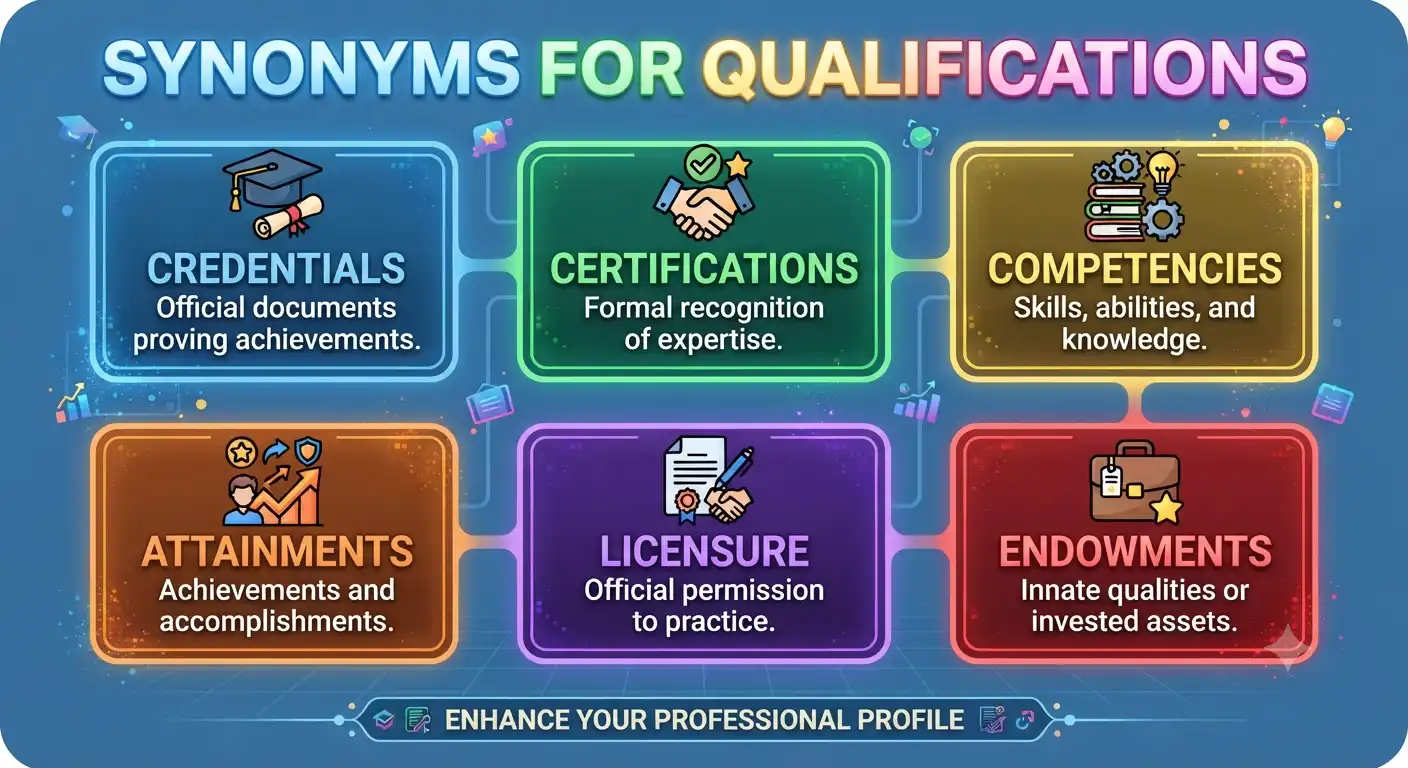
1. Credentials
Pronunciation: US: /krəˈdɛnʃəlz/ | UK: /krɪˈdɛnʃəlz/ Meaning: Credentials are proofs that show you are trained or approved for something. Examples:
- She showed her teaching credentials at the interview.
- His medical credentials were checked before he started work.
2. Skills
Pronunciation: US: /skɪlz/ | UK: /skɪlz/ Meaning: Skills are things you can do well because you learned or practiced them. Examples:
- His writing skills improved after months of practice.
- Good communication skills help you make friends fast.
3. Competencies
Pronunciation: US: /ˈkɑːmpətənsiz/ | UK: /ˈkɒmpɪtənsiz/ Meaning: Competencies are the abilities you need to do a task correctly. Examples:
- The job needed strong leadership competencies.
- Her core competencies include budgeting and planning.
4. Requirements
Pronunciation: US: /rɪˈkwaɪərmənts/ | UK: /rɪˈkwaɪəmənts/ Meaning: Requirements are things you must have or do to qualify for something. Examples:
- The college listed its entry requirements online.
- He met all the requirements for the scholarship.
5. Criteria
Pronunciation: US: /kraɪˈtɪəriə/ | UK: /kraɪˈtɪəriə/ Meaning: Criteria are the standards used to judge or decide something. Examples:
- The judges explained their scoring criteria.
- She passed every criteria for the visa.
6. Prerequisites
Pronunciation: US: /priːˈrɛkwəzɪts/ | UK: /priːˈrɛkwɪzɪts/ Meaning: Prerequisites are things you must finish before doing something else. Examples:
- Math 101 is a prerequisite for this class.
- He completed all the prerequisites before applying.
7. Attributes
Pronunciation: US: /ˈætrɪbjuːts/ | UK: /ˈætrɪbjuːts/ Meaning: Attributes are qualities or features a person has. Examples:
- Honesty is one of her best attributes.
- The manager listed key attributes for the role.
8. Aptitude
Pronunciation: US: /ˈæptɪtuːd/ | UK: /ˈæptɪtjuːd/ Meaning: Aptitude is a natural talent for learning or doing something. Examples:
- He showed a strong aptitude for numbers early on.
- Her aptitude for music surprised her teachers.
9. Capabilities
Pronunciation: US: /ˌkeɪpəˈbɪlətiz/ | UK: /ˌkeɪpəˈbɪlətiz/ Meaning: Capabilities are the powers or skills someone has to do things. Examples:
- The software has strong data capabilities.
- Her leadership capabilities grew with experience.
10. Eligibility
Pronunciation: US: /ˌɛlɪdʒəˈbɪləti/ | UK: /ˌɛlɪdʒəˈbɪləti/ Meaning: Eligibility means you meet the rules needed to apply or join. Examples:
- Check your eligibility before you apply.
- His age met the eligibility rules for the contest.
11. Proficiency
Pronunciation: US: /prəˈfɪʃənsi/ | UK: /prəˈfɪʃənsi/ Meaning: Proficiency means being very good at doing something. Examples:
- Her proficiency in Spanish helped her get the job.
- He gained proficiency in coding within a year.
12. Expertise
Pronunciation: US: /ˌɛkspərˈtiːz/ | UK: /ˌɛkspɜːˈtiːz/ Meaning: Expertise is deep skill or knowledge in one subject. Examples:
- The doctor’s expertise saved the patient’s life.
- She built her expertise through years of study.
13. Certification
Pronunciation: US: /ˌsɜːrtɪfɪˈkeɪʃən/ | UK: /ˌsɜːtɪfɪˈkeɪʃən/ Meaning: Certification is an official paper that proves you passed a course. Examples:
- He earned his certification in project management.
- The trainer needed a fitness certification.
14. Licensure
Pronunciation: US: /ˈlaɪsənʃər/ | UK: /ˈlaɪsənʃə/ Meaning: Licensure is the legal permission to work in a certain field. Examples:
- Nurses need licensure before they can practice.
- Her licensure expired last month.
15. Training
Pronunciation: US: /ˈtreɪnɪŋ/ | UK: /ˈtreɪnɪŋ/ Meaning: Training is learning done to prepare for a job or task. Examples:
- New staff go through two weeks of training.
- His pilot training took over a year.
16. Experience
Pronunciation: US: /ɪkˈspɪəriəns/ | UK: /ɪkˈspɪərɪəns/ Meaning: Experience is the knowledge you gain from doing something over time. Examples:
- Ten years of experience made him an expert.
- Her travel experience shaped her writing.
17. Skill set
Pronunciation: US: /skɪl sɛt/ | UK: /skɪl sɛt/ Meaning: A skill set is the full group of abilities a person has. Examples:
- Her skill set fits this role perfectly.
- The team needed a broader skill set.
18. Background
Pronunciation: US: /ˈbækɡraʊnd/ | UK: /ˈbækɡraʊnd/ Meaning: Background is your past training, work, or education. Examples:
- He has a background in finance.
- Her design background helped the project.
19. Competence
Pronunciation: US: /ˈkɑːmpɪtəns/ | UK: /ˈkɒmpɪtəns/ Meaning: Competence means having enough skill to do a job well. Examples:
- His competence in cooking grew every week.
- The panel tested her competence in law.
20. Capacity
Pronunciation: US: /kəˈpæsəti/ | UK: /kəˈpæsəti/ Meaning: Capacity is the ability to handle or do something. Examples:
- He has the capacity to lead a big team.
- Her mental capacity for math is impressive.
21. Fitness
Pronunciation: US: /ˈfɪtnəs/ | UK: /ˈfɪtnəs/ Meaning: Fitness, in this sense, means being suitable for a task. Examples:
- They questioned his fitness for the role.
- Her fitness for the job was never in doubt.
22. Suitability
Pronunciation: US: /ˌsuːtəˈbɪləti/ | UK: /ˌsjuːtəˈbɪləti/ Meaning: Suitability means being the right fit for a purpose. Examples:
- The test checks suitability for the program.
- Her calm nature proved her suitability for teaching.
23. Merit
Pronunciation: US: /ˈmɛrɪt/ | UK: /ˈmɛrɪt/ Meaning: Merit is the quality of deserving praise or reward. Examples:
- He earned the spot on merit alone.
- Her hard work had real merit.
24. Accreditation
Pronunciation: US: /əˌkrɛdɪˈteɪʃən/ | UK: /əˌkrɛdɪˈteɪʃən/ Meaning: Accreditation is official approval that proves a standard is met. Examples:
- The school lost its accreditation last year.
- His course had full accreditation.
25. Endorsement
Pronunciation: US: /ɪnˈdɔːrsmənt/ | UK: /ɪnˈdɔːsmənt/ Meaning: An endorsement is official support that proves someone is capable. Examples:
- His license had a driving endorsement.
- The board gave its endorsement quickly.
26. Requisites
Pronunciation: US: /ˈrɛkwəzɪts/ | UK: /ˈrɛkwɪzɪts/ Meaning: Requisites are the things needed before you can do something. Examples:
- She met all the requisites for the loan.
- The job listed several requisites for hiring.
27. Standing
Pronunciation: US: /ˈstændɪŋ/ | UK: /ˈstændɪŋ/ Meaning: Standing means your reputation or level in a field. Examples:
- His professional standing grew over time.
- Her academic standing was excellent.
28. Distinction
Pronunciation: US: /dɪˈstɪŋkʃən/ | UK: /dɪˈstɪŋkʃən/ Meaning: Distinction is a special mark of excellence or honor. Examples:
- She graduated with high distinction.
- His work earned him academic distinction.
29. Attainment
Pronunciation: US: /əˈteɪnmənt/ | UK: /əˈteɪnmənt/ Meaning: Attainment is something you achieve through effort. Examples:
- His degree was a proud attainment.
- Her fitness attainment took months of work.
30. Aptness
Pronunciation: US: /ˈæptnəs/ | UK: /ˈæptnəs/ Meaning: Aptness means being naturally fit or suited for something. Examples:
- His aptness for languages was clear early on.
- Her aptness for teaching showed in class.
31. Caliber
Pronunciation: US: /ˈkælɪbər/ | UK: /ˈkælɪbə/ Meaning: Caliber means the level of skill or quality someone has. Examples:
- She is a writer of high caliber.
- The team needed players of that caliber.
32. Wherewithal
Pronunciation: US: /ˈwɛrwɪðɔːl/ | UK: /ˈwɛəwɪðɒːl/ Meaning: Wherewithal means having the means or ability to do something. Examples:
- He had the wherewithal to start a business.
- She lacked the wherewithal to finish alone.
33. Entitlement
Pronunciation: US: /ɪnˈtaɪtəlmənt/ | UK: /ɪnˈtaɪtəlmənt/ Meaning: Entitlement is the right to have or do something based on status. Examples:
- His degree gave him entitlement to apply.
- She checked her entitlement to the benefit.
34. Specifications
Pronunciation: US: /ˌspɛsɪfɪˈkeɪʃənz/ | UK: /ˌspɛsɪfɪˈkeɪʃənz/ Meaning: Specifications are exact details someone must meet or follow. Examples:
- The job had strict specifications.
- He matched the technical specifications needed.
35. Stipulations
Pronunciation: US: /ˌstɪpjuˈleɪʃənz/ | UK: /ˌstɪpjʊˈleɪʃənz/ Meaning: Stipulations are conditions that must be followed or met. Examples:
- The contract had several stipulations.
- She agreed to the visa stipulations.
36. Benchmarks
Pronunciation: US: /ˈbɛntʃmɑːrks/ | UK: /ˈbɛntʃmɑːks/ Meaning: Benchmarks are standards used to judge performance or skill. Examples:
- He passed all the training benchmarks.
- Her scores set new industry benchmarks.
37. Standards
Pronunciation: US: /ˈstændərdz/ | UK: /ˈstændədz/ Meaning: Standards are the accepted level something must reach. Examples:
- The factory met safety standards easily.
- Her work always met high standards.
38. Track record
Pronunciation: US: /træk ˈrɛkərd/ | UK: /træk ˈrɛkɒːd/ Meaning: A track record is your history of past success or performance. Examples:
- He has a strong track record in sales.
- Her track record impressed the panel.
39. Résumé
Pronunciation: US: /ˈrɛzəmeɪ/ | UK: /ˈrɛzjʊmeɪ/ Meaning: A résumé is a document listing your skills, jobs, and education. Examples:
- She updated her résumé before applying.
- His résumé showed years of experience.
40. Portfolio
Pronunciation: US: /pɔːrtˈfoʊlioʊ/ | UK: /pɔːtˈfəʊliəʊ/ Meaning: A portfolio is a collection of work that shows your skills. Examples:
- She shared her design portfolio at the interview.
- His writing portfolio helped him land the gig.
41. License
Pronunciation: US: /ˈlaɪsəns/ | UK: /ˈlaɪsns/ Meaning: A license is official permission proving you can legally do something. Examples:
- He got his driving license last week.
- Her nursing license was renewed on time.
42. Diploma
Pronunciation: US: /dɪˈploʊmə/ | UK: /dɪˈpləʊmə/ Meaning: A diploma is a certificate proving you finished a course of study. Examples:
- She framed her college diploma.
- His diploma helped him get promoted.
43. Degree
Pronunciation: US: /dɪˈɡriː/ | UK: /dɪˈɡriː/ Meaning: A degree is a qualification earned after finishing university study. Examples:
- He earned a degree in engineering.
- Her degree took four years to complete.
44. Certificate
Pronunciation: US: /sərˈtɪfɪkət/ | UK: /səˈtɪfɪkət/ Meaning: A certificate is a paper that proves you completed training. Examples:
- She received a certificate in first aid.
- His teaching certificate arrived by mail.
45. Accomplishment
Pronunciation: US: /əˈkɑːmplɪʃmənt/ | UK: /əˈkʌmplɪʃmənt/ Meaning: An accomplishment is something you achieve through skill or effort. Examples:
- Winning the award was a huge accomplishment.
- Her biggest accomplishment was starting her own firm.
46. Achievement
Pronunciation: US: /əˈtʃiːvmənt/ | UK: /əˈtʃiːvmənt/ Meaning: An achievement is something good you reach through hard work. Examples:
- Graduating early was a real achievement.
- His sales record was a great achievement.
47. Know-how
Pronunciation: US: /ˈnoʊ haʊ/ | UK: /ˈnəʊ haʊ/ Meaning: Know-how is the practical skill or knowledge needed to do a task. Examples:
- She has the know-how to fix any engine.
- His technical know-how solved the problem fast.
48. Talent
Pronunciation: US: /ˈtælənt/ | UK: /ˈtælənt/ Meaning: Talent is a natural gift for doing something well. Examples:
- His talent for painting was clear as a child.
- She showed real talent on stage.
49. Prowess
Pronunciation: US: /ˈpraʊəs/ | UK: /ˈpraʊɪs/ Meaning: Prowess is great skill or ability in a certain area. Examples:
- His prowess in chess amazed the crowd.
- Her athletic prowess won her a scholarship.
50. Calibration of skill (Skillfulness)
Pronunciation: US: /ˈskɪlfəlnəs/ | UK: /ˈskɪlfəlnəs/ Meaning: Skillfulness means showing great ability in doing something well. Examples:
- His skillfulness in negotiation closed the deal.
- Her skillfulness at cooking impressed the guests.
Antonyms of Qualifications
- Incompetence
- Unsuitability
- Ineligibility
- Inexperience
- Deficiency
- Incapability
- Unfitness
Prototype Meaning and Categorization of Qualifications
The prototype meaning of qualifications refers to the clearest, most typical example people picture when they hear the word — usually a degree, certificate, or license that proves someone can do a job. Qualifications fall into a few main categories:
- Academic qualifications — degrees, diplomas, certificates
- Professional qualifications — licenses, certifications, accreditations
- Personal qualifications — skills, traits, and natural aptitude
- Experiential qualifications — work history and hands-on training
FAQs About Synonyms for Qualifications
1. What is the best synonym for qualifications in a resume? “Credentials” and “skills” work best because they sound professional and are easy to understand.
2. Is “expertise” the same as “qualifications”? Not exactly. Expertise means deep skill in one area, while qualifications can include degrees, licenses, and general skills.
3. Can “experience” replace “qualifications” in a sentence? Yes, in many cases. Experience often supports or proves your qualifications.
4. What is a formal synonym for qualifications? “Credentials” and “certification” are more formal choices, often used in academic or legal writing.
5. Why should writers use synonyms for qualifications? Synonyms keep writing fresh, avoid repetition, and improve reader engagement and SEO ranking.
6. What is a casual synonym for qualifications? “Skills” and “know-how” sound more casual and fit everyday conversation.
7. Are all synonyms for qualifications interchangeable? No. Some fit formal writing, while others suit casual speech. Always match the tone of your sentence.
Conclusion
Learning synonyms for qualifications makes a real difference in how you write, blog, speak, and connect with people. It improves your writing by adding variety and keeping readers interested, strengthens your blogging by making content sound natural instead of repetitive, sharpens your speaking by giving you more confident word choices in interviews and meetings, boosts your communication overall, helping you express ideas clearly and professionally.
“Language grows richer the moment we stop repeating ourselves.”
Try using these words in your next email. Add one or two into your next essay. Practice them in daily conversations until they feel natural. Small changes like this build big skills over time.
“Every new word you learn is a new door you can open.”
The 50 synonyms in this guide give you plenty of choices for any situation, whether formal, casual, or professional. Keep practicing, keep writing, and your vocabulary will keep growing stronger every day.
“Practice is the bridge between knowing a word and owning it.”

Robert Hayes is an ESL educator and curriculum developer with over nine years of experience teaching English to beginners and intermediate learners across multiple countries ( Biography ).