Introduction
Synonyms for highly are words that let you say “very” or “to a great degree” without repeating the same tired word again and again. Synonyms for highly give your writing more color, more emotion, and more precision. If you use the word “highly” in every second sentence, your writing starts to sound flat, and readers notice. That is exactly why learning fresh synonyms for highly matters so much for anyone who writes in English every day.
Picture this: you are writing a product review, and you type “This laptop is highly recommended” three times in one paragraph. It reads boring, right? Now imagine swapping those words for “strongly recommended,” “widely praised,” and “exceptionally rated.” Suddenly, the same review feels lively and professional.
“The right word may be effective, but no word was ever as effective as a rightly timed pause.” — Mark Twain
The word “highly” simply means “to a very great degree” or “very much.” It is a small word, but it carries big weight in a sentence. Learning its synonyms helps in real, practical ways:
- Students write stronger essays without repeating words.
- Bloggers keep readers hooked with fresh vocabulary.
- Content writers avoid keyword repetition and sound more natural.
- Daily English users speak and write with more confidence.
“Words are, in my not-so-humble opinion, our most inexhaustible source of magic.” — J.K. Rowling
Once you build a strong list of synonyms for highly, your writing instantly feels more advanced, more human, and more engaging.
Connotative Meaning of “Highly”
The word “highly” carries a positive, strong, and intense feeling. It suggests admiration, importance, or a very large amount of something. It rarely feels negative unless paired with a negative word, like “highly dangerous.”
Etymology of “Highly”
- Comes from the Old English word “hēalice”
- Related to “high,” meaning elevated or great in degree
- Originally used to describe physical height
- Over time, it grew to describe degree, intensity, and quality
- Became common in written English by the Middle English period
Pronunciation of “Highly”
- US English (IPA): /ˈhaɪ.li/
- UK English (IPA): /ˈhaɪ.li/
Syllables
“High-ly” — 2 syllables
Affixation Pattern
- Base word: high (adjective)
- Suffix: -ly (turns the adjective into an adverb)
- Pattern: high + ly = highly
Comparison Table: Highly vs Its Top Synonyms
| Keyword | Meaning | Usage Type | Context |
| Highly | To a very great degree | Formal | Reviews, reports, workplace |
| Extremely | To the greatest possible degree | Formal/Casual | Daily use, emotional situations |
| Incredibly | So much that it is hard to believe | Casual/Emotional | Storytelling, social media |
| Exceptionally | Unusually well or to a rare degree | Formal | Academic, professional |
| Really | Very much (simple form) | Casual | Daily conversation |
| Absolutely | Completely and totally | Emotional/Casual | Strong opinions, reactions |
| Profoundly | Very deeply, at an emotional level | Formal | Emotional writing, essays |
50 Synonyms for Highly
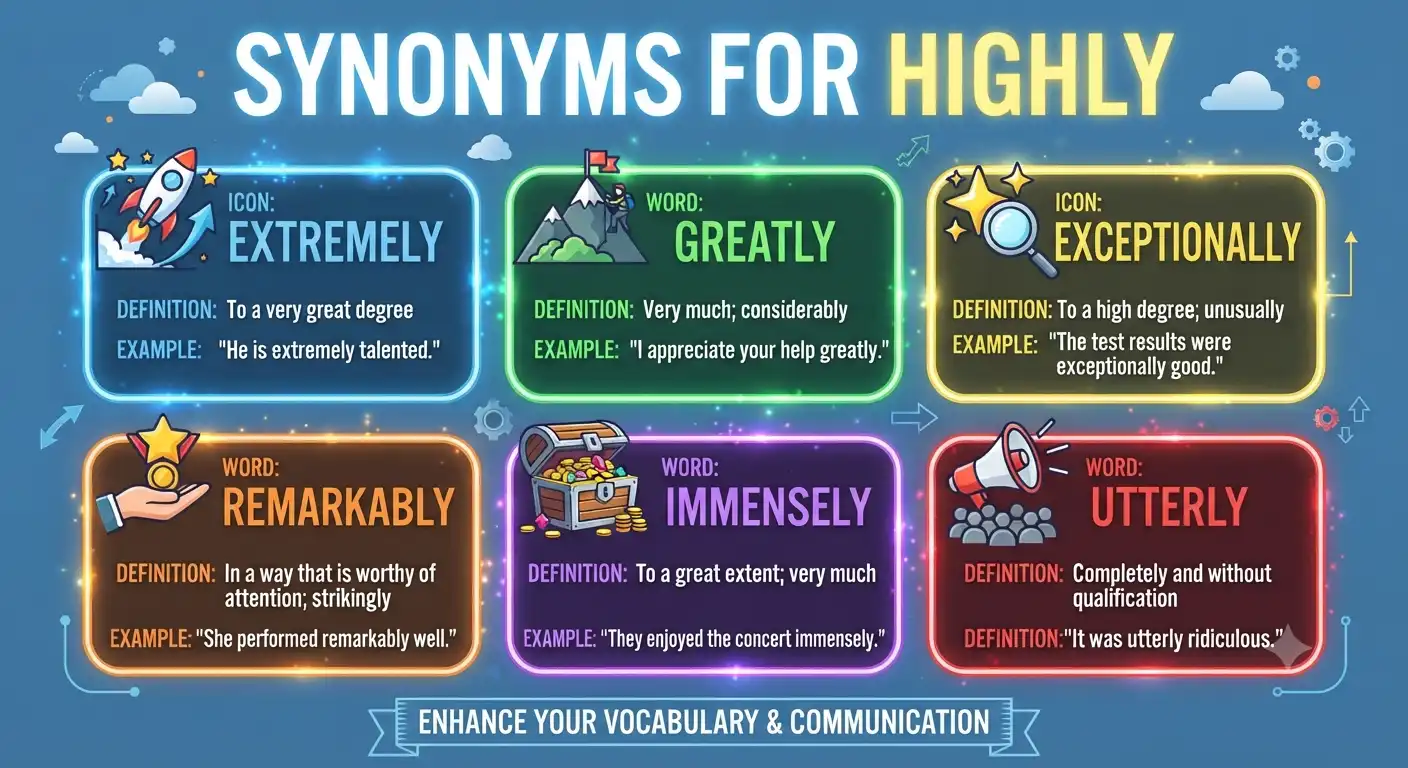
1. Extremely
Pronunciation: US: /ɪkˈstriːm.li/ | UK: /ɪkˈstriːm.li/
Meaning: This word means “very, very much.”
Examples:
- The test was extremely hard.
- She felt extremely happy after the win.
2. Exceedingly
Pronunciation: US: /ɪkˈsiː.dɪŋ.li/ | UK: /ɪkˈsiː.dɪŋ.li/
Meaning: This word means “much more than usual.”
Examples:
- He was exceedingly polite to guests.
- The cake tasted exceedingly sweet.
3. Tremendously
Pronunciation: US: /trəˈmen.dəs.li/ | UK: /trɪˈmen.dəs.li/
Meaning: This word means “in a very large or strong way.”
Examples:
- The team played tremendously well.
- Sales grew tremendously last year.
4. Immensely
Pronunciation: US: /ɪˈmens.li/ | UK: /ɪˈmens.li/
Meaning: This word means “very greatly.”
Examples:
- I immensely enjoyed the movie.
- The city has grown immensely since 2010.
5. Exceptionally
Pronunciation: US: /ɪkˈsep.ʃən.əl.i/ | UK: /ɪkˈsep.ʃən.əl.i/
Meaning: This word means “in a way that is not common; unusually good.”
Examples:
- She is exceptionally talented at art.
- The weather was exceptionally cold this week.
6. Remarkably
Pronunciation: US: /rɪˈmɑːr.kə.bli/ | UK: /rɪˈmɑː.kə.bli/
Meaning: This word means “in a surprising or notable way.”
Examples:
- The plan worked remarkably well.
- He stayed remarkably calm during the storm.
7. Incredibly
Pronunciation: US: /ɪnˈkred.ə.bli/ | UK: /ɪnˈkred.ɪ.bli/
Meaning: This word means “so much that it is hard to believe.”
Examples:
- The trip was incredibly fun.
- She is incredibly kind to everyone.
8. Extraordinarily
Pronunciation: US: /ɪkˌstrɔːr.dəˈner.ə.li/ | UK: /ɪkˈstrɔː.dɪ.nər.ə.li/
Meaning: This word means “in a way that is very unusual or special.”
Examples:
- He is extraordinarily gifted at music.
- The house was extraordinarily large.
9. Particularly
Pronunciation: US: /pərˈtɪk.jə.lɚ.li/ | UK: /pəˈtɪk.jə.lə.li/
Meaning: This word means “more than usual; especially.”
Examples:
- This lesson is particularly useful.
- She is particularly good at math.
10. Especially
Pronunciation: US: /ɪˈspeʃ.əl.i/ | UK: /ɪˈspeʃ.əl.i/
Meaning: This word means “more than others; in a special way.”
Examples:
- I especially love spring mornings.
- The food was especially spicy today.
11. Notably
Pronunciation: US: /ˈnoʊ.tə.bli/ | UK: /ˈnoʊ.tə.bli/
Meaning: This word means “in a way worth noticing.”
Examples:
- The city has changed, notably its skyline.
- He was notably absent from the meeting.
12. Considerably
Pronunciation: US: /kənˈsɪd.ɚ.ə.bli/ | UK: /kənˈsɪd.ər.ə.bli/
Meaning: This word means “by a large amount.”
Examples:
- Prices rose considerably this year.
- Her skills improved considerably after practice.
13. Substantially
Pronunciation: US: /səbˈstæn.ʃəl.i/ | UK: /səbˈstæn.ʃəl.i/
Meaning: This word means “in a large or important way.”
Examples:
- The budget increased substantially.
- His health improved substantially last month.
14. Greatly
Pronunciation: US: /ˈgreɪt.li/ | UK: /ˈgreɪt.li/
Meaning: This word means “very much; a lot.”
Examples:
- I greatly appreciate your help.
- The plan greatly reduced our costs.
15. Vastly
Pronunciation: US: /ˈvæst.li/ | UK: /ˈvɑːst.li/
Meaning: This word means “by a very large amount.”
Examples:
- The two designs are vastly different.
- Her English has vastly improved.
16. Hugely
Pronunciation: US: /ˈhjuːdʒ.li/ | UK: /ˈhjuːdʒ.li/
Meaning: This word means “very much or very big in size.”
Examples:
- The movie was hugely successful.
- I am hugely thankful for your support.
17. Enormously
Pronunciation: US: /ɪˈnɔːr.məs.li/ | UK: /ɪˈnɔː.məs.li/
Meaning: This word means “to a very large degree.”
Examples:
- Traffic has enormously increased downtown.
- She enjoyed the concert enormously.
18. Mightily
Pronunciation: US: /ˈmaɪ.tɪ.li/ | UK: /ˈmaɪ.tɪ.li/
Meaning: This word means “with a lot of strength or effort.”
Examples:
- He worked mightily to finish the project.
- The team tried mightily to win.
19. Intensely
Pronunciation: US: /ɪnˈtens.li/ | UK: /ɪnˈtens.li/
Meaning: This word means “in a very strong or deep way.”
Examples:
- She felt intensely nervous before the exam.
- The sun shone intensely all afternoon.
20. Profoundly
Pronunciation: US: /prəˈfaʊnd.li/ | UK: /prəˈfaʊnd.li/
Meaning: This word means “very deeply, especially in feeling.”
Examples:
- The news affected him profoundly.
- She is profoundly grateful for the gift.
21. Deeply
Pronunciation: US: /ˈdiːp.li/ | UK: /ˈdiːp.li/
Meaning: This word means “very much, from the heart.”
Examples:
- I am deeply sorry for the delay.
- He deeply loves his hometown.
22. Thoroughly
Pronunciation: US: /ˈθɝː.oʊ.li/ | UK: /ˈθʌr.ə.li/
Meaning: This word means “completely and carefully.”
Examples:
- She thoroughly checked her homework.
- We thoroughly enjoyed the trip.
23. Decidedly
Pronunciation: US: /dɪˈsaɪ.dɪd.li/ | UK: /dɪˈsaɪ.dɪd.li/
Meaning: This word means “clearly and without doubt.”
Examples:
- The plan was decidedly better than before.
- He looked decidedly tired after work.
24. Eminently
Pronunciation: US: /ˈem.ə.nənt.li/ | UK: /ˈem.ɪ.nənt.li/
Meaning: This word means “in a very clear and obvious way.”
Examples:
- She is eminently qualified for the job.
- The idea is eminently practical.
25. Supremely
Pronunciation: US: /suˈpriːm.li/ | UK: /sjuːˈpriːm.li/
Meaning: This word means “in the highest or greatest way.”
Examples:
- He felt supremely confident before the match.
- The dish was supremely delicious.
26. Superbly
Pronunciation: US: /suːˈpɝːb.li/ | UK: /sjuːˈpɜːb.li/
Meaning: This word means “in an excellent or perfect way.”
Examples:
- The dancer performed superbly on stage.
- The hotel room was superbly clean.
27. Uncommonly
Pronunciation: US: /ʌnˈkɑː.mən.li/ | UK: /ʌnˈkɒm.ən.li/
Meaning: This word means “in a way that is not usual; very.”
Examples:
- The child was uncommonly polite.
- It was an uncommonly warm winter.
28. Unusually
Pronunciation: US: /ʌnˈjuː.ʒu.ə.li/ | UK: /ʌnˈjuː.ʒu.ə.li/
Meaning: This word means “more than normal.”
Examples:
- The street was unusually quiet tonight.
- She was unusually quiet in class.
29. Singularly
Pronunciation: US: /ˈsɪŋ.gjə.lɚ.li/ | UK: /ˈsɪŋ.gjə.lə.li/
Meaning: This word means “in a very unique or special way.”
Examples:
- He was singularly focused on his goal.
- The design is singularly beautiful.
30. Strikingly
Pronunciation: US: /ˈstraɪ.kɪŋ.li/ | UK: /ˈstraɪ.kɪŋ.li/
Meaning: This word means “in a way that grabs attention.”
Examples:
- The two sisters look strikingly similar.
- Her dress was strikingly bright.
31. Markedly
Pronunciation: US: /ˈmɑːr.kɪd.li/ | UK: /ˈmɑː.kɪd.li/
Meaning: This word means “clearly and noticeably.”
Examples:
- Her mood was markedly better today.
- Sales dropped markedly last month.
32. Significantly
Pronunciation: US: /sɪgˈnɪf.ɪ.kənt.li/ | UK: /sɪgˈnɪf.ɪ.kənt.li/
Meaning: This word means “in an important or large way.”
Examples:
- His grades improved significantly this term.
- The price dropped significantly last week.
33. Seriously
Pronunciation: US: /ˈsɪr.i.əs.li/ | UK: /ˈsɪər.i.əs.li/
Meaning: This word means “to a great degree; not lightly.”
Examples:
- He was seriously injured in the game.
- I am seriously impressed by your work.
34. Majorly
Pronunciation: US: /ˈmeɪ.dʒɚ.li/ | UK: /ˈmeɪ.dʒə.li/
Meaning: This word means “very much” (casual style).
Examples:
- I majorly messed up that test.
- She was majorly excited about the trip.
35. Ultra
Pronunciation: US: /ˈʌl.trə/ | UK: /ˈʌl.trə/
Meaning: This word means “extremely, beyond the normal level.”
Examples:
- The phone has an ultra bright screen.
- She is ultra careful with money.
36. Very
Pronunciation: US: /ˈver.i/ | UK: /ˈver.i/
Meaning: This word means “to a large degree.”
Examples:
- The soup is very hot.
- He is very kind to strangers.
37. Really
Pronunciation: US: /ˈriː.ə.li/ | UK: /ˈrɪə.li/
Meaning: This word means “very much” (used in daily talk).
Examples:
- That movie was really scary.
- I really enjoyed the party.
38. Truly
Pronunciation: US: /ˈtruː.li/ | UK: /ˈtruː.li/
Meaning: This word means “in a real and honest way, very much.”
Examples:
- She is truly talented at singing.
- I am truly thankful for this chance.
39. Genuinely
Pronunciation: US: /ˈdʒen.juː.ɪn.li/ | UK: /ˈdʒen.juː.ɪn.li/
Meaning: This word means “in a real and honest way.”
Examples:
- He was genuinely happy for his friend.
- I am genuinely surprised by the news.
40. Absolutely
Pronunciation: US: /ˌæb.səˈluːt.li/ | UK: /ˌæb.səˈluːt.li/
Meaning: This word means “completely, with no doubt.”
Examples:
- The food was absolutely delicious.
- She is absolutely right about this.
41. Utterly
Pronunciation: US: /ˈʌt.ɚ.li/ | UK: /ˈʌt.ə.li/
Meaning: This word means “completely and totally.”
Examples:
- The room was utterly silent.
- He felt utterly exhausted after work.
42. Totally
Pronunciation: US: /ˈtoʊ.tə.li/ | UK: /ˈtoʊ.tə.li/
Meaning: This word means “completely, in every way.”
Examples:
- I totally agree with your idea.
- The plan was totally different from ours.
43. Completely
Pronunciation: US: /kəmˈpliːt.li/ | UK: /kəmˈpliːt.li/
Meaning: This word means “fully, with nothing missing.”
Examples:
- The house was completely empty.
- I completely forgot about the meeting.
44. Acutely
Pronunciation: US: /əˈkjuːt.li/ | UK: /əˈkjuːt.li/
Meaning: This word means “very sharply or strongly felt.”
Examples:
- She was acutely aware of the silence.
- He felt acutely embarrassed after the mistake.
45. Keenly
Pronunciation: US: /ˈkiːn.li/ | UK: /ˈkiːn.li/
Meaning: This word means “with strong interest or feeling.”
Examples:
- He is keenly interested in space science.
- She watched the match keenly.
46. Powerfully
Pronunciation: US: /ˈpaʊ.ɚ.fəl.i/ | UK: /ˈpaʊ.ə.fəl.i/
Meaning: This word means “with great strength or effect.”
Examples:
- The speech was powerfully written.
- The story powerfully touched the readers.
47. Terrifically
Pronunciation: US: /təˈrɪf.ɪ.kəl.i/ | UK: /təˈrɪf.ɪ.kəl.i/
Meaning: This word means “very well; to a great degree.”
Examples:
- The show went terrifically well.
- She played the piano terrifically.
48. Wonderfully
Pronunciation: US: /ˈwʌn.dɚ.fəl.i/ | UK: /ˈwʌn.də.fəl.i/
Meaning: This word means “in a very good or pleasing way.”
Examples:
- The garden smelled wonderfully fresh.
- She sang wonderfully at the concert.
49. Fabulously
Pronunciation: US: /ˈfæb.jə.ləs.li/ | UK: /ˈfæb.jə.ləs.li/
Meaning: This word means “in an amazing or excellent way.”
Examples:
- The hotel looked fabulously modern.
- She dressed fabulously for the event.
50. Abundantly
Pronunciation: US: /əˈbʌn.dənt.li/ | UK: /əˈbʌn.dənt.li/
Meaning: This word means “very clearly, in a large amount.”
Examples:
- It was abundantly clear he was right.
- The garden grew abundantly this spring.
Antonyms of “Highly”
- Slightly
- Barely
- Hardly
- Poorly
- Minimally
- Insufficiently
- Moderately
Prototype Meaning and Categorization of “Highly”
“Highly” belongs to the category of degree adverbs. Its prototype meaning centers on describing intensity, quality, or amount at a high level. It usually pairs with adjectives (highly skilled) or verbs (highly recommend), placing emphasis on the strength of the quality or action that follows.
FAQ
1. What is a simple synonym for “highly”? “Very” or “extremely” are simple, everyday synonyms for “highly.”
2. Is “highly” formal or casual? “Highly” is mostly formal and works well in reports, reviews, and workplace writing.
3. Can “highly” be used with any adjective? No. It pairs best with adjectives like skilled, recommended, likely, or unusual, not with simple adjectives like “big” or “small.”
4. What is the opposite of “highly”? Words like “slightly,” “barely,” or “hardly” work as opposites of “highly.”
5. Why do writers avoid repeating “highly”? Repeating the same word makes writing sound boring and can hurt readability scores in SEO tools like Yoast.
6. Which synonym for “highly” sounds most casual? “Really” and “majorly” sound casual and fit daily conversation.
7. Which synonym for “highly” sounds most professional? “Exceptionally” and “substantially” sound professional and fit business or academic writing.
Conclusion
Learning synonyms for highly is one of the simplest ways to level up your English. When you know more words for the same idea, your writing feels fresh instead of repetitive. This small change makes a big difference in how people read and trust your content.
Better vocabulary improves your writing, because sentences sound smarter and more varied. It improves your blogging, because readers stay longer on pages that feel alive, not robotic. It improves your speaking, because you sound more fluent and natural in conversations. And it improves your communication overall, because you can express the exact level of meaning you want, instead of settling for one tired word.
“The limits of my language are the limits of my world.” — Ludwig Wittgenstein
Try using these new words today. Add one or two into your next email, your next essay, or even your next casual conversation. Small daily practice builds big vocabulary over time.
“To learn a language is to have one more window from which to look at the world.” — Chinese Proverb
Keep this list close, review it often, and watch your English grow stronger with every sentence you write.

Robert Hayes is an ESL educator and curriculum developer with over nine years of experience teaching English to beginners and intermediate learners across multiple countries ( Biography ).