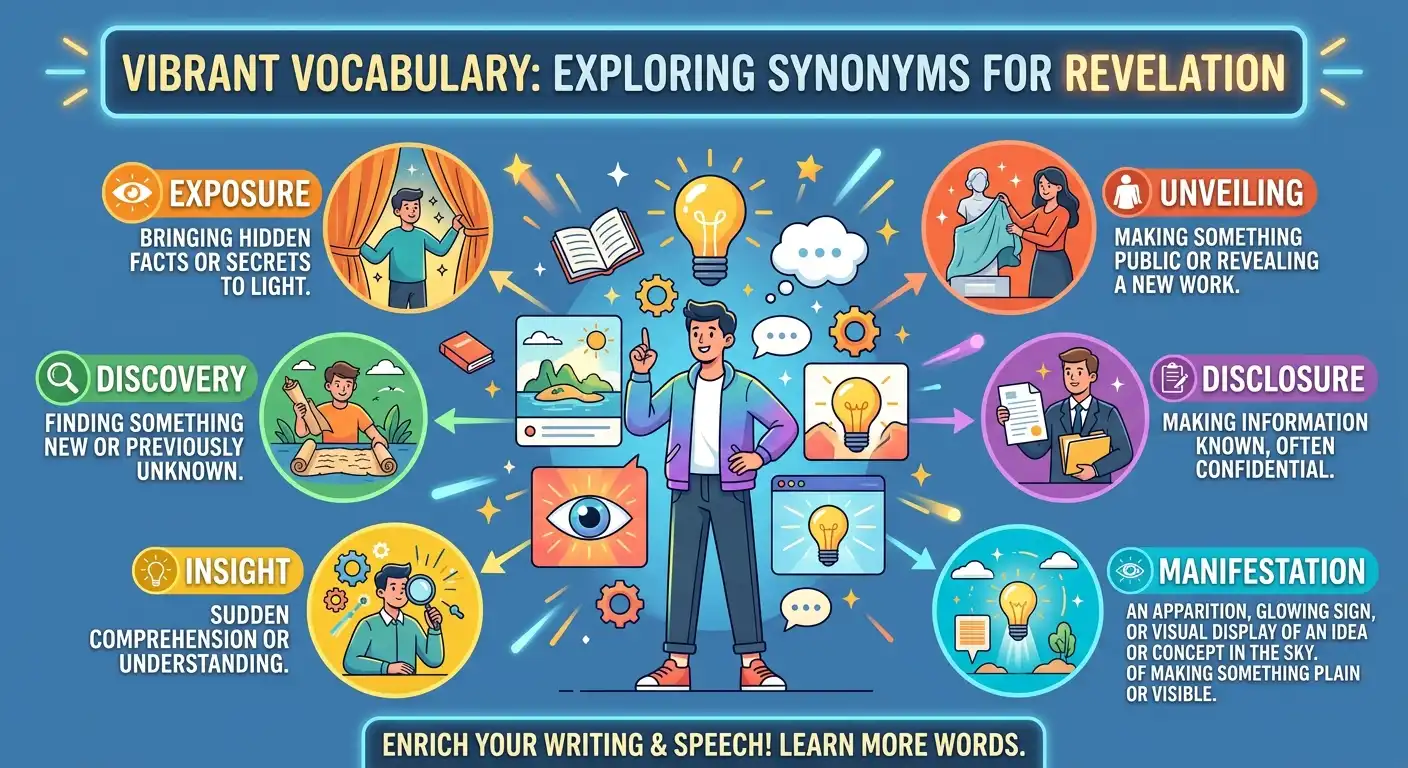
Finding accurate synonyms for revelation helps you share surprising truths and sudden discoveries with total clarity. When you build a strong list of synonyms for revelation, you can easily describe hidden facts, dramatic moments, and deep insights. Using precise synonyms for revelation keeps your speech engaging and improves your everyday writing.
Picture a detective who uncovers a vital secret after weeks of searching for clues. When asked about the breakthrough moment, calling it a simple surprise feels too weak. Using rich options like “epiphany,” “unveiling,” or “exposure” gives much more depth and excitement to your story.
For example, when a scientist suddenly understands how a complex machine works, you can say it was an eye-opener. Choosing accurate choices like “insight” or “realization” helps listeners grasp your exact point right away.
The term revelation means the act of making a secret, hidden fact, or surprising truth known to others. Expanding your knowledge of synonyms for revelation helps many groups of readers:
- Students write clearer essays when describing history, literature, and science.
- Bloggers write exciting headlines and reviews that grab attention instantly.
- Content writers increase organic search traffic with natural, scannable phrasing.
- Daily English users express sudden thoughts and facts smoothly in daily conversations.
“The right word turns a routine comment into a meaningful thought.”
“A strong vocabulary brings clarity, power, and confidence to every sentence.”
Linguistic Breakdown of “Revelation”
Connotative Meaning
The word revelation carries dramatic, surprising, and eye-opening connotations. It implies that important truth, previously hidden or unknown, is suddenly made clear to everyone.
Etymology
- Origin: Derived from Latin revelatio (meaning an uncovering or drawing back of the veil).
- Root Words: Re- (back or opposite) + velare (to cover or veil).
- Historical Shift: First used in religious contexts to describe divine truth shown to humans, then expanded into general English to mean any surprising disclosure.
Pronunciation
- US (IPA): /ˌrev.əˈleɪ.ʃən/
- UK (IPA): /ˌrev.əˈleɪ.ʃən/
Syllables & Affixation Pattern
- Syllables: 4 syllables (rev-e-la-tion)
- Base Structure: Verb root reveal + Noun suffix -ation
- Grammatical Patterns:
- Singular Noun: A revelation / The revelation
- Plural Noun: Revelations
- Adjective Form: Revelatory
Comparison Table: Common Synonyms for Revelation
| Keyword | Meaning | Usage Type | Context |
| Epiphany | A sudden moment of deep understanding or insight | Emotional / Thoughtful | Personal Growth, Science, & Creative Ideas |
| Disclosure | The act of making secret information public | Formal / Professional | Business Reports, Legal Cases, & News |
| Exposure | Revealing hidden truth or wrong behavior | Dramatic / Analytical | Journalism, Investigations, & Politics |
| Eye-opener | An event that teaches you something unexpected | Casual / Conversational | Travel, New Experiences, & Daily Life |
| Unveiling | Showing a new product or idea for the first time | Professional / Public | Product Launches, Art Shows, & Events |
| Breakthrough | An important discovery that solves a difficult problem | Enthusiastic / Technical | Science, Research, & Technology |
| Leak | Unofficial or secret release of private details | Informally Formal | Media, Government, & Business News |
37 Best Synonyms for Revelation
1. Disclosure
- Pronunciation: US /dɪsˈkloʊ.ʒɚ/ | UK /dɪsˈkləʊ.ʒə/
- Meaning: Disclosure means making secret or private facts known to others.
- Examples:
- The company made a public disclosure about its yearly earnings.
- Her sudden disclosure surprised everyone in the meeting room.
2. Epiphany
- Pronunciation: US /ɪˈpɪf.ə.ni/ | UK /ɪˈpɪf.ə.ni/
- Meaning: Epiphany means a sudden moment of deep understanding or insight.
- Examples:
- He had a sudden epiphany while walking in the quiet park.
- Reading that book brought an epiphany about her career goals.
3. Exposure
- Pronunciation: US /ɪkˈspoʊ.ʒɚ/ | UK /ɪkˈspəʊ.ʒə/
- Meaning: Exposure means revealing hidden truth or wrong actions to the public.
- Examples:
- The news article led to the exposure of the corrupt plan.
- The dishonest trader feared public exposure of his secrets.
4. Eye-opener
- Pronunciation: US /ˈaɪˌoʊ.pə.nɚ/ | UK /ˈaɪˌəʊ.pə.nə/
- Meaning: Eye-opener means an unexpected event that teaches you a clear truth.
- Examples:
- Visiting the busy animal shelter was a real eye-opener for us.
- The hard trip proved to be an eye-opener regarding team safety.
5. Unveiling
- Pronunciation: US /ʌnˈveɪ.lɪŋ/ | UK /ʌnˈveɪ.lɪŋ/
- Meaning: Unveiling means showing or introducing something new to the public.
- Examples:
- The tech firm hosted an unveiling of its new smartphone.
- We attended the unveiling of the town founder statue.
6. Realization
- Pronunciation: US /ˌriː.əl.əˈzeɪ.ʃən/ | UK /ˌrɪə.laɪˈzeɪ.ʃən/
- Meaning: Realization means becoming fully aware that a fact is true.
- Examples:
- A sudden realization hit him that he lost his office keys.
- Her realization helped the team fix the mistake quickly.
7. Insight
- Pronunciation: US /ˈɪn.saɪt/ | UK /ˈɪn.saɪt/
- Meaning: Insight means a clear and deep understanding of a complex problem.
- Examples:
- The teacher gave us valuable insight into history lessons.
- Her study provided fresh insight on healthy eating habits.
8. Announcement
- Pronunciation: US /əˈnaʊns.mənt/ | UK /əˈnaʊns.mənt/
- Meaning: Announcement means a formal public statement giving new facts.
- Examples:
- The principal made an announcement about the school holiday.
- We listened to the captain announcement on the airplane.
9. Declaration
- Pronunciation: US /ˌdek.ləˈreɪ.ʃən/ | UK /ˌdek.ləˈreɪ.ʃən/
- Meaning: Declaration means an official or strong statement of truth.
- Examples:
- The mayor made a clear declaration about city safety.
- They signed an official declaration of peace after the talk.
10. Discovery
- Pronunciation: US /dɪˈskʌv.ɚ.i/ | UK /dɪˈskʌv.ər.i/
- Meaning: Discovery means finding or learning something new for the first time.
- Examples:
- The scientist made an exciting medical discovery in the lab.
- Our quiet walk led to the discovery of a hidden beach.
11. Leak
- Pronunciation: US /liːk/ | UK /liːk/
- Meaning: Leak means secret information given to the public without permission.
- Examples:
- The news reporter received an anonymous leak about the deal.
- A security leak exposed the upcoming movie plot online.
12. Admission
- Pronunciation: US /ədˈmɪʃ.ən/ | UK /ədˈmɪʃ.ən/
- Meaning: Admission means stating that a hidden fact or fault is true.
- Examples:
- His honest admission of the mistake earned him respect.
- The boy made a quiet admission that he broke the cup.
13. Divulgence
- Pronunciation: US /daɪˈvʌl.dʒəns/ | UK /daɪˈvʌl.dʒəns/
- Meaning: Divulgence means the act of telling secret news to someone.
- Examples:
- The lawyer warned against the unauthorized divulgence of facts.
- Her careful divulgence of the plan helped the team prepare.
14. Vision
- Pronunciation: US /ˈvɪʒ.ən/ | UK /ˈvɪʒ.ən/
- Meaning: Vision means a vivid thought or picture of future possibilities.
- Examples:
- The leader shared a clear vision for the company growth.
- She had a creative vision for decorating the living room.
15. Awakening
- Pronunciation: US /əˈweɪ.kə.nɪŋ/ | UK /əˈweɪ.kə.nɪŋ/
- Meaning: Awakening means a sudden start of understanding or new awareness.
- Examples:
- The summer camp caused a personal awakening in his habits.
- Moving to a big city was a cultural awakening for her.
16. Unearthing
- Pronunciation: US /ʌnˈɝː.θɪŋ/ | UK /ʌnˈɜː.θɪŋ/
- Meaning: Unearthing means finding something that was hidden or buried.
- Examples:
- The unearthing of old coins excited the town historians.
- Their careful research led to the unearthing of lost files.
17. Manifestation
- Pronunciation: US /ˌmæn.ə.fesˈteɪ.ʃən/ | UK /ˌmæn.ɪ.fesˈteɪ.ʃən/
- Meaning: Manifestation means a clear sign that shows a hidden truth clearly.
- Examples:
- Her bright smile was a manifestation of true joy.
- The high sales were a manifestation of hard teamwork.
18. Surprise
- Pronunciation: US /sɚˈpraɪz/ | UK /səˈpraɪz/
- Meaning: Surprise means an unexpected fact or event that stuns you.
- Examples:
- The test results brought a pleasant surprise to the student.
- Her sudden arrival was a wonderful weekend surprise.
19. Inspiration
- Pronunciation: US /ˌɪn.spəˈreɪ.ʃən/ | UK /ˌɪn.spɪˈreɪ.ʃən/
- Meaning: Inspiration means a sudden bright idea that moves you to act.
- Examples:
- Nature provided endless inspiration for the painter work.
- His success story served as an inspiration to young athletes.
20. Confession
- Pronunciation: US /kənˈfeʃ.ən/ | UK /kənˈfeʃ.ən/
- Meaning: Confession means admitting a secret thought, crime, or hidden fault.
- Examples:
- The suspect made a full confession to the local police.
- Her quiet confession brought relief after weeks of worry.
“Choosing exact words turns basic choices into clear statements of value.”
21. Clue
- Pronunciation: US /kluː/ | UK /kluː/
- Meaning: Clue means a piece of evidence that helps solve a mystery.
- Examples:
- The muddy footprint was a vital clue for the officer.
- She found a helpful clue in the old family letter.
22. Uncovering
- Pronunciation: US /ʌnˈkʌv.ɚ.ɪŋ/ | UK /ʌnˈkʌv.ər.ɪŋ/
- Meaning: Uncovering means removing a cover to show what is underneath.
- Examples:
- The uncovering of the old mural delighted the visitors.
- Systematic testing led to the uncovering of system errors.
23. Broadcast
- Pronunciation: US /ˈbrɑːd.kæst/ | UK /ˈbrɔːd.kɑːst/
- Meaning: Broadcast means sending news or facts widely over radio or TV.
- Examples:
- The morning broadcast shared breaking news about the weather.
- The radio station made a live broadcast of the speech.
24. Presentation
- Pronunciation: US /ˌprez.ənˈteɪ.ʃən/ | UK /ˌprez.ənˈteɪ.ʃən/
- Meaning: Presentation means showing or explaining an idea to an audience.
- Examples:
- She gave an impressive slide presentation on clean energy.
- The team worked hard on the final sales presentation.
25. Proclamation
- Pronunciation: US /ˌprɑː.kləˈmeɪ.ʃən/ | UK /ˌprɒk.ləˈmeɪ.ʃən/
- Meaning: Proclamation means an official public announcement made by leaders.
- Examples:
- The governor issued a formal proclamation for the holiday.
- The king made a grand proclamation in the public square.
26. Expose
- Pronunciation: US /ekˈspoʊ.zeɪ/ | UK /ekˈspəʊ.zeɪ/
- Meaning: Expose means a news story that reveals shocking hidden truths.
- Examples:
- The newspaper printed a major expose on factory conditions.
- The TV show aired a hard-hitting expose about food safety.
27. Breakthrough
- Pronunciation: US /ˈbreɪk.θruː/ | UK /ˈbreɪk.θruː/
- Meaning: Breakthrough means an important discovery that leads to quick progress.
- Examples:
- Doctors made a scientific breakthrough in cancer medicine.
- Finding the key document was a big breakthrough in the case.
28. Illumination
- Pronunciation: US /ɪˌluː.məˈneɪ.ʃən/ | UK /ɪˌluː.mɪˈneɪ.ʃən/
- Meaning: Illumination means giving light or making a confusing topic clear.
- Examples:
- The book offered great illumination on complex financial topics.
- The lantern provided bright illumination in the dark tent.
29. Tip-off
- Pronunciation: US /ˈtɪp.ɑːf/ | UK /ˈtɪp.ɒf/
- Meaning: Tip-off means secret information given to help solve a problem.
- Examples:
- Thanks to an anonymous tip-off, police found the stolen car.
- The manager acted quickly after a helpful customer tip-off.
30. Unmasking
- Pronunciation: US /ʌnˈmæsk.ɪŋ/ | UK /ʌnˈmɑːsk.ɪŋ/
- Meaning: Unmasking means revealing the true identity or nature of someone.
- Examples:
- The unmasking of the villain surprised movie viewers.
- Careful investigation led to the unmasking of the online scam.
31. Statement
- Pronunciation: US /ˈsteɪt.mənt/ | UK /ˈsteɪt.mənt/
- Meaning: Statement means something that is said or written officially.
- Examples:
- The official released a written statement to the press.
- Her clear statement answered all remaining student questions.
32. Key
- Pronunciation: US /kiː/ | UK /kiː/
- Meaning: Key means an essential piece of information that explains something.
- Examples:
- Patience was the main key to solving the hard puzzle.
- Understanding the rules is the key to winning the game.
33. Foretelling
- Pronunciation: US /fɔːrˈtel.ɪŋ/ | UK /fɔːˈtel.ɪŋ/
- Meaning: Foretelling means revealing or predicting future events before they happen.
- Examples:
- The ancient story included a foretelling of peaceful times.
- Economic forecasts offer a careful foretelling of market shifts.
34. Output
- Pronunciation: US /ˈaʊt.pʊt/ | UK /ˈaʊt.pʊt/
- Meaning: Output means information or results produced and brought to light.
- Examples:
- The computer provided a detailed data output on screen.
- Factory production output rose sharply this past month.
35. Broadening
- Pronunciation: US /ˈbrɑː.dən.ɪŋ/ | UK /ˈbrɔː.dən.ɪŋ/
- Meaning: Broadening means expanding your knowledge or perspective on life.
- Examples:
- Travel offers a broadening of personal understanding and habits.
- Reading widely leads to a broadening of your vocabulary.
36. News
- Pronunciation: US /nuːz/ | UK /njuːz/
- Meaning: News means newly received or noteworthy facts about recent events.
- Examples:
- We received good news about the project approval today.
- She shared the exciting news with her entire family.
37. Clue-in
- Pronunciation: US /kluː ɪn/ | UK /kluː ɪn/
- Meaning: Clue-in means giving someone key details so they understand a situation.
- Examples:
- The quick chat served as a helpful clue-in for the new employee.
- He gave us a short clue-in before the presentation started.
Antonyms of “Revelation”
Knowing opposite terms helps you describe secrecy, hidden facts, or silence accurately.
- Concealment: The action of hiding something or keeping it secret.
- Cover-up: An attempt to prevent people from discovering mistakes or crimes.
- Secret: Something that is kept hidden or unknown to others.
- Suppression: The act of preventing information from being published or known.
- Hiding: Keeping something out of sight or keeping facts quiet.
- Silence: Refusing to speak or share facts about a situation.
Prototype Meaning & Categorization of “Revelation”
The primary concept of revelation rests on truth discovery, public exposure, and sudden understanding. Depending on your intent, these 37 synonyms divide into four operational categories:
- Sudden Insight & Mental Clarity: Epiphany, eye-opener, realization, insight, vision, awakening, inspiration, illumination, broadening, breakthrough.
- Official & Public Announcements: Disclosure, unveiling, announcement, declaration, broadcast, presentation, proclamation, statement, news.
- Exposing Secrets & Crime: Exposure, leak, admission, divulgence, unearthing, confession, uncovering, expose, tip-off, unmasking.
- Clues & Indicators: Manifestation, surprise, clue, key, foretelling, output, clue-in.
Frequently Asked Questions (FAQs)
1. What is the most common formal synonym for “revelation”?
In formal, corporate, or legal settings, “disclosure” or “declaration” works best. They clearly describe sharing official facts without sounding emotional.
2. What is the main difference between “revelation” and “epiphany”?
A revelation can be any new fact revealed to people, often from an outside source. An epiphany is a sudden personal moment of deep mental understanding inside your own mind.
3. Which synonym for “revelation” should I use in news articles?
For news reporting, terms like “exposure,” “disclosure,” “breakthrough,” or “expose” sound objective, dramatic, and professional.
4. Is “eye-opener” appropriate for academic essays?
“Eye-opener” is slightly informal and best for blog posts or personal essays. In formal academic writing, use “insight” or “revelation.”
5. Can “leak” be used in formal business writing?
Yes, but “leak” usually implies that information was shared without permission. If the company shared information officially, use “disclosure” instead.
6. How does using diverse synonyms for “revelation” boost SEO?
Using varied synonyms satisfies different search queries, prevents keyword stuffing, strengthens semantic relevance, and keeps readers engaged on your page longer.
Conclusion
Expanding your collection of synonyms for revelation brings clarity, freshness, and authority to your language. Replacing repetitive words with precise terms like epiphany, disclosure, unveiling, or exposure ensures your message makes a strong impression every time.
Whether you write business emails, compose school essays, publish blog reviews, or chat in daily conversations, exact vocabulary builds instant trust. Varied phrasing removes fluff and transforms basic statements into powerful narratives. Practice using these 37 synonyms today to share your ideas with lasting impact.
“Clear word choices bring quiet strength and authority to every message.”
“Mastering exact vocabulary turns simple thoughts into powerful expressions.”

Robert Hayes is an ESL educator and curriculum developer with over nine years of experience teaching English to beginners and intermediate learners across multiple countries ( Biography ).