
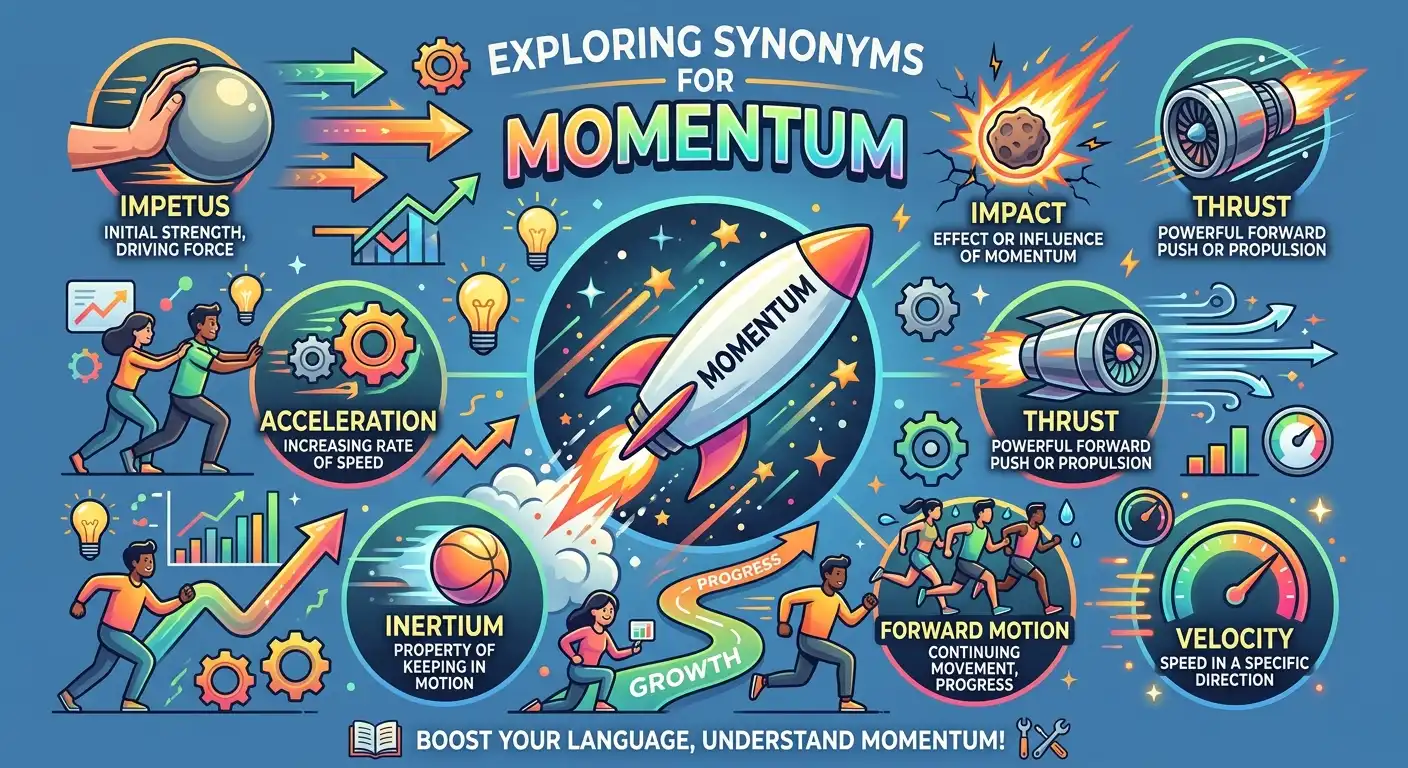
Learning exact synonyms for momentum helps you describe speed, progress, and power in your writing. When you use diverse synonyms for momentum, you can explain how projects gain strength and how fast ideas move. Replacing basic words with precise synonyms for momentum keeps your sentences active, clear, and easy to read.
Imagine a small sled sitting at the top of a snowy hill. When someone gives it a tiny push, it starts sliding down slowly. As it moves further down, it goes faster and faster on its own. That growing speed and forward push is what we call momentum.
For example, when a new business gets its first ten customers, sales start to build up fast. Saying the business gained “drive,” “impetus,” or “traction” explains its success much better than using the same word again.
The word momentum means the strength or speed that something gains as it moves forward over time. Expanding your vocabulary with synonyms for momentum helps many types of readers:
- Students write better essays on science, history, and current events.
- Bloggers write exciting stories that hold reader attention.
- Content writers improve search rankings with natural keyword choices.
- Daily English users express thoughts clearly in work and home chats.
“A strong start creates momentum that carries you all the way to success.”
“The right words help you describe forward progress with energy and clarity.”
Linguistic Breakdown of “Momentum”
Connotative Meaning
The word momentum carries active, energetic, and positive connotations. It suggests unstoppable forward movement, growing strength, and ongoing success.
Etymology
- Origin: From Latin momentum (short form of movimentum).
- Root Word: Latin verb movere (meaning to move).
- Historical Shift: Originally used in physics to describe physical motion, then adapted into everyday language for progress, growth, and team energy.
Pronunciation
- US (IPA):/moʊˈmen.t̬əm/
- UK (IPA): /məˈmen.təm/
Syllables & Affixation Pattern
- Syllables: 3 syllables (mo-men-tum)
- Base Structure: Latin root momen + Noun suffix -tum
- Grammatical Patterns:
- Active Form: Build momentum / Gain momentum
- Loss Form: Lose momentum / Stop momentum
- Adjective Form: Momentous
Comparison Table: Common Synonyms for Momentum
| Keyword | Meaning | Usage Type | Context |
| Impetus | A force that makes something happen faster | Formal / Professional | Business Projects, Studies, & Science |
| Drive | Strong personal energy or determination | Personal / Motivational | Career, Personal Goals, & Sports |
| Thrust | Strong forward push or pressure | Technical / Action | Rockets, Physics, & Strong Speeches |
| Traction | Grip that allows forward progress without slipping | Business / Professional | Startups, Marketing, & Car Tires |
| Pace | The speed at which something moves or happens | General / Daily | Walking, Reading, & Daily Routines |
| Velocity | High speed of movement in a clear direction | Formal / Technical | Physics, Science, & High-Speed Trends |
| Steam | Working power or energy that moves things | Casual / Conversational | Work Projects, Teamwork, & Daily Effort |
“Keeping your forward drive active turns small gains into huge victories.”
37 Best Synonyms for Momentum
1. Impetus
- Pronunciation: US /ˈɪm.pə.t̬əs/ | UK /ˈɪm.pɪ.təs/
- Meaning: Impetus is a force or idea that makes something move or start quickly.
- Examples:
- The new grant gave an impetus to the research team.
- Her speech provided the impetus we needed to clean the park.
2. Drive
- Pronunciation: US /draɪv/ | UK /draɪv/
- Meaning: Drive is strong energy and effort to reach a goal.
- Examples:
- His personal drive helped him finish the race in first place.
- The team has the drive to win the championship game.
3. Thrust
- Pronunciation: US /θrʌst/ | UK /θrʌst/
- Meaning: Thrust is a sudden or powerful forward push.
- Examples:
- The jet engines provided powerful thrust during takeoff.
- The main thrust of her plan was to cut company waste.
4. Energy
- Pronunciation: US /ˈen.ɚ.dʒi/ | UK /ˈen.ə.dʒi/
- Meaning: Energy is the power and force needed to do active work.
- Examples:
- The kids showed great energy during their morning gym class.
- Solar panels convert sunlight into clean electric energy.
5. Force
- Pronunciation: US /fɔːrs/ | UK /fɔːs/
- Meaning: Force is strong power or pressure that causes motion.
- Examples:
- Strong wind force pushed the sailboat across the lake.
- Gravity is the natural force that pulls objects toward Earth.
6. Speed
- Pronunciation: US /spiːd/ | UK /spiːd/
- Meaning: Speed is how fast an object moves or travels.
- Examples:
- The car traveled down the highway at a safe speed.
- She finished her math test with great speed and care.
7. Power
- Pronunciation: US /ˈpaʊ.ɚ/ | UK /ˈpaʊ.ər/
- Meaning: Power is the ability or strength to do heavy work.
- Examples:
- The new tractor has enough power to pull heavy loads.
- Electric power returned to the neighborhood after the storm.
8. Steam
- Pronunciation: US /stiːm/ | UK /stiːm/
- Meaning: Steam means active power, effort, or moving energy.
- Examples:
- The building project lost steam when rainy weather started.
- He ran up the final hill with full steam.
9. Velocity
- Pronunciation: US /vəˈlɑː.sə.t̬i/ | UK /vəˈlɒs.ə.ti/
- Meaning: Velocity is the speed of an object in a specific direction.
- Examples:
- The ball gained velocity as it rolled down the ramp.
- Scientists measured the wind velocity during the big storm.
10. Push
- Pronunciation: US /pʊʃ/ | UK /pʊʃ/
- Meaning: Push is an act of applying force to move something forward.
- Examples:
- A firm push helped move the heavy wooden door open.
- The store gave a big marketing push before the holidays.
11. Pace
- Pronunciation: US /peɪs/ | UK /peɪs/
- Meaning: Pace is the steady speed at which something happens or moves.
- Examples:
- They walked at a fast pace to catch the train.
- He likes to work at a quiet, steady pace.
12. Traction
- Pronunciation: US /ˈtræk.ʃən/ | UK /ˈtræk.ʃən/
- Meaning: Traction is the grip that allows progress without slipping.
- Examples:
- New snow tires give your car good traction on icy roads.
- The new website app is gaining traction with young users.
13. Impulse
- Pronunciation: US /ˈɪm.pʌls/ | UK /ˈɪm.pʌls/
- Meaning: Impulse is a sudden force or urge that starts an action.
- Examples:
- An electrical impulse sent signals along the main wire.
- She bought the book on an impulse while waiting in line.
14. Motivation
- Pronunciation: US /ˌmoʊ.t̬əˈveɪ.ʃən/ | UK /ˌməʊ.tɪˈveɪ.ʃən/
- Meaning: Motivation is the reason or desire to take action.
- Examples:
- Good student grades were her main motivation for studying hard.
- The coach gave a speech to boost team motivation.
15. Stimulus
- Pronunciation: US /ˈstɪm.jə.ləs/ | UK /ˈstɪm.jʊ.ləs/
- Meaning: Stimulus is something that causes active growth or action.
- Examples:
- Bright sunlight acts as a natural stimulus for plant growth.
- Tax cuts provided a quick stimulus to local shop owners.
16. Headway
- Pronunciation: US /ˈhed.weɪ/ | UK /ˈhed.weɪ/
- Meaning: Headway means making good forward progress on a task.
- Examples:
- We made great headway on our school project yesterday.
- Heavy road traffic prevented the bus from making headway.
17. Surge
- Pronunciation: US /sɝːdʒ/ | UK /sɜːdʒ/
- Meaning: Surge is a sudden, powerful movement forward or upward.
- Examples:
- A surge of water rushed down the small river channel.
- Online sales saw a huge surge during the weekend event.
18. Vitality
- Pronunciation: US /vaɪˈtæl.ə.t̬i/ | UK /vaɪˈtæl.ə.ti/
- Meaning: Vitality is full life energy, strength, and active power.
- Examples:
- Daily morning walks give her great health and vitality.
- The main street restored its economic vitality with new shops.
19. Strength
- Pronunciation: US /streŋθ/ | UK /streŋθ/
- Meaning: Strength is physical power or solid ability to resist force.
- Examples:
- Lifting weights regularly helps build muscle strength.
- The steel bridge has the strength to carry heavy trains.
20. Progress
- Pronunciation: US /ˈprɑː.ɡres/ | UK /ˈprəʊ.ɡres/
- Meaning: Progress is movement forward toward a completed goal.
- Examples:
- The medical team made great progress on the new cure.
- Construction workers show daily progress on the new school.
21. Propulsion
- Pronunciation: US /prəˈpʌl.ʃən/ | UK /prəˈpʌl.ʃən/
- Meaning: Propulsion is the force that pushes an object forward.
- Examples:
- Boat paddles provide quick propulsion through calm river water.
- Rocket propulsion system tests were successful yesterday.
22. Pressure
- Pronunciation: US /ˈpreʃ.ɚ/ | UK /ˈpreʃ.ər/
- Meaning: Pressure is continuous force applied against an object.
- Examples:
- High water pressure makes the shower work very well.
- Public pressure forced the city council to fix the road.
23. Flow
- Pronunciation: US /floʊ/ | UK /fləʊ/
- Meaning: Flow is smooth and continuous movement in one direction.
- Examples:
- Traffic flow moved smoothly across the city center.
- Clean water has a steady flow through the new pipes.
24. Acceleration
- Pronunciation: US /əkˌsel.əˈreɪ.ʃən/ | UK /əkˌsel.əˈreɪ.ʃən/
- Meaning: Acceleration is an increase in speed or rate of movement.
- Examples:
- The sports car had rapid acceleration on the race track.
- We noticed an acceleration in sales during the summer.
25. Swing
- Pronunciation: US /swɪŋ/ | UK /swɪŋ/
- Meaning: Swing is smooth curve movement or a major shift in action.
- Examples:
- The batter hit the baseball with a strong swing.
- Public opinion showed a big swing toward the new idea.
26. Motion
- Pronunciation: US /ˈmoʊ.ʃən/ | UK /ˈməʊ.ʃən/
- Meaning: Motion is the process or state of changing place or position.
- Examples:
- The boat was set in motion by the strong ocean wind.
- Motion sensors turn on the hall lights automatically.
27. Spark
- Pronunciation: US /spɑːrk/ | UK /spɑːk/
- Meaning: Spark is a small action or event that starts a big movement.
- Examples:
- Her creative proposal provided the spark for the whole campaign.
- A single campfire spark started the forest fire last night.
28. Boost
- Pronunciation: US /buːst/ | UK /buːst/
- Meaning: Boost is an action that helps increase power, speed, or morale.
- Examples:
- Drinking fresh water gives your body a healthy energy boost.
- A bonus gave a big boost to worker satisfaction.
29. Rush
- Pronunciation: US /rʌʃ/ | UK /rʌʃ/
- Meaning: Rush is a sudden fast movement or strong flow of feeling.
- Examples:
- She felt a rush of excitement when she won the award.
- The morning rush of commuters filled the local subways.
30. Lift
- Pronunciation: US /lɪft/ | UK /lɪft/
- Meaning: Lift is an upward force or a helpful rise in energy.
- Examples:
- Airplane wings generate lift to stay high in the sky.
- Encouraging words gave his confidence a great lift.
31. Dynamism
- Pronunciation: US /ˈdaɪ.nə.mɪ.zəm/ | UK /ˈdaɪ.nə.mɪ.zəm/
- Meaning: Dynamism is great energy, active force, and continuous movement.
- Examples:
- The speaker brought great dynamism to the business conference.
- The city is famous for its cultural dynamism and arts.
32. Vigor
- Pronunciation: US /ˈvɪɡ.ɚ/ | UK /ˈvɪɡ.ər/
- Meaning: Vigor is active physical strength, health, and high energy.
- Examples:
- He worked in his garden with full vigor all afternoon.
- The young dog ran around the yard with boundless vigor.
33. Clout
- Pronunciation: US /klaʊt/ | UK /klaʊt/
- Meaning: Clout is power or influence that helps move things forward.
- Examples:
- The famous store owner has major business clout in town.
- Political clout helped pass the local park renovation law.
34. Forward movement
- Pronunciation: US /ˈfɔːr.wɚd ˈmuːv.mənt/ | UK /ˈfɔː.wəd ˈmuːv.mənt/
- Meaning: Forward movement means advancing straight toward a goal.
- Examples:
- We observed steady forward movement in the building plans.
- Clear goals ensure forward movement for company projects.
35. Onrush
- Pronunciation: US /ˈɑːn.rʌʃ/ | UK /ˈɒn.rʌʃ/
- Meaning: Onrush is a forceful and rapid forward movement or surge.
- Examples:
- The football players blocked the onrush of the opposing team.
- They stood together to resist the onrush of deep ocean waves.
36. Sway
- Pronunciation: US /sweɪ/ | UK /sweɪ/
- Meaning: Sway is a moving influence that leads others in a direction.
- Examples:
- The speaker held great sway over the crowd of listeners.
- Strong wind caused tall pine trees to sway slowly.
37. Inertia
- Pronunciation: US /ɪˈnɝː.ʃə/ | UK /ɪˈnɜː.ʃə/
- Meaning: Inertia is physical momentum that keeps a moving body in motion.
- Examples:
- Rolling ball inertia carried it across the smooth wooden floor.
- Company inertia kept sales growing strong all year long.
Antonyms of “Momentum”
Knowing opposite words helps you describe delays, loss of speed, or stoppage accurately.
- Stagnation: A state of stopping and making zero progress.
- Halt: A complete stop in motion or forward action.
- Slowdown: A reduction in speed, progress, or activity.
- Inaction: Lack of movement, energy, or necessary action.
- Resistance: A force that acts against motion to slow it down.
- Delay: A period of waiting where no movement takes place.
Prototype Meaning & Categorization of “Momentum”
The concept of momentum rests on forward motion, physical force, personal drive, and steady progress. Depending on your intent, these 37 synonyms divide into four clear operational categories:
- Physical & Technical Motion: Velocity, speed, thrust, force, propulsion, acceleration, motion, inertia, onrush.
- Personal Drive & Energy: Drive, energy, motivation, vitality, vigor, dynamism, impulse, spark, boost.
- Progress & Traction: Impetus, headway, progress, traction, forward movement, pace, flow, surge.
- Power & Influence: Power, strength, steam, push, pressure, lift, clout, swing, sway.
Frequently Asked Questions (FAQs)
1. What is the most formal synonym for “momentum”?
In scientific, professional, or formal contexts, “impetus,” “velocity,” or “propulsion” work best. They clearly express movement and force without sounding casual.
2. What is the difference between “momentum” and “speed”?
Speed tells you how fast something is moving at one point. Momentum combines speed with weight and force to describe how hard it is to stop that movement.
3. Which synonym for “momentum” is best for business growth?
For corporate growth and startup progress, “traction,” “impetus,” or “headway” sound professional and focused on results.
4. Can “steam” be used in academic writing?
No, “steam” (as in “gaining steam”) is a casual idiom. Use “impetus” or “acceleration” in academic essays.
5. How does using synonyms for “momentum” improve writing?
Using varied synonyms avoids repeating the same word, improves sentence flow, engages readers, and helps your content rank higher on search engines.
6. Is “drive” an exact synonym for “momentum”?
“Drive” focuses on the inner effort or force that starts movement, while “momentum” focuses on the growing speed of that movement over time.
Conclusion
Mastering synonyms for momentum gives you the tools to describe progress, speed, and energy with clarity and style. Using exact terms like impetus, traction, drive, or velocity keeps your writing active and easy for readers to follow.
Whether you write student essays, post blog stories, draft work emails, or speak in daily chats, choosing strong words builds instant confidence. Clear vocabulary removes dull repetition and turns simple sentences into powerful statements. Start using these 37 synonyms today to share your ideas with lasting energy.
“Choosing precise words builds clear thoughts and lasting confidence.”
“Every new word you master keeps your learning momentum moving forward.”

Robert Hayes is an ESL educator and curriculum developer with over nine years of experience teaching English to beginners and intermediate learners across multiple countries ( Biography ).