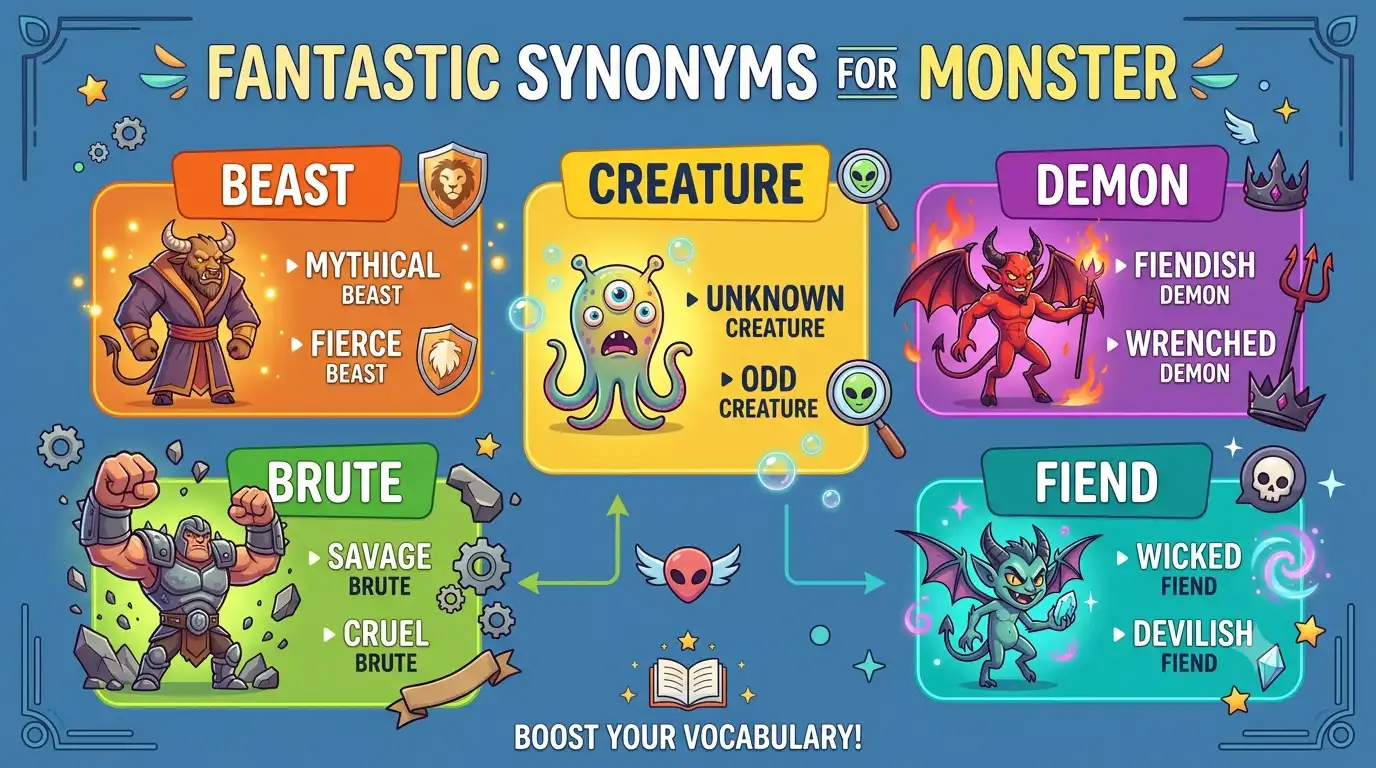
Learning synonyms for monster helps you describe frightening creatures, giant beasts, or evil villains with clear words. When you study synonyms for monster, you find precise terms to express fear, power, or mystery in your stories. Exploring different synonyms for monster makes your daily writing and storytelling much more exciting.
Picture walking through a dark forest late at night when a huge shadow suddenly appears between the trees. Your heart beats fast because you do not know what kind of wild creature is standing before you. This spooky moment is a classic real-life example of facing an unknown beast.
In simple English, a monster is any huge, ugly, dangerous, or scary creature that creates fear. Understanding these vocabulary choices gives every reader a great advantage:
- Students: Improve your creative writing and essay scores by replacing simple words with vivid vocabulary.
- Bloggers: Keep your readers hooked on every paragraph with descriptive story language.
- Content Writers: Craft thrilling movie reviews, gaming articles, and novel summaries.
- Daily English Users: Express feelings of shock, awe, or fear clearly during everyday talks.
“Monsters are real, and ghosts are real too. They live inside us, and sometimes, they win.” – Stephen King
“Beware; for I am fearless, and therefore powerful.” – Mary Shelley
Technical & Linguistic Breakdown of “Monster”
Connotative Meaning
The word monster carries a frightening, dangerous, or unnatural connotation. In fantasy or horror stories, it describes giant beasts or evil creatures. In daily casual talks, people also use it to describe a cruel person or something unusually large, like a monster truck.
Etymology of “Monster”
- Latin Root: Derived from monstrum (meaning “divine portent, wonder, or warning sign”).
- Base Verb: From monere (meaning “to warn or remind”).
- Old French Entry: Entered Old French in the 14th century as monstre.
- Middle English Evolution: Adopted into Middle English to describe strange creatures or deformed animals.
Pronunciation (IPA)
- US IPA: /ˈmɑːn.stɚ/
- UK IPA: /ˈmɒn.stər/
Syllables & Structure
- Syllables: 2 Syllables (mon – ster)
- Stress Pattern: Primary stress on the first syllable (MON-ster).
Affixation Pattern
- Base Form: Monster
- Adjective Derivative: Monstrous
- Adverb Derivative: Monstrously
- Noun Derivative: Monstrosity
Quick Comparison Table of Key Synonyms
| Keyword | Meaning | Usage Type | Context |
| Beast | A large, dangerous, or wild animal | Casual / Story | Nature, fables, wild encounters |
| Creature | Any living animal or strange form | Neutral / General | Science fiction, nature, fantasy |
| Fiend | A very cruel or evil spirit or person | Emotional / Serious | Horror stories, villains, crime |
| Ogre | A cruel giant or scary person | Casual / Expressive | Fairy tales, rude bosses, legends |
| Brute | A rough, strong, and violent person | Physical / Casual | Fights, sports, bad behavior |
| Demon | An evil spirit with dark power | Serious / Fantasy | Mythology, religion, ghost tales |
| Titan | A huge and extremely powerful force | Formal / Heroic | Greek myths, giants, big companies |
| Behemoth | Something of huge size and strength | Formal / Impressive | Giant ships, corporations, beasts |
50 Best Synonyms for Monster
1. Beast
- Pronunciation: US: /biːst/ | UK: /biːst/
- Meaning: This word describes a wild animal or a dangerous creature.
- Examples:
- A fierce beast roared loudly inside the dark cave.
- The hunter saw a wild beast near the river.
2. Creature
- Pronunciation: US: /ˈkriː.tʃɚ/ | UK: /ˈkriː.tʃər/
- Meaning: This word describes any living animal or strange real thing.
- Examples:
- A strange creature swam across the deep blue lake.
- Scientists discovered a new creature in the ocean.
3. Fiend
- Pronunciation: US: /fiːnd/ | UK: /fiːnd/
- Meaning: This word describes an evil spirit or a very cruel person.
- Examples:
- The villain was an evil fiend who harmed the city.
- A wicked fiend hid in the shadows of the old house.
4. Ogre
- Pronunciation: US: /ˈoʊ.ɡɚ/ | UK: /ˈəʊ.ɡər/
- Meaning: This word describes a scary giant or a harsh person.
- Examples:
- The fairy tale tells the story of a hungry ogre.
- Kids thought the grumpy guard was an ogre.
5. Brute
- Pronunciation: US: /brooːt/ | UK: /bruːt/
- Meaning: This word describes a strong and violent person or animal.
- Examples:
- The guard was a giant brute who blocked the door.
- A wild brute ran through the village streets.
6. Giant
- Pronunciation: US: /ˈdʒaɪ.ənt/ | UK: /ˈdʒaɪ.ənt/
- Meaning: This word describes a creature of huge size and great strength.
- Examples:
- A friendly giant lived at the top of the beanstalk.
- The movie showed a towering giant walking over trees.
7. Demon
- Pronunciation: US: /ˈdiː.mən/ | UK: /ˈdiː.mən/
- Meaning: This word describes an evil spirit with dark power.
- Examples:
- The hero fought a dark demon inside the temple.
- Old stories speak of a fire demon under the mountain.
8. Titan
- Pronunciation: US: /ˈtaɪ.tən/ | UK: /ˈtaɪ.tən/
- Meaning: This word describes an immense figure of great power.
- Examples:
- The ancient myth described a powerful titan.
- A giant titan defended the ancient city gate.
9. Behemoth
- Pronunciation: US: /bɪˈhiː.məθ/ | UK: /bɪˈhiː.mɒθ/
- Meaning: This word describes something that is huge and incredibly heavy.
- Examples:
- A sea behemoth rose out from the deep ocean water.
- The ship looked like a huge steel behemoth.
10. Leviathan
- Pronunciation: US: /ləˈvaɪ.ə.θən/ | UK: /ləˈvaɪ.ə.θən/
- Meaning: This word describes a huge sea monster or giant marine animal.
- Examples:
- Sailors feared the giant leviathan beneath their boat.
- The story tells of a giant leviathan guarding the sea.
11. Abomination
- Pronunciation: US: /əˌbɑː.məˈneɪ.ʃən/ | UK: /əˌbɒm.ɪˈneɪ.ʃən/
- Meaning: This word describes a disgusting or unnatural creature that causes disgust.
- Examples:
- The scary lab experiment created a horrible abomination.
- Everyone fled when the ugly abomination appeared.
12. Mutant
- Pronunciation: US: /ˈmjuː.tənt/ | UK: /ˈmjuː.tənt/
- Meaning: This word describes a creature changed by biology into a strange form.
- Examples:
- A green mutant crawled out of the glowing river.
- The movie features a fast mutant hero.
13. Kaiju
- Pronunciation: US: /ˈkaɪ.dʒuː/ | UK: /ˈkaɪ.dʒuː/
- Meaning: This word describes a giant Japanese movie creature that destroys cities.
- Examples:
- Godzilla is the most famous kaiju in world history.
- The giant kaiju stepped over the city buildings.
14. Freak
- Pronunciation: US: /friːk/ | UK: /friːk/
- Meaning: This word describes an unusually strange or weird looking creature.
- Examples:
- The spooky story described a night freak in the woods.
- A strange freak ran across the dark field.
15. Villain
- Pronunciation: US: /ˈvɪl.ən/ | UK: /ˈvɪl.ən/
- Meaning: This word describes an evil character who works against the hero.
- Examples:
- The clever villain planned to rule the kingdom.
- Every good adventure story needs a dark villain.
16. Colossus
- Pronunciation: US: /kəˈlɑː.səs/ | UK: /kəˈlɒs.əs/
- Meaning: This word describes a creature or statue of immense height.
- Examples:
- A giant colossus stood tall at the sea harbor.
- The stone colossus woke up from its long sleep.
17. Savage
- Pronunciation: US: /ˈsæv.ɪdʒ/ | UK: /ˈsæv.ɪdʒ/
- Meaning: This word describes a wild, fierce, and untamed creature.
- Examples:
- A savage wolf guarded the mountain pass.
- The hero tamed a savage wild dragon.
18. Spectre
- Pronunciation: US: /ˈspek.tɚ/ | UK: /ˈspek.tər/
- Meaning: This word describes a ghostly vision or scary phantom.
- Examples:
- A pale spectre floated through the ruined castle.
- The old town has a spooky spectre legend.
19. Ghoul
- Pronunciation: US: /ɡuːl/ | UK: /ɡuːl/
- Meaning: This word describes an evil spirit that feeds on the dead.
- Examples:
- A shadowy ghoul haunted the silent cemetery.
- The old story warned people about the graveyard ghoul.
20. Entity
- Pronunciation: US: /ˈen.t̬ə.t̬i/ | UK: /ˈen.tɪ.ti/
- Meaning: This word describes a mysterious living being or presence.
- Examples:
- A glowing entity appeared inside the dark room.
- Scientists studied the unknown dark entity.
21. Gargoyle
- Pronunciation: US: /ˈɡɑːr.ɡɔɪl/ | UK: /ˈɡɑː.ɡɔɪl/
- Meaning: This word describes a carved stone creature sitting on old roofs.
- Examples:
- A stone gargoyle perched high on the church wall.
- The old cathedral held a spooky gargoyle face.
22. Kraken
- Pronunciation: US: /ˈkrɑː.kən/ | UK: /ˈkrɑː.kən/
- Meaning: This word describes a legendary sea creature with long arms.
- Examples:
- The giant kraken pulled the wooden ship down.
- Sailors told scary tales about the deep sea kraken.
23. Phantom
- Pronunciation: US: /ˈfæn.təm/ | UK: /ˈfæn.təm/
- Meaning: This word describes a ghost or scary form that vanishes quickly.
- Examples:
- A dark phantom walked down the quiet hallway.
- He saw a pale phantom near the window.
24. Imp
- Pronunciation: US: /ɪmp/ | UK: /ɪmp/
- Meaning: This word describes a small, mischievous creature that causes trouble.
- Examples:
- A little imp hid the traveler’s keys.
- The tiny imp laughed behind the tree.
25. Goblin
- Pronunciation: US: /ˈɡɑː.blɪn/ | UK: /ˈɡɒb.lɪn/
- Meaning: This word describes a ugly fairy tale creature that likes tricks.
- Examples:
- A green goblin guarded the gold under the bridge.
- The cave was full of small goblin workers.
26. Tyrant
- Pronunciation: US: /ˈtaɪ.rənt/ | UK: /ˈtaɪ.rənt/
- Meaning: This word describes a cruel and powerful ruler who scares people.
- Examples:
- The bad king was a harsh tyrant to his people.
- People stood up against the evil tyrant.
27. Devil
- Pronunciation: US: /ˈdev.əl/ | UK: /ˈdev.əl/
- Meaning: This word describes a powerful evil spirit or tricky creature.
- Examples:
- The red devil carried a sharp pitchfork.
- The story warns against deals made with a devil.
28. Troll
- Pronunciation: US: /troʊl/ | UK: /trɒl/
- Meaning: This word describes a slow, ugly creature that lives in caves.
- Examples:
- A giant troll lived under the wooden bridge.
- The travelers tried not to wake the sleeping troll.
29. Cyclops
- Pronunciation: US: /ˈsaɪ.klɑːps/ | UK: /ˈsaɪ.klɒps/
- Meaning: This word describes a giant myth creature with one round eye.
- Examples:
- The single-eyed cyclops rolled a rock over the cave entrance.
- Odysseus met a giant cyclops on the island.
30. Vampire
- Pronunciation: US: /ˈvæm.paɪ.ɚ/ | UK: /ˈvæm.paɪ.ər/
- Meaning: This word describes a creature that drinks blood and avoids light.
- Examples:
- Count Dracula is the world’s most famous vampire.
- The scary vampire turned into a bat at night.
31. Werewolf
- Pronunciation: US: /ˈwer.wʊlf/ | UK: /ˈwɪə.wʊlf/
- Meaning: This word describes a person who changes into a wolf at full moon.
- Examples:
- A wild werewolf howled at the bright moon.
- The village feared the dark forest werewolf.
32. Shadow
- Pronunciation: US: /ˈʃæd.oʊ/ | UK: /ˈʃæd.əʊ/
- Meaning: This word describes a dark, mysterious form with no clear face.
- Examples:
- A scary shadow moved across the bedroom wall.
- The hero saw a strange shadow behind him.
33. Monstro
- Pronunciation: US: /ˈmɑːn.stroʊ/ | UK: /ˈmɒn.strəʊ/
- Meaning: This word describes a huge whale or massive water monster.
- Examples:
- Pinocchio was swallowed by the giant whale named Monstro.
- The sea captain hunted the big monstro for years.
34. Gorgon
- Pronunciation: US: /ˈɡɔːr.ɡən/ | UK: /ˈɡɔː.ɡən/
- Meaning: This word describes a creature with snake hair that turns people to stone.
- Examples:
- Medusa is a famous snake-haired gorgon from Greek myths.
- The knight avoided looking directly at the gorgon.
35. Minotaur
- Pronunciation: US: /ˈmɪn.ə.tɔːr/ | UK: /ˈmɪn.ə.tɔːr/
- Meaning: This word describes a myth creature with a bull head and human body.
- Examples:
- The fierce minotaur lived inside the maze.
- A brave hero entered the maze to battle the minotaur.
36. Dragon
- Pronunciation: US: /ˈdræɡ.ən/ | UK: /ˈdræɡ.ən/
- Meaning: This word describes a giant flying reptile that breathes fire.
- Examples:
- A red dragon guarded the mountain gold room.
- The dragon flew high above the burning castle.
37. Cryptid
- Pronunciation: US: /ˈkrɪp.tɪd/ | UK: /ˈkrɪp.tɪd/
- Meaning: This word describes a creature like Bigfoot that people claim exists.
- Examples:
- Bigfoot is a famous forest cryptid in North America.
- Many people search the lake for a hidden cryptid.
38. Nightmare
- Pronunciation: US: /ˈnaɪt.mer/ | UK: /ˈnaɪt.meər/
- Meaning: This word describes a scary dream creature or terrifying situation.
- Examples:
- A dark nightmare scared the sleeping boy.
- The stormy night felt like a total nightmare.
39. Warlock
- Pronunciation: US: /ˈwɔːr.lɑːk/ | UK: /ˈwɔː.lɒk/
- Meaning: This word describes an evil male wizard who uses dark magic.
- Examples:
- The dark warlock cast a spell on the village.
- A wicked warlock lived in the black tower.
40. Zombie
- Pronunciation: US: /ˈzɑːm.bi/ | UK: /ˈzɒm.bi/
- Meaning: This word describes a walking dead creature brought back to life.
- Examples:
- A slow zombie walked through the empty city street.
- The movie showed a giant zombie army.
41. Barbarian
- Pronunciation: US: /bɑːrˈber.i.ən/ | UK: /bɑːˈbeə.ri.ən/
- Meaning: This word describes a wild, crude, and destructive warrior.
- Examples:
- The village was attacked by a giant barbarian.
- He acted like a crude barbarian during dinner.
42. Rogue
- Pronunciation: US: /roʊɡ/ | UK: /rəʊɡ/
- Meaning: This word describes a dishonest or dangerous outcast creature.
- Examples:
- A rogue elephant destroyed the crops near the village.
- The sneaky rogue stole gold from the palace.
43. Shape-shifter
- Pronunciation: US: /ˈʃeɪp.ʃɪf.tɚ/ | UK: /ˈʃeɪp.ʃɪf.tər/
- Meaning: This word describes a creature that changes its body into other forms.
- Examples:
- The clever shape-shifter changed into a black wolf.
- Be careful around a trickster shape-shifter.
44. Terror
- Pronunciation: US: /ˈter.ɚ/ | UK: /ˈter.ər/
- Meaning: This word describes a scary creature or thing that causes extreme fear.
- Examples:
- The flying beast brought terror to the countryside.
- That scary movie was a total night terror.
45. Harpy
- Pronunciation: US: /ˈhɑːr.pi/ | UK: /ˈhɑː.pi/
- Meaning: This word describes a mythical bird creature with a woman’s face.
- Examples:
- A screeching harpy flew down from the cliff.
- The hero guarded his food from the hungry harpy.
46. Banshee
- Pronunciation: US: /ˈbæn.ʃiː/ | UK: /ˈbæn.ʃiː/
- Meaning: This word describes a spirit whose loud scream warns of danger.
- Examples:
- We heard the scary cry of a banshee in the wind.
- Legend says a banshee wails near old houses.
47. Basilisk
- Pronunciation: US: /ˈbæs.ə.lɪsk/ | UK: /ˈbæs.ɪ.lɪsk/
- Meaning: This word describes a legendary giant serpent that kills with its glance.
- Examples:
- The giant basilisk slithered through the underground pipes.
- Warriors avoided the deadly stare of the basilisk.
48. Cerberus
- Pronunciation: US: /ˈsɝː.bɚ.əs/ | UK: /ˈsɜː.bər.əs/
- Meaning: This word describes a three-headed dog creature that guards gates.
- Examples:
- A giant cerberus guarded the door to the dark underworld.
- The three heads of cerberus barked at the same time.
49. Hydra
- Pronunciation: US: /ˈhaɪ.drə/ | UK: /ˈhaɪ.drə/
- Meaning: This word describes a water monster with many heads that grow back.
- Examples:
- Hercules fought the giant multi-headed hydra.
- When one head was cut off, the hydra grew two more.
50. Chimera
- Pronunciation: US: /kaɪˈmɪr.ə/ | UK: /kaɪˈmɪə.rə/
- Meaning: This word describes a mythical creature made from different animal parts.
- Examples:
- The chimera had a lion head, a goat body, and a snake tail.
- Artists drew a scary chimera in the ancient book.
“Without monsters, there is no need for heroes.” – Popular Fantasy Proverb
Antonyms of “Monster”
Understanding the direct opposites of “monster” helps you contrast scary beasts with good, gentle, or heroic figures:
- Hero: A brave person who protects others from danger or evil.
- Angel: A gentle, pure spirit associated with kindness and light.
- Protector: Someone who guards people from harm or wild beasts.
- Gentle creature: A soft, friendly animal that poses no threat to anyone.
- Humanitarian: A kind person who works to help others and show care.
- Guardian: A loyal defender who watches over a community or person safely.
Prototype Meaning and Categorization of Monster
To master these synonyms for monster, it helps to organize the terms into clear written categories based on physical size, evil behavior, mythic origin, and ghost-like forms:
Core Prototype Definition
At its core, “monster” describes any creature, animal, or person that is unusually large, frightening, or wicked, creating fear or danger for those nearby.
1. Giant Physical Size and Power
This category includes terms that describe beasts or entities defined by their massive height, weight, and destructive force.
- Primary Focus: Physical size, heavy weight, and giant bodies.
- Key Synonyms: Giant, titan, behemoth, leviathan, colossus, kaiju, monstro.
- Common Contexts: Movie blockbusters, ocean legends, fantasy novels, and epic tales.
2. Cruel and Evil Character (Humans or Spirits)
This category focuses on bad characters, villains, or spirits defined by their mean intentions and wicked actions rather than just physical shape.
- Primary Focus: Evil plans, cruelty, hatred, and wicked behavior.
- Key Synonyms: Fiend, villain, tyrant, demon, devil, abomination, brute, savage, warlock.
- Common Contexts: Crime stories, history books, horror movies, and fantasy games.
3. Mythological and Legendary Beasts
These terms apply to legendary creatures found in old fables, Greek myths, or ancient folk tales.
- Primary Focus: Ancient folklore, multi-headed forms, and magic powers.
- Key Synonyms: Ogre, dragon, kraken, cyclops, gorgon, minotaur, hydra, chimera, basilisk, cerberus, harpy, imp, goblin, troll.
- Common Contexts: Fairy tales, classical literature, mythology classes, and role-playing games.
4. Ghostly, Supernatural, and Undead Forms
This category involves spooky shapes, undead bodies, or night spirits that haunt places or move in shadows.
- Primary Focus: Ghosts, dark shadows, moonlight changes, and spirit presence.
- Key Synonyms: Spectre, ghoul, phantom, zombie, vampire, werewolf, banshee, cryptid, shape-shifter, shadow, entity, nightmare.
- Common Contexts: Halloween events, ghost hunting, scary books, and mystery television shows.
Frequently Asked Questions (FAQs)
1. What is the most common synonym for monster?
The most common everyday synonyms for monster are beast (for wild animals) and creature (for any strange living thing).
2. Can “monster” be used as an adjective?
Yes! When used before another word, “monster” acts like an adjective meaning huge or giant, such as a monster storm or a monster truck.
3. What is the difference between “monster” and “beast”?
A monster usually implies something unnatural, scary, or evil. A beast simply refers to a large, wild, or powerful animal.
4. Which synonym for monster works best in fantasy writing?
In fantasy or creative writing, terms like behemoth, leviathan, abomination, or fiend create rich, dramatic images for readers.
5. What does “kaiju” mean?
“Kaiju” is a Japanese word that means giant monster. It specifically refers to massive creatures like Godzilla that fight in cities.
6. Is a “villain” the same thing as a “monster”?
Not always. A villain is an evil human or character in a story. However, a person who acts extremely cruelly can metaphorically be called a monster.
Conclusion
Learning descriptive synonyms for monster will greatly enrich your creative writing, reading comprehension, and daily English speaking skills. Expanding your vocabulary allows you to pick exact words that fit your specific audience and mood. Whether you are writing a spooky story, crafting a book review, drafting a game script, or chatting about movies with friends, using varied words makes your communication dynamic and powerful.
When you swap simple words with rich choices like behemoth, fiend, abomination, or spectre, your descriptions instantly come to life. Try adding two or three new terms each week to your creative stories, emails, and notes. Daily vocabulary practice will help you express imaginative ideas with complete confidence.
“The world is full of magical things, patiently waiting for our senses to grow sharper.” – Bertrand Russell
“Words are our most inexhaustible source of magic.” – J.K. Rowling

Robert Hayes is an ESL educator and curriculum developer with over nine years of experience teaching English to beginners and intermediate learners across multiple countries ( Biography ).