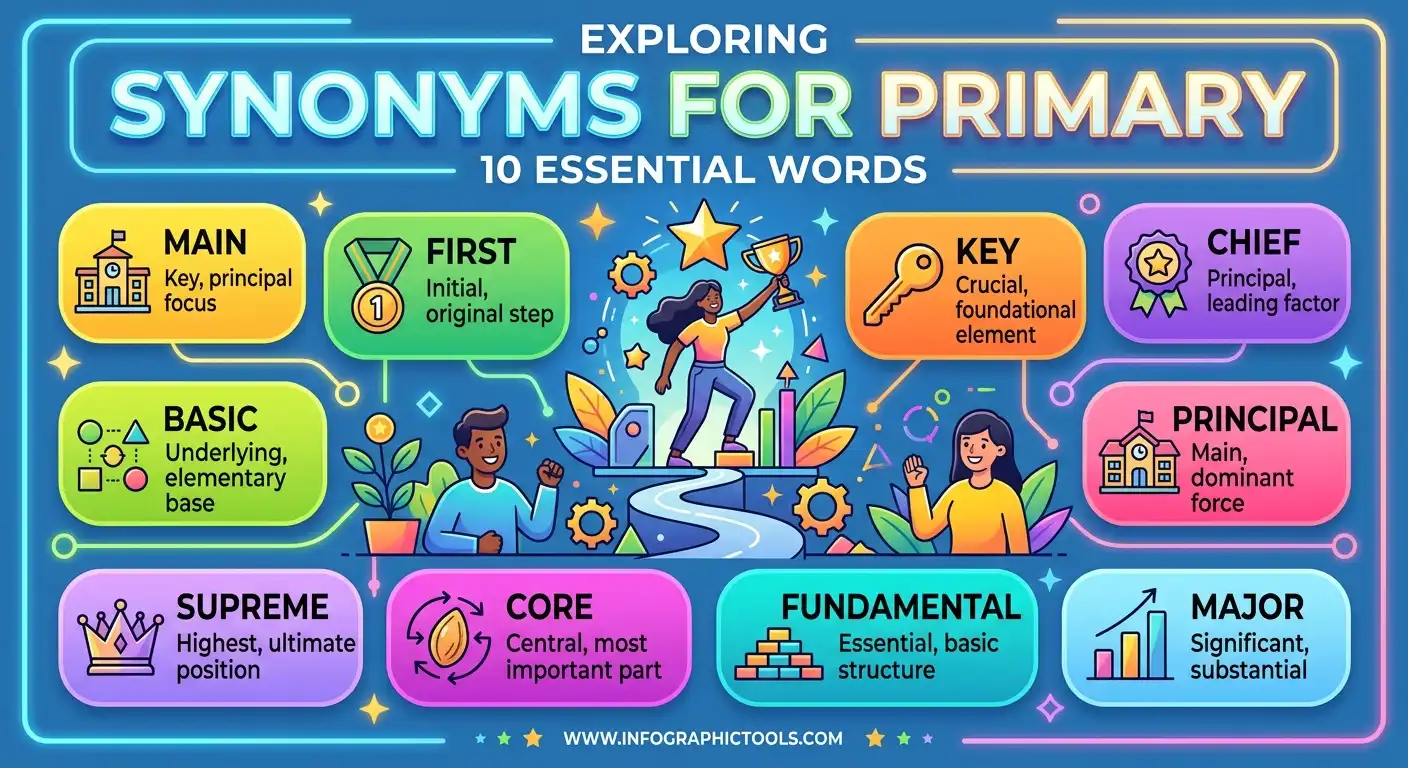
Learning the best synonyms for primary helps you choose the right word when describing main goals, basic rules, and first steps. When you master diverse synonyms for primary, your speaking and writing become much clearer and more persuasive. Exploring accurate synonyms for primary prevents repetitive vocabulary and elevates your everyday communication.
Imagine a city Mayor delivering an important annual speech about town safety. Calling every new policy a “primary goal” makes the presentation sound plain and repetitive. Switching to precise choices like “chief objective,” “core focus,” or “fundamental duty” gives the talk immediate authority and structure.
For example, when a student plans a daily study schedule, their top job is completing homework. Calling that task a “leading priority” helps everyone understand its high importance right away.
The word primary means the first, most important, or fundamental part of something. Understanding synonyms for primary helps many different groups of people:
- Students write clearer essays and group project summaries.
- Bloggers create engaging headers that grab reader attention quickly.
- Content writers optimize guides with precise semantic vocabulary.
- Daily English users build natural confidence in workplace conversations.
“The right word brings immediate clarity and power to every sentence.”
“A strong vocabulary turns simple ideas into memorable statements.”
Linguistic Breakdown of “Primary”
Connotative Meaning
The term primary carries strong, authoritative, and foundational connotations. It signals supreme importance, essential value, or the original starting point of a process.
Etymology
- Origin: Derived from Latin primarius (meaning of the first rank or chief).
- Root Word: Latin primus (meaning first).
- Historical Shift: Entered Middle English in the 14th century to describe items that came first in order, rank, or time.
Pronunciation
- US (IPA): /ˈpraɪ.mer.i/
- UK (IPA): /ˈpraɪ.mər.i/
Syllables & Affixation Pattern
- Syllables: 3 syllables (pri-ma-ry)
- Base Structure: Root prim- (first) + Adjective suffix -ary (connected with)
- Grammatical Patterns:
- Adjective: Primary cause / Primary goal
- Adverb form: Primarily
- Related Noun: Primacy / Primary
Comparison Table: Common Synonyms for Primary
| Keyword | Meaning | Usage Type | Context | | Main | Most important or largest in size | Neutral / Common | Daily Tasks, News Headlines, & Work | | Principal | Highest in rank or importance | Formal / Professional | Business Deals, School Leadership, & Law | | Fundamental | Forming the basic foundation of something | Analytical / Academic | Science, Philosophy, & Basic Rules |
| Prime | Of first choice or highest quality | Enthusiastic / Commercial | Real Estate, Meat Quality, & Prime Time | | Chief | Leading or holding the main role | Direct / Authoritative | Job Titles, Main Causes, & Top Concerns | | Core | The central and most crucial part | Collaborative / Modern | Team Values, Strategy, & Fitness | | Initial | Occurring at the very beginning | Sequential / Formal | Project Starts, Medical Tests, & Research |
“Choosing exact words turns basic choices into clear statements of value.”
50 Best Synonyms for Primary
1. Main
- Pronunciation: US /meɪn/ | UK /meɪn/
- Meaning: Main means the biggest or most important part of something.
- Examples:
- Water is the main drink on our dinner table.
- Her main goal is finishing her homework early.
2. Principal
- Pronunciation: US /ˈprɪn.sə.pəl/ | UK /ˈprɪn.sɪ.pəl/
- Meaning: Principal means highest in rank or main in importance.
- Examples:
- Corn is the principal crop grown on this farm.
- He is the principal singer in the school choir.
3. Chief
- Pronunciation: US /tʃiːf/ | UK /tʃiːf/
- Meaning: Chief means most important or holding the highest position.
- Examples:
- Safety is our chief concern on the bus trip.
- She is the chief planner for the city library.
4. Prime
- Pronunciation: US /praɪm/ | UK /praɪm/
- Meaning: Prime means of the best quality or first importance.
- Examples:
- Morning is the prime time for my study routine.
- The store sits in a prime spot downtown.
5. Key
- Pronunciation: US /kiː/ | UK /kiː/
- Meaning: Key means very important and necessary for success.
- Examples:
- Practice is the key secret to learning piano.
- She gave a key speech at the meeting.
6. Leading
- Pronunciation: US /ˈliː.dɪŋ/ | UK /ˈliː.dɪŋ/
- Meaning: Leading means most successful or in the front position.
- Examples:
- He is a leading scientist in solar energy.
- Our team took the leading spot in the game.
7. Major
- Pronunciation: US /ˈmeɪ.dʒɚ/ | UK /ˈmeɪ.dʒər/
- Meaning: Major means very large, serious, or important.
- Examples:
- Heavy rain was a major reason for the delay.
- She made a major update to her presentation.
8. Central
- Pronunciation: US /ˈsen.trəl/ | UK /ˈsen.trəl/
- Meaning: Central means located in the middle or being most vital.
- Examples:
- Love is the central theme of this sweet story.
- We met at the central park in town.
9. Essential
- Pronunciation: US /ɪˈsen.ʃəl/ | UK /ɪˈsen.ʃəl/
- Meaning: Essential means completely necessary for life or success.
- Examples:
- Clean water is essential for good health.
- Good tires are essential for winter driving.
10. Basic
- Pronunciation: US /ˈbeɪ.sɪk/ | UK /ˈbeɪ.sɪk/
- Meaning: Basic means forming the simplest and most necessary part.
- Examples:
- Food and shelter are basic human needs.
- We learned basic math steps in second grade.
11. Fundamental
- Pronunciation: US /ˌfʌn.dəˈmen.t̬əl/ | UK /ˌfʌn.dəˈmen.təl/
- Meaning: Fundamental means serving as the main base or foundation.
- Examples:
- Trust is a fundamental rule in friendship.
- Reading is a fundamental skill for all students.
12. Core
- Pronunciation: US /kɔːr/ | UK /kɔː/
- Meaning: Core means the central, hidden, or most vital center.
- Examples:
- Honesty is a core value in our home.
- The core team met to plan the event.
13. Premier
- Pronunciation: US /prɪˈmɪr/ | UK /ˈprem.i.ər/
- Meaning: Premier means first in importance, order, or quality.
- Examples:
- This park is the premier spot for picnics.
- She works at a premier hospital in the state.
14. Paramount
- Pronunciation: US /ˈper.ə.maʊnt/ | UK /ˈpær.ə.maʊnt/
- Meaning: Paramount means more important than anything else.
- Examples:
- Child safety is paramount during school trips.
- Silence is paramount inside the reading room.
15. Dominant
- Pronunciation: US /ˈdɑː.mə.nənt/ | UK /ˈdɒm.ɪ.nənt/
- Meaning: Dominant means stronger, noticeable, or more influential than others.
- Examples:
- Blue is the dominant color in her room.
- The tall tree is the dominant feature in the yard.
16. First
- Pronunciation: US /fɝːst/ | UK /fɜːst/
- Meaning: First means coming before all others in time or order.
- Examples:
- She took the first turn in the game.
- January is the first month of the year.
17. Initial
- Pronunciation: US /ɪˈnɪʃ.əl/ | UK /ɪˈnɪʃ.əl/
- Meaning: Initial means happening at the very start of something.
- Examples:
- My initial thought was to stay at home.
- The doctor completed the initial exam quickly.
18. Original
- Pronunciation: US /əˈrɪdʒ.ən.əl/ | UK /əˈrɪdʒ.ən.əl/
- Meaning: Original means existing from the very beginning.
- Examples:
- The house still has its original wooden doors.
- Her original idea was to paint the wall green.
19. Elementary
- Pronunciation: US /ˌel.əˈmen.t̬ɚ.i/ | UK /ˌel.ɪˈmen.tri/
- Meaning: Elementary means simple, basic, or introductory.
- Examples:
- He solved the problem with elementary math steps.
- We attend the local elementary school down the street.
20. Foremost
- Pronunciation: US /ˈfɔːr.moʊst/ | UK /ˈfɔː.məʊst/
- Meaning: Foremost means most important or positioned right at the front.
- Examples:
- She is the foremost writer on ocean life.
- Safety remains our foremost thought during travel.
21. Highest
- Pronunciation: US /ˈhaɪ.ɪst/ | UK /ˈhaɪ.ɪst/
- Meaning: Highest means top in rank, level, degree, or value.
- Examples:
- Winning the trophy was her highest honor.
- The mountain peak is the highest point nearby.
22. Supreme
- Pronunciation: US /səˈpriːm/ | UK /səˈpriːm/
- Meaning: Supreme means highest in power, authority, or quality.
- Examples:
- The supreme court made the final choice today.
- He showed supreme confidence on stage.
23. Prevailing
- Pronunciation: US /prɪˈveɪ.lɪŋ/ | UK /prɪˈveɪ.lɪŋ/
- Meaning: Prevailing means most common or widespread at a given time.
- Examples:
- The prevailing wind comes from the west today.
- Kindness was the prevailing feeling in the room.
24. Cardinal
- Pronunciation: US /ˈkɑːr.dən.əl/ | UK /ˈkɑː.dɪ.nəl/
- Meaning: Cardinal means of fundamental importance or chief value.
- Examples:
- Telling the truth is a cardinal rule here.
- He made a cardinal mistake by forgetting his key.
25. Capital
- Pronunciation: US /ˈkæp.ə.t̬əl/ | UK /ˈkæp.ɪ.təl/
- Meaning: Capital means most important or standing at the head.
- Examples:
- Starting early was an idea of capital value.
- Washington is the capital city of our nation.
26. Vital
- Pronunciation: US /ˈvaɪ.t̬əl/ | UK /ˈvaɪ.təl/
- Meaning: Vital means extremely important and necessary for life.
- Examples:
- Fresh air is vital for healthy breathing.
- She played a vital role in our win.
27. Crucial
- Pronunciation: US /ˈkruː.ʃəl/ | UK /ˈkruː.ʃəl/
- Meaning: Crucial means extremely important because it decides the outcome.
- Examples:
- The last minute was crucial for the team.
- Sleep is crucial before a big test day.
28. Critical
- Pronunciation: US /ˈkrɪt̬.ɪ.kəl/ | UK /ˈkrɪt.ɪ.kəl/
- Meaning: Critical means urgent and of maximum importance.
- Examples:
- Water supply is critical during summer heat.
- He made a critical decision for his shop.
29. Focal
- Pronunciation: US /ˈfoʊ.kəl/ | UK /ˈfəʊ.kəl/
- Meaning: Focal means serving as the center of interest or activity.
- Examples:
- The large fireplace is the focal point of the room.
- Her speech was the focal moment of the event.
30. Root
- Pronunciation: US /ruːt/ | UK /ruːt/
- Meaning: Root means the deep, original cause or source of something.
- Examples:
- Fear was the root cause of his silence.
- We found the root issue in the engine.
31. Underlying
- Pronunciation: US /ˌʌn.dɚˈlaɪ.ɪŋ/ | UK /ˌʌn.dəˈlaɪ.ɪŋ/
- Meaning: Underlying means lying beneath or forming the hidden base.
- Examples:
- Stress was the underlying reason for his tiredness.
- We discussed the underlying message of the book.
32. Priority
- Pronunciation: US /praɪˈɔːr.ə.t̬i/ | UK /praɪˈɒr.ə.ti/
- Meaning: Priority means something that is regarded as more important than others.
- Examples:
- Finishing this task is my top priority today.
- Family time is always a high priority for us.
33. Structural
- Pronunciation: US /ˈstrʌk.tʃɚ.əl/ | UK /ˈstrʌk.tʃər.əl/
- Meaning: Structural means related to the essential frame or foundation.
- Examples:
- The builders checked the structural strength of the wall.
- They made structural changes to the company plan.
34. Ultimate
- Pronunciation: US /ˈʌl.tə.mət/ | UK /ˈʌl.tɪ.mət/
- Meaning: Ultimate means final, maximum, or highest in degree.
- Examples:
- Winning the medal was her ultimate dream.
- The ultimate choice rests with the store manager.
35. Primeval
- Pronunciation: US /praɪˈmiː.vəl/ | UK /praɪˈmiː.vəl/
- Meaning: Primeval means belonging to the earliest ages of the world.
- Examples:
- The deep forest had a primeval beauty.
- Scientists studied primeval rocks on the island.
36. Primary-stage
- Pronunciation: US /ˈpraɪ.mer.i steɪdʒ/ | UK /ˈpraɪ.mər.i steɪdʒ/
- Meaning: Primary-stage means belonging to the first phase of development.
- Examples:
- The project is still in its primary-stage phase.
- Primary-stage testing showed very good results today.
37. Top
- Pronunciation: US /tɑːp/ | UK /tɒp/
- Meaning: Top means highest in position, rank, or degree.
- Examples:
- She is the top student in her math class.
- Place the fruit on the top shelf please.
38. Front
- Pronunciation: US /frʌnt/ | UK /frʌnt/
- Meaning: Front means leading or placed right at the beginning.
- Examples:
- He sat in the front seat of the bus.
- Her story was on the front page today.
39. Master
- Pronunciation: US /ˈmæs.tɚ/ | UK /ˈmɑː.stər/
- Meaning: Master means main, controlling, or principal.
- Examples:
- He unlocked the door with a master key.
- She created a master plan for the garden.
40. Head
- Pronunciation: US /hed/ | UK /hed/
- Meaning: Head means chief, top, or leading in position.
- Examples:
- She is the head doctor at the clinic.
- The head chef cooked a tasty soup today.
41. Prime-grade
- Pronunciation: US /praɪm greɪd/ | UK /praɪm greɪd/
- Meaning: Prime-grade means belonging to the highest quality level.
- Examples:
- The carpenter used prime-grade wood for the table.
- They only sell prime-grade fruits in this store.
42. Preeminent
- Pronunciation: US /priːˈem.ə.nənt/ | UK /priːˈem.ɪ.nənt/
- Meaning: Preeminent means standing above all others in quality or rank.
- Examples:
- She is the preeminent expert on bird migration.
- The town is preeminent for its clean waters.
43. Overriding
- Pronunciation: US /ˌoʊ.vɚˈraɪ.dɪŋ/ | UK /ˌəʊ.vəˈraɪ.dɪŋ/
- Meaning: Overriding means more important than any other consideration.
- Examples:
- Safety was the overriding goal for the drivers.
- Her overriding concern was reaching home on time.
44. Sovereign
- Pronunciation: US /ˈsɑːv.rən/ | UK /ˈsɒv.rɪn/
- Meaning: Sovereign means supreme in power or effectiveness.
- Examples:
- The state holds sovereign power over its lands.
- Good rest is a sovereign remedy for fatigue.
45. Standard
- Pronunciation: US /ˈstæn.dɚd/ | UK /ˈstæn.dəd/
- Meaning: Standard means serving as an established rule or model.
- Examples:
- Washing hands is standard rule in cooking.
- White paper is the standard choice for prints.
46. Unrivaled
- Pronunciation: US /ʌnˈraɪ.vəld/ | UK /ʌnˈraɪ.vəld/
- Meaning: Unrivaled means better than all others of the same type.
- Examples:
- The bakery offers unrivaled cake quality in town.
- Her skill on the piano remains unrivaled today.
47. Base
- Pronunciation: US /beɪs/ | UK /beɪs/
- Meaning: Base means serving as the bottom support or foundation.
- Examples:
- Milk is the base ingredient for homemade ice cream.
- Good practice is the base step of learning.
48. Focal-point
- Pronunciation: US /ˈfoʊ.kəl pɔɪnt/ | UK /ˈfəʊ.kəl pɔɪnt/
- Meaning: Focal-point means the center of attention or main focus.
- Examples:
- The tall fountain is the focal-point of the square.
- Her painting became the focal-point of the show.
49. Lead
- Pronunciation: US /liːd/ | UK /liːd/
- Meaning: Lead means principal, main, or guiding.
- Examples:
- She got the lead role in the school play.
- He is the lead runner in the race.
50. Number-one
- Pronunciation: US /ˌnʌm.bɚˈwʌn/ | UK /ˌnʌm.bəˈwʌn/
- Meaning: Number-one means top in priority, rank, or quality.
- Examples:
- Cleanliness is our number-one goal in the kitchen.
- He is the number-one player on the team.
Antonyms of “Primary”
Knowing opposite expressions helps you identify secondary details or minor aspects accurately.
- Secondary: Coming second in order, time, or importance.
- Minor: Lesser in size, importance, or degree.
- Subordinate: Lower in rank, position, or authority.
- Auxiliary: Giving extra help or support to the main part.
- Trivial: Having very little value, importance, or meaning.
- Peripheral: Located on the outer edge or less important side.
Prototype Meaning & Categorization of “Primary”
The central concept of primary rests on supreme importance, original position, and foundational strength. Depending on your intent, these 50 synonyms divide into four clear operational categories:
- Importance & Supremacy: Main, principal, chief, key, leading, major, central, premier, paramount, dominant, foremost, highest, supreme, cardinal, overriding, preeminent, sovereign, unrivaled, top, head, number-one, lead.
- Foundation & Structure: Essential, basic, fundamental, core, vital, crucial, critical, focal, root, underlying, structural, base, focal-point.
- Time & Sequence: Prime, first, initial, original, elementary, primeval, primary-stage, front.
- Quality & Standard: Prevailing, capital, priority, ultimate, master, prime-grade, standard.
Frequently Asked Questions (FAQs)
1. What is the most common formal synonym for “primary”?
In formal business reports and academic writing, “principal” and “chief” are the most common synonyms. They sound professional and clearly indicate high rank.
2. How do “primary” and “principal” differ in daily usage?
“Primary” often refers to the first step or fundamental cause. “Principal” usually emphasizes the highest person in rank or the largest dollar amount in finance.
3. Can I use “key” instead of “primary” in essays?
Yes! “Key” is a fantastic, highly natural synonym that describes vital factors or main arguments without sounding overly stiff.
4. Which synonym for “primary” works best for goal setting?
For goal setting, terms like “top priority,” “chief goal,” or “core objective” provide maximum clarity and impact.
5. Why is expanding my vocabulary of synonyms important for writing?
Varying your vocabulary prevents repetitive phrasing, engages your reader, satisfies search intent, and demonstrates deep topic mastery.
6. How does using semantic synonyms for “primary” benefit SEO?
Using semantic synonyms helps search engines understand the complete context of your content, preventing keyword stuffing while covering user search variations naturally.
Conclusion
Expanding your vocabulary with synonyms for primary adds precision, variety, and confidence to your daily communication. Swapping repetitive words with exact alternatives like main, principal, chief, or fundamental ensures your writing makes a strong impression every single time.
Whether you are writing academic essays, publishing engaging blog posts, drafting professional emails, or talking with colleagues, using diverse words builds trust and authority. Clear vocabulary removes fuzziness and turns simple points into convincing arguments. Start using these 50 synonyms today to express your main ideas with clarity and power.
“Gratitude and clear communication build connections that last a lifetime.”
“Choosing the exact right word leaves a positive impression that lasts long after the conversation ends.”

Robert Hayes is an ESL educator and curriculum developer with over nine years of experience teaching English to beginners and intermediate learners across multiple countries ( Biography ).