Have you ever repeated the word principle too many times in your essay and felt your writing sounded dull or repetitive? You’re not alone. Many ESL learners struggle to find the right alternatives, especially in academic or IELTS writing tasks.
In this guide, you’ll learn the most useful synonyms for principle, along with simple meanings, examples, and when to use each one correctly. This is not just a list—you’ll understand how each word works in real sentences.
As an ESL learner, your goal is clarity and accuracy. Using the right synonym can improve your vocabulary score, especially in exams like IELTS where lexical range matters. By the end of this article, you’ll confidently choose the best word depending on your context.
Quick Answer:
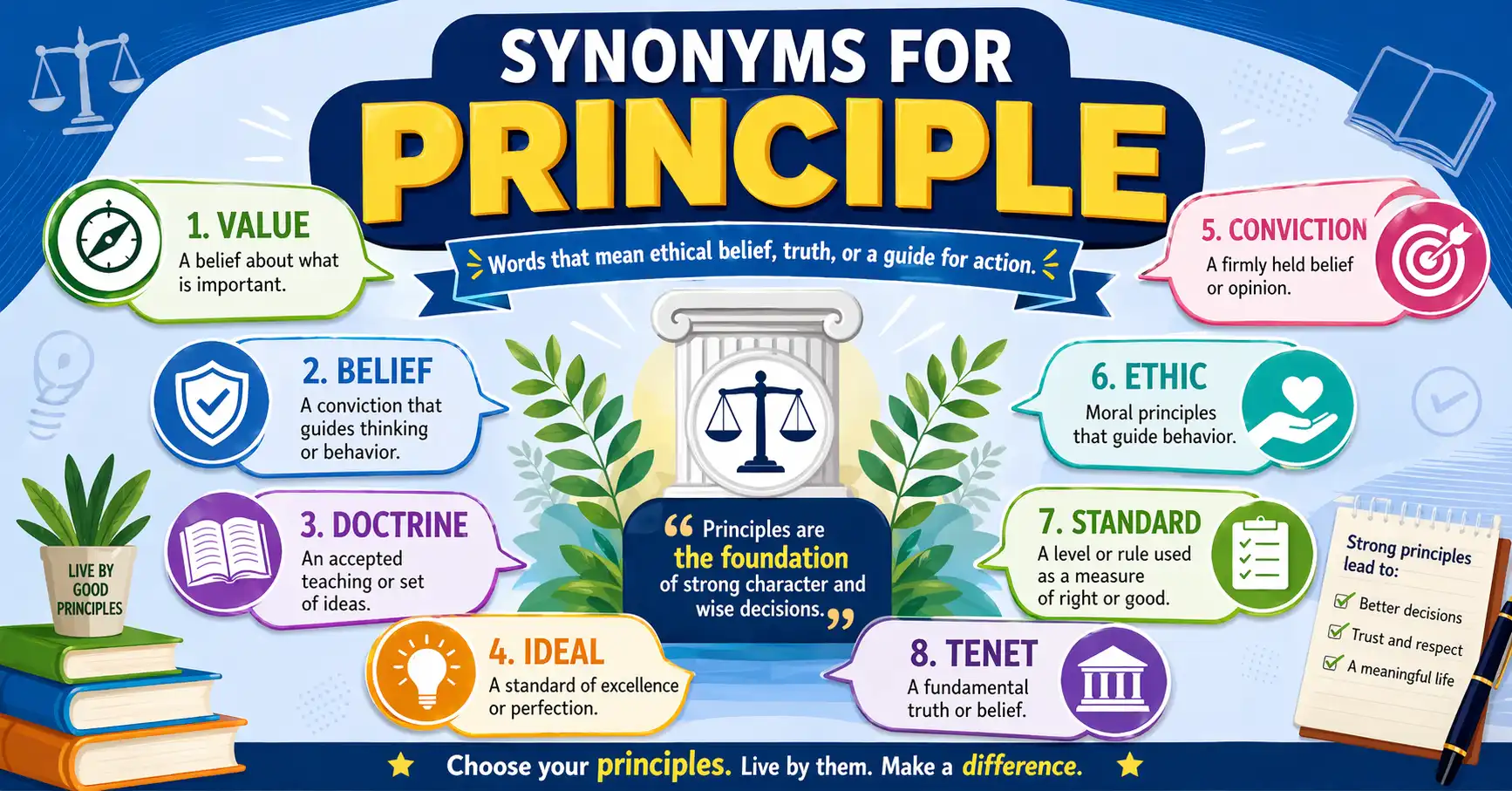
The most common synonyms for principle are: rule, belief, value, standard, doctrine, law, guideline, theory, code, and ethic.
These words can replace principle depending on context—especially in academic, moral, or scientific writing. Always choose based on meaning, not just similarity.
What Does “Principle” Mean?
The word principle has two main meanings in English:
- A basic truth, rule, or idea
- Example: The principle of equality is important in society.
- A personal belief or moral value
- Example: She refuses to lie because of her principles.
In ESL and academic writing, principle often appears in essays about ethics, science, and social topics. According to academic writing conventions, using varied vocabulary improves clarity and avoids repetition—this is especially important for higher IELTS bands (Band 7+).
Complete Synonyms List
Here are 10+ strong synonyms for principle with simple explanations:
- Rule – a general instruction or law
- Belief – something you think is true
- Value – something important to you
- Standard – a level or expectation
- Doctrine – a formal belief system (often religious or political)
- Law – an official rule or scientific truth
- Guideline – advice on how to do something
- Theory – an idea explaining something
- Code – a set of rules (e.g., moral code)
- Ethic – a moral belief
- Foundation – a basic supporting idea
- Tenet – a principle or belief in a system
👉 ESL Note: Not all synonyms are interchangeable. For example, law works in science, but not in personal beliefs.
Comparison Table
| Word | Simple Meaning | Best Used When | Avoid When |
| Principle | Basic truth or belief | Academic or formal writing | Casual conversation |
| Rule | Instruction or law | General situations | Deep philosophical ideas |
| Belief | Personal opinion | Opinions or religion | Scientific writing |
| Value | Important idea | Social or cultural topics | Technical explanations |
| Doctrine | Formal belief system | Politics or religion | Informal writing |
| Law | Official or scientific rule | Science or legal context | Personal opinions |
| Guideline | Advice or suggestion | Instructions or processes | Strong rules |
| Theory | Explanation idea | Academic/scientific writing | Moral discussions |
Formal vs Informal Synonyms
| Formal Words | Informal Alternatives |
| Principle | Rule |
| Doctrine | Idea |
| Tenet | Belief |
| Ethic | Value |
| Standard | Rule |
| Guideline | Tip |
👉 ESL Note: Use formal words like principle and doctrine in essays. Use simpler words like rule in conversation.
Real Example Sentences
Here are 8 practical examples using synonyms for principle:
- The principle of fairness should guide all decisions.
- This company follows strict standards for quality.
- His beliefs influence how he treats others.
- The scientific law explains how gravity works.
- Teachers should follow clear guidelines in the classroom.
- Freedom is a core value in many societies.
- The political doctrine shaped national policies.
- Her personal ethics prevent her from cheating.
👉 IELTS Tip: Try to use at least 2–3 synonyms in your essay to show lexical variety.
When to Use vs When NOT to Use
✅ When to Use “Principle” or Its Synonyms
Use these words when you are:
- Writing academic essays
- Explaining ideas or theories
- Discussing moral or social topics
- Giving structured arguments
❌ When NOT to Use Them
Avoid using complex synonyms when:
- You are speaking casually
- Simpler words are clearer
- The meaning may become confusing
👉 In our experience helping ESL writers, many students lose marks because they choose a “fancy” synonym that does not match the context.
Common Mistakes Writers Make
Here are mistakes ESL learners often make:
1. Confusing “Principle” and “Principal”
- Principle = rule or belief
- Principal = main or most important
2. Using Synonyms Incorrectly
- ❌ The law of honesty (incorrect)
- ✅ The principle of honesty
3. Overusing One Word
Repeating principle too many times lowers your lexical score.
4. Using Too Formal Words in Simple Contexts
- ❌ “My doctrine is to wake up early.”
- ✅ “My habit is to wake up early.”
Tips and Best Practices
Here are practical tips to improve your vocabulary:
1. Match the Context
Always check if the synonym fits the situation:
- Science → law, theory
- Ethics → value, ethic
- General → rule, guideline
2. Learn in Groups
Study words in categories instead of alone.
3. Practice with Sentences
Write your own examples using each synonym.
4. Keep It Simple
Clear writing is better than complicated vocabulary.
👉 Writers we work with often improve faster when they focus on accuracy first, then variety.
Frequently Asked Questions
Q: What is the best synonym for principle?
A: The best synonym depends on context. Rule is common in general situations, while value works for moral discussions and law fits scientific contexts. Always choose based on meaning, not similarity.
Q: Can I use “rule” instead of principle?
A: Yes, but only in simple contexts. Rule works for general instructions, but not for deep ideas or moral beliefs. In academic writing, principle or standard is usually more appropriate.
Q: What is the difference between principle and value?
A: A principle is a guiding rule or idea, while a value is something you consider important. Principles guide actions, while values reflect priorities in life or society.
Q: Are synonyms for principle useful in IELTS writing?
A: Yes. Using synonyms correctly improves your lexical resource score. However, accuracy matters more than variety. Incorrect synonyms can lower your band score, especially in Task 2 essays.
Q: Is “theory” a synonym for principle?
A: Sometimes. Theory works when referring to explanations in science or academics. However, it does not fit moral or ethical contexts where principle or value is more appropriate.
Q: How can I learn synonyms faster as an ESL learner?
A: Practice using synonyms in sentences and group them by context. Focus on common words first. Reading academic texts and writing daily also helps reinforce correct usage over time.
Conclusion
Understanding the synonyms for principle helps you write more clearly and effectively, especially in academic and IELTS contexts. You’ve learned key alternatives like rule, value, law, and guideline, along with when to use them correctly.
Remember, strong writing is not about using difficult words—it’s about using the right word in the right place.
You might also want to read our guide on synonyms for idea to expand your vocabulary further.
Keep practicing, stay consistent, and your English will improve step by step.

Robert Hayes is an ESL educator and curriculum developer with over nine years of experience teaching English to beginners and intermediate learners across multiple countries ( Biography ).