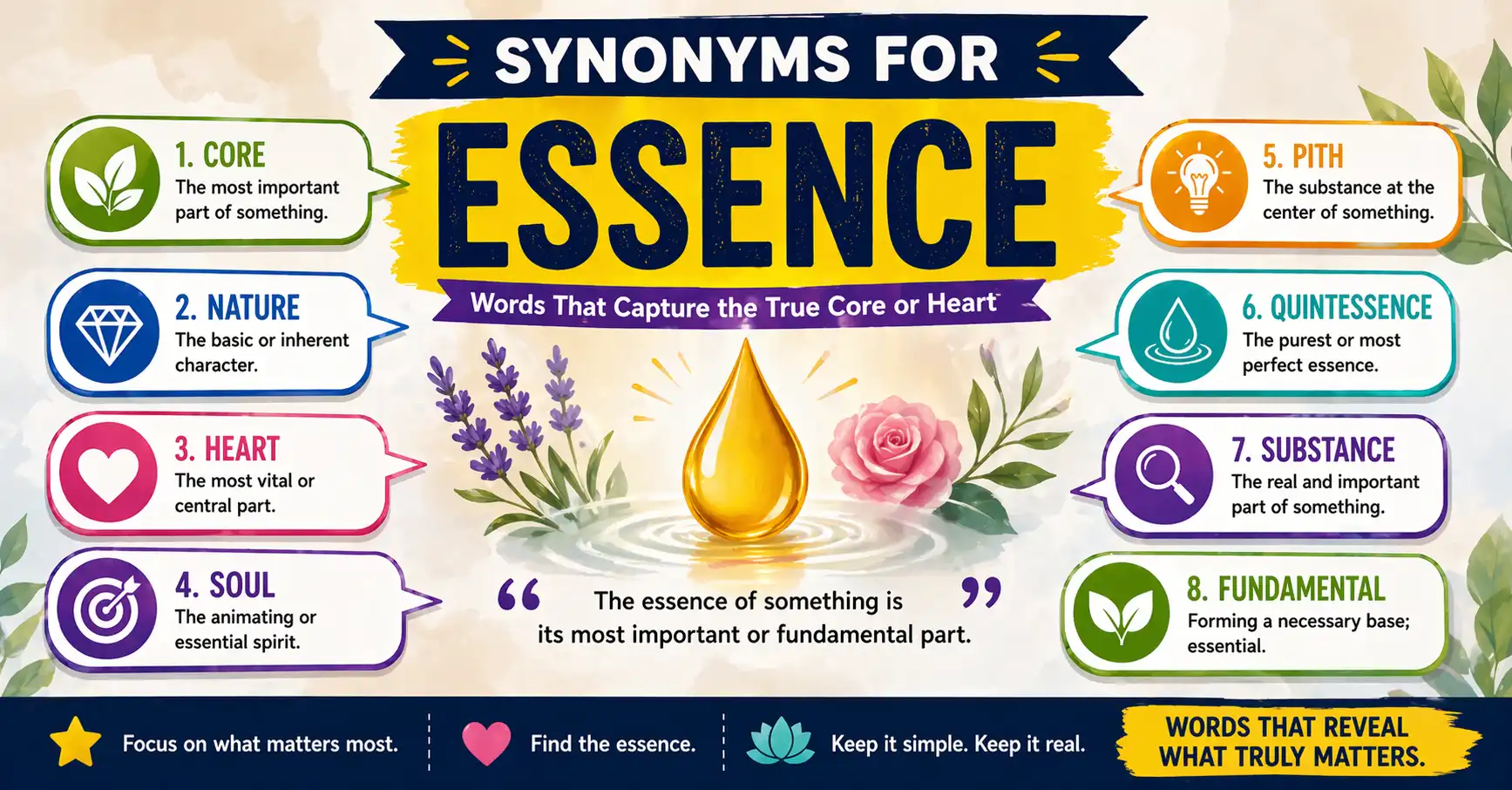
Have you ever baked a chocolate cake but forgotten to add the cocoa powder? What you have left might be sweet, but it is missing the soul of the cake. Cocoa is the very core, or essence, of a chocolate cake. It is what makes it what it is. In simple terms, the word “essence” means the most important part of something.
Learning new synonyms for essence is incredibly useful for students, bloggers, content writers, and daily English users. When you use different words instead of repeating yourself, your writing flows better and keeps your readers happy. Exploring fresh synonyms for essence helps make your stories, essays, and blogs much more exciting to read. Let us look at fifty wonderful synonyms for essence to improve your writing style today!
Core
Meaning:
- This word means the most important or middle part of something.
Examples:
- Love is the core of their happy family.
- She got straight to the core of the problem.
Heart
Meaning:
- This word refers to the central and most vital part of an idea or thing.
Examples:
- Trust is at the heart of any good friendship.
- We walked into the heart of the busy city.
Soul
Meaning:
- This word represents the deepest, most spiritual part of a person or thing.
Examples:
- Music is the soul of her life.
- The old writer put his whole soul into the book.
Substance
Meaning:
- This word means the real, physical, or most important matter of something.
Examples:
- His speech was short but full of rich substance.
- We need to look at the substance of the report.
Spirit
Meaning:
- This word means the true meaning or mood of something rather than just the rules.
Examples:
- The kids played the game in a friendly spirit.
- We must follow the true spirit of the law.
Crux
Meaning:
- This word means the most important point of an issue or a problem.
Examples:
- The crux of the matter is that we lack money.
- He quickly explained the crux of the argument.
Basis
Meaning:
- This word means the main support or starting idea that something rests on.
Examples:
- Hard work is the basis of his success.
- They meet on a regular basis to talk.
Bottom line
Meaning:
- This phrase means the final result or most important fact of a situation.
Examples:
- The bottom line is that we need to work harder.
- What is the bottom line of this new plan?
Center
Meaning:
- This word means the middle point or the main focus of attention.
Examples:
- The young boy was the center of the family.
- This busy town is the center of trade.
Gist
Meaning:
- This word means the general or main meaning of what someone says or writes.
Examples:
- I did not hear every word, but I got the gist of it.
- She gave us the gist of the long story.
Nature
Meaning:
- This word means the basic character or quality of a person, animal, or thing.
Examples:
- It is in his nature to be kind to animals.
- We need to understand the true nature of the problem.
Kernel
Meaning:
- This word means a small but very important seed or core of truth.
Examples:
- There is a kernel of truth in her wild story.
- He found a useful kernel of ideas in the book.
Pith
Meaning:
- This word means the essential or deepest part of an idea or a speech.
Examples:
- The speaker got straight to the pith of the subject.
- Her short note contained the pith of the whole plan.
Root
Meaning:
- This word means the primary source or origin of a feeling or problem.
Examples:
- Money is often called the root of all evil.
- We must find the root of this loud noise.
Marrow
Meaning:
- This word means the deepest, innermost, and most vital part of something.
Examples:
- The cold wind chilled him to the marrow of his bones.
- His words reached the marrow of the issue.
Key
Meaning:
- This word means the most important thing that explains or solves a problem.
Examples:
- Planning is the key to a good trip.
- She found the key to solving the math puzzle.
Foundation
Meaning:
- This word means the solid base that supports a building or an idea.
Examples:
- A strong foundation keeps the tall house safe.
- Trust is the foundation of their marriage.
Element
Meaning:
- This word means a basic and necessary part of a larger whole.
Examples:
- Water is a key element of life on earth.
- Honesty is an important element of a good character.
Principle
Meaning:
- This word means a basic truth, rule, or belief that guides how things work.
Examples:
- He is a man of high principle and honor.
- We learned the basic principle of flight today.
Life
Meaning:
- This word can mean the active, exciting, and most vital part of something.
Examples:
- The young dancer was the life of the party.
- Good books bring life to our quiet library.
Mainstay
Meaning:
- This word means the most important thing or person that supports everything else.
Examples:
- Tourism is the mainstay of the island’s wealth.
- My mother is the mainstay of our family.
Meat
Meaning:
- This word can mean the most important or substantial part of a story or plan.
Examples:
- The meat of the book is in the middle chapters.
- Let us get to the meat of the discussion.
Backbone
Meaning:
- This word means the main support or strength of a group or plan.
Examples:
- Hard-working farmers are the backbone of our country.
- He lacks the backbone to stand up for himself.
Character
Meaning:
- This word means the unique qualities that make a person or place special.
Examples:
- The old town has a lot of charm and character.
- Her strong character helped her win the race.
Lifeblood
Meaning:
- This word means the vital force or most important thing that keeps something alive.
Examples:
- Small businesses are the lifeblood of our town.
- Fresh water is the lifeblood of the valley.
Inside
Meaning:
- This word means the inner part or true feeling hidden under the surface.
Examples:
- I know she is a sweet person on the inside.
- The inside of the box was lined with red silk.
Being
Meaning:
- This word means the state of existing or the true inner self of a person.
Examples:
- He loved her with his whole being.
- The strange being lived deep in the green forest.
Reality
Meaning:
- This word means the true state of things as they actually are.
Examples:
- We must face the hard reality of the situation.
- His dream of flying became a reality today.
Quality
Meaning:
- This word means a distinctive trait or how good something is.
Examples:
- Kindness is a very beautiful quality in a person.
- This shop sells shoes of the highest quality.
Quintessence
Meaning:
- This word means the perfect or most typical example of a quality.
Examples:
- He is the quintessence of a polite gentleman.
- This old village is the quintessence of country life.
Texture
Meaning:
- This word can mean the essential character, feel, or structure of something.
Examples:
- The thick fabric has a rough texture to touch.
- She changed the texture of the music with a flute.
Feature
Meaning:
- This word means an important or noticeable part of something.
Examples:
- The big blue pool is the best feature of the house.
- Her blue eyes are her most striking feature.
Subject
Meaning:
- This word means the main thing being talked about, written about, or studied.
Examples:
- Math is my favorite subject at school.
- The speaker changed the subject of his talk.
Core value
Meaning:
- This phrase means a primary belief that guides a person or a company.
Examples:
- Honesty is a core value of our business.
- Respect is the main core value in this school.
Point
Meaning:
- This word means the main idea or purpose of what is being said.
Examples:
- I do not understand the point of this game.
- He made a very good point during the meeting.
Meaning
Meaning:
- This word means the idea or message that is intended to be understood.
Examples:
- The red rose has a deep meaning of love.
- I do not know the meaning of this hard word.
Focus
Meaning:
- This word means the central point of interest or activity.
Examples:
- The main focus of the lesson was spelling.
- She adjusted the lens to bring the bird into focus.
Hub
Meaning:
- This word means the busy center of an activity or place.
Examples:
- The airport is a major hub for world travel.
- The kitchen is the busy hub of our home.
Base
Meaning:
- This word means the bottom part of something that supports the rest.
Examples:
- The camp was set up at the base of the mountain.
- This clear soup is the base for our rich stew.
Identity
Meaning:
- This word means who or what a person or thing truly is.
Examples:
- The shy man kept his identity a secret.
- Culture gives a group of people their identity.
Truth
Meaning:
- This word means the actual facts about a matter instead of lies.
Examples:
- You must always tell the truth to your parents.
- We are searching for the real truth of the story.
Flavor
Meaning:
- This word can mean the distinctive quality, taste, or character of something.
Examples:
- Fresh mint gives a cool flavor to the tea.
- The old city has a unique historic flavor.
Tone
Meaning:
- This word means the general mood, attitude, or quality of a place or piece of writing.
Examples:
- Her polite tone made the guests feel welcome.
- The dark music set a sad tone for the movie.
Stamp
Meaning:
- This word can mean a characteristic mark or quality that shows who made or did something.
Examples:
- The new house bears the stamp of a great builder.
- Her unique style is her personal stamp on the work.
Makeup
Meaning:
- This word can mean the combination of qualities or parts that form something.
Examples:
- We studied the chemical makeup of clean water.
- Courage is a big part of his mental makeup.
Blueprint
Meaning:
- This word means a detailed plan or model for how to do something.
Examples:
- The builder showed us the blueprint of the house.
- This guide is a great blueprint for starting a blog.
Spark
Meaning:
- This word can mean a small but vital quality that starts or gives life to something.
Examples:
- A tiny spark can start a huge fire in the woods.
- She has a bright spark of genius in her mind.
Breath
Meaning:
- This word can represent life, air, or the very small presence of a quality.
Examples:
- A cool breath of wind blew through the open window.
- The news brought a fresh breath of hope to the town.
Seed
Meaning:
- This word means the small start or origin of an idea, feeling, or plant.
Examples:
- He planted the seed of doubt in my mind.
- The tiny seed grew into a beautiful sunflower.
Theme
Meaning:
- This word means the main subject or recurring idea in a talk, book, or event.
Examples:
- Friendship is the main theme of the story.
- The party had a fun wild west theme.
Why Learning Synonyms Improves Your Writing
Learning synonyms for essence is a wonderful way to boost your writing, blogging, speaking, and daily communication. When you avoid using the same words over and over, your reader stays interested. We encourage you to practice using these fifty words in your next emails, school essays, and daily conversations. You will quickly see how easy it is to make your English sound clear, exciting, and highly professional!

Robert Hayes is an ESL educator and curriculum developer with over nine years of experience teaching English to beginners and intermediate learners across multiple countries ( Biography ).