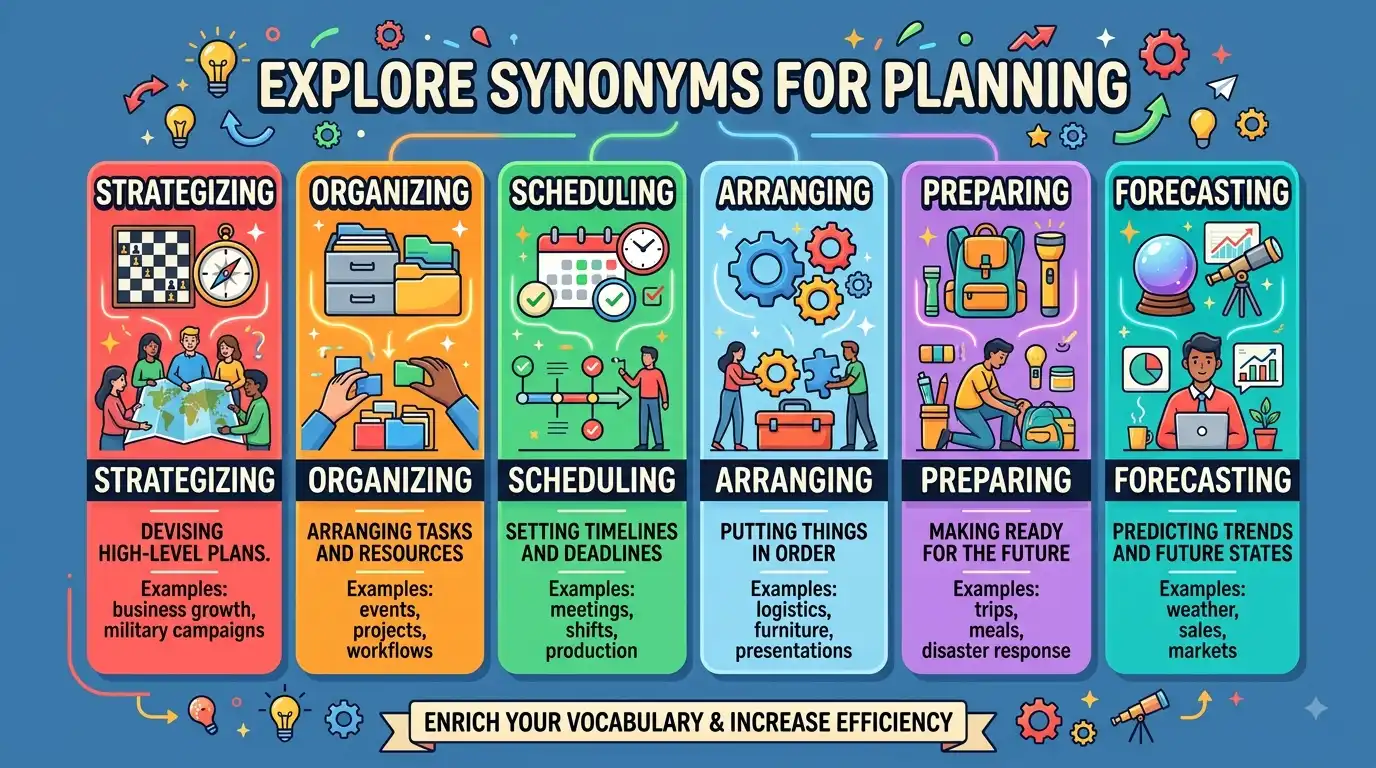
Finding exact synonyms for planning helps you explain your ideas, schedules, and future goals with total clarity. Learning diverse synonyms for planning enables you to describe business projects, school tasks, and daily routines without repeating the same words. Using strong synonyms for planning improves your writing quality and boosts your vocabulary confidence.
Imagine a team leader introducing a big project to company executives. If they repeat the word “planning” in every single sentence, the audience quickly loses interest. Switching to precise options like “strategizing,” “organizing,” or “mapping out” makes the entire presentation sound polished, professional, and convincing.
For instance, when a family prepares for a weekend trip, they organize their schedule and pack their bags ahead of time. Choosing simple, accurate choices like “preparing” or “arranging” helps listeners understand the exact process immediately.
The phrase synonyms for planning means alternative words that describe the act of organizing, preparing, or setting up actions for the future. Expanding your knowledge of synonyms for planning gives great advantages to many readers:
- Students write better school essays and outline research projects smoothly.
- Bloggers write engaging guides that keep readers reading longer.
- Content writers increase search engine rankings with natural, varied phrasing.
- Daily English users express their daily goals clearly in conversations and work emails.
“Clear words give order and strength to every future goal.”
“A rich vocabulary turns basic ideas into actionable success.”
Linguistic Breakdown of “Planning”
Connotative Meaning
The word planning carries positive, organized, and constructive connotations. It implies foresight, thoughtful preparation, purpose, and control over future outcomes.
Etymology
- Root Word: Plan (from French plan and Latin planus, meaning flat surface or ground map).
- Suffix: -ing (present participle suffix forming an active verbal noun).
- Historical Evolution: First used in drawing architectural blueprints on flat paper, then expanded to describe mental preparation and goal-setting.
Pronunciation of “Planning”
- US (IPA): /ˈplæn.ɪŋ/
- UK (IPA): /ˈplæn.ɪŋ/
Syllables & Affixation Pattern
- Syllables: 2 syllables (plan-ning)
- Base Structure: Root verb plan + continuous suffix -ing
- Grammatical Forms:
- Active Verb: Planning
- Past Tense: Planned
- Noun Form: Plan / Planner
- Adjective Form: Planned
Comparison Table: Common Synonyms for Planning
| Keyword | Meaning | Usage Type | Context |
|---|---|---|---|
| Organizing | Arranging items or tasks into a neat order | Practical / Casual | Home, Office, & Daily Chores |
| Preparing | Getting ready for a future event or task | General / Essential | Studies, Cooking, & Events |
| Strategizing | Creating a clever plan to achieve a goal | Formal / Professional | Business, Sports, & Games |
| Scheduling | Setting specific times for planned activities | Technical / Administrative | Work Calendar, Appointments, & School |
| Formulating | Developing a detailed plan or systematic formula | Academic / Analytical | Science, Policy, & Legal Work |
| Outlining | Writing down main points or basic steps | Creative / Educational | Writing Essays, Books, & Speeches |
| Brainstorming | Gathering quick creative ideas before starting | Collaborative / Casual | Group Work, Marketing, & Design |
50 Best Synonyms for Planning
1. Organizing
- Pronunciation: US /ˌɔːr.ɡəˈnaɪ.zɪŋ/ | UK /ˌɔː.ɡən.aɪ.zɪŋ/
- Meaning: Organizing means putting things or tasks into a neat and useful order.
- Examples:
- She is organizing her study desk before the final exam.
- Organizing the family picnic took only two hours.
2. Preparing
- Pronunciation: US /prɪˈper.ɪŋ/ | UK /prɪˈpeə.rɪŋ/
- Meaning: Preparing means getting people, items, or actions ready for what comes next.
- Examples:
- The chef is preparing fresh ingredients for dinner.
- They spent the morning preparing for the job interview.
3. Arranging
- Pronunciation: US /əˈreɪn.dʒɪŋ/ | UK /əˈreɪn.dʒɪŋ/
- Meaning: Arranging means placing items or events in a specific order or position.
- Examples:
- He is arranging a quick meeting with the new client.
- Arranging flowers in a tall vase makes the room look nice.
4. Mapping
- Pronunciation: US /ˈmæp.ɪŋ/ | UK /ˈmæp.ɪŋ/
- Meaning: Mapping means laying out a clear path or plan to follow.
- Examples:
- The team is mapping out their road trip on paper.
- Mapping your daily goals helps you stay focused on work.
5. Designing
- Pronunciation: US /dɪˈzaɪ.nɪŋ/ | UK /dɪˈzaɪ.nɪŋ/
- Meaning: Designing means creating a visual or functional plan for something new.
- Examples:
- She is designing a new website for her online store.
- Designing a cozy bedroom takes careful thought and patience.
6. Drafting
- Pronunciation: US /ˈdræf.tɪŋ/ | UK /ˈdrɑːf.tɪŋ/
- Meaning: Drafting means writing a preliminary version of a plan or text.
- Examples:
- He is drafting a simple contract for his new client.
- Drafting an essay outline makes writing much faster.
7. Scheduling
- Pronunciation: US /ˈskedʒ.uː.lɪŋ/ | UK /ˈʃed.juː.lɪŋ/
- Meaning: Scheduling means assigning specific dates and times to planned activities.
- Examples:
- She is scheduling her dental visit for next Tuesday.
- Scheduling your study hours prevents last-minute stress.
8. Strategizing
- Pronunciation: US /ˈstræt̬.ə.dʒaɪ.zɪŋ/ | UK /ˈstræt.ə.dʒaɪ.zɪŋ/
- Meaning: Strategizing means making clever plans to reach a long-term target.
- Examples:
- The coach is strategizing new plays for the big game.
- Strategizing sales goals helps small businesses grow steadily.
9. Formulating
- Pronunciation: US /ˈfɔːr.mjə.leɪ.tɪŋ/ | UK /ˈfɔː.mjə.leɪ.tɪŋ/
- Meaning: Formulating means building a precise plan or combination of steps.
- Examples:
- Scientists are formulating a new solution to clean water.
- Formulating a firm budget keeps your family savings safe.
10. Projecting
- Pronunciation: US /prəˈdʒek.tɪŋ/ | UK /prəˈdʒek.tɪŋ/
- Meaning: Projecting means calculating or estimating future costs and results.
- Examples:
- The bank is projecting higher earnings for next year.
- Projecting monthly expenses prevents unexpected money trouble.
“Good preparation removes confusion and guides every step toward progress.”
11. Structuring
- Pronunciation: US /ˈstrʌk.tʃɚ.ɪŋ/ | UK /ˈstrʌk.tʃər.ɪŋ/
- Meaning: Structuring means forming a solid framework or clear system for tasks.
- Examples:
- He is structuring his workday into two-hour blocks.
- Structuring a clear lesson plan helps students learn faster.
12. Outlining
- Pronunciation: US /ˈaʊt.laɪ.nɪŋ/ | UK /ˈaʊt.laɪ.nɪŋ/
- Meaning: Outlining means listing main ideas and major steps in order.
- Examples:
- She finished outlining her main speech for the school assembly.
- Outlining your project steps keeps the whole group on track.
13. Plotting
- Pronunciation: US /ˈplɑː.tɪŋ/ | UK /ˈplɒt.ɪŋ/
- Meaning: Plotting means planning a sequence of events or secret actions.
- Examples:
- The author is plotting an exciting story for her novel.
- They were plotting a surprise party for their best friend.
14. Charting
- Pronunciation: US /ˈtʃɑːr.tɪŋ/ | UK /ˈtʃɑː.tɪŋ/
- Meaning: Charting means tracking or drawing a clear course of action.
- Examples:
- The captain is charting a safe path for the ship.
- Charting your daily progress builds strong working habits.
15. Forecasting
- Pronunciation: US /ˈfɔːr.kæst.ɪŋ/ | UK /ˈfɔː.kɑːst.ɪŋ/
- Meaning: Forecasting means predicting future events based on present information.
- Examples:
- Experts are forecasting pleasant weather for the weekend festival.
- Forecasting sales helps stores order the right amount of goods.
16. Devising
- Pronunciation: US /dɪˈvaɪ.zɪŋ/ | UK /dɪˈvaɪ.zɪŋ/
- Meaning: Devising means inventing a clever or creative plan to solve a problem.
- Examples:
- They are devising a quick way to repair the broken gate.
- Devising a study schedule made her test preparation easier.
17. Framing
- Pronunciation: US /ˈfreɪ.mɪŋ/ | UK /ˈfreɪ.mɪŋ/
- Meaning: Framing means setting up basic rules or boundaries for a project.
- Examples:
- The team is framing new rules for their office project.
- Framing your main questions helps guide research work nicely.
18. Systematizing
- Pronunciation: US /ˈsɪs.tə.mə.t̬aɪ.zɪŋ/ | UK /ˈsɪs.tə.mə.taɪ.zɪŋ/
- Meaning: Systematizing means organizing processes into repeatable and steady routines.
- Examples:
- The company is systematizing its customer support answers.
- Systematizing daily chores saves a lot of personal time.
19. Budgeting
- Pronunciation: US /ˈbʌdʒ.ɪ.t̬ɪŋ/ | UK /ˈbʌdʒ.ɪ.tɪŋ/
- Meaning: Budgeting means planning how much money to spend and save wisely.
- Examples:
- They are budgeting carefully for their upcoming summer vacation.
- Budgeting money every month keeps household debts very low.
20. Brainstorming
- Pronunciation: US /ˈbreɪn.stɔːr.mɪŋ/ | UK /ˈbreɪn.stɔː.mɪŋ/
- Meaning: Brainstorming means sharing many creative ideas quickly with a team.
- Examples:
- Our group spent an hour brainstorming ideas for the video.
- Brainstorming helps writers find fresh topics to write about.
21. Coordinating
- Pronunciation: US /koʊˈɔːr.də.neɪ.t̬ɪŋ/ | UK /kəʊˈɔː.dɪ.neɪ.tɪŋ/
- Meaning: Coordinating means bringing different people or tasks together smoothly.
- Examples:
- She is coordinating the arrival times for all party guests.
- Coordinating team schedules avoids unnecessary project delays.
22. Engineering
- Pronunciation: US /ˌen.dʒəˈnɪr.ɪŋ/ | UK /ˌen.dʒɪˈnɪə.rɪŋ/
- Meaning: Engineering means skillfully building or arranging a complex system.
- Examples:
- The manager is engineering a smooth change in office work.
- Engineering a strong web layout takes patience and testing.
23. Managing
- Pronunciation: US /ˈmæn.ə.dʒɪŋ/ | UK /ˈmæn.ɪ.dʒɪŋ/
- Meaning: Managing means controlling and directing resources or time effectively.
- Examples:
- He is managing the office project with great skill today.
- Managing daily tasks well reduces personal stress levels.
24. Orchestrating
- Pronunciation: US /ˈɔːr.kə.streɪ.t̬ɪŋ/ | UK /ˈɔː.kɪ.streɪ.tɪŋ/
- Meaning: Orchestrating means arranging complex events so they work perfectly together.
- Examples:
- She is orchestrating a large charity event for the town.
- Orchestrating a successful product release takes months of effort.
25. Programming
- Pronunciation: US /ˈproʊ.ɡræm.ɪŋ/ | UK /ˈprəʊ.ɡræm.ɪŋ/
- Meaning: Programming means setting up a scheduled sequence of future events.
- Examples:
- The staff is programming the radio broadcast for tonight.
- Programming your daily tasks keeps your mind calm and steady.
26. Blueprinting
- Pronunciation: US /ˈbluː.prɪn.t̬ɪŋ/ | UK /ˈbluː.prɪn.tɪŋ/
- Meaning: Blueprinting means making a detailed technical plan or drawing.
- Examples:
- Architects are blueprinting the new community center downtown.
- Blueprinting business steps leads to steady operational growth.
27. Establishing
- Pronunciation: US /ɪˈstæb.lɪ.ʃɪŋ/ | UK /ɪˈstæb.lɪ.ʃɪŋ/
- Meaning: Establishing means setting up firm rules, goals, or foundations.
- Examples:
- The firm is establishing new guidelines for remote workers.
- Establishing clear goals gives every team member purpose.
28. Envisioning
- Pronunciation: US /ɪnˈvɪʒ.ən.ɪŋ/ | UK /ɪnˈvɪʒ.ən.ɪŋ/
- Meaning: Envisioning means picturing a future possibility or result in your mind.
- Examples:
- She is envisioning a successful outcome for her new book.
- Envisioning your ideal career helps you pick the right major.
29. Prearranging
- Pronunciation: US /ˌpriː.əˈreɪn.dʒɪŋ/ | UK /ˌpriː.əˈreɪn.dʒɪŋ/
- Meaning: Prearranging means fixing details or agreements before an event starts.
- Examples:
- They are prearranging hotel stays for their business trip.
- Prearranging group travel saves both time and money.
30. Regulating
- Pronunciation: US /ˈreɡ.jə.leɪ.t̬ɪŋ/ | UK /ˈreɡ.jə.leɪ.tɪŋ/
- Meaning: Regulating means controlling speed, timing, or rules in an organized way.
- Examples:
- The teacher is regulating study time during class hours.
- Regulating sleep routines improves your daily morning energy.
31. Target-setting
- Pronunciation: US /ˈtɑːr.ɡɪt ˌset.ɪŋ/ | UK /ˈtɑː.ɡɪt ˌset.ɪŋ/
- Meaning: Target-setting means choosing specific, measurable goals to achieve.
- Examples:
- Target-setting is an important part of personal growth.
- Effective target-setting motivates students to study daily.
32. Intending
- Pronunciation: US /ɪnˈtend.ɪŋ/ | UK /ɪnˈtend.ɪŋ/
- Meaning: Intending means having a clear purpose or mind to do something.
- Examples:
- She is intending to start her workout early tomorrow morning.
- Intending to help others brings deep personal satisfaction.
33. Aiming
- Pronunciation: US /ˈeɪ.mɪŋ/ | UK /ˈeɪ.mɪŋ/
- Meaning: Aiming means directing your actions toward a specific goal.
- Examples:
- He is aiming to finish his reading book by Friday.
- Aiming for high test scores requires steady study practice.
34. Ordering
- Pronunciation: US /ˈɔːr.dɚ.ɪŋ/ | UK /ˈɔː.dər.ɪŋ/
- Meaning: Ordering means arranging thoughts or items in sequential step steps.
- Examples:
- She is ordering her thoughts before writing the essay.
- Ordering project priorities keeps workers calm and focused.
35. Setting up
- Pronunciation: US /ˈset.ɪŋ ʌp/ | UK /ˈset.ɪŋ ʌp/
- Meaning: Setting up means preparing equipment, rooms, or systems for use.
- Examples:
- They are setting up the meeting room for visitors.
- Setting up a clean study corner helps you work faster.
36. Thinking ahead
- Pronunciation: US /ˈθɪŋk.ɪŋ əˈhed/ | UK /ˈθɪŋk.ɪŋ əˈhed/
- Meaning: Thinking ahead means considering future events and needs beforehand.
- Examples:
- Thinking ahead saves you from unexpected travel problems.
- Wise leaders are always thinking ahead about market trends.
37. Goal-setting
- Pronunciation: US /ˈɡoʊl ˌset.ɪŋ/ | UK /ˈɡəʊl ˌset.ɪŋ/
- Meaning: Goal-setting means defining clear targets you want to reach.
- Examples:
- Goal-setting helps athletes train harder every week.
- Weekly goal-setting keeps students focused on their lessons.
38. Mapping out
- Pronunciation: US /ˈmæp.ɪŋ aʊt/ | UK /ˈmæp.ɪŋ aʊt/
- Meaning: Mapping out means working through every detail of a future path.
- Examples:
- They are mapping out the full schedule for the conference.
- Mapping out your budget prevents overspending on weekends.
39. Premeditating
- Pronunciation: US /ˌpriːˈmed.ə.teɪ.t̬ɪŋ/ | UK /ˌpriːˈmed.ɪ.teɪ.tɪŋ/
- Meaning: Premeditating means thinking through actions carefully beforehand.
- Examples:
- Premeditating your responses helps keep discussions peaceful.
- He was premeditating his next move in the chess game.
40. Laying out
- Pronunciation: US /ˈleɪ.ɪŋ aʊt/ | UK /ˈleɪ.ɪŋ aʊt/
- Meaning: Laying out means spreading out ideas or plans so they are easy to see.
- Examples:
- She is laying out her ideas on a large white board.
- Laying out project costs clearly helps get quick approval.
41. Provisioning
- Pronunciation: US /prəˈvɪʒ.ən.ɪŋ/ | UK /prəˈvɪʒ.ən.ɪŋ/
- Meaning: Provisioning means gathering needed supplies and tools before starting.
- Examples:
- The crew is provisioning the boat with food and water.
- Provisioning office materials keeps daily work smooth.
42. Charting out
- Pronunciation: US /ˈtʃɑːr.tɪŋ aʊt/ | UK /ˈtʃɑː.tɪŋ aʊt/
- Meaning: Charting out means drawing a line-by-line guide for future progress.
- Examples:
- We spent the afternoon charting out next month’s goals.
- Charting out your study hours leads to higher test grades.
43. Aligning
- Pronunciation: US /əˈlaɪ.nɪŋ/ | UK /əˈlaɪ.nɪŋ/
- Meaning: Aligning means matching plans and tasks so they work together well.
- Examples:
- She is aligning her personal schedule with family plans.
- Aligning team goals makes large company projects successful.
44. Codifying
- Pronunciation: US /ˈkoʊ.də.faɪ.ɪŋ/ | UK /ˈkəʊ.dɪ.faɪ.ɪŋ/
- Meaning: Codifying means turning casual plans into formal written rules.
- Examples:
- The firm is codifying safety policies for all workers.
- Codifying house rules keeps shared living spaces neat.
45. Methodizing
- Pronunciation: US /ˈmeθ.ə.daɪ.zɪŋ/ | UK /ˈmeθ.ə.daɪ.zɪŋ/
- Meaning: Methodizing means arranging work into an efficient, logical system.
- Examples:
- He is methodizing his daily file management routine.
- Methodizing research notes makes essay writing much easier.
46. Figuring out
- Pronunciation: US /ˈfɪɡ.jɚ.ɪŋ aʊt/ | UK /ˈfɪɡ.ər.ɪŋ aʊt/
- Meaning: Figuring out means solving a problem or working out a method.
- Examples:
- She is figuring out the quickest route to her new job.
- Figuring out weekly meal choices saves cooking time.
47. Pre-planning
- Pronunciation: US /ˌpriːˈplæn.ɪŋ/ | UK /ˌpriːˈplæn.ɪŋ/
- Meaning: Pre-planning means organizing general details before formal arrangements start.
- Examples:
- Pre-planning the event made actual setup stress-free.
- Good pre-planning guarantees smooth trip execution.
48. Scheduling in
- Pronunciation: US /ˈskedʒ.uː.lɪŋ ɪn/ | UK /ˈʃed.juː.lɪŋ ɪn/
- Meaning: Scheduling in means placing a specific event into an active calendar.
- Examples:
- She is scheduling in time for a quick lunch break.
- Scheduling in rest hours keeps your body healthy.
49. Setting course
- Pronunciation: US /ˈset.ɪŋ kɔːrs/ | UK /ˈset.ɪŋ kɔːs/
- Meaning: Setting course means choosing a directional path for future movement.
- Examples:
- The new manager is setting course for better sales.
- Setting course toward your career goal takes dedication.
50. Charting a path
- Pronunciation: US /ˈtʃɑːr.tɪŋ ə pæθ/ | UK /ˈtʃɑː.tɪŋ ə pɑːθ/
- Meaning: Charting a path means outlining step-by-step progress toward a destination.
- Examples:
- Teachers help students by charting a path to academic success.
- Charting a path for life goals brings peace of mind.
Antonyms of “Planning”
Knowing opposite terms helps you express confusion, unexpected events, or lack of preparation accurately:
- Improvising: Doing or making something on the spot without preparation.
- Winging it: Handling a situation casually without prior thought or organization.
- Neglecting: Failing to care for or prepare tasks in advance.
- Disorganizing: Messing up order or breaking down systematic structure.
- Overlooking: Missing or forgetting important steps and future requirements.
- Procrastinating: Delaying action or putting off tasks until the last minute.
Prototype Meaning & Categorization of “Planning”
The fundamental meaning of planning focuses on future orientation, task organization, target setting, and systematic execution. Depending on your intention, these 50 synonyms divide into four clear operational categories:
- Systematic & Structural Organization: Organizing, structuring, systematizing, framing, codifying, methodizing, aligning, ordering, setting up.
- Goal & Strategy Formation: Strategizing, formulating, designing, blueprinting, target-setting, goal-setting, establishing, aim, intending, setting course, charting a path.
- Time & Resource Allocation: Scheduling, budgeting, provisioning, prearranging, scheduling in, managing, coordinating, regulating.
- Creative & Mental Preparation: Preparing, mapping, drafting, outlining, plotting, charting, forecasting, devising, brainstorming, projecting, envisioning, thinking ahead, mapping out, premeditating, laying out, charting out, figuring out, pre-planning.
Frequently Asked Questions (FAQs)
1. What is the most formal synonym for “planning”?
In professional, business, and legal writing, “strategizing,” “formulating,” or “coordinating” serve as the most formal synonyms for planning.
2. What is the difference between “planning” and “strategizing”?
Planning refers broadly to organizing any activity or timeline. Strategizing specifically focuses on forming smart, competitive methods to achieve long-term success.
3. Which synonym for “planning” works best for daily schedules?
For everyday personal tasks, “organizing,” “scheduling,” or “preparing” sound natural and clear in conversations.
4. Is “winging it” an antonym for planning?
Yes, “winging it” is an informal idiom that means doing something spontaneously without any advance planning.
5. Why should writers use varied synonyms for “planning”?
Using different synonyms prevents vocabulary repetition, keeps readers engaged, improves SEO semantic relevance, and conveys precise meanings.
6. Can “designing” be used as a synonym for planning?
Yes, “designing” works as a synonym when creating structural systems, project flows, or conceptual blueprints before execution.
Conclusion
Expanding your command over synonyms for planning brings remarkable clarity, variety, and confidence to your communication. Replacing repetitive expressions with precise terms like organizing, strategizing, scheduling, or formulating ensures that your message reaches listeners and readers with real force.
Whether you write work emails, craft academic essays, publish online articles, or participate in everyday conversations, choosing the right word builds instant credibility. Using varied language eliminates wordiness and transforms vague intentions into clear, actionable goals. Start using these 50 synonyms today to present your future thoughts with lasting impact.
“The right word turns vague intentions into powerful actions.”
“Mastering clear vocabulary opens doors to effective leadership.”

Robert Hayes is an ESL educator and curriculum developer with over nine years of experience teaching English to beginners and intermediate learners across multiple countries ( Biography ).