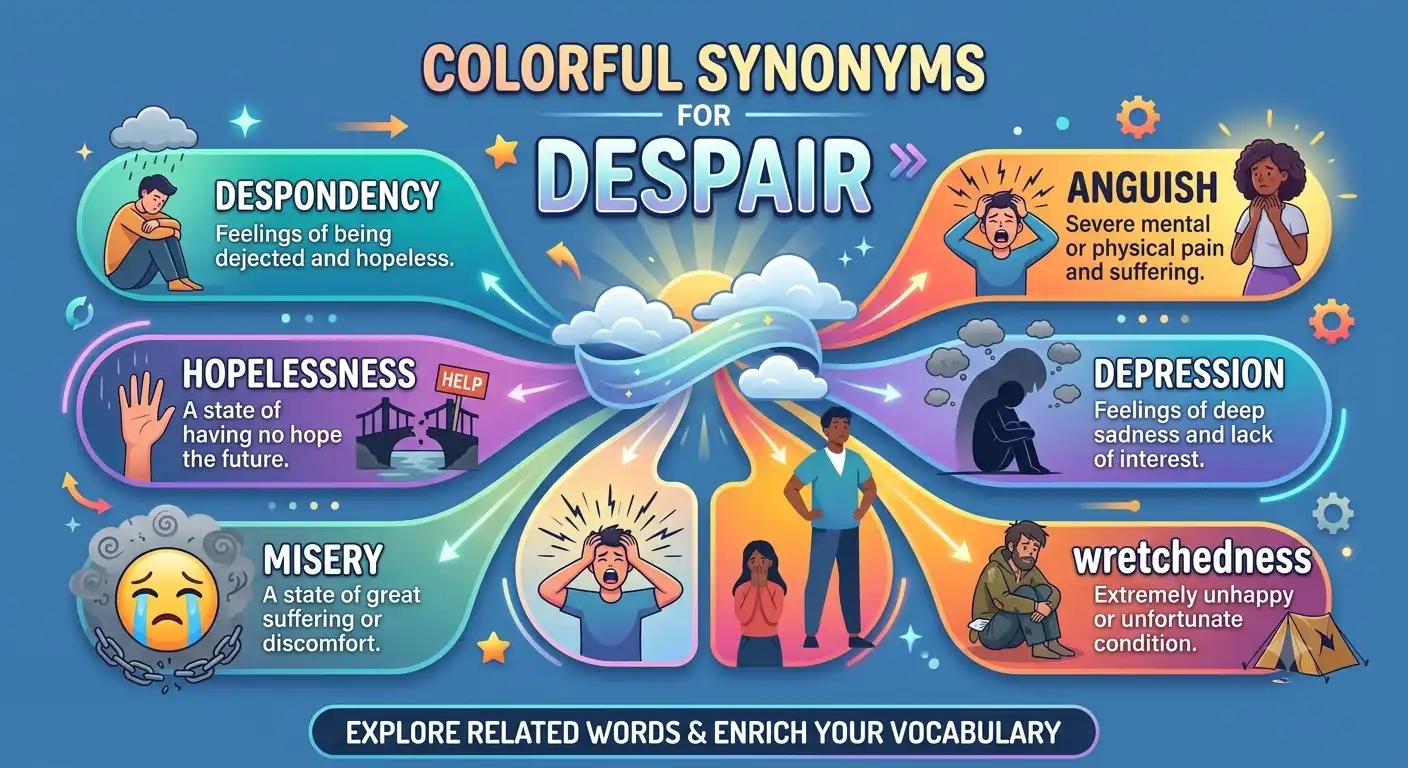
Learning exact synonyms for despair helps you express deep sadness and emotion with total confidence. When you use accurate synonyms for despair, you can easily explain difficult feelings, write rich stories, and share emotional moments. Knowing clear synonyms for despair keeps your vocabulary fresh and makes your writing stand out.
Imagine a student writing a short story about a lost sailor at sea. Repeating the word “despair” in every paragraph makes the story feel repetitive and plain. Switching to vivid choices like “hopelessness,” “gloom,” or “anguish” makes the story exciting, deep, and touching.
For instance, when someone loses a long sports match, saying they felt heavy sorrow explains the emotion right away. Using clear words like “grief” or “misery” helps readers picture the moment fast.
The word despair means a complete loss of hope or a feeling that things will never get better. Expanding your knowledge of synonyms for despair offers strong benefits for four key reader groups:
- Students describe dramatic book characters and history events clearly in class essays.
- Bloggers write moving personal stories and mental health articles that connect with readers.
- Content writers improve search rankings with natural, expressive phrasing.
- Daily English users share feelings smoothly during supportive chats with friends and family.
“Finding the right word transforms silent pain into shared understanding.”
“A strong vocabulary brings hope and clarity to our deepest emotional moments.”
Linguistic Breakdown of “Despair”
Connotative Meaning
The word despair carries heavy, sorrowful, serious, and tragic connotations. It signals a total absence of hope, deep emotional suffering, or a feeling of complete defeat.
Etymology
- Origin: Derived from Middle English despeir, coming from Old French despeir.
- Root Words: Traced back to Latin desperare (meaning to be hopeless), from de- (without) + sperare (to hope).
- Historical Shift: Shifted from a theological term for loss of faith to a general word for intense grief and loss of hope.
Pronunciation
- US (IPA): /dɪˈsper/
- UK (IPA): /dɪˈspeər/
Syllables & Affixation Pattern
- Syllables: 2 syllables (de-spair)
- Base Structure: Prefix de- + Root verb spair (from sperare)
- Grammatical Patterns:
- Noun form: Despair / Desperation
- Adjective form: Despairing / Desperate
- Verb form: Despair
Comparison Table: Common Synonyms for Despair
| Keyword | Meaning | Usage Type | Context |
| Hopelessness | A feeling that things will never improve | Deep / Emotional | Hard personal struggles & dark moments |
| Gloom | A dark state of mind or quiet sadness | Casual / Atmospheric | Rainy days, sad news, & bad moods |
| Anguish | Severe mental or physical pain | Tragic / Intense | Losing a loved one or big life shocks |
| Misery | A state of great suffering or discomfort | General / Everyday | Bad weather, illness, & long hard work |
| Melancholy | A gentle, long-lasting feeling of sadness | Expressive / Literary | Art, poetry, & quiet reflective moments |
| Desperation | Strong worry caused by a bad situation | Action-Oriented / Urgent | Emergencies, quick choices, & danger |
| Dejection | Low spirits caused by failure or rejection | Personal / Relatable | Test results, lost games, & missed chances |
50 Best Synonyms for Despair
1. Hopelessness
- Pronunciation: US /ˈhoʊp.ləs.nəs/ | UK /ˈhəʊp.ləs.nəs/
- Meaning: Hopelessness means feeling that good things will not happen in the future.
- Examples:
- The lost hiker felt a surge of hopelessness in the dark forest.
- She smiled to beat the feeling of hopelessness during the long wait.
2. Desperation
- Pronunciation: US /ˌdes.pəˈreɪ.ʃən/ | UK /ˌdes.pərˈeɪ.ʃən/
- Meaning: Desperation means feeling so worried that you will try anything to fix a bad situation.
- Examples:
- In pure desperation, he called his older brother for help.
- The hungry animal searched the yard with clear desperation.
3. Anguish
- Pronunciation: US /ˈæŋ.ɡwɪʃ/ | UK /ˈæŋ.ɡwɪʃ/
- Meaning: Anguish means extreme mental pain or deep suffering.
- Examples:
- The mother cried out in anguish after hearing the sad news.
- He felt deep anguish when his favorite dog ran away.
4. Gloom
- Pronunciation: US /ɡluːm/ | UK /ɡluːm/
- Meaning: Gloom means a feeling of dark sadness or low spirits.
- Examples:
- The stormy weather brought a mood of gloom to the house.
- His quiet face showed the gloom he felt inside.
5. Despondency
- Pronunciation: US /dɪˈspɑːn.dən.si/ | UK /dɪˈspɒn.dən.si/
- Meaning: Despondency means a low mood caused by a lack of hope.
- Examples:
- Months of job hunting led to a state of despondency.
- She tried to lift him out of his deep despondency.
6. Misery
- Pronunciation: US /ˈmɪz.ɚ.i/ | UK /ˈmɪz.ər.i/
- Meaning: Misery means great suffering or unhappy conditions.
- Examples:
- Cold rain added to the misery of the camping trip.
- He shared his story of rising above poverty and misery.
7. Agony
- Pronunciation: US /ˈæɡ.ə.ni/ | UK /ˈæɡ.ə.ni/
- Meaning: Agony means severe physical or emotional suffering.
- Examples:
- Waiting for the doctor’s report was total agony.
- Her heart was in agony after the hard goodbye.
8. Grief
- Pronunciation: US /ɡriːf/ | UK /ɡriːf/
- Meaning: Grief means deep sadness caused by losing someone special.
- Examples:
- The whole family felt great grief after the news.
- Time helps ease the sharp edge of grief.
9. Sorrow
- Pronunciation: US /ˈsɑːr.oʊ/ | UK /ˈsɒr.əʊ/
- Meaning: Sorrow means a strong feeling of sadness or regret.
- Examples:
- He expressed deep sorrow for his past mistakes.
- The sad songs filled the room with soft sorrow.
10. Depression
- Pronunciation: US /dɪˈpreʃ.ən/ | UK /dɪˈpreʃ.ən/
- Meaning: Depression means a long period of feeling very sad and lifeless.
- Examples:
- Regular walks helped her fight off seasonal depression.
- He spoke openly about his battle with depression.
11. Heartache
- Pronunciation: US /ˈhɑːrt.eɪk/ | UK /ˈhɑːt.eɪk/
- Meaning: Heartache means deep emotional pain or strong sadness.
- Examples:
- Moving away from old friends caused her real heartache.
- The movie tells a story of love and heartache.
12. Melancholy
- Pronunciation: US /ˈmel.ən.kɑː.li/ | UK /ˈmel.ən.kɒl.i/
- Meaning: Melancholy means a calm or thoughtful feeling of sadness.
- Examples:
- The old photo album brought back a wave of melancholy.
- Soft piano music often has a sweet melancholy sound.
13. Dejection
- Pronunciation: US /dɪˈdʒek.ʃən/ | UK /dɪˈdʒek.ʃən/
- Meaning: Dejection means sadness caused by disappointment or failure.
- Examples:
- He walked off the game field in total dejection.
- Her face showed dejection when the trip was canceled.
14. Wretchedness
- Pronunciation: US /ˈretʃ.ɪd.nəs/ | UK /ˈretʃ.ɪd.nəs/
- Meaning: Wretchedness means a state of being very unhappy, poor, or sick.
- Examples:
- The poor conditions filled the shelter with wretchedness.
- He felt the wretchedness of having no place to sleep.
15. Discouragement
- Pronunciation: US /dɪˈskɝː.ɪdʒ.mənt/ | UK /dɪˈskʌr.ɪdʒ.mənt/
- Meaning: Discouragement means a loss of confidence or enthusiasm.
- Examples:
- Do not let early mistakes lead to discouragement.
- Friendly words can heal a person’s discouragement.
16. Downheartedness
- Pronunciation: US /ˌdaʊnˈhɑːr.t̬ɪd.nəs/ | UK /ˌdaʊnˈhɑː.tɪd.nəs/
- Meaning: Downheartedness means a low and sad mood with little cheer.
- Examples:
- Her downheartedness disappeared when her friend arrived.
- He hid his downheartedness behind a quick smile.
17. Heartbreak
- Pronunciation: US /ˈhɑːrt.breɪk/ | UK /ˈhɑːt.breɪk/
- Meaning: Heartbreak means severe sorrow caused by a ruined relationship or big loss.
- Examples:
- The team suffered a painful heartbreak in the final match.
- She wrote a song about surviving her first heartbreak.
18. Sadness
- Pronunciation: US /ˈsæd.nəs/ | UK /ˈsæd.nəs/
- Meaning: Sadness means the general state of feeling unhappy or down.
- Examples:
- Tears filled his eyes with quiet sadness.
- We felt a brief sadness as summer came to an end.
19. Distress
- Pronunciation: US /dɪˈstres/ | UK /dɪˈstres/
- Meaning: Distress means great worry, pain, or danger.
- Examples:
- The lost puppy showed signs of clear distress.
- She called her mother to share her emotional distress.
20. Bleakness
- Pronunciation: US /ˈbliːk.nəs/ | UK /ˈbliːk.nəs/
- Meaning: Bleakness means a cold, empty, and hopeless feeling.
- Examples:
- The bleakness of the dark winter morning felt heavy.
- He worried about the bleakness of his job prospects.
21. Desolation
- Pronunciation: US /ˌdes.əˈleɪ.ʃən/ | UK /ˌdes.əˈleɪ.ʃən/
- Meaning: Desolation means a feeling of complete loneliness and misery.
- Examples:
- The empty house gave her a sense of desolation.
- He felt deep desolation after his best friend moved away.
22. Pessimism
- Pronunciation: US /ˈpes.ə.mɪ.zəm/ | UK /ˈpes.ɪ.mɪ.zəm/
- Meaning: Pessimism means expecting bad things to happen all the time.
- Examples:
- His constant pessimism made the project feel harder.
- Try to replace dark pessimism with positive action.
23. Torment
- Pronunciation: US /ˈtɔːr.ment/ | UK /ˈtɔː.ment/
- Meaning: Torment means strong mental or physical suffering.
- Examples:
- Worrying about the secret was pure torment for him.
- The loud noise caused torment to the sick man.
24. Woefulness
- Pronunciation: US /ˈwoʊ.fəl.nəs/ | UK /ˈwəʊ.fəl.nəs/
- Meaning: Woefulness means full of deep sorrow and unhappiness.
- Examples:
- The sad film left a feeling of woefulness in the room.
- Her woefulness showed in her quiet voice.
25. Mourning
- Pronunciation: US /ˈmɔːr.nɪŋ/ | UK /ˈmɔː.nɪŋ/
- Meaning: Mourning means showing sorrow for someone who has passed away.
- Examples:
- The town was in mourning after the accident.
- She wore black clothes during her week of mourning.
“Choosing exact emotion words gives power and grace to your story.”
26. Pain
- Pronunciation: US /peɪn/ | UK /peɪn/
- Meaning: Pain means a strong feeling of physical or emotional hurt.
- Examples:
- Rest helps body muscles heal from sharp pain.
- Kind words can soothe emotional pain quickly.
27. Suffering
- Pronunciation: US /ˈsʌf.ɚ.ɪŋ/ | UK /ˈsʌf.ər.ɪŋ/
- Meaning: Suffering means enduring physical or mental hardship.
- Examples:
- The hospital works to end patient suffering.
- She showed great courage despite her personal suffering.
28. Heavyheartedness
- Pronunciation: US /ˌhev.iˈhɑːr.t̬ɪd.nəs/ | UK /ˌhev.iˈhɑː.tɪd.nəs/
- Meaning: Heavyheartedness means feeling sad and weighed down by worry.
- Examples:
- He packed his bags with clear heavyheartedness.
- A warm drink eased her heavyheartedness a little bit.
29. Dismay
- Pronunciation: US /dɪˈsmeɪ/ | UK /dɪˈsmeɪ/
- Meaning: Dismay means sudden distress or shock caused by bad news.
- Examples:
- To our dismay, the morning flight was delayed.
- She looked at the ruined garden with dismay.
30. Unhappiness
- Pronunciation: US /ʌnˈhæp.i.nəs/ | UK /ʌnˈhæp.i.nəs/
- Meaning: Unhappiness means a feeling of not being glad or satisfied.
- Examples:
- Bad work hours caused unhappiness among workers.
- She spoke openly about her inner unhappiness.
31. Defeatism
- Pronunciation: US /dɪˈfiː.t̬ə.mɪ.zəm/ | UK /dɪˈfiː.tɪ.zəm/
- Meaning: Defeatism means expecting to fail before even trying.
- Examples:
- Avoid defeatism when tackling a tough test.
- His defeatism stopped him from joining the race.
32. Doldrums
- Pronunciation: US /ˈdoʊl.drəmz/ | UK /ˈdɒl.drəmz/
- Meaning: Doldrums means a state of low energy, dullness, or sadness.
- Examples:
- Winter weather often puts people in the doldrums.
- The local market woke up after months in the doldrums.
33. Gloominess
- Pronunciation: US /ˈɡluː.mi.nəs/ | UK /ˈɡluː.mi.nəs/
- Meaning: Gloominess means a dark or sad quality in a place or person.
- Examples:
- Bright lighting removed the gloominess of the basement.
- His gloominess made everyone in the car quiet.
34. Melancholia
- Pronunciation: US /ˌmel.ənˈkoʊ.li.ə/ | UK /ˌmel.ənˈkəʊ.li.ə/
- Meaning: Melancholia means a deep, long-lasting state of dark sadness.
- Examples:
- The artist painted portraits filled with melancholia.
- Old stories often carry a touch of melancholia.
35. Affliction
- Pronunciation: US /əˈflɪk.ʃən/ | UK /əˈflɪk.ʃən/
- Meaning: Affliction means something that causes heavy pain or trouble.
- Examples:
- Poverty is a tough affliction for many small towns.
- He faced his health affliction with strong patience.
36. Regret
- Pronunciation: US /rɪˈɡret/ | UK /rɪˈɡret/
- Meaning: Regret means sadness over something you did or failed to do.
- Examples:
- She felt regret for shouting at her little brother.
- He left the meeting without any single regret.
37. Disconsolation
- Pronunciation: US /ˌdɪs.kɑːn.səˈleɪ.ʃən/ | UK /ˌdɪs.kɒn.səˈleɪ.ʃən/
- Meaning: Disconsolation means sadness so deep that nothing can comfort you.
- Examples:
- The child wept in complete disconsolation after losing his toy.
- News of the loss caused total disconsolation.
38. Glumness
- Pronunciation: US /ˈɡlʌm.nəs/ | UK /ˈɡlʌm.nəs/
- Meaning: Glumness means a quiet, moody state of unhappiness.
- Examples:
- A cloud of glumness hung over the defeated team.
- She shook off her glumness with a short walk.
39. Tribulation
- Pronunciation: US /ˌtrɪb.jəˈleɪ.ʃən/ | UK /ˌtrɪb.jəˈleɪ.ʃən/
- Meaning: Tribulation means a great trouble, test, or painful experience.
- Examples:
- The pioneers survived years of heavy tribulation.
- Every life faces moments of joy and tribulation.
40. Bitterness
- Pronunciation: US /ˈbɪt̬.ɚ.nəs/ | UK /ˈbɪt.ə.nəs/
- Meaning: Bitterness means anger and sadness caused by unfair treatment.
- Examples:
- Forgiveness helped her release her inner bitterness.
- He spoke about his old job without any bitterness.
41. Forlornness
- Pronunciation: US /fɚˈlɔːrn.nəs/ | UK /fəˈlɔːn.nəs/
- Meaning: Forlornness means a lonely, abandoned, and sad state.
- Examples:
- The abandoned house had an air of forlornness.
- Her forlornness moved her friends to give her a hug.
42. Crestfallenness
- Pronunciation: US /ˈkrestˌfɑː.lən.nəs/ | UK /ˈkrestˌfɔː.lən.nəs/
- Meaning: Crestfallenness means feeling suddenly sad and disappointed.
- Examples:
- His crestfallenness showed when he saw the test score.
- She hid her crestfallenness behind a quick bow.
43. Weariness
- Pronunciation: US /ˈwɪr.i.nəs/ | UK /ˈwɪə.ri.nəs/
- Meaning: Weariness means deep tiredness of mind or body from long struggle.
- Examples:
- A sense of weariness settled over the late night workers.
- Good sleep cures physical weariness fast.
44. Disquiet
- Pronunciation: US /dɪsˈkwaɪ.ət/ | UK /dɪsˈkwaɪ.ət/
- Meaning: Disquiet means a feeling of worry, anxiety, or lack of peace.
- Examples:
- Rumors of budget cuts created disquiet in the office.
- She felt a strange disquiet before entering the room.
45. Heart-heaviness
- Pronunciation: US /hɑːrt ˈhev.i.nəs/ | UK hɑːt ˈhev.i.nəs/
- Meaning: Heart-heaviness means carrying a heavy emotional load inside.
- Examples:
- He left his old hometown with real heart-heaviness.
- A warm smile can lighten someone’s heart-heaviness.
46. Dreariness
- Pronunciation: US /ˈdrɪr.i.nəs/ | UK /ˈdrɪə.ri.nəs/
- Meaning: Dreariness means a dull, gloomy, and depressing feeling.
- Examples:
- Bright curtains removed the dreariness of the room.
- Rain added to the dreariness of the quiet afternoon.
47. Sullenness
- Pronunciation: US /ˈsʌl.ən.nəs/ | UK /ˈsʌl.ən.nəs/
- Meaning: Sullenness means silent anger and dark unhappiness.
- Examples:
- The teenager answered his parents with sullenness.
- Her sullenness dissolved once her dog jumped on her lap.
48. Brokenness
- Pronunciation: US /ˈbroʊ.kən.nəs/ | UK /ˈbrəʊ.kən.nəs/
- Meaning: Brokenness means a state of feeling crushed or emotionally hurt.
- Examples:
- Kind words helped him heal his deep brokenness.
- She wrote stories about overcoming personal brokenness.
49. Blackness
- Pronunciation: US /ˈblæk.nəs/ | UK /ˈblæk.nəs/
- Meaning: Blackness means a deep dark mood or total absence of hope.
- Examples:
- Sunlight broke through the emotional blackness of the day.
- He described his worst days as a period of blackness.
50. Lowliness
- Pronunciation: US /ˈloʊ.li.nəs/ | UK /ˈləʊ.li.nəs/
- Meaning: Lowliness means feeling humble, low in spirits, or small.
- Examples:
- He spoke with lowliness after making his mistake.
- Her lowliness made her gentle toward other hurting people.
Antonyms of “Despair”
Knowing opposite words helps you describe hope, joy, and emotional recovery accurately.
- Hope: A strong feeling of desire and expectation for good things.
- Optimism: A bright habit of expecting the best outcome in all things.
- Joy: A deep feeling of great happiness and delight.
- Elation: A state of proud joy and high excitement.
- Cheerfulness: A bright, happy, and positive attitude toward life.
- Confidence: Trust in yourself, your future, and your abilities.
- Peace: A calm state of mind free from worry and distress.
Prototype Meaning & Categorization of “Despair”
The main idea of despair centers on loss of hope, emotional pain, gloom, and deep sorrow. Depending on your context, these 50 synonyms divide into four main groups:
- Total Loss of Hope: Hopelessness, desperation, despondency, pessimism, defeatism, bleakness, desolation, blackness.
- Sharp Emotional Pain & Shock: Anguish, agony, heartbreak, heartache, torment, distress, affliction, tribulation, disconsolation, brokenness, pain, suffering.
- Sadness & Low Spirits: Gloom, misery, grief, sorrow, depression, melancholy, dejection, sadness, woefulness, mourning, heavyheartedness, unhappiness, doldrums, gloominess, melancholia, glumness, forlornness, crestfallenness, heart-heaviness, dreariness, sullenness, lowliness.
- Worry, Fatigue & Disappointment: Wretchedness, discouragement, downheartedness, dismay, regret, bitterness, weariness, disquiet.
Frequently Asked Questions (FAQs)
1. What is the most common formal synonym for “despair” in essays?
In formal academic writing, terms like “hopelessness,” “despondency,” or “anguish” work best. They describe deep emotion clearly without sounding casual.
2. Is “despair” the exact same thing as “sadness”?
Not quite. “Sadness” is a general term for feeling down. “Despair” is much stronger because it means a complete loss of all hope.
3. Which synonym for “despair” works best in creative stories?
In creative writing, words like “melancholy,” “gloom,” “desolation,” or “anguish” create strong pictures and rich mood for readers.
4. Can I use “depression” as a direct synonym for “despair”?
Yes, in general writing, both mean deep unhappiness. However, “depression” can also mean a formal medical condition, while “despair” refers specifically to losing hope.
5. How does learning synonyms for “despair” help SEO content?
Using varied emotion terms prevents keyword overuse, satisfies different search queries, and keeps readers engaged on your website longer.
6. What is a good synonym for “despair” when describing a lost match?
When describing sports or games, use “dejection,” “heartbreak,” “dismay,” or “crestfallenness.”
Conclusion
Expanding your collection of synonyms for despair brings emotional power, variety, and clarity to your everyday writing. Replacing simple words with exact choices like hopelessness, anguish, melancholy, or dejection ensures your message connects deeply with every reader.
Whether you write student essays, publish personal blogs, draft stories, or chat with friends, using precise words builds real confidence. Varied vocabulary removes boring repetition and transforms simple lines into touching statements. Practice using these 50 synonyms today to share your thoughts with lasting strength.
“The right words help us share deep feelings with quiet strength.”
“Building your vocabulary brings light and truth to every sentence.”

Robert Hayes is an ESL educator and curriculum developer with over nine years of experience teaching English to beginners and intermediate learners across multiple countries ( Biography ).