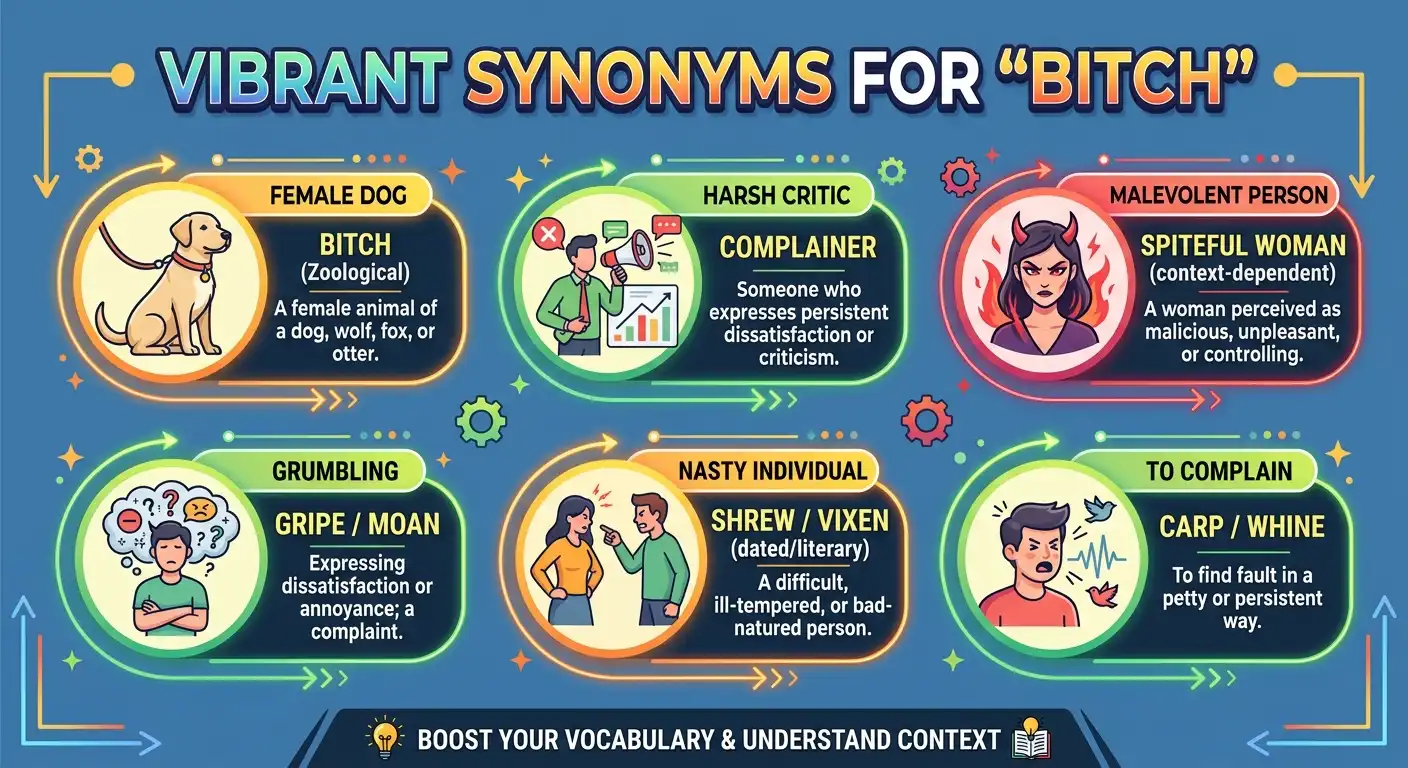
Finding accurate synonyms for bitch helps you express different ideas with total clarity and safety. When you learn context-specific synonyms for bitch, you can easily discuss animal terminology, daily complaints, and tough situations. Using clear synonyms for bitch upgrades your vocabulary and keeps your communication appropriate across all settings.
Imagine a dog breeder describing a purebred mother dog to a prospective buyer. If they use everyday slang instead of precise terms, the conversation might lead to confusion. Choosing clear alternatives like “female dog” or “canine” ensures the message stays professional and clear.
For example, when a complex project creates unexpected delays, someone might describe the task as a major hassle. Using precise alternatives like “headache” or “ordeal” helps your listeners understand your frustration right away without resorting to rude language.
The phrase synonyms for bitch refers to alternative words that replace the term in its literal canine sense, its informal verb form (to complain), or its noun forms (a tough situation or an ill-tempered person). Learning these options helps several reader groups:
- Students write precise biology papers and literary essays.
- Bloggers keep their online content friendly, clear, and family-safe.
- Content writers improve search rankings while adhering to web safety standards.
- Daily English users speak politely and confidently in everyday conversations.
“The right word turns confusing thoughts into clear, respectful expressions.”
“Expanding your vocabulary builds stronger communication and deeper confidence.”
Linguistic Breakdown of “Bitch”
Connotative Meaning
The term bitch carries multiple connotations depending on context: neutral and technical in animal biology (female canine); highly informal and unpleasant when used as a verb (to complain continuously); and severe or vulgar when used as a personal insult.
Etymology
- Origin: Derived from Old English bicce (meaning female dog).
- Proto-Germanic Root: From bikkjon (female canine).
- Historical Shift: Started purely as a zoological term for female dogs, wolves, and foxes, before shifting into informal slang for complaining in the 19th century.
Pronunciation
- US (IPA): /bɪtʃ/
- UK (IPA): /bɪtʃ/
Syllables & Affixation Pattern
- Syllables: 1 syllable (bitch)
- Base Structure: Monosyllabic noun/verb root
- Grammatical Patterns:
- Noun Form: A female dog / A difficult situation
- Verb Form: Bitches / Bitching / Bitched
- Adjective Form: Bitchy
Comparison Table: Common Synonyms for Bitch
| Keyword | Meaning | Usage Type | Context |
| Female dog | A mother or female canine animal | Formal / Technical | Veterinary Science, Breeding, & Pets |
| Complain | To express pain, grief, or discontent | Formal / Universal | Workplace, Customer Service, & Daily Life |
| Gripe | To complain about small things repeatedly | Informal / Conversational | Casual Talks, Friend Groups, & Work |
| Whine | To complain in a nagging, high tone | Informal / Casual | Parenting, School, & Daily Routine |
| Hassle | A situation causing trouble or difficulty | Informal / Conversational | Travel, Work Tasks, & Tech Problems |
| Ordeal | A very difficult or severe test | Formal / Expressive | Personal Challenges, History, & News |
| Vixen | A female fox or a sharp-tempered person | Literary / Descriptive | Nature Studies, Literature, & Stories |
15 Best Synonyms for Bitch
1. Female Dog
- Pronunciation: US /ˈfiː.meɪl dɑːɡ/ | UK /ˈfiː.meɪl dɒɡ/
- Meaning: A female dog is a mother or female canine animal.
- Examples:
- The female dog cared for her four small puppies.
- Our vet checked the female dog during her morning visit.
2. Complain
- Pronunciation: US /kəmˈpleɪn/ | UK /kəmˈpleɪn/
- Meaning: Complain means to express unhappiness or dissatisfaction about something.
- Examples:
- Customers often complain when the train arrives late.
- He did not complain about the long walk home.
3. Gripe
- Pronunciation: US /ɡraɪp/ | UK /ɡraɪp/
- Meaning: Gripe means to complain naggingly about minor problems.
- Examples:
- Workers sometimes gripe about rainy morning commute delays.
- She listened quietly while her friend started to gripe.
4. Whine
- Pronunciation: US /waɪn/ | UK /waɪn/
- Meaning: Whine means to complain in an annoying or high-pitched tone.
- Examples:
- Tired children whine when they need an afternoon nap.
- Please do not whine about your daily chores.
5. Grumble
- Pronunciation: US /ˈɡrʌm.bəl/ | UK /ˈɡrʌm.bəl/
- Meaning: Grumble means to utter low, quiet complaints in discontent.
- Examples:
- The hungry players grumble when dinner is delayed.
- He began to grumble about the cold winter weather.
6. Hassle
- Pronunciation: US /ˈhæs.əl/ | UK /ˈhæs.əl/
- Meaning: Hassle means a situation that causes unwanted trouble or bother.
- Examples:
- Fixing the flat tire was a big hassle today.
- Shopping online saves you from traffic hassle.
“Choosing accurate words helps you share feelings without causing offense.”
7. Ordeal
- Pronunciation: US /ɔːrˈdiːl/ | UK /ɔːˈdiːl/
- Meaning: Ordeal means a very painful, difficult, or severe experience.
- Examples:
- Surviving the stormy flight was a scary ordeal.
- The long exam week proved to be a tough ordeal.
8. Headache
- Pronunciation: US /ˈhed.eɪk/ | UK /ˈhed.eɪk/
- Meaning: Headache means a persistent problem or source of worry.
- Examples:
- Sorting these old financial tax files is a total headache.
- Bad software updates created a major headache for staff.
9. Nag
- Pronunciation: US /næɡ/ | UK /næɡ/
- Meaning: Nag means to annoy someone by asking them repeatedly to do something.
- Examples:
- Parents often nag kids to clean their bedrooms.
- I do not want to nag you about the homework.
10. Scold
- Pronunciation: US /skoʊld/ | UK /skəʊld/
- Meaning: Scold means to criticize someone angrily for wrong behavior.
- Examples:
- The teacher had to scold the noisy class room.
- She will scold anyone who drops trash outside.
11. Vixen
- Pronunciation: US /ˈvɪk.sən/ | UK /ˈvɪk.sən/
- Meaning: Vixen means a female fox or a fiery, sharp-tempered person.
- Examples:
- The wild red vixen guarded her den near the forest.
- Novel authors often write stories featuring a fiery vixen.
12. Shrew
- Pronunciation: US /ʃruː/ | UK /ʃruː/
- Meaning: Shrew means an ill-tempered, nagging person in classic literature.
- Examples:
- Shakespeare wrote a famous play about taming a shrew.
- Old stories described the grumpy character as a shrew.
13. Criticize
- Pronunciation: US /ˈkrɪt̬.ə.saɪz/ | UK /ˈkrɪt.ɪ.saɪz/
- Meaning: Criticize means to point out faults or mistakes in something.
- Examples:
- Reviewers tend to criticize movies with weak story lines.
- It is easy to criticize when you do not help.
14. Moan
- Pronunciation: US /moʊn/ | UK /məʊn/
- Meaning: Moan means to make a sound showing grief or annoyance.
- Examples:
- Students moan when extra weekend reading is assigned.
- He began to moan about his sore muscles after running.
15. Nuisance
- Pronunciation: US /ˈnuː.səns/ | UK /ˈnjuː.səns/
- Meaning: Nuisance means a person, thing, or situation causing inconvenience.
- Examples:
- Loud street construction is a real neighborhood nuisance.
- Losing your front door key is a major nuisance.
Antonyms of “Bitch”
Knowing opposite terms helps you express praise, satisfaction, ease, and positive traits clearly.
- Praise: Expressing warm approval or admiration.
- Compliment: A polite expression of praise or congratulations.
- Delight: A high degree of gratification or pleasure.
- Breeze: A task or job that is very easy to finish.
- Male dog: A male canine animal (stud or dog).
- Pleasure: A feeling of happy satisfaction and enjoyment.
Prototype Meaning & Categorization of “Bitch”
The term bitch carries different meanings based on animal terminology, expressions of discontent, difficult situations, and character descriptions. These 15 synonyms split into four main categories:
- Canine & Biological Terms: Female dog, vixen.
- Verbs for Complaining & Criticizing: Complain, gripe, whine, grumble, nag, scold, criticize, moan.
- Difficult & Annoying Situations: Hassle, ordeal, headache, nuisance.
- Literary Character Types: Shrew, vixen.
Frequently Asked Questions (FAQs)
1. What is the literal dictionary definition of “bitch”?
The literal zoological definition of the word is a female dog, female wolf, or female fox.
2. What is the best polite synonym for “bitch” when referring to complaining?
When replacing the verb form in polite speech, words like “complain,” “gripe,” or “express discontent” work best.
3. Which synonym should I use for a difficult task or problem?
For a hard task, use terms like “headache,” “hassle,” “ordeal,” or “nuisance.”
4. Why should writers use alternatives for informal slang?
Using alternatives maintains professional tone, prevents audience offense, ensures compliance with website content policies, and improves writing quality.
5. What is the proper literary term for a female fox?
The exact word for a female fox is “vixen.”
6. How does learning these synonyms improve SEO?
Using safe, accurate synonyms helps web content rank for varied user intents without triggering safe-search filters or policy violations.
Conclusion
Expanding your knowledge of synonyms for bitch gives you clean, effective, and polite choices for every context. Swapping out informal or rude terms with exact words like female dog, complain, hassle, or ordeal ensures your message remains strong, clear, and universally acceptable.
Whether you write academic papers, publish online blogs, send professional workplace emails, or chat with friends, using precise vocabulary builds instant respect. Clear language removes unnecessary offense and transforms basic thoughts into impactful communication. Practice these 15 synonyms today to master polite English in any environment.
“Polite and precise word choices turn everyday communication into effective dialogue.”
“Mastering flexible vocabulary gives your voice authority and lasting clarity.”
“Smart writers choose exact terms to match their true intent.”

Robert Hayes is an ESL educator and curriculum developer with over nine years of experience teaching English to beginners and intermediate learners across multiple countries ( Biography ).