Do you often repeat the word logic in your writing and feel stuck finding better alternatives? Many ESL learners face this exact problem. You want your sentences to sound natural, clear, and academic—but using the same word again and again weakens your writing.
In this guide, you’ll learn the most useful synonyms for logic, along with simple meanings, examples, and practical tips you can use immediately. Whether you are preparing for IELTS, writing essays, or improving everyday English, choosing the right synonym can make your ideas sound more precise and professional.
At Synonymlabz.com, we focus on helping beginners like you understand vocabulary in a simple way. By the end of this article, you’ll not only know multiple alternatives to logic, but also understand when to use each one—and when not to.
Quick Answer:
The best synonyms for logic include reasoning, rationality, sense, coherence, and analysis. These words all relate to clear thinking and structured ideas, but each has a slightly different meaning depending on context. Choosing the right synonym helps make your writing more natural and effective, especially in academic and ESL contexts.
What Does “Logic” Mean?
Logic means clear and correct thinking. It is the ability to understand ideas in a structured and reasonable way.
In simple terms:
- Logic helps you connect ideas clearly
- It ensures your arguments make sense
- It avoids confusion and contradiction
ESL Note:
Think of logic as “thinking in a smart and organized way.”
In academic writing, logic is essential. According to IELTS band descriptors, higher scores require “clear progression of ideas,” which is directly connected to logical thinking.
Complete Synonyms List
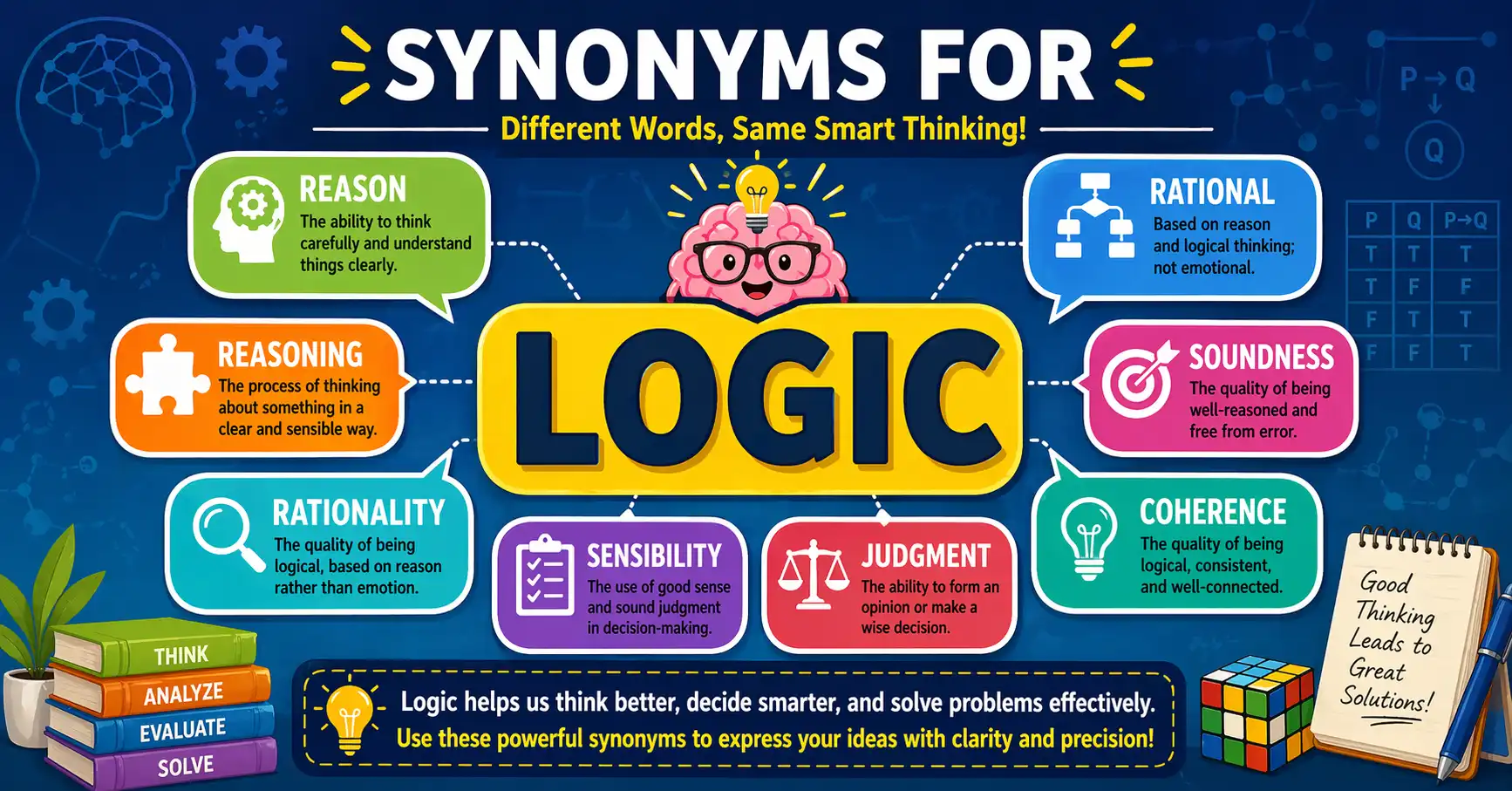
Here are the most common and useful synonyms for logic you can use:
- Reasoning
- Rationality
- Sense
- Understanding
- Analysis
- Coherence
- Judgment
- Thinking
- Intellect
- Clarity
- Sound thinking
- Consistency
ESL Note:
Not all synonyms are equal. Some are formal (used in essays), while others are informal (used in conversation).
Comparison Table
| Word | Simple Meaning | Best Used When | Avoid When |
| Logic | Clear thinking | General use | Repetition |
| Reasoning | Process of thinking | Explaining ideas | Casual talk |
| Rationality | Logical thinking | Academic writing | Informal speech |
| Sense | Practical thinking | Everyday English | Formal essays |
| Analysis | Deep thinking | Academic tasks | Simple ideas |
| Coherence | Logical flow | Essays | Casual use |
| Judgment | Decision ability | Opinions | Technical writing |
| Clarity | Clear ideas | Writing structure | Abstract thinking |
Formal vs Informal Synonyms
| Formal Synonyms | Informal Synonyms |
| Rationality | Sense |
| Analysis | Thinking |
| Coherence | Common sense |
| Reasoning | Clear thinking |
| Consistency | Good judgment |
ESL Note:
Use formal synonyms in IELTS essays and assignments. Use informal ones in speaking or casual writing.
Real Example Sentences
Here are practical examples using synonyms for logic:
- Her reasoning was strong and easy to follow.
- The argument lacked rationality and confused readers.
- That idea doesn’t make sense to me.
- Good writing requires clear analysis of the topic.
- The essay shows strong coherence between paragraphs.
- His judgment was based on facts, not emotions.
- Clear thinking helps you avoid mistakes.
- The explanation lacked clarity, so students struggled.
IELTS Tip:
Examiners look for variety in vocabulary. Using different synonyms instead of repeating “logic” can improve your Lexical Resource score.
When to Use vs When NOT to Use
When to Use Synonyms for Logic
Use these alternatives when:
- You repeat “logic” too often
- You want more precise meaning
- You are writing academic essays
- You need to explain thinking processes
When NOT to Use Them
Avoid replacing logic when:
- The original meaning is very specific
- The synonym changes the tone
- You are unsure about the word’s meaning
ESL Note:
If you are not confident, it is better to use logic correctly than use the wrong synonym.
Common Mistakes Writers Make
Many ESL learners misuse synonyms. Here are the most common errors:
1. Using Formal Words in Casual Contexts
❌ “Your rationality is wrong.”
✔ “That doesn’t make sense.”
2. Confusing Meaning Differences
- Analysis ≠ Logic
- Judgment ≠ Reasoning
3. Overusing Difficult Words
Writers often try to sound “advanced” but create unnatural sentences.
4. Ignoring Context
Each synonym works in a specific situation.
In our experience helping writers:
Students improve faster when they focus on correct usage, not just memorizing lists.
Tips and Best Practices
Here are practical ways to master synonyms for logic:
1. Learn Words in Context
Do not memorize alone. Always see example sentences.
2. Practice Substitution
Take a sentence and replace “logic” with different synonyms.
3. Focus on IELTS Writing
Use:
- Reasoning
- Coherence
- Analysis
These are highly valued in academic scoring.
4. Keep It Simple
Simple, clear English is better than complex mistakes.
5. Build Vocabulary Slowly
Learn 2–3 synonyms at a time and use them daily.
Frequently Asked Questions
Q: What is the best synonym for logic in essays?
A: The best synonym depends on context, but reasoning, coherence, and analysis are ideal for academic essays. They clearly express structured thinking and are commonly used in IELTS and formal writing tasks.
Q: Can I use “sense” instead of logic?
A: Yes, but only in informal contexts. “Sense” is more natural in everyday conversation, while “logic” or “reasoning” works better in formal writing like essays or reports.
Q: What is the difference between logic and reasoning?
A: Logic refers to correct thinking overall, while reasoning is the process used to reach conclusions. In writing, reasoning explains how you arrive at your ideas step by step.
Q: Is “analysis” a synonym for logic?
A: Not exactly. Analysis is a deeper process of examining details. It relates to logic but focuses more on breaking down information rather than general thinking patterns.
Q: How can I improve logical writing in English?
A: Practice organizing ideas clearly, use linking words, and choose accurate vocabulary. Reading academic examples and writing regularly also helps improve logical flow and clarity.
Q: Are synonyms for logic important in IELTS?
A: Yes. IELTS rewards vocabulary variety. Using correct synonyms like reasoning or coherence improves your Lexical Resource score and shows better control of academic English.
CONCLUSION
Learning the right synonyms for logic can greatly improve your writing clarity and variety. Words like reasoning, coherence, and analysis help you express ideas more precisely, Synonyms for Logic (2026 Guide for ESL Writers)especially in academic and IELTS contexts.
Remember, the goal is not to use difficult words—but to use the right words correctly. Start small, practice regularly, and focus on meaning and context.
You might also want to read our guide on synonyms for thinking to build your vocabulary further.
Keep practicing—you’re improving with every sentence you write.

Robert Hayes is an ESL educator and curriculum developer with over nine years of experience teaching English to beginners and intermediate learners across multiple countries ( Biography ).