Do you often use the word reaction in your writing but feel it sounds repetitive? You’re not alone. Many ESL learners struggle to find the right alternatives, especially when writing essays, emails, or exam answers. Using the same word again and again can make your writing feel basic and less engaging.
In this guide, you will learn a wide range of synonyms for reaction that are easy to understand and use. Whether you are preparing for an English test, improving your vocabulary, or writing better sentences, this article will help you choose the right word in the right context.
You will also see clear examples, simple explanations, and helpful tips based on real ESL teaching experience. By the end, you will feel more confident using different words instead of repeating reaction.
Quick Answer:
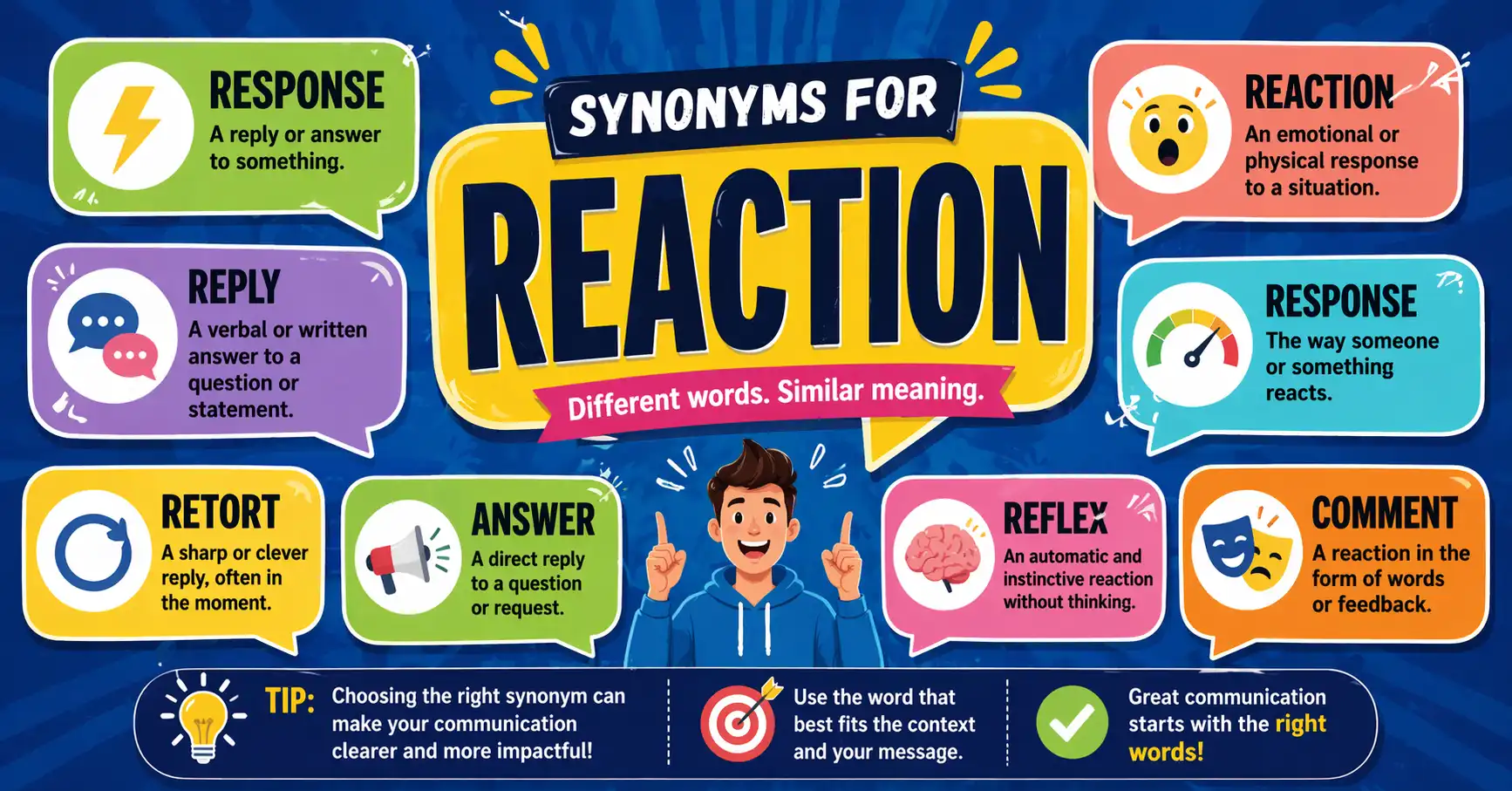
The most common synonyms for “reaction” include response, reply, answer, feedback, and response. These words describe how someone behaves or speaks after something happens. The best choice depends on context—formal writing often prefers response, while casual English may use reply or reaction itself.
What Does “Reaction” Mean?
The word reaction means how someone responds to something. It can be emotional, physical, or verbal.
Simple Definition:
- A reaction is what you do, feel, or say after something happens.
Examples:
- Her reaction to the news was surprising.
- The chemical reaction caused a color change.
👉 In ESL learning, reaction is commonly used in both speaking and writing, but overusing it can lower your vocabulary score in exams like IELTS.
Complete Synonyms List
Here are common and useful synonyms for reaction:
- Response
- Reply
- Answer
- Feedback
- Outcome
- Effect
- Result
- Reflex
- Impression
- Behavior
- Repercussion
ESL Note:
Some words like effect and result are not exact synonyms but are used in similar contexts. Always check the meaning before using them.
Comparison Table
| Word | Simple Meaning | Best Used When | Avoid When |
| Response | A general answer or action | Formal writing, essays | Casual speech |
| Reply | A spoken or written answer | Emails, conversations | Academic essays |
| Feedback | Opinion or evaluation | Work, school, reviews | Emotional situations |
| Result | What happens after something | Reports, explanations | Emotional reactions |
| Effect | A change caused by something | Science or analysis | Personal feelings |
| Reflex | Automatic action | Science or biology | General conversation |
Formal vs Informal Synonyms
| Formal Words | Informal Words |
| Response | Reply |
| Feedback | Reaction |
| Outcome | Result |
| Repercussion | Comeback |
ESL Note:
Use formal words in exams and academic writing. Use informal words in speaking or casual writing.
Real Example Sentences
Here are examples to help you understand how to use these synonyms:
- His response to the question was clear and direct.
- I didn’t get a reply to my email.
- The teacher gave helpful feedback on my essay.
- The result of the experiment was unexpected.
- Her reaction to the movie was emotional.
- The medicine had a strong effect on him.
- The child showed a quick reflex when touched.
- Their response to the crisis was immediate.
ESL Tip:
In our experience helping writers, students improve faster when they rewrite sentences using different synonyms. Try replacing reaction in your own sentences with at least three alternatives.
When to Use vs When NOT to Use
When to Use Synonyms for Reaction:
Use different words when:
- You want to avoid repetition
- You are writing essays or reports
- You need more precise meaning
When NOT to Use:
Do NOT replace reaction when:
- The meaning changes (e.g., effect vs emotional reaction)
- You are unsure of the synonym
- Simpler English is better (especially for beginners)
ESL Note:
According to academic writing standards, clarity is more important than complexity. Do not use difficult words if you are not confident.
Common Mistakes Writers Make
Here are common errors ESL learners make:
1. Using the Wrong Context
- ❌ “His feedback was emotional.”
- ✔ “His reaction was emotional.”
2. Confusing “Effect” and “Reaction”
- Effect = result
- Reaction = response
3. Overusing One Synonym
Many learners replace reaction with only response. This reduces variety.
4. Using Informal Words in Formal Writing
- ❌ “His comeback was strong.” (essay)
- ✔ “His response was strong.”
ESL Note:
Writers we work with often lose marks in IELTS for incorrect word choice. Always check meaning carefully.
Tips and Best Practices
1. Learn Words in Context
Do not memorize lists. Learn how words are used in sentences.
2. Practice Rewriting
Take one sentence and rewrite it using different synonyms.
3. Keep It Simple
For ESL beginners, simple words are better than complex ones.
4. Use a Vocabulary Notebook
Write new words with meanings and examples.
5. Focus on IELTS Writing
Using varied vocabulary can improve your score, especially for Task 2 essays.
ESL Tip:
Try this exercise: Write one paragraph using reaction, then rewrite it using response, feedback, and result. This builds flexibility.
Frequently Asked Questions
Q1: What is the best synonym for reaction in essays?
A: The best synonym is usually response. It is formal, clear, and widely accepted in academic writing. It fits most contexts and helps improve vocabulary scores in exams like IELTS without sounding too complex or confusing.
Q2: Are reaction and response the same?
A: They are similar but not always identical. Reaction often shows emotion, while response is more neutral and formal. In essays, response is preferred because it sounds more academic and precise.
Q3: Can I use “feedback” instead of reaction?
A: Yes, but only in specific contexts. Feedback means giving opinions or evaluation. It is not suitable for emotional or physical reactions. Use it mainly in work, school, or review situations.
Q4: Is “result” a synonym for reaction?
A: Not exactly. Result refers to what happens after something, while reaction is how someone responds. They can sometimes overlap, but they are not always interchangeable in every sentence.
Q5: Which synonym is easiest for ESL beginners?
A: The easiest words are response and reply. They are simple, commonly used, and easy to understand. Beginners should focus on these before learning more complex synonyms like repercussion or reflex.
Q6: How can I remember synonyms for reaction?
A: Practice regularly by writing sentences and reading English texts. Use a notebook to record new words. Repetition and real usage help memory. Also, try using each synonym in speaking and writing exercises.
Conclusion
Learning synonyms for reaction helps you improve your vocabulary, avoid repetition, and write more clearly. Words like response, reply, and feedback are especially useful for ESL learners. Always choose the right word based on context, and keep your sentences simple and accurate.
In our experience teaching ESL students, consistent practice and real examples make the biggest difference. Keep practicing, and your confidence will grow.
You might also want to read our guide on synonyms for response to continue improving your vocabulary.

Robert Hayes is an ESL educator and curriculum developer with over nine years of experience teaching English to beginners and intermediate learners across multiple countries ( Biography ).