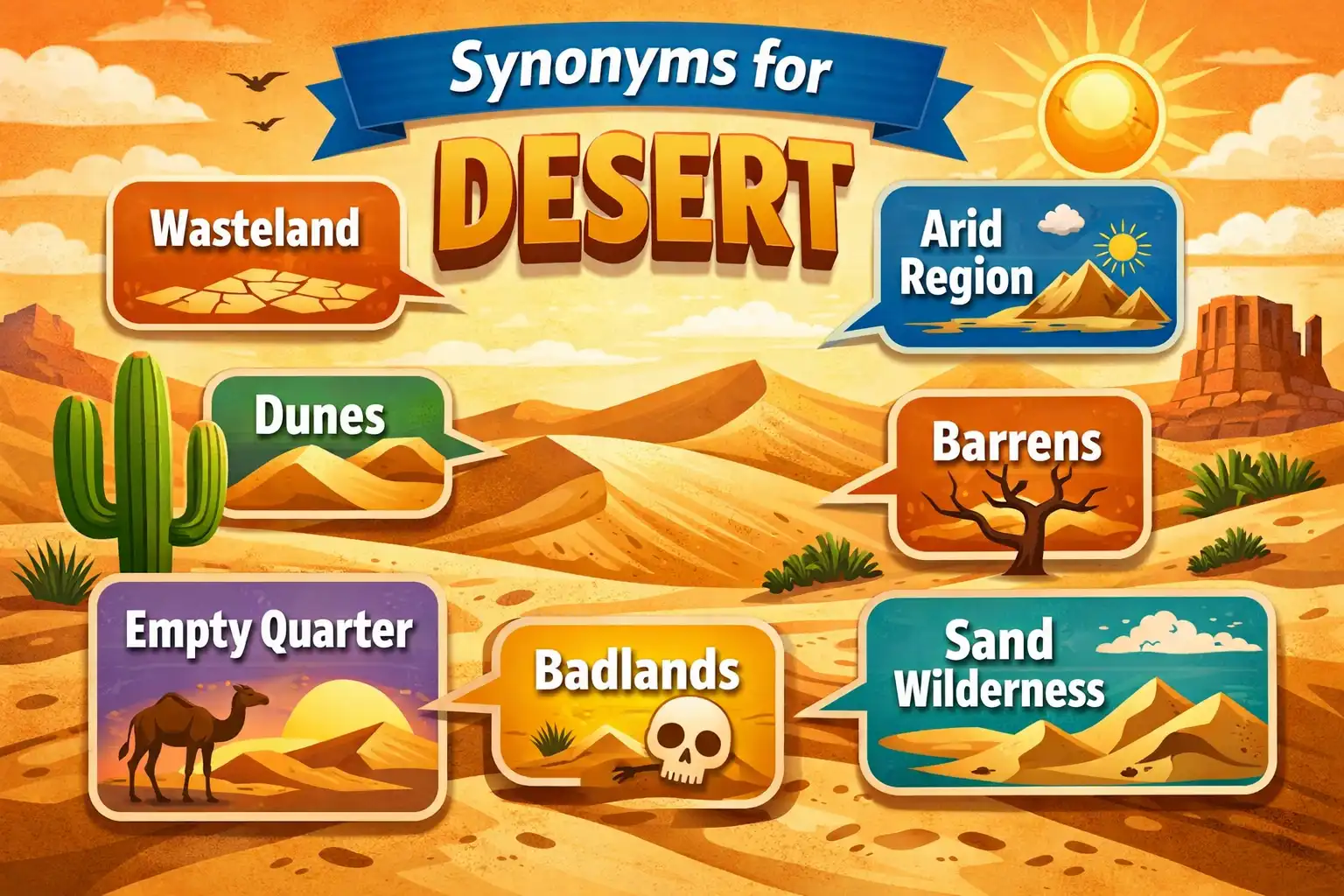
When you picture a desert, your mind probably goes straight to endless sand dunes, scorching heat, and a glaring sun. But did you know that the word desert has multiple meanings? It can describe a dry, sandy wasteland, or it can mean leaving someone behind in a time of need. Finding the right synonyms for desert can completely transform your writing, whether you are describing a beautiful landscape or a lonely feeling.
“Words have the power to turn a barren landscape into a vivid masterpiece of human emotion.”
Imagine a writer trying to describe a character lost in an empty, dry land. If they keep repeating the word desert, the story feels dry too! Using diverse synonyms for desert helps you paint a much clearer picture for your audience. A desert is simply a large, dry area of land with very little water or plants. It can also mean running away from a duty or abandoning a friend. Learning these new words is incredibly useful for students writing essays, bloggers creating vivid travel stories, content writers trying to capture a mood, and anyone who wants to speak daily English with more color and variety.
“To change your words is to change the very scenery of your mind.”
The Linguistics of Desert
Connotative Meaning of Desert
While the literal meaning is a dry place, the emotional weight or connotation of a desert often involves loneliness, isolation, survival, emptiness, and harsh beauty. When used as a verb, it carries a heavy connotation of betrayal, abandonment, and disloyalty.
Etymology of Desert
- Origin: Derived from the Latin word desertus, which means “abandoned” or “lying waste.”
- Old French: Passed into Old French as desert before entering Middle English.
- Historical Shift: Originally meant any uninhabited place before specifically targeting dry, arid regions.
Linguistic Breakdown
- Syllables: des-ert (2 syllables)
- Affixation Pattern: Root word with no prefixes or suffixes (can take suffixes like -ed in deserted or -er in deserter).
- Pronunciation (Noun): US: /ˈdɛzərt/ | UK: /ˈdɛzət/
- Pronunciation (Verb): US: /dɪˈzɜrt/ | UK: /dɪˈzɜːt/
Quick Comparison of Key Terms
| Keyword | Meaning | Usage Type | Context |
|---|---|---|---|
| Desert | A dry, empty land or to leave someone behind. | Neutral / Flexible | Geography, daily stories, relationship issues. |
| Wasteland | An area of land that cannot be used for anything. | Emotional / Strong | Environmental damage, post-war scenes. |
| Arid | Having little or no rain; too dry for plants to grow. | Professional / Formal | Science reports, weather forecasts, geography. |
| Abandon | To leave a place or person forever. | Casual to Professional | Relationship breakups, leaving a sinking ship. |
| Barren | Land that is too poor to produce any vegetation. | Formal / Literary | Farming discussions, poetic writing. |
50 Creative Synonyms for Desert
1. Wasteland
- Pronunciation: US: /ˈweɪstˌlænd/ | UK: /ˈweɪstlænd/
- Meaning: A large area of empty land that is destroyed or ruined.
- Examples:
- The old factory site turned into a grey wasteland.
- Nothing grew in the cold wasteland after the fire.
2. Arid Region
- Pronunciation: US: /ˈærəd ˈriʤən/ | UK: /ˈærɪd ˈriːʤən/
- Meaning: A specific geographic area that gets almost no rain.
- Examples:
- Cacti thrive beautifully in this arid region.
- Animals must adapt to survive in an arid region.
3. Wilderness
- Pronunciation: US: /ˈwɪldərnəs/ | UK: /ˈwɪldənəs/
- Meaning: A wild and natural area where no people live.
- Examples:
- They got lost in the vast mountain wilderness.
- We love exploring the quiet wilderness every summer.
4. Barren Land
- Pronunciation: US: /ˈbærən lænd/ | UK: /ˈbærən lænd/
- Meaning: Dry ground where plants simply cannot grow.
- Examples:
- The farmer looked sadly at his barren land.
- Rocks covered the empty, barren land for miles.
5. Sahara
- Pronunciation: US: /səˈhærə/ | UK: /səˈhɑːrə/
- Meaning: A massive sand desert used to describe any hot place.
- Examples:
- The playground felt like a hot Sahara in July.
- Our local beach looks like a miniature Sahara.
6. Solitude
- Pronunciation: US: /ˈsɑləˌtud/ | UK: /ˈsɒlɪtjuːd/
- Meaning: A lonely, empty state that mimics an empty place.
- Examples:
- He sought the peaceful solitude of the deep woods.
- The empty house offered her a quiet solitude.
7. Dust Bowl
- Pronunciation: US: /dʌst boʊl/ | UK: /dʌst bəʊl/
- Meaning: A dry area where wind blows the loose dirt away.
- Examples:
- The dry farm became a miserable dust bowl.
- Strong winds created a massive dust bowl yesterday.
8. Sand Dunes
- Pronunciation: US: /sænd dunz/ | UK: /sænd djuːnz/
- Meaning: Hills of loose sand formed by the blowing wind.
- Examples:
- We took pictures on top of the golden sand dunes.
- The wind constantly shapes the tall sand dunes.
9. Badlands
- Pronunciation: US: /ˈbædˌlændz/ | UK: /ˈbædlændz/
- Meaning: Dry terrain with sharp rocks and eroded hills.
- Examples:
- The travelers slowly rode horses through the badlands.
- Very few roads cross through the rocky badlands.
10. Empty Space
- Pronunciation: US: /ˈɛmpti speɪs/ | UK: /ˈɛmpti speɪs/
- Meaning: A location containing absolutely nothing inside it.
- Examples:
- The fields were just a giant empty space.
- I looked out at the cold, empty space.
11. Abandon
- Pronunciation: US: /əˈbændən/ | UK: /əˈbændən/
- Meaning: To walk away from a person or place completely.
- Examples:
- Please do not abandon your pets on the street.
- The sailors had to abandon the broken ship.
12. Forsake
- Pronunciation: US: /fɔrˈseɪk/ | UK: /fəˈseɪk/
- Meaning: To leave someone you love alone in trouble.
- Examples:
- A true friend will never forsake you.
- He promised to never forsake his family duties.
13. Strand
- Pronunciation: US: /strænd/ | UK: /strænd/
- Meaning: To leave someone stuck in a helpless position.
- Examples:
- The missed bus will strand us at school.
- The storm might strand travelers at the airport.
14. Maroon
- Pronunciation: US: /məˈrun/ | UK: /məˈruːn/
- Meaning: To leave someone isolated on a lonely island.
- Examples:
- The pirates chose to maroon the captain.
- High waters could maroon us in the cabin.
15. Quit
- Pronunciation: US: /kwɪt/ | UK: /kwɪt/
- Meaning: To stop doing a duty or leave a post.
- Examples:
- The guard decided to quit his night post early.
- You should never quit when things get tough.
16. Leave Behind
- Pronunciation: US: /liv bɪˈhaɪnd/ | UK: /liːv bɪˈhaɪnd/
- Meaning: To depart without taking an object or person.
- Examples:
- Do not leave behind your warm winter coat.
- We had to leave behind our broken old car.
17. Deserted Area
- Pronunciation: US: /dɪˈzɜrtəd ˈɛriə/ | UK: /dɪˈzɜːtɪd ˈeərɪə/
- Meaning: A place that no people live in anymore.
- Examples:
- The ghost town is a completely deserted area.
- We found an old house in a deserted area.
18. Jilt
- Pronunciation: US: /ʤɪlt/ | UK: /ʤɪlt/
- Meaning: To suddenly drop or reject a romantic partner.
- Examples:
- She decided to jilt her groom at the wedding.
- It is cruel to jilt someone without explaining why.
19. Clear Out
- Pronunciation: US: /klɪr aʊt/ | UK: /klɪər aʊt/
- Meaning: To empty a room or leave a place quickly.
- Examples:
- The students will clear out when school ends.
- We need to clear out the messy garage today.
20. Vacate
- Pronunciation: US: /ˈveɪkeɪt/ | UK: /vəˈkeɪt/
- Meaning: To leave a room or building completely empty.
- Examples:
- The guests must vacate the hotel room by noon.
- They had to vacate the building during the fire alarm.
21. Steer Clear
- Pronunciation: US: /stɪr klɪr/ | UK: /stɪə klɪə/
- Meaning: To actively avoid going near a specific place.
- Examples:
- You should steer clear of that swampy area.
- Smart animals steer clear of the hunter’s trap.
22. Void
- Pronunciation: US: /vɔɪd/ | UK: /vɔɪd/
- Meaning: A completely empty space containing absolutely nothing.
- Examples:
- The outer space looked like a dark void.
- Losing his dog left a giant void in his heart.
23. Salt Flat
- Pronunciation: US: /sɔlt flæt/ | UK: /sɔːlt flæt/
- Meaning: A flat expanse of ground covered with white salt crust.
- Examples:
- Drivers race fast cars across the dry salt flat.
- The sun reflected brightly off the white salt flat.
24. Heath
- Pronunciation: US: /hiθ/ | UK: /hiːθ/
- Meaning: An area of wild, uncultivated land with small shrubs.
- Examples:
- Wild purple flowers grew across the windy heath.
- We walked across the open heath for hours.
25. Scrubland
- Pronunciation: US: /ˈskrʌbˌlænd/ | UK: /ˈskrʌblænd/
- Meaning: Land consisting of short, dry bushes and little water.
- Examples:
- Goats grazed on the tough plants in the scrubland.
- The forest slowly turned into a dry scrubland.
26. Sterile Ground
- Pronunciation: US: /ˈstɛrəl graʊnd/ | UK: /ˈstɛraɪl graʊnd/
- Meaning: Soil that is completely incapable of growing plants.
- Examples:
- No crops could survive on the sterile ground.
- Chemicals turned the fertile farm into sterile ground.
27. Dry Land
- Pronunciation: US: /draɪ lænd/ | UK: /draɪ lænd/
- Meaning: Ground that does not have surface water on it.
- Examples:
- The sailors were glad to step on dry land.
- The fish cannot live out on dry land.
28. Dune Fields
- Pronunciation: US: /dun fildz/ | UK: /djuːn fiːldz/
- Meaning: Large stretches of land made entirely of sand hills.
- Examples:
- The camels walked slowly across the hot dune fields.
- Beautiful patterns appeared on the sweeping dune fields.
29. Ergh
- Pronunciation: US: /ɜrg/ | UK: /ɜːg/
- Meaning: A vast, flat area of desert covered with windblown sand.
- Examples:
- The explorer crossed the sandy ergh with a guide.
- Nothing but sand was visible across the endless ergh.
30. Reg
- Pronunciation: US: /rɛg/ | UK: /rɛg/
- Meaning: A desert plain covered with tight gravel and rocks.
- Examples:
- Walking on the sharp reg hurt our boots.
- Trucks drove easily across the flat desert reg.
31. Solitary Outpost
- Pronunciation: US: /ˈsɑləˌtɛri /ˈaʊtˌpoʊst/ | UK: /ˈsɒlɪtəri /ˈaʊtpəʊst/
- Meaning: A lonely station located far from city life.
- Examples:
- The soldiers lived in a solitary outpost for months.
- The weather station was just a solitary outpost.
32. Depopulated Zone
- Pronunciation: US: /diˈpɑpjəˌleɪtəd zoʊn/ | UK: /diːˈpɒpjʊleɪtɪd zəʊn/
- Meaning: An area where all the human residents have left.
- Examples:
- The government created a safe, depopulated zone.
- No lights shined in the dark, depopulated zone.
33. Isolated Expanse
- Pronunciation: US: /ˈaɪsəˌleɪtəd ɪkˈspæns/ | UK: /ˈaɪsəleɪtɪd ɪksˈpæns/
- Meaning: A wide, open area separated from human civilization.
- Examples:
- The plane flew over an isolated expanse of snow.
- They built a tiny cabin in that isolated expanse.
34. Waterless Waste
- Pronunciation: US: /ˈwɔtərləs weɪst/ | UK: /ˈwɔːtələs weɪst/
- Meaning: A useless piece of land without any fresh water sources.
- Examples:
- Travelers must carry water across the waterless waste.
- The map marked the region as a waterless waste.
35. Uninhabited Region
- Pronunciation: US: /ˌʌnɪnˈhæbətəd ˈriʤən/ | UK: /ˌʌnɪnˈhæbɪtɪd ˈriːʤən/
- Meaning: A place where no people reside or make homes.
- Examples:
- Scientists studied animals in the uninhabited region.
- The wild island remained a beautiful, uninhabited region.
36. Dustland
- Pronunciation: US: /dʌst lænd/ | UK: /dʌst lænd/
- Meaning: Ground covered completely in thick dust and dirt particles.
- Examples:
- The drought turned the green valley into a dustland.
- He coughed as he walked across the dry dustland.
37. Sand Ocean
- Pronunciation: US: /sænd ˈoʊʃən/ | UK: /sænd ˈəʊʃən/
- Meaning: A poetic phrase describing sand that looks like water waves.
- Examples:
- The caravan traveled across the golden sand ocean.
- The sun sank low over the shimmering sand ocean.
38. Baked Earth
- Pronunciation: US: /beɪkt ɜrθ/ | UK: /beɪkt ɜːθ/
- Meaning: Soil that has become completely hardened by extreme sun heat.
- Examples:
- Cracks opened up all across the hot, baked earth.
- Rainwater could not soak into the solid, baked earth.
39. Stony Desert
- Pronunciation: US: /ˈstoʊni /ˈdɛzərt/ | UK: /ˈstəʊni /ˈdɛzət/
- Meaning: A dry land covered in stones instead of soft sand dunes.
- Examples:
- The stony desert was very difficult to cross on foot.
- Lizards hid beneath the rocks in the stony desert.
40. Oasis Edge
- Pronunciation: US: /oʊˈeɪsəs ɛʤ/ | UK: /əʊˈeɪsɪs ɛʤ/
- Meaning: The boundary line where the dry land meets fresh water.
- Examples:
- Trees stopped growing right at the dry oasis edge.
- We pitched our tents along the grassy oasis edge.
“The oasis edge reminds us that even in the darkest dryness, life is just a step away.”
41. Shifting Sands
- Pronunciation: US: /ˈʃɪftɪŋ sændz/ | UK: /ˈʃɪftɪŋ sændz/
- Meaning: Sand that constantly moves around due to high winds.
- Examples:
- It is dangerous to walk on the shifting sands without a map.
- The old landmarks were buried by the shifting sands.
42. Parched Terrain
- Pronunciation: US: /pɑrʧt təˈreɪn/ | UK: /pɑːʧt təˈreɪn/
- Meaning: Landscape that is desperately in need of water or moisture.
- Examples:
- A single stream flowed through the parched terrain.
- The dry summer heat created a brown, parched terrain.
43. Death Valley
- Pronunciation: US: /dɛθ ˈvæli/ | UK: /dɛθ ˈvæli/
- Meaning: A term used for any incredibly hot, life-threatening environment.
- Examples:
- The broken-down bus felt like a mini Death Valley.
- Working in the direct sun felt like Death Valley today.
44. Heat Trap
- Pronunciation: US: /hit træp/ | UK: /hiːt træp/
- Meaning: An enclosed space that holds onto intense heat tightly.
- Examples:
- The stone valley becomes an absolute heat trap at noon.
- Do not leave your car window closed in this heat trap.
45. Miraged Plain
- Pronunciation: US: /məˈrɑʒd pleɪn/ | UK: /mɪˈrɑːʒd pleɪn/
- Meaning: A flat land where heat trickery creates illusions of water.
- Examples:
- The thirsty men kept walking toward the miraged plain.
- Fake water pools shimmered across the hot, miraged plain.
46. Sun-Scorched Land
- Pronunciation: US: /sʌn-skɔrʧt lænd/ | UK: /sʌn-skɔːʧt lænd/
- Meaning: Soil that has been burned or dried by the bright sun.
- Examples:
- Nothing could survive on the bare, sun-scorched land.
- The grass turned brown on the sun-scorched land.
47. Dead Zone
- Pronunciation: US: /dɛd zoʊn/ | UK: /dɛd zəʊn/
- Meaning: An environmental area where nothing can live or grow well.
- Examples:
- Pollution turned the small river into a silent dead zone.
- The salty ground formed a natural dead zone for crops.
48. Desertic Area
- Pronunciation: US: /dɪˈzɜrtɪk ˈɛriə/ | UK: /dɪˈzɜːtɪk ˈeərɪə/
- Meaning: A region that looks and feels exactly like a desert.
- Examples:
- The rocky mountain trail opened into a desertic area.
- Special plants live comfortably in this desertic area.
49. Empty Land
- Pronunciation: US: /ˈmti lænd/ | UK: /ˈɛmpti lænd/
- Meaning: A broad plot of earth with no structures or people.
- Examples:
- The pioneers traveled across the wide, empty land.
- They planned to build a new town on the empty land.
50. Desolation
- Pronunciation: US: /ˌdɛsəˈleɪʃən/ | UK: /ˌdɛsəˈleɪʃən/
- Meaning: A state of complete emptiness, sadness, and loneliness.
- Examples:
- The ruined city was filled with eerie desolation.
- She felt a deep sense of desolation when her friend left.
Antonyms of Desert
If you want to find the exact opposite of a dry, empty place, you can use these lively words:
- Oasis: A fertile spot in a desert where water is found.
- Wetland: Land consisting of marshes or swamps; saturated land.
- Rainforest: A luxuriant, dense forest rich in biodiversity, found in typical tropical areas with consistently heavy rainfall.
- Jungle: An area of land overgrown with dense forest and tangled vegetation.
Prototype Meaning and Categorization
The core prototype of a desert is a geographical landform categorized under biomes and earth science. It represents an ecosystem defined by extreme moisture deficit. In cognitive linguistics, its secondary prototype falls under the category of actions of abandonment (verbs showing disloyalty or departure from duty).
Frequently Asked Questions
1. Can a cold place be considered a desert?
Yes! Antarctica is actually the largest desert in the world because it receives almost no precipitation (rain or snow) each year.
2. What is the difference between desert and dessert?
A desert (one ‘s’) is a dry, sandy land or means to abandon someone. A dessert (two ‘s’s) is a sweet treat you eat after dinner, like cake or ice cream.
3. Why is the verb form of desert pronounced differently?
In English, we change the word stress to tell nouns and verbs apart. The noun stresses the first syllable (DE-sert), while the verb stresses the second syllable (de-SERT).
4. Is a wasteland always a desert?
Not always. A wasteland can be created by pollution, war, or industry, whereas a natural desert is created by weather patterns and geography.
5. Can animals live easily in a desertic area?
Yes, but they must have special adaptations, like camels storing fat or nocturnal animals only coming out in the cool night air.
Conclusion
Expanding your vocabulary by mastering synonyms for desert is one of the fastest ways to elevate your communication skills. When you stop repeating the same old words, your writing instantly becomes more engaging, your blog posts rank higher on search engines, and your essays stand out to teachers. Using specific words like arid region, wasteland, or barren land creates sharp, unforgettable mental pictures for your audience.
Whether you are typing an important professional email, editing a creative school essay, or just chatting with friends, using precise words shows deep confidence and clarity. Keep practicing these terms in your daily conversations, and watch your communication blossom!
“To speak with variety is to paint your thoughts with a full box of colors.”
“Do not let your language become a barren field; plant new words daily.”

Robert Hayes is an ESL educator and curriculum developer with over nine years of experience teaching English to beginners and intermediate learners across multiple countries ( Biography ).