Do you often repeat the word reasoning in your essays and feel your writing sounds dull or repetitive? You’re not alone. Many ESL learners struggle to find the right alternatives that sound natural and academic. Using the correct synonyms for reasoning can instantly improve clarity, variety, and your overall writing score—especially in exams like IELTS.
In this guide, you’ll learn not just a list of synonyms, but how to use them correctly in real contexts. You’ll see clear meanings, example sentences, and practical tips based on real ESL teaching experience. Whether you’re writing essays, reports, or academic assignments, this article will help you express ideas more precisely and confidently.
Quick Answer:
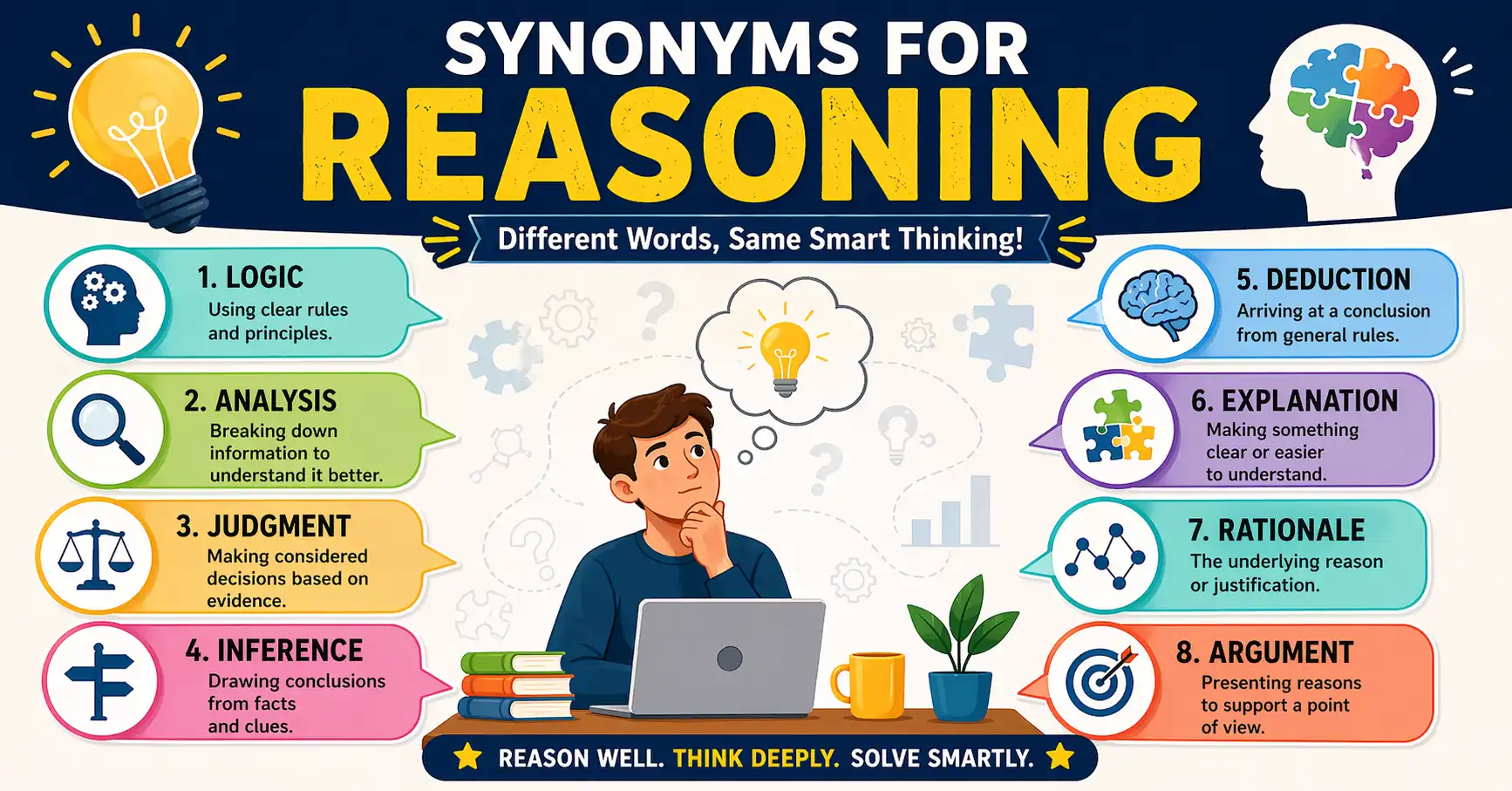
The best synonyms for reasoning include logic, thinking, analysis, argument, rationale, inference, judgment, deduction, and explanation.
Each word has a slightly different meaning, so choosing the right one depends on your context—academic writing, casual speech, or formal arguments.
What Does Reasoning Mean?
Reasoning refers to the process of thinking logically in order to form conclusions, judgments, or decisions. It involves analyzing information, connecting ideas, and drawing conclusions based on evidence.
In academic writing, reasoning is essential because it shows how well you can:
- Explain ideas clearly
- Support arguments logically
- Connect evidence with conclusions
According to academic writing conventions, strong reasoning is a key factor in high IELTS band scores, especially in Task 2 essays.
Complete Synonyms List
Here are some of the most useful synonyms for reasoning you can use in different contexts:
- Logic
- Thinking
- Analysis
- Argument
- Rationale
- Inference
- Judgment
- Deduction
- Explanation
- Conclusion
- Interpretation
- Evaluation
IELTS Tip:
Use “analysis” and “argument” in essays instead of simple words like “thinking” to sound more academic.
Comparison Table
| Word | Simple Meaning | Best Used When | Avoid When |
| Logic | Clear thinking rules | Academic or formal writing | Casual conversation |
| Thinking | General mental process | Informal or basic ESL writing | Advanced essays |
| Analysis | Breaking ideas into parts | Academic essays and reports | Casual speech |
| Argument | Reasoned opinion | Persuasive writing | Neutral explanations |
| Rationale | Reason behind a decision | Formal or business writing | Informal writing |
| Inference | Guess based on evidence | Academic or research context | Simple explanations |
| Judgment | Personal decision | Opinion-based writing | Scientific reports |
| Deduction | Logical conclusion | Formal logic or academic work | Everyday conversation |
Formal vs Informal Synonyms
| Formal Synonyms | Informal Synonyms |
| Rationale | Thinking |
| Analysis | Idea process |
| Deduction | Figuring out |
| Inference | Guess |
| Argument | Opinion |
| Evaluation | Looking at |
Key Insight:
- Use formal synonyms in essays, reports, and exams
- Use informal synonyms in speaking or casual writing
Real Example Sentences
Here are practical examples to help you understand how to use these synonyms correctly:
- His logic was clear and easy to follow.
- The essay shows strong analysis of the topic.
- Her argument was supported by reliable evidence.
- The rationale behind the policy is well explained.
- Students must develop critical thinking skills.
- The scientist made an inference based on data.
- Good judgment is important in decision-making.
- The conclusion was reached through careful deduction.
ESL Note:
In our experience helping ESL learners, students often overuse “thinking.” Replace it with analysis or logic in essays to improve quality instantly.
When to Use vs When NOT to Use
When to Use Synonyms for Reasoning
Use these alternatives when you want to:
- Avoid repetition in essays
- Sound more academic
- Show deeper understanding
- Improve IELTS vocabulary score
When NOT to Use Them
Do NOT use complex synonyms when:
- Writing for beginners or A1 level readers
- Speaking casually with friends
- You are unsure of the exact meaning
Example mistake:
Using “deduction” instead of “thinking” in simple conversation can sound unnatural.
Common Mistakes Writers Make
Here are mistakes ESL learners often make:
1. Using synonyms without understanding meaning
Not all words are equal. “Logic” and “inference” are different.
2. Overusing advanced vocabulary
Too many complex words can reduce clarity.
3. Mixing formal and informal words
Example: “The rationale is kinda simple.” ❌
4. Replacing words blindly
Always check context before switching synonyms.
5. Ignoring tone
Academic writing requires formal vocabulary.
Tips and Best Practices
1. Learn synonyms in context
Don’t memorize lists. Use them in sentences.
2. Focus on IELTS-friendly words
Words like analysis, argument, and evaluation are highly valued.
3. Practice rewriting sentences
Example:
- Original: His reasoning is good
- Better: His analysis is strong
4. Keep it simple when needed
Clarity is more important than complexity.
5. Build a personal vocabulary list
Writers we work with often improve faster when they track useful synonyms in a notebook.
Frequently Asked Questions
Q1: What is the best synonym for reasoning in essays?
A: The best synonym depends on context, but “analysis” and “argument” are most effective in academic essays. They sound formal and clearly show logical thinking, which is important for IELTS and academic writing tasks.
Q2: Can I use “thinking” instead of reasoning?
A: Yes, but “thinking” is informal and basic. In academic writing, it’s better to use words like “analysis” or “logic” to sound more professional and precise.
Q3: Are all synonyms for reasoning interchangeable?
A: No, each synonym has a slightly different meaning. For example, “inference” involves guessing from evidence, while “deduction” is based on strict logic. Always choose based on context.
Q4: Which synonyms are best for IELTS writing?
A: Words like “analysis,” “argument,” “evaluation,” and “rationale” are ideal. They match academic tone and help improve lexical resource scores in IELTS writing tasks.
Q5: How can I remember these synonyms easily?
A: Practice using them in sentences and group them by meaning. For example, learn “analysis” and “evaluation” together as academic terms. Repetition and usage help long-term memory.
Q6: Is using synonyms always better than repeating words?
A: Not always. While synonyms improve variety, using the wrong word can confuse readers. It’s better to repeat a correct word than use an incorrect synonym.
Conclusion
Mastering synonyms for reasoning can transform your writing from basic to advanced. You now understand their meanings, differences, and correct usage in academic contexts. Remember to choose words based on clarity, tone, and purpose—not just complexity.
You might also want to read our guide on synonyms for thinking to further strengthen your vocabulary.
Keep practicing, stay consistent, and your writing will improve faster than you expect.

Robert Hayes is an ESL educator and curriculum developer with over nine years of experience teaching English to beginners and intermediate learners across multiple countries ( Biography ).