Finding clear synonyms for secret helps you express hidden facts, private moments, and quiet information with high accuracy. When you study synonyms for secret, you learn how to describe personal confidences, mystery stories, and official privacy clearly. Using varied synonyms for secret makes your writing and everyday conversation far more precise and interesting.
Imagine a little boy hiding a small wooden treasure box under his bedroom floorboards. He keeps the silver key around his neck and tells nobody where it is. Only he knows what rests inside that dark wooden chest. This simple moment shows what it means to keep hidden information safe from the world.
Learning these vocabulary options helps many people every day:
- Students: Improve your essay scores by replacing repeated words with rich vocabulary.
- Bloggers: Keep your readers engaged with fresh, dynamic language on every page.
- Content Writers: Craft punchy headlines and distinct mystery tones for brand stories.
- Daily English Users: Choose the exact right word for private chats, family talks, or office meetings.
“There are no secrets that time does not reveal.” – Jean Racine
“Three can keep a secret, if two of them are dead.” – Benjamin Franklin
Technical & Linguistic Breakdown of “Secret”
Connotative Meaning
The word secret carries a neutral to cautious connotation. It implies holding information back from others to protect privacy, maintain safety, or create surprise. Depending on the context, it can feel protective and warm (like a birthday surprise) or dark and untrustworthy (like a hidden lie).
Etymology of “Secret”
- Latin Root: Derived from secretus (meaning “set apart, hidden, or private”).
- Base Verb: From secernere (se- meaning “apart” + cernere meaning “to separate”).
- Old French Entry: Entered Old French in the 13th century as secret.
- Middle English Evolution: Adopted into Middle English in the late 14th century to describe hidden knowledge.
Pronunciation (IPA)
- US IPA: /ˈsiː.krət/
- UK IPA: /ˈsiː.krət/
Syllables & Structure
- Syllables: 2 Syllables (se – cret)
- Stress Pattern: Primary stress on the first syllable (SEE-krit).
Affixation Pattern
- Base Form: Secret
- Adverb Derivative: Secretly
- Noun Derivative: Secrecy
- Verb Derivative: Secrete (in biological contexts)
Quick Comparison Table of Key Synonyms
| Keyword | Meaning | Usage Type | Context |
| Hidden | Kept out of sight or unknown | Casual / Neutral | Daily objects, feelings, places |
| Private | Intended for only one person or group | Casual / Formal | Personal life, conversations, notes |
| Confidential | Meant to be kept safe and private | Professional / Formal | Work records, doctor visits, legal papers |
| Covert | Done in a hidden or secret way | Formal / Technical | Military plans, spying, government work |
| Stealthy | Done quietly so nobody notices | Casual / Creative | Animals hunting, surprise moves, games |
| Clandestine | Done secretly, often because it is unlawful | Formal / Literary | Secret meetings, political deals, plots |
| Cryptic | Having a hidden meaning that is hard to solve | Academic / Creative | Puzzles, strange notes, coded clues |
| Concealed | Placed where others cannot see it | Neutral / Formal | Hidden items, weapons, secret doors |
50 Best Synonyms for Secret
1. Hidden
- Pronunciation: US: /ˈhɪd.ən/ | UK: /ˈhɪd.ən/
- Meaning: This word describes something placed where people cannot easily see it.
- Examples:
- She found a hidden key under the door mat.
- The small island stayed hidden in the ocean fog.
2. Private
- Pronunciation: US: /ˈpraɪ.vət/ | UK: /ˈpraɪ.vət/
- Meaning: This word describes things meant for only one person or small group.
- Examples:
- They had a private talk in the quiet office.
- Please respect his private diary on the desk.
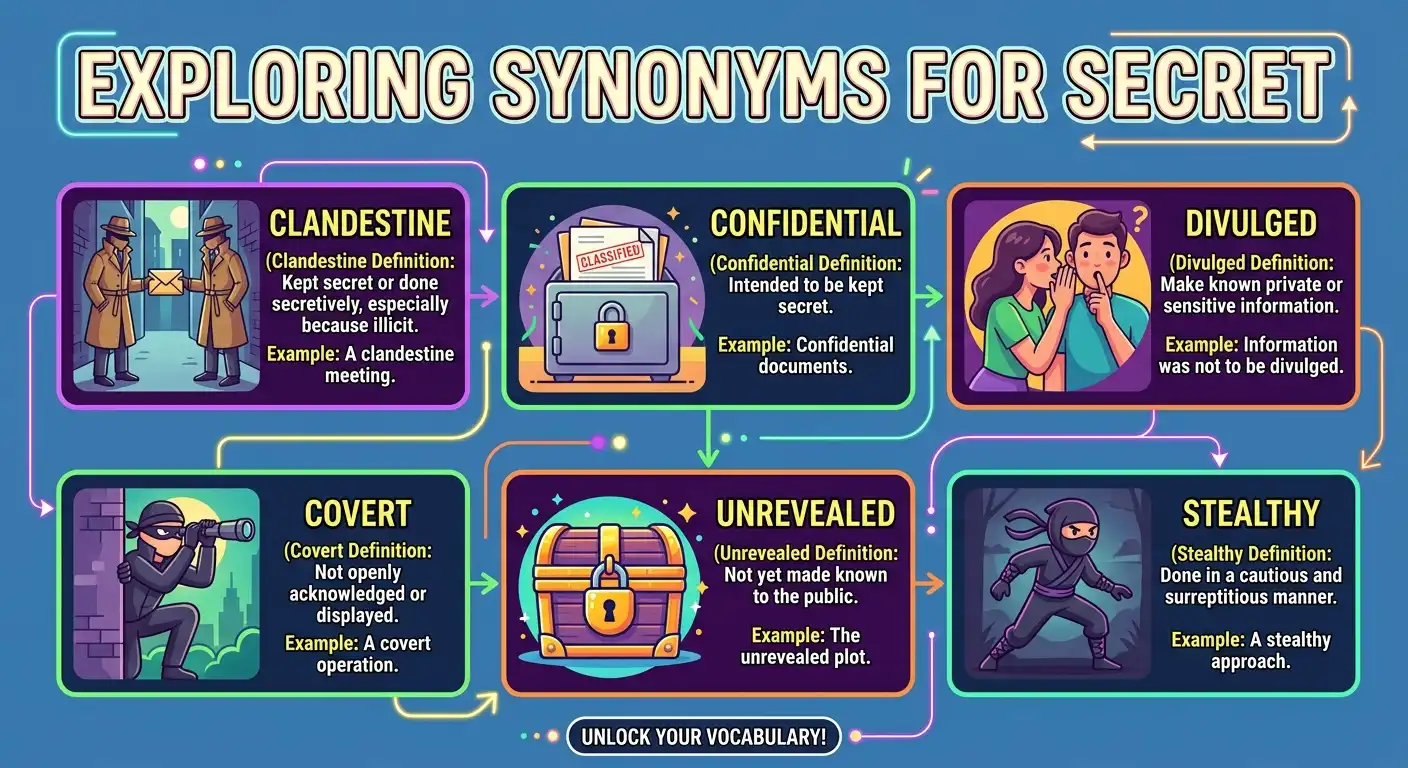
3. Confidential
- Pronunciation: US: /ˌkɑːn.fəˈden.ʃəl/ | UK: /ˌkɒn.fɪˈden.ʃəl/
- Meaning: This word describes important information meant to stay strictly protected.
- Examples:
- The doctor keeps all medical records confidential at all times.
- She marked the company document as confidential before sending it.
4. Covert
- Pronunciation: US: /ˈkoʊ.vɝːt/ | UK: /ˈkʌv.ət/
- Meaning: This word describes an action done quietly without public knowledge.
- Examples:
- The team carried out a covert plan in the dark night.
- Guards noticed a covert movement near the city fence.
5. Concealed
- Pronunciation: US: /kənˈsiːld/ | UK: /kənˈsiːld/
- Meaning: This word describes something intentionally covered up or kept from view.
- Examples:
- He kept a concealed gift inside his coat pocket.
- The actor wore a concealed microphone under her shirt.
6. Stealthy
- Pronunciation: US: /ˈstel.θi/ | UK: /ˈstel.θi/
- Meaning: This word describes moving very quietly so no one hears or sees you.
- Examples:
- The stealthy cat walked softly across the wooden floor.
- He took a stealthy glance at the birthday cake.
7. Classified
- Pronunciation: US: /ˈklæs.ə.faɪd/ | UK: /ˈklæs.ɪ.faɪd/
- Meaning: This word describes official government information guarded for national safety.
- Examples:
- Only top officers can read these classified papers.
- The government stored the classified files in a safe room.
8. Clandestine
- Pronunciation: US: /klænˈdes.tɪn/ | UK: /klænˈdes.tɪn/
- Meaning: This word describes an action done in secret, often against rules.
- Examples:
- They arranged a clandestine meeting in the empty park.
- The group held clandestine talks late at night.
9. Mysterious
- Pronunciation: US: /mɪˈstɪr.i.əs/ | UK: /mɪˈstɪə.ri.əs/
- Meaning: This word describes something strange that is hard to explain or understand.
- Examples:
- A mysterious visitor knocked on the wooden door.
- We heard a mysterious noise coming from the attic.
10. Surreptitious
- Pronunciation: US: /ˌsɝː.əpˈtɪʃ.əs/ | UK: /ˌsʌr.əpˈtɪʃ.əs/
- Meaning: This word describes taking quick actions in secret to avoid notice.
- Examples:
- She made a surreptitious phone call from the hallway.
- He took a surreptitious sip of juice before dinner.
11. Quiet
- Pronunciation: US: /ˈkwaɪ.ət/ | UK: /ˈkwaɪ.ət/
- Meaning: This word describes keeping things gentle and calm without making noise.
- Examples:
- They shared a quiet agreement without saying a word.
- He kept his future plans very quiet for now.
12. Untold
- Pronunciation: US: /ˌʌnˈtoʊld/ | UK: /ˌʌnˈtəʊld/
- Meaning: This word describes facts or stories that have never been shared with anyone.
- Examples:
- The old sailor carried many untold stories in his heart.
- Her kindness brought untold happiness to the village.
13. Unseen
- Pronunciation: US: /ˌʌnˈsiːn/ | UK: /ˌʌnˈsiːn/
- Meaning: This word describes something that remains out of view for people.
- Examples:
- The small bird sang from an unseen tree branch.
- An unseen hand seemed to guide the quiet boat.
14. Unknown
- Pronunciation: US: /ˌʌnˈnoʊn/ | UK: /ˌʌnˈnəʊn/
- Meaning: This word describes facts or places that people do not know about yet.
- Examples:
- They traveled into an unknown forest path.
- The identity of the painter remains unknown today.
15. Hush-hush
- Pronunciation: US: /ˌhʌʃˈhʌʃ/ | UK: /ˌhʌʃˈhʌʃ/
- Meaning: This word describes news kept very quiet so the public does not find out.
- Examples:
- The movie project is top hush-hush until next month.
- They planned a hush-hush party for their teacher.
16. Furtive
- Pronunciation: US: /ˈfɝː.t̬ɪv/ | UK: /ˈfɜː.tɪv/
- Meaning: This word describes quick, nervous actions done to hide something bad.
- Examples:
- He gave a furtive glance toward the open window.
- She slipped a furtive note into her coat pocket.
17. Arcane
- Pronunciation: US: /ɑːrˈkeɪn/ | UK: /ɑːˈkeɪn/
- Meaning: This word describes old or rare knowledge understood by only a few people.
- Examples:
- The scholar studied arcane math formulas in old books.
- The ancient law contained many arcane rules.
18. Cryptic
- Pronunciation: US: /ˈkrɪp.tɪk/ | UK: /ˈkrɪp.tɪk/
- Meaning: This word describes clues or messages with hidden meanings that confuse readers.
- Examples:
- He left a cryptic message on the whiteboard.
- Her short email had a cryptic tone.
19. Dark
- Pronunciation: US: /dɑːrk/ | UK: /dɑːk/
- Meaning: This word describes things kept hidden or mysterious away from light.
- Examples:
- The story contains a few dark family history details.
- She kept her old fears in a dark corner of her mind.
20. Enigmatic
- Pronunciation: US: /ˌen.ɪɡˈmæt̬.ɪk/ | UK: /ˌen.ɪɡˈmæt.ɪk/
- Meaning: This word describes a person or thing that stays puzzling and hard to figure out.
- Examples:
- The Mona Lisa painting has an enigmatic smile.
- He gave an enigmatic answer to our question.
21. Esoteric
- Pronunciation: US: /ˌes.əˈter.ɪk/ | UK: /ˌes.əˈter.ɪk/
- Meaning: This word describes information meant for only a tiny group of specialists.
- Examples:
- Quantum physics can seem like an esoteric subject to most.
- The club discussed esoteric history details.
22. Deep
- Pronunciation: US: /diːp/ | UK: /diːp/
- Meaning: This word describes thoughts or feelings hidden far below the surface.
- Examples:
- He kept his deep thoughts written in a locked notebook.
- Ocean divers explored the deep water caves.
23. Camouflaged
- Pronunciation: US: /ˈkæm.ə.flɑːʒd/ | UK: /ˈkæm.ə.flɑːʒd/
- Meaning: This word describes objects made to look like their surroundings so they blend in.
- Examples:
- The frog stayed camouflaged among the green leaves.
- Soldiers wore camouflaged jackets in the woods.
24. Masked
- Pronunciation: US: /mæskt/ | UK: /mɑːskt/
- Meaning: This word describes hiding true feelings or identity behind a cover.
- Examples:
- She spoke with masked emotion during the hard talk.
- A masked dancer stepped onto the bright stage.
25. Obscure
- Pronunciation: US: /əbˈskjʊr/ | UK: /əbˈskjʊər/
- Meaning: This word describes things that are not well-known or clear to see.
- Examples:
- He loves collecting obscure music records from the past.
- The small village sits in an obscure valley.
“The secret of getting ahead is getting started.” – Mark Twain
26. Veiled
- Pronunciation: US: /veɪld/ | UK: /veɪld/
- Meaning: This word describes statements or items partially covered so they remain unclear.
- Examples:
- He made a veiled comment about changing jobs soon.
- Sunlight shone through the veiled morning sky.
27. Shrouded
- Pronunciation: US: /ˈʃraʊ.dɪd/ | UK: /ˈʃraʊ.dɪd/
- Meaning: This word describes something completely wrapped or covered in mystery or fog.
- Examples:
- The tall mountain peak stayed shrouded in thick clouds.
- Old historical events remain shrouded in deep mystery.
28. Undercover
- Pronunciation: US: /ˌʌn.dɚˈkʌv.ɚ/ | UK: /ˌʌn.dəˈkʌv.ər/
- Meaning: This word describes working in secret while pretending to be someone else.
- Examples:
- An undercover officer joined the group to catch thieves.
- They opened an undercover search for missing items.
29. Underground
- Pronunciation: US: /ˈʌn.dɚ.ɡraʊnd/ | UK: /ˈʌn.də.ɡraʊnd/
- Meaning: This word describes hidden activities carried out away from official rules.
- Examples:
- Artists formed an underground club in the city basement.
- They printed an underground news page last year.
30. Off-the-record
- Pronunciation: US: /ˌɑːf.ðəˈrek.ɚd/ | UK: /ˌɒf.ðəˈrek.ɔːd/
- Meaning: This word describes spoken information that must not be published or shared.
- Examples:
- The leader gave an off-the-record comment to reporters.
- Keep this detail off-the-record for our safety.
31. Personal
- Pronunciation: US: /ˈpɝː.sən.əl/ | UK: /ˈpɜː.sən.əl/
- Meaning: This word describes things connected directly to one individual life.
- Examples:
- Writing poetry is her personal way to relax.
- He kept his personal choices quiet at work.
32. Inside
- Pronunciation: US: /ˌɪnˈsaɪd/ | UK: /ˌɪnˈsaɪd/
- Meaning: This word describes knowledge known only by people within a group.
- Examples:
- The team shared an inside joke during lunch break.
- He got inside news about upcoming company changes.
33. Privy
- Pronunciation: US: /ˈprɪv.i/ | UK: /ˈprɪv.i/
- Meaning: This word describes being allowed to share in secret knowledge.
- Examples:
- She was privy to the main decision before others.
- Only three workers were privy to the password.
34. Cloaked
- Pronunciation: US: /kloʊkt/ | UK: /kləʊkt/
- Meaning: This word describes something wrapped up to keep it completely hidden.
- Examples:
- The ship sailed cloaked in deep night darkness.
- His real intentions remained cloaked behind a big smile.
35. Unrevealed
- Pronunciation: US: /ˌʌn.rɪˈviːld/ | UK: /ˌʌn.rɪˈviːld/
- Meaning: This word describes facts that have not been shown to the public yet.
- Examples:
- The location of the new store remains unrevealed.
- Her surprise project stays unrevealed until Friday.
36. Disguised
- Pronunciation: US: /dɪsˈɡaɪzd/ | UK: /dɪsˈɡaɪzd/
- Meaning: This word describes changing clothes or look to conceal who you are.
- Examples:
- He visited the party disguised in a dark red cape.
- Her soft voice was disguised on the telephone call.
37. Unspoken
- Pronunciation: US: /ˌʌnˈspoʊ.kən/ | UK: /ˌʌnˈspəʊ.kən/
- Meaning: This word describes feelings or rules understood without needing words.
- Examples:
- There was an unspoken trust between the two friends.
- They shared an unspoken rule about sharing tools.
38. Shadowy
- Pronunciation: US: /ˈʃæd.oʊ.i/ | UK: /ˈʃæd.əʊ.i/
- Meaning: This word describes things associated with dark shapes or mystery.
- Examples:
- A shadowy figure walked through the quiet alley.
- They met in a shadowy corner of the old library.
39. Sub rosa
- Pronunciation: US: /ˌsʌb ˈroʊ.zə/ | UK: /ˌsʌb ˈrəʊ.zə/
- Meaning: This word describes discussions conducted under a promise of total privacy.
- Examples:
- The committee held its meeting sub rosa behind locked doors.
- All financial talks happened sub rosa this morning.
40. Top-secret
- Pronunciation: US: /ˌtɑːpˈsiː.krət/ | UK: /ˌtɒpˈsiː.krət/
- Meaning: This word describes information kept under the highest level of protection.
- Examples:
- They designed a top-secret jet plane for defense.
- The team holds top-secret clearance for this project.
41. Unmarked
- Pronunciation: US: /ˌʌnˈmɑːrkt/ | UK: /ˌʌnˈmɑːkt/
- Meaning: This word describes cars or doors without signs so nobody identifies them.
- Examples:
- The officer drove an unmarked white car today.
- They entered through an unmarked wooden side door.
42. Under-the-table
- Pronunciation: US: /ˌʌn.dɚ.ðəˈteɪ.bəl/ | UK: /ˌʌn.də.ðəˈteɪ.bəl/
- Meaning: This word describes secret financial payments made outside official tax laws.
- Examples:
- He made an under-the-table deal for the used car.
- They wanted to avoid under-the-table business deals.
43. Behind-the-scenes
- Pronunciation: US: /bɪˌhaɪnd.ðəˈsiːnz/ | UK: /bɪˌhaɪnd.ðəˈsiːnz/
- Meaning: This word describes work done away from public view or the main stage.
- Examples:
- The crew did great behind-the-scenes work for the play.
- We saw a behind-the-scenes video of the movie set.
44. Eyes-only
- Pronunciation: US: /ˈaɪzˌoʊn.li/ | UK: /ˈaɪzˌəʊn.li/
- Meaning: This word describes documents meant to be read by named readers only.
- Examples:
- He received an eyes-only memo from the company director.
- This report is eyes-only for project group members.
45. Unexpressed
- Pronunciation: US: /ˌʌn.ɪkˈsprest/ | UK: /ˌʌn.ɪkˈsprest/
- Meaning: This word describes thoughts or feelings held inside without speaking them out.
- Examples:
- She felt an unexpressed joy when her team won.
- His unexpressed worries showed on his tired face.
46. Unannounced
- Pronunciation: US: /ˌʌn.əˈnaʊnst/ | UK: /ˌʌn.əˈnaʊnst/
- Meaning: This word describes actions taken without telling anyone in advance.
- Examples:
- The inspector made an unannounced visit to the store.
- She arrived unannounced with homemade cookies.
47. Unpublicized
- Pronunciation: US: /ˌʌnˈpʌb.lə.saɪzd/ | UK: /ˌʌnˈpʌb.lɪ.saɪzd/
- Meaning: This word describes events kept quiet without news or advertisement.
- Examples:
- The contest was unpublicized to keep crowds small.
- They held an unpublicized meeting near the lake.
48. Unmapped
- Pronunciation: US: /ˌʌnˈmæpt/ | UK: /ˌʌnˈmæpt/
- Meaning: This word describes wild land areas that do not appear on official maps.
- Examples:
- Explorers found an unmapped cave system near the hills.
- They hiked through unmapped forest paths all day.
49. Stealth
- Pronunciation: US: /stelθ/ | UK: /stelθ/
- Meaning: This word describes using careful, silent steps to remain completely unnoticed.
- Examples:
- The hunter moved with great stealth through tall grass.
- Modern planes use stealth tech to hide from radar.
50. Guarded
- Pronunciation: US: /ˈɡɑːr.dɪd/ | UK: /ˈɡɑː.dɪd/
- Meaning: This word describes being cautious and careful about what facts you share.
- Examples:
- He gave a guarded response to the news reporter.
- She remained guarded about her past job choices.
Antonyms of “Secret”
Understanding the direct opposites of “secret” helps you contrast hidden details with open communication:
- Public: Available, known, or open to everyone in the community.
- Open: Exposed to general view without any attempt to hide facts.
- Known: Recognized and understood clearly by many people.
- Revealed: Made clear or shown plainly to the public eye.
- Overt: Done openly without any attempt to hide intentions.
- Transparent: Easy to see through, honest, and completely open.
Prototype Meaning and Categorization of Secret
To master these synonyms for secret, it helps to organize the terms into written categories based on physical placement, workplace privacy, strategic moves, and quiet communication:
Core Prototype Definition
At its core, “secret” describes any knowledge, item, or action intentionally kept hidden from view or protected from public knowledge.
1. Physical Concealment and Hidden Places
This category includes terms that describe hiding physical items, blending into surroundings, or traveling unseen.
- Primary Focus: Hidden objects, masked identities, and unseen physical locations.
- Key Synonyms: Hidden, concealed, unseen, camouflaged, cloaked, masked, obscured, unmapped, shadowy, disguised.
- Common Contexts: Treasure maps, outdoor camouflage, hidden doors, and surprise gift boxes.
2. Workplace Privacy and Official Security
This category focuses on keeping legal papers, company plans, and personal records safe from outside eyes.
- Primary Focus: Professional privacy, security ranks, and legal records.
- Key Synonyms: Confidential, classified, top-secret, private, eyes-only, off-the-record, sub rosa, personal.
- Common Contexts: Corporate meetings, medical files, legal contracts, and security passes.
3. Quiet Actions and Strategic Moves
These terms apply when people move, plan, or act quietly so others do not spot them.
- Primary Focus: Quiet movement, undercover operations, and hidden plans.
- Key Synonyms: Covert, stealthy, clandestine, surreptitious, furtive, undercover, underground, stealth, under-the-table, behind-the-scenes.
- Common Contexts: Detective work, game strategy, stealth moves, and silent steps.
4. Mystery, Coding, and Unspoken Feelings
This category involves puzzling clues, deep knowledge, and silent understandings between friends.
- Primary Focus: Mysteries, rare facts, coded messages, and unsaid emotions.
- Key Synonyms: Mysterious, cryptic, arcane, esoteric, enigmatic, untold, unspoken, unexpressed, deep, privy, hush-hush.
- Common Contexts: Riddle solving, academic studies, personal trust, and ancient history.
Frequently Asked Questions (FAQs)
1. What is the most common synonym for secret?
The most common everyday synonyms for secret are hidden (for physical items) and private (for personal news).
2. What is the difference between “secret” and “confidential”?
Secret can be used casually for anything kept hidden. Confidential is a formal term used in business, healthcare, or law to show that facts must be protected.
3. Is “hush-hush” appropriate for formal writing?
No, hush-hush is an informal, casual term. In formal or academic writing, choose terms like confidential, classified, or clandestine.
4. How can I use synonyms for secret on a job resume?
On a resume, use professional terms like confidential, guarded, or behind-the-scenes to show your respect for privacy and teamwork.
5. Can “secret” be used as both an adjective and a noun?
Yes! As an adjective, it describes something hidden (a secret message). As a noun, it refers to the hidden fact itself (keep a secret).
6. Which synonym for secret works best in mystery story writing?
In creative story writing, expressive words like shrouded, cryptic, arcane, shadowy, and enigmatic build rich mystery for readers.
Conclusion
Learning dynamic synonyms for secret will greatly enhance your daily English writing and speaking skills. Expanding your vocabulary allows you to choose precise words that match your exact context and audience. Whether you are writing a school essay, drafting a blog entry, sending a professional email, or describing a goal to a friend, using varied vocabulary makes your communication clear and engaging.
When you replace repetitive words with precise terms like confidential, covert, cryptic, or stealthy, your sentences sound polished and thoughtful. Practice adding two or three new terms each week to your emails, essays, and daily discussions. Regular vocabulary practice will help you express complex ideas with confidence and ease.
“Knowledge is power, but enthusiasm pulls the switch.” – Ivern Ball
“The true secret of useful writing is to say simple things well.” – English Proverb

Robert Hayes is an ESL educator and curriculum developer with over nine years of experience teaching English to beginners and intermediate learners across multiple countries ( Biography ).