Do you struggle to find the right word when speaking or writing in English? You’re not alone. Many learners feel stuck repeating the same vocabulary again and again. This is exactly why learning antonyms and synonyms for ESL students is essential.
When you understand synonyms (words with similar meanings) and antonyms (words with opposite meanings), your English becomes clearer, richer, and more natural. Whether you are preparing for IELTS, writing essays, or improving everyday communication, this skill will help you express ideas with confidence.
In this guide, you will learn everything step by step. I’ll explain meanings in simple terms, give practical examples, and share teaching tips based on real ESL classroom experience. By the end, you’ll not only know more words—you’ll know how and when to use them correctly.
Quick Answer:
Antonyms and synonyms for ESL students are words that help expand vocabulary by showing similar (synonyms) and opposite (antonyms) meanings. Learning them improves speaking, writing, and comprehension, especially in academic English and IELTS tasks. They allow you to avoid repetition and express ideas more clearly and precisely.
What Does “Antonyms and Synonyms” Mean?
Synonyms
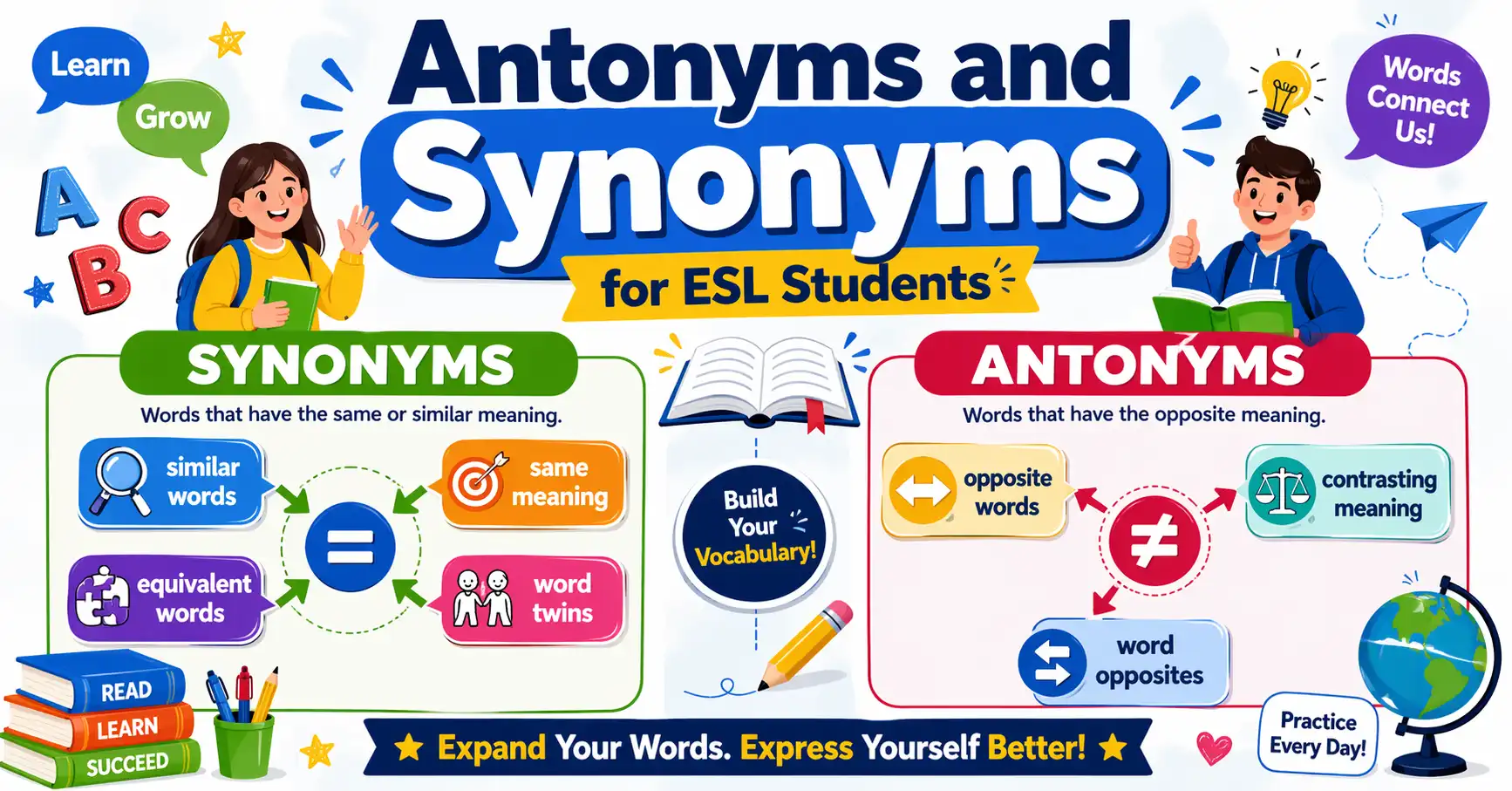
Synonyms are words that have the same or nearly the same meaning.
- Example: happy → joyful, cheerful
Antonyms
Antonyms are words that have opposite meanings.
- Example: happy → sad
Why This Matters for ESL Beginners
In our experience helping writers, students who actively learn synonyms and antonyms improve their writing scores faster. According to IELTS band descriptors, lexical resource (vocabulary range) is a key scoring factor.
Complete Synonyms List
Here are useful synonyms ESL students should learn:
- Big → large, huge, enormous
- Small → tiny, little, mini
- Happy → joyful, glad, cheerful
- Sad → unhappy, upset, miserable
- Fast → quick, rapid, speedy
- Slow → gradual, sluggish, delayed
- Good → excellent, great, positive
- Bad → poor, terrible, negative
- Easy → simple, effortless
- Hard → difficult, challenging
ESL Note:
Start with common words first, then learn 2–3 synonyms per word. This keeps learning manageable.
Comparison Table
| Word | Simple Meaning | Best Used When | Avoid When |
| Big | Large size | General speaking | Academic writing (use “significant”) |
| Huge | Very big | Informal emphasis | Formal essays |
| Small | Little size | Everyday use | Scientific writing |
| Tiny | Very small | Descriptions | Formal contexts |
| Good | Positive | General use | IELTS essays (use “beneficial”) |
| Excellent | Very good | Academic writing | Casual speech |
| Bad | Negative | Basic English | Advanced writing |
| Terrible | Very bad | Strong emotion | Neutral tone writing |
Formal vs Informal Synonyms
| Informal Word | Formal Synonym |
| Get | Obtain |
| Help | Assist |
| Buy | Purchase |
| Show | Demonstrate |
| Ask | Request |
| Fix | Repair |
| Start | Commence |
| End | Conclude |
IELTS Tip:
Using formal synonyms correctly can help you reach Band 6–7 in writing tasks.
Real Example Sentences
Here are practical examples using synonyms and antonyms:
- The movie was good, but the ending was excellent.
- She felt happy, but later became sad.
- This task is easy, but the next one is difficult.
- The car is fast, while the bus is slow.
- He gave a big speech at a small event.
- The weather was terrible, but the trip was great.
- She made a quick decision instead of a slow one.
- The solution was simple, not complicated.
When to Use vs When NOT to Use
When to Use Synonyms and Antonyms
Use them when:
- You want to avoid repeating the same word
- You are writing essays or reports
- You want to sound more fluent and natural
- You are preparing for IELTS or exams
When NOT to Use Them
Do NOT use them when:
- The synonym changes the meaning slightly
- You are unsure about the context
- The word sounds too formal for casual conversation
- It makes your sentence unclear
Example:
“Big problem” vs “significant problem” → both work, but context matters.
Common Mistakes Writers Make
Many ESL learners make these errors:
- Using incorrect synonyms
- Example: “cheap” instead of “inexpensive” in formal writing
- Ignoring context
- Not all synonyms fit every sentence
- Overusing advanced words
- This can sound unnatural
- Confusing antonyms
- Example: “hot” vs “cold” works, but “hot” vs “cool” depends on context
- Mixing formal and informal words
- Example: “commence the project quickly” sounds unnatural
Tips and Best Practices
Here are proven strategies from 9 years of ESL teaching:
1. Learn in Pairs
Study words together:
- happy ↔ sad
- fast ↔ slow
2. Use a Vocabulary Notebook
Write:
- Word
- Synonym
- Antonym
- Example sentence
3. Practice Daily
Spend 10 minutes learning 5 new words.
4. Read More
Books, articles, and essays expose you to natural word use.
5. Use Words in Sentences
Writers we work with often improve faster when they actively use new vocabulary, not just memorize it.
Frequently Asked Questions
Q1: What are synonyms and antonyms for ESL students?
A: Synonyms are words with similar meanings, while antonyms have opposite meanings. ESL students use them to expand vocabulary, improve communication, and avoid repetition in speaking and writing, especially in academic and exam settings.
Q2: Why are synonyms important for IELTS writing?
A: Synonyms help demonstrate a wide vocabulary range, which is essential for higher IELTS band scores. They reduce repetition and make writing more natural, precise, and engaging for examiners.
Q3: How can beginners learn antonyms easily?
A: Beginners should learn antonyms in pairs, such as “hot–cold” or “big–small.” Using flashcards, simple examples, and daily practice helps reinforce memory and understanding.
Q4: Can synonyms always replace each other?
A: No, synonyms cannot always be used interchangeably. Many words have slight differences in tone, formality, or context. Choosing the wrong synonym can change the meaning of your sentence.
Q5: What is the best way to practice synonyms daily?
A: The best method is to learn a few words daily, write example sentences, and use them in conversation or writing. Consistent practice builds long-term vocabulary skills.
Q6: Are antonyms useful for speaking English?
A: Yes, antonyms improve speaking by helping you express contrast and clarity. They allow you to explain ideas more effectively and sound more natural in conversations.
Conclusion
Learning antonyms and synonyms for ESL students is one of the fastest ways to improve your English. It helps you avoid repetition, express ideas clearly, and perform better in exams like IELTS. Focus on understanding meaning, context, and usage—not just memorizing lists.
You might also want to read our guide on basic vocabulary for beginners to build a strong foundation.
Keep practicing daily, stay consistent, and your vocabulary will grow naturally.

Robert Hayes is an ESL educator and curriculum developer with over nine years of experience teaching English to beginners and intermediate learners across multiple countries ( Biography ).