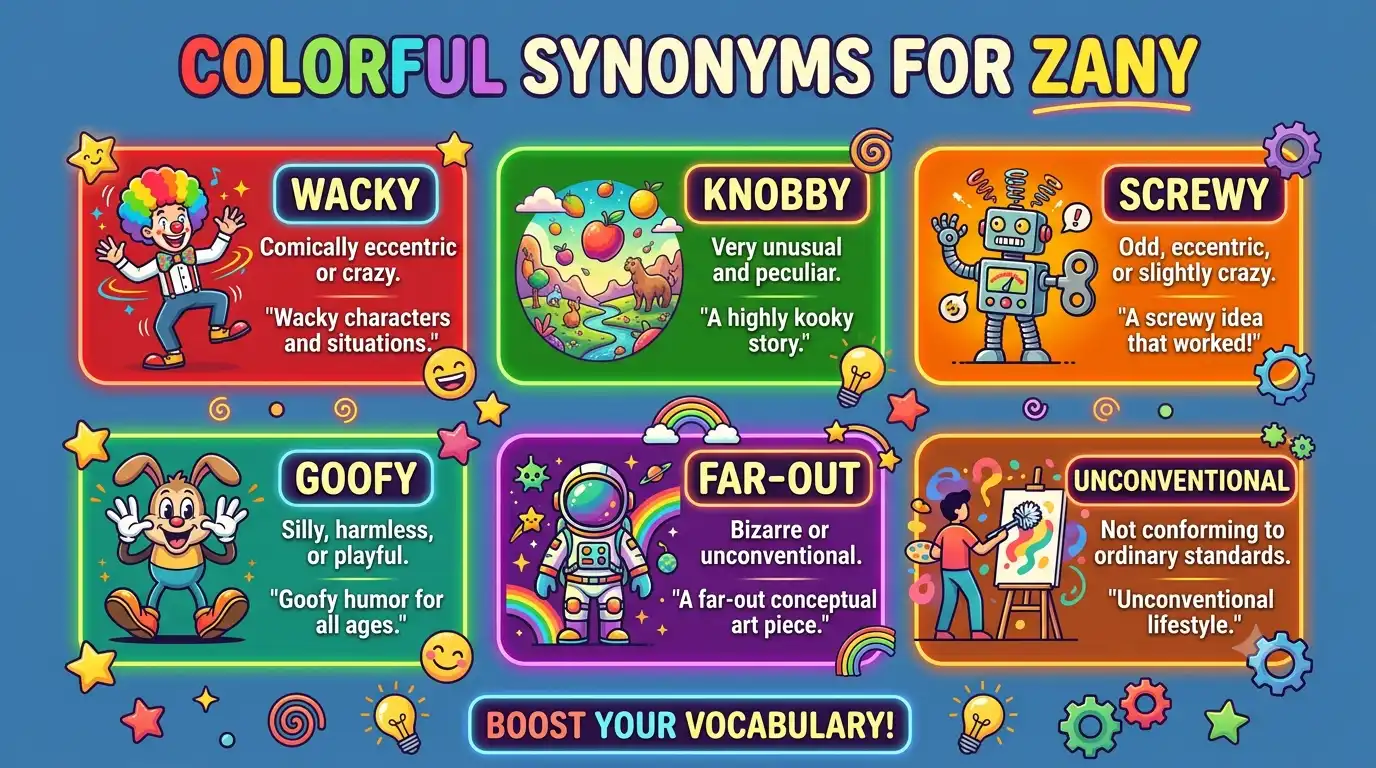
Exploring creative synonyms for zany helps you describe wildly funny or unconventional ideas with total accuracy. Studying top synonyms for zany allows you to replace overused words with vivid expressions for eccentric behavior. Expanding your vocabulary with smart synonyms for zany makes your stories, essays, and daily conversations far more entertaining.
Imagine walking into a neighborhood festival and seeing a clown riding a tiny unicycle while juggling brightly colored rubber chickens. Everyone bursts into laughter at his hilarious costume and silly antics. He loves bringing pure joy to the crowd through unpredictable humor. This playful situation shows what the word zany truly means in real life.
In simple English, zany describes someone or something that is delightfully strange, funny, or crazy in a lighthearted way.
Learning these vocabulary options brings clear benefits to different types of writers and speakers:
- Students: Express character traits clearly in literature essays and book reports.
- Bloggers: Write eye-catching headlines and funny stories for your online audience.
- Content Writers: Craft playful brand messaging, scripts, and entertainment reviews.
- Daily English Users: Add humor and excitement to casual chats with friends and family.
“Creativity is intelligence having fun.” – Albert Einstein
“There is no great genius without a touch of madness.” – Seneca
Technical & Linguistic Breakdown of “Zany”
Connotative Meaning
As an adjective, zany carries a warm, positive, and humorous connotation. It describes harmlessly eccentric behavior that makes people smile or laugh. Unlike words that imply genuine madness or danger, zany highlights fun, playfulness, and imaginative foolishness.
Etymology of “Zany”
- Italian Origin: Derived from Zanni, a traditional comical servant character in Renaissance Italian theatre (Commedia dell’arte).
- Name Root: Zanni originated as a dialect nickname for Giovanni (John).
- English Entry: Entered the English language in the late 16th century to describe a clown’s assistant who foolishly mimicked the master clown.
Pronunciation (IPA)
- US Pronunciation: /ˈzeɪni/
- UK Pronunciation: /ˈzeɪni/
Syllables & Structure
- Syllables: 2 Syllables (za – ny)
- Stress Pattern: Primary stress on the first syllable (ZA-ny).
Affixation Pattern
- Base Form: Adjective / Noun (zany)
- Plural Form: Zanies
- Noun Derivative: Zaniness / Zanyism
- Adverb Derivative: Zanily
- Comparative Form: Zanier
- Superlative Form: Zaniest
Quick Comparison Table of Key Synonyms
| Keyword | Meaning | Usage Type | Context |
| Wacky | Funny and amusingly strange | Casual / Informal | Cartoons, games, party ideas |
| Kooky | Slightly strange or odd in a silly way | Informal / Playful | Creative personalities, fashion |
| Eccentric | Unconventional or unusual in behavior | Formal / Neutral | Artists, academics, habits |
| Offbeat | Unconventional and delightfully different | Professional / Casual | Music styles, movies, art |
| Screwball | Crazy, whimsical, or wildly erratic | Retro / Informal | Comedy films, sports plays |
| Goofy | Silly, foolish, and harmlessly funny | Casual / Family | Kids’ shows, casual jokes |
| Bonkers | Completely crazy or wildly energetic | Informal / Slang | Energetic crowds, wild parties |
| Whimsical | Playfully quaint or fancifully imaginative | Creative / Formal | Fairy tales, decor, art |
50 Best Synonyms for Zany
1. Wacky
- Pronunciation: US: /ˈwæki/ | UK: /ˈwæki/
- Meaning: You are funny and amusingly strange in your behavior.
- Examples:
- He wore a wacky hat to the school party.
- The cartoon character had many wacky ideas.
2. Kooky
- Pronunciation: US: /ˈkuːki/ | UK: /ˈkuːki/
- Meaning: You are slightly strange or odd in a silly way.
- Examples:
- My aunt has a kooky collection of teapot clocks.
- She came up with a kooky story for class.
3. Eccentric
- Pronunciation: US: /ɪkˈsentrɪk/ | UK: /ɪkˈsentrɪk/
- Meaning: You act in ways that are unusual or different from others.
- Examples:
- The eccentric painter lived in a round purple house.
- He has an eccentric habit of collecting old bus tickets.
4. Offbeat
- Pronunciation: US: /ˌɔːfˈbiːt/ | UK: /ˌɒfˈbiːt/
- Meaning: Something is unconventional, unique, and pleasantly different.
- Examples:
- We watched an offbeat comedy movie last night.
- She likes offbeat music from around the world.
5. Screwball
- Pronunciation: US: /ˈskruːbɔːl/ | UK: /ˈskruːbɔːl/
- Meaning: Someone or something is crazy and wildly funny in behavior.
- Examples:
- That screwball comedy made the audience laugh out loud.
- He acted like a total screwball on stage.
6. Goofy
- Pronunciation: US: /ˈɡuːfi/ | UK: /ˈɡuːfi/
- Meaning: You act silly, foolish, and harmlessly funny.
- Examples:
- The puppy made a goofy face at the window.
- He wore goofy glasses to make his sister laugh.
7. Quirky
- Pronunciation: US: /ˈkwɜːrki/ | UK: /ˈkwɜːki/
- Meaning: Having unusual and interesting personal habits or traits.
- Examples:
- She has a quirky sense of humor that everyone loves.
- The shop sells quirky handmade gifts.
8. Bonkers
- Pronunciation: US: /ˈbɑːŋkərz/ | UK: /ˈbɒŋkəz/
- Meaning: Wildly crazy, foolish, or extremely energetic.
- Examples:
- The crowd went bonkers when the team scored.
- That loud idea sounds completely bonkers to me.
9. Whimsical
- Pronunciation: US: /ˈwɪmzɪkl/ | UK: /ˈwɪmzɪkl/
- Meaning: Playfully quaint, imaginative, or full of fanciful fun.
- Examples:
- The book features whimsical drawings of flying cats.
- She decorated her room in a whimsical style.
10. Bizarre
- Pronunciation: US: /bɪˈzɑːr/ | UK: /bɪˈzɑː/
- Meaning: Very strange, unusual, or unexpected in visual appearance.
- Examples:
- We saw a bizarre creature in the deep sea video.
- He told a bizarre tale about his morning walk.
11. Wild
- Pronunciation: US: /waɪld/ | UK: /waɪld/
- Meaning: Full of unchecked excitement, crazy energy, or passion.
- Examples:
- The kids had a wild time at the indoor playground.
- She had a wild dream about flying over mountains.
12. Silly
- Pronunciation: US: /ˈsɪli/ | UK: /ˈsɪli/
- Meaning: Showing a charming lack of common sense or seriousness.
- Examples:
- Don’t be silly, you look great in that sweater.
- The clown played a silly trick on his friend.
13. Freaky
- Pronunciation: US: /ˈfriːki/ | UK: /ˈfriːki/
- Meaning: Strangely odd, bizarre, or unexpected in nature.
- Examples:
- That storm created some freaky weather patterns.
- He has a freaky talent for guessing secret numbers.
14. Nuts
- Pronunciation: US: /nʌts/ | UK: /nʌts/
- Meaning: Extremely silly, crazy, or enthusiastic about an event.
- Examples:
- The fans went nuts during the musical concert.
- Are you nuts for going out in the rain?
15. Nutty
- Pronunciation: US: /ˈnʌti/ | UK: /ˈnʌti/
- Meaning: Silly, eccentric, or slightly foolish in a harmless way.
- Examples:
- My uncle has a nutty plan to build a boat.
- She gave a nutty answer that made us smile.
16. Loony
- Pronunciation: US: /ˈluːni/ | UK: /ˈluːni/
- Meaning: Silly, foolish, or crazy in a lighthearted manner.
- Examples:
- He had a loony idea to race down the hill in a basket.
- The cartoon featured a loony rabbit character.
17. Outlandish
- Pronunciation: US: /aʊtˈlændɪʃ/ | UK: /aʊtˈlændɪʃ/
- Meaning: Looking or sounding bizarre, strange, or extremely unfamiliar.
- Examples:
- He wore an outlandish outfit with bright feathers.
- The story made several outlandish claims.
18. Absurd
- Pronunciation: US: /əbˈsɜːrd/ | UK: /əbˈsɜːd/
- Meaning: Wildly unreasonable, illogical, or ridiculously funny.
- Examples:
- It is absurd to wear snow boots to the beach.
- The play was filled with absurd dialogue.
19. Madcap
- Pronunciation: US: /ˈmædkæp/ | UK: /ˈmædkæp/
- Meaning: Amusingly eccentric, reckless, or wildly impulsive.
- Examples:
- They went on a madcap road trip across the state.
- She hatched a madcap scheme to surprise her dad.
20. Unconventional
- Pronunciation: US: /ˌʌnkənˈvenʃənl/ | UK: /ˌʌnkənˈvenʃənl/
- Meaning: Not following traditional rules, standards, or social norms.
- Examples:
- He used an unconventional method to solve the math puzzle.
- Her unconventional art attracted many curious viewers.
21. Peculiar
- Pronunciation: US: /pɪˈkjuːliər/ | UK: /pɪˈkjuːliə/
- Meaning: Strange, odd, or distinct from what is normal.
- Examples:
- The soup has a peculiar but tasty flavor.
- I heard a peculiar noise coming from the attic.
22. Batty
- Pronunciation: US: /ˈbæti/ | UK: /ˈbæti/
- Meaning: Slightly crazy, eccentric, or delightfully foolish.
- Examples:
- Our old neighbor is a bit batty but very kind.
- That batty plan actually worked out well.
23. Barmy
- Pronunciation: US: /ˈbɑːrmi/ | UK: /ˈbɑːmi/
- Meaning: Mad, foolish, or eccentric in a playful British way.
- Examples:
- He came up with a barmy idea for a new game.
- You must be barmy to swim in freezing water.
24. Daffy
- Pronunciation: US: /ˈdæfi/ | UK: /ˈdæfi/
- Meaning: Silly, eccentric, or foolish in a cartoonish way.
- Examples:
- The duck made a daffy sound as it waddled away.
- She loves watching daffy animated movies.
25. Preposterous
- Pronunciation: US: /prɪˈpɑːstərəs/ | UK: /prɪˈpɒstərəs/
- Meaning: Contrary to reason or common sense; utterly ridiculous.
- Examples:
- Claiming pigs can fly is completely preposterous.
- That was a preposterous suggestion for our project.
“Laughter is timeless, imagination has no age, and dreams are forever.” – Walt Disney
26. Far-fetched
- Pronunciation: US: /ˌfɑːr ˈfetʃt/ | UK: /ˌfɑː ˈfetʃt/
- Meaning: Unlikely to be true or difficult to believe easily.
- Examples:
- His excuse about aliens taking his homework was far-fetched.
- The movie had a far-fetched ending.
27. Screwy
- Pronunciation: US: /ˈskruːi/ | UK: /ˈskruːi/
- Meaning: Eccentric, odd, or not working in a normal way.
- Examples:
- My clock has been acting screwy all morning.
- That is a screwy way to fix a broken door.
28. Clownish
- Pronunciation: US: /ˈklaʊnɪʃ/ | UK: /ˈklaʊnɪʃ/
- Meaning: Acting like a comedian or clown in a foolish manner.
- Examples:
- He entertained the class with his clownish behavior.
- She wore a clownish wig for the festival.
29. Farcical
- Pronunciation: US: /ˈfɑːrsɪkl/ | UK: /ˈfɑːsɪkl/
- Meaning: Ridiculous, absurd, or organized like a funny comedy play.
- Examples:
- The mix-up at the restaurant was totally farcical.
- It was a farcical situation from start to finish.
30. Ludicrous
- Pronunciation: US: /ˈluːdɪkrəs/ | UK: /ˈluːdɪkrəs/
- Meaning: So foolish or unreasonable that it causes laughter.
- Examples:
- Paying a hundred dollars for a pencil is ludicrous.
- He made a ludicrous face to mock the situation.
31. Odd
- Pronunciation: US: /ɑːd/ | UK: /ɒd/
- Meaning: Different from what is expected, normal, or ordinary.
- Examples:
- He wore an odd pair of unmatching socks.
- It felt odd to see the streets so quiet.
32. Strange
- Pronunciation: US: /streɪndʒ/ | UK: /streɪndʒ/
- Meaning: Unusual or surprising in a way that is hard to explain.
- Examples:
- A strange bird landed on our balcony today.
- She noticed a strange light in the night sky.
33. Freakish
- Pronunciation: US: /ˈfriːkɪʃ/ | UK: /ˈfriːkɪʃ/
- Meaning: Very unusual, bizarre, or abnormal in character.
- Examples:
- A freakish gust of wind blew away our umbrella.
- The athlete has freakish physical strength.
34. Crazy
- Pronunciation: US: /ˈkreɪzi/ | UK: /ˈkreɪzi/
- Meaning: Wildly enthusiastic, foolish, or out of the ordinary.
- Examples:
- They had a crazy idea to dance in the pouring rain.
- He is crazy about collecting old comic books.
35. Slapstick
- Pronunciation: US: /ˈslæpstɪk/ | UK: /ˈslæpstɪk/
- Meaning: Clumsy physical comedy involving funny trips and falls.
- Examples:
- The movie relied on slapstick humor to get laughs.
- Kids love slapstick routines with spilled milk.
36. Crackpot
- Pronunciation: US: /ˈkrækpɑːt/ | UK: /ˈkrækpɒt/
- Meaning: Eccentric or impractical in thought and behavior.
- Examples:
- He was known for his crackpot inventions that never worked.
- Nobody believed his crackpot theory.
37. Off-the-wall
- Pronunciation: US: /ˌɔːf ðə ˈwɔːl/ | UK: /ˌɒf ðə ˈwɔːl/
- Meaning: Highly unconventional, bizarre, or surprisingly quirky.
- Examples:
- She gave an off-the-wall answer that surprised the teacher.
- The gallery displays off-the-wall artwork.
38. Cuckoo
- Pronunciation: US: /ˈkuːkuː/ | UK: /ˈkʊkuː/
- Meaning: Mad, silly, or foolish in a playful fashion.
- Examples:
- That loud noise is driving me cuckoo.
- He came up with a cuckoo plan to catch a mouse.
39. Flaky
- Pronunciation: US: /ˈfleɪki/ | UK: /ˈfleɪki/
- Meaning: Eccentric, flighty, or slightly unreliable in character.
- Examples:
- Her flaky behavior made us wonder if she would come.
- He played a flaky character in the comedy show.
40. Balmy
- Pronunciation: US: /ˈbɑːmi/ | UK: /ˈbɑːmi/
- Meaning: Extremely foolish, silly, or crazy in British slang.
- Examples:
- You must be balmy to walk outdoors without a jacket.
- It was a balmy idea that made everyone laugh.
41. Droll
- Pronunciation: US: /droʊl/ | UK: /drəʊl/
- Meaning: Curious or unusual in a way that provokes dry amusement.
- Examples:
- He has a droll sense of dry humor.
- She told a droll story about her pet parrot.
42. Unorthodox
- Pronunciation: US: /ʌnˈɔːrθədɑːks/ | UK: /ʌnˈɔːθədɒks/
- Meaning: Contrary to traditional rules, beliefs, or accepted ways.
- Examples:
- The coach used an unorthodox strategy to win the match.
- She has an unorthodox approach to studying history.
43. Weird
- Pronunciation: US: /wɪrd/ | UK: /wɪəd/
- Meaning: Very strange or unusual in a striking way.
- Examples:
- That movie had a very weird ending scene.
- I had a weird dream about talking trees.
44. Off-center
- Pronunciation: US: /ˌɔːf ˈsentər/ | UK: /ˌɒf ˈsentə/
- Meaning: Slightly eccentric or unconventional in viewpoint or style.
- Examples:
- He views the world from an off-center perspective.
- The designer is famous for her off-center fashion.
45. Uncanny
- Pronunciation: US: /ʌnˈkæni/ | UK: /ʌnˈkæni/
- Meaning: Strange or mysterious in an unsettling or impressive way.
- Examples:
- She has an uncanny ability to predict the future.
- The two twins had an uncanny resemblance.
46. Grotesque
- Pronunciation: US: /ɡroʊˈtesk/ | UK: /ɡrəʊˈtesk/
- Meaning: Comically or repulsively ugly, distorted, or strange.
- Examples:
- The museum displayed grotesque gargoyle statues.
- He made a grotesque face to make his friends laugh.
47. Mind-bending
- Pronunciation: US: /ˈmaɪnd bendɪŋ/ | UK: /ˈmaɪnd bendɪŋ/
- Meaning: Extremely strange, complex, or baffling to comprehension.
- Examples:
- The sci-fi book had a mind-bending plot twist.
- Optical illusions create mind-bending visual tricks.
48. Surreal
- Pronunciation: US: /səˈriːəl/ | UK: /səˈriːəl/
- Meaning: Having the dreamlike, strange quality of a surrealist vision.
- Examples:
- Walking through the empty airport felt totally surreal.
- The painting showed a surreal landscape with floating clocks.
49. Campy
- Pronunciation: US: /ˈkæmpi/ | UK: /ˈkæmpi/
- Meaning: Absurd, exaggerated, or theatrical in an entertaining way.
- Examples:
- We loved watching old campy horror movies on Halloween.
- The play featured campy costumes and dramatic speeches.
50. Off-the-wall
- Pronunciation: US: /ˌɔːf ðə ˈwɔːl/ | UK: /ˌɒf ðə ˈwɔːl/
- Meaning: Exceptionally unusual, surprising, or wildly eccentric.
- Examples:
- He is famous for his off-the-wall sense of humor.
- The team brainstormed several off-the-wall advertising ideas.
Antonyms of “Zany”
Understanding direct opposites of “zany” helps you contrast playful foolishness with calm, serious, and predictable behavior:
- Serious: Acting with solemnity, gravity, and deep thought.
- Sensible: Showing wisdom, good judgment, and practical thinking.
- Normal: Conforming to standard, regular, or expected patterns.
- Conventional: Following traditional social rules and accepted habits.
- Solemn: Deeply formal, serious, and dignified in tone.
- Boring: Lacking interest, excitement, or playful imagination.
Prototype Meaning and Categorization of “Zany”
To master synonyms for zany, it helps to understand the core prototype of the word and organize its alternatives into written categories based on context and style:
Core Prototype Definition
At its core, “zany” represents a blend of harmless eccentricity, playful clowning, and spontaneous humor. A prototype zany idea or person breaks ordinary rules in a way that causes amusement rather than fear or confusion.
1. Playful and Comical Behaviors (Humor)
This category includes terms focused on physical comedy, clowning, and funny foolishness.
- Primary Focus: Lighthearted jokes, funny expressions, and slapstick acts.
- Key Synonyms: Wacky, goofy, silly, screwball, madcap, slapstick, clownish, daffy.
- Common Contexts: Children’s books, cartoon shows, party antics, and comedy performances.
2. Unconventional and Peculiar Personalities (Character)
This category includes terms describing unique people who think or act outside social norms.
- Primary Focus: Individual style, unique habits, and eccentric personal traits.
- Key Synonyms: Eccentric, quirky, kooky, offbeat, batty, barmy, crackpot, flaky, off-center.
- Common Contexts: Character studies, literature reviews, creative biographies, and personal compliments.
3. Extreme and Bizarre Concepts (Ideas & Situations)
This category covers words used when an idea, plot, or situation seems wildly unbelievable or dreamlike.
- Primary Focus: Unusual events, illogical ideas, and surprising visual sights.
- Key Synonyms: Absurd, bizarre, outlandish, preposterous, far-fetched, farcical, ludicrous, surreal, mind-bending.
- Common Contexts: Movie reviews, artistic critiques, fiction writing, and fantasy stories.
4. Informal and Slang Expressions (Casual Talk)
These terms represent colloquial or energetic words used to express wild surprise or silly energy.
- Primary Focus: Everyday social energy, informal chats, and slang descriptions.
- Key Synonyms: Bonkers, nuts, nutty, loony, freaky, wild, cuckoo, balmy, off-the-wall.
- Common Contexts: Social media posts, casual text messages, playground talk, and friendly banter.
Frequently Asked Questions (FAQs)
1. What is the most common synonym for zany?
The most common daily synonyms for zany are wacky, goofy, or quirky.
2. Is “zany” a positive or negative word?
Zany is almost always positive or lighthearted, describing fun and amusing foolishness rather than harmful behavior.
3. What is the difference between “zany” and “eccentric”?
A zany person is actively funny, foolish, and comical, while an eccentric person simply has unusual habits without necessarily trying to be funny.
4. Can “zany” be used in formal business writing?
In formal or corporate writing, replace zany with professional terms like unconventional, offbeat, or creative.
5. What is the etymology of the word “zany”?
Zany comes from Zanni, an Italian theatre clown character, which was a dialect nickname for Giovanni (John).
6. How is “zany” pronounced in US and UK English?
Both US and UK English pronounce zany identically as /ˈzeɪni/.
Conclusion
Expanding your vocabulary with precise synonyms for zany gives you the power to describe humor, creativity, and unique behavior with vibrant clarity. Choosing rich vocabulary alternatives ensures that your character descriptions, stories, and social messages remain lively and memorable. Whether you are drafting a school essay, writing a lifestyle article, or sharing a joke with friends, varied words bring warmth and energy to your language.
Replacing repetitive terms with dynamic options like wacky, quirky, whimsical, or offbeat instantly elevates your speaking and writing skills. Regular practice with new words transforms your daily communication into an engaging experience for every listener and reader. Try incorporating 2 to 3 new synonyms from this list into your journal, emails, and conversations this week.
“To truly laugh, you must be able to take your pain, and play with it!” – Charlie Chaplin
“A day without laughter is a day wasted.” – Charlie Chaplin

Robert Hayes is an ESL educator and curriculum developer with over nine years of experience teaching English to beginners and intermediate learners across multiple countries ( Biography ).